
Did you know that moisture damage compromises roughly 10% of all containerized ocean cargo shipments annually, resulting in up to $8 billion in economic losses? For industrial manufacturers and aerospace companies, these aren’t just numbers; they represent costly product returns and failed quality inspections. You’ve likely dealt with the frustration of “container rain” ruining high-value shipments despite your best efforts to seal them. This guide explains exactly how to prevent condensation inside packaging by mastering the micro-climate within your shipping containers.
As an experienced industrial packaging supplier, we understand that protecting your bottom line requires more than just a standard box. We’ll provide a technical blueprint for 2026 to help you achieve zero-damage shipping cycles and maintain compliance with strict industrial standards. You’ll learn about the thermodynamics of dew points, the latest MIL-PRF-131L barrier materials, and how to integrate desiccants into your custom packaging solutions. Whether you’re a local Southern California manufacturer or shipping nationwide, these strategies will help you reduce insurance claims and improve supply reliability through engineered protection.
Key Takeaways
- Understand the physics behind “container rain” and how rapid temperature shifts during long-haul freight lead to catastrophic moisture damage.
- Identify the specific materials, such as MIL-PRF-131L barrier foils and moisture barrier bags, required to protect sensitive aerospace and industrial components.
- Learn how to prevent condensation inside packaging by deploying active moisture control systems like MIL-D-3464E desiccants and VCI technology.
- Implement operational strategies, including pre-conditioning packaging materials and optimizing stretch wrap techniques, to eliminate the “chimney effect” in transit.
- Discover how custom-engineered crates and foam inserts reduce internal air volume to minimize the potential for water vapor transition.
Understanding the Physics of ‘Container Rain’ and Packaging Condensation
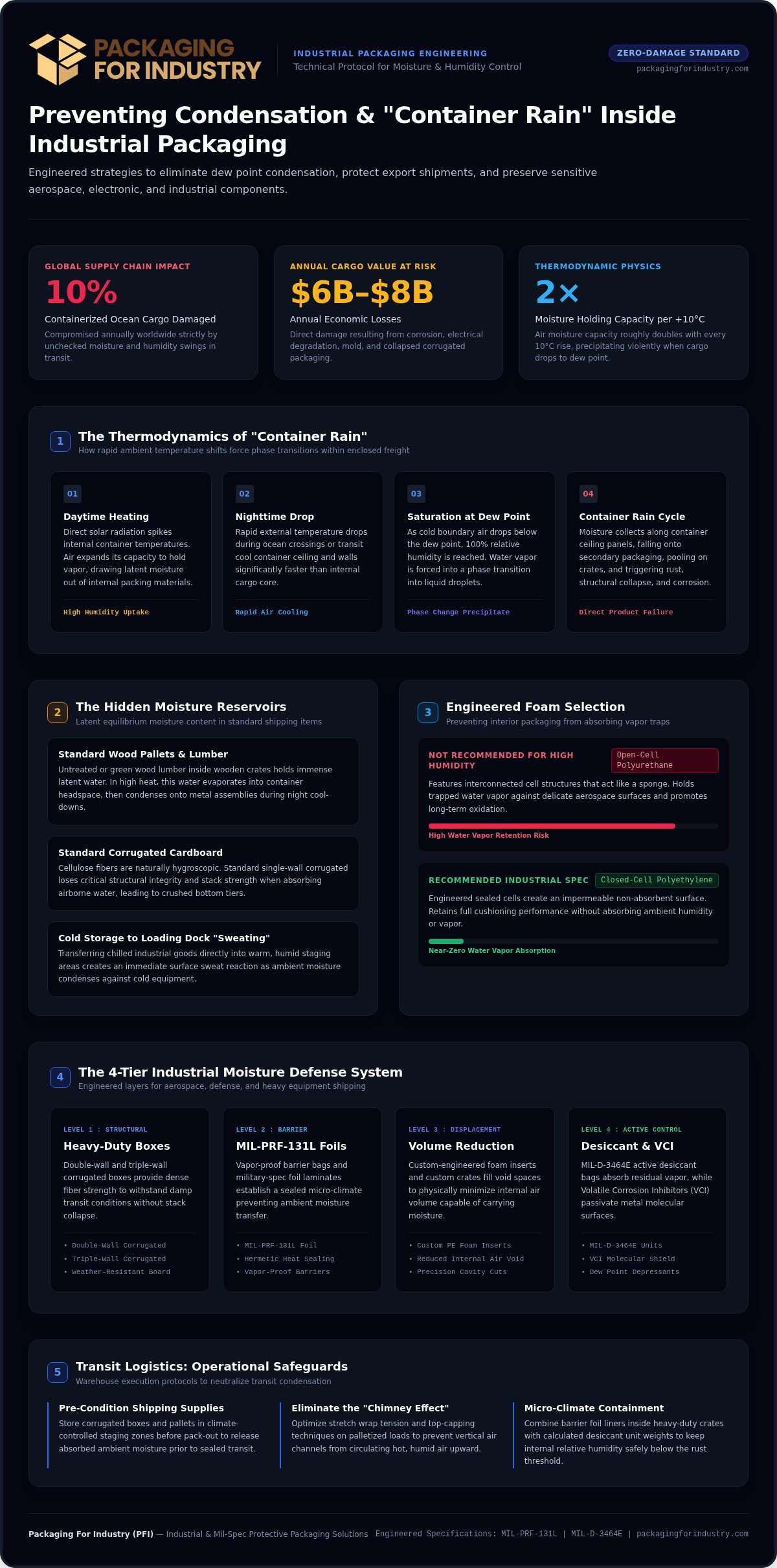
Condensation is a phase change that occurs when water vapor transforms into liquid as air cools. In industrial logistics, this process leads to “container rain,” a phenomenon where moisture accumulates on the interior ceiling of a shipping container and eventually drips onto the cargo below. This isn’t a minor inconvenience; it is a primary driver behind the $6 billion to $8 billion in annual economic losses attributed to moisture damage. Understanding the mechanics behind this moisture buildup is the first step in learning how to prevent condensation inside packaging.
Rapid temperature swings accelerate this process. During the day, intense heat in a warehouse or container increases the air’s ability to hold moisture. As temperatures drop at night, the air reaches saturation, forcing liquid water to precipitate. Without an engineered barrier or absorption strategy, your high-value industrial shipments are at constant risk of corrosion, mold, and electrical failure.
The Role of Relative Humidity and Dew Point
Even a hermetically sealed container holds a specific volume of air, and that air contains water vapor. The amount of moisture air can hold is directly tied to its temperature. For every 10°C increase in temperature, the air’s water-holding capacity approximately doubles. When temperatures drop, particularly during night transit or ocean crossings, the air can no longer hold that vapor. You must account for the thermodynamic physics of the dew point to ensure your goods remain dry. The dew point is the specific temperature at which air becomes saturated and water vapor begins to condense into liquid droplets.
Hygroscopic Materials: The Hidden Moisture Traps
Many industrial shipments fail because of the materials used in the packaging itself. Standard corrugated boxes and wood pallets are hygroscopic, meaning they naturally absorb and release moisture based on the surrounding environment. If you utilize high-moisture-content lumber in your wooden crates, that moisture will eventually evaporate into the enclosed space as temperatures rise. Later, when the environment cools, that same moisture precipitates onto your equipment. This cycle is especially dangerous for sensitive electronics or aerospace components where rust and corrosion lead to immediate failure.
Moving goods from cold storage to a warm loading dock creates a “sweating” effect as the warm, humid air hits the cold surface of the product. This makes it vital to understand how to prevent condensation inside packaging through careful material selection and pre-conditioning of your shipping supplies. By identifying these hidden moisture sources, you can implement more effective protective measures like moisture barrier bags or vapor-proof wraps.
Selecting Moisture-Resistant Materials for Industrial Protection
While understanding the physics of dew points is essential, your primary defense lies in technical material selection. Standard packaging materials often fail in high-humidity or export environments because they lack the necessary barrier properties to repel water vapor. Choosing the right corrugated boxes is a critical first step. Standard cardboard can lose a significant portion of its structural integrity when it absorbs moisture, leading to collapsed stacks and crushed products. To maintain supply reliability, you must transition to engineered substrates designed for industrial rigors.
A Virginia Tech research on moisture in sea containers emphasizes how the equilibrium moisture content in hygroscopic materials can compromise an entire load. To mitigate this, consider closed-cell foam packaging. Unlike open-cell polyurethane, which can trap and hold water vapor like a sponge, closed-cell polyethylene foam provides a non-absorbent surface that remains dry even in fluctuating temperatures. This material choice is a fundamental component of how to prevent condensation inside packaging for sensitive machinery and precision tools.
Weather-Resistant Corrugated and Heavy-Duty Boxes
For extreme transit conditions, double-wall and triple-wall heavy-duty corrugated boxes offer superior resistance to humidity-induced failure. These boxes can be treated with wax coatings or plastic infusions to create a water-repellent exterior. This is especially important for shipments moving through tropical climates or those stored in non-climate-controlled warehouses. If you’re managing complex logistics, utilizing industrial packaging solutions that prioritize material density and specialized coatings will drastically reduce your damage claims. You can request a packaging quote to compare the durability of these heavy-duty options against your current inventory.
Moisture Barrier Bags and ESD Protection
In the aerospace and electronics sectors, standard poly bags are insufficient. High-value components require moisture barrier bags (MBBs), which are constructed with multiple layers of foil and polyester to provide a near-zero water vapor transmission rate. These barriers are often a requirement for military packaging standards like MIL-PRF-131L. These specialized bags don’t just block external humidity; they create a controlled micro-environment when heat-sealed. For electronics, these barrier bags can also incorporate anti-static properties to protect against electrostatic discharge. Integrating these high-performance barriers is a proven method for how to prevent condensation inside packaging during long-term storage or international export.
Active Moisture Control: Desiccants and VCI Technology
Passive barriers like foil bags effectively block external humidity, but they cannot address the moisture already trapped inside the enclosure at the time of sealing. Active moisture control uses chemical agents to strip water vapor from the air, maintaining a safe relative humidity level. This is a critical component of how to prevent condensation inside packaging for high-value industrial assets. By deploying desiccants and Volatile Corrosion Inhibitors (VCI), you can ensure that even if the temperature drops below the dew point, there isn’t enough moisture left in the air to condense.
Determining the correct volume of protection requires more than guesswork. Under MIL-STD-2073-1, the standard formula for calculating desiccant units is based on the surface area of the barrier material and the weight of internal dunnage, such as foam inserts or corrugated dividers. For a basic sealed flexible barrier, you typically need 1.6 units of desiccant per square foot of barrier material, plus additional units for any hygroscopic dunnage inside. One “unit” is defined by the MIL-D-3464E standard as the amount of desiccant that will adsorb at least 3 grams of water vapor at 20% relative humidity and 6 grams at 40% relative humidity.
Choosing the Right Desiccant for Your Industry
Not all desiccants perform the same. Silica Gel is the most common choice for general industrial use due to its high adsorption capacity at room temperature, typically holding 20% to 40% of its dry weight in moisture. For bulk industrial applications, Bentonite Clay is a cost-effective, natural alternative that meets MIL-D-3464E specifications. It’s highly effective in lower humidity ranges and is often the preferred choice for heavy machinery. We recommend Molecular Sieve for aerospace packaging where rapid moisture removal is critical. Molecular sieve has the fastest adsorption rate and can hold moisture even at extremely high temperatures, making it ideal for the volatile environments found in flight logistics.
VCI Technology for Metal and Machinery
While desiccants manage humidity, VCI technology targets the metal surfaces directly. VCI molecules sublimate from a carrier material, such as paper or film, and create an invisible, monomolecular protective layer on the metal. This layer prevents the electrochemical reaction that causes rust. You can integrate VCI papers, films, and emitters directly into custom crates to protect internal components that are difficult to reach with traditional oils. This “dry” protection is a cleaner, more efficient alternative to greases. It allows your customers to use the machinery immediately upon arrival without the need for degreasing or extensive cleanup.
Operational Strategies to Minimize Humidity During Logistics
Implementing a pre-conditioning phase is a pragmatic step for any high-volume manufacturer. This process involves allowing your packaging materials to stabilize in the packing area’s environment before they’re used to secure goods. If you store triple-wall corrugated boxes in a damp, non-climate-controlled zone and immediately move them to a dry packing line, they’ll release trapped moisture into the sealed shipment. This oversight is a common reason why teams struggle with how to prevent condensation inside packaging despite using high-quality desiccants.
Loading dock management is equally vital for maintaining a dry supply chain. In Southern California, early morning humidity in areas like Los Angeles and Orange County can regularly exceed 80%. Leaving dock doors open during these hours invites moist air directly into your facility and into your open containers. Audit your warehouse procedures to ensure doors remain closed when not in active use. You might also consider installing high-speed industrial doors to minimize the duration of air exchange during loading cycles.
Proper Palletization and Stretch Film Usage
Over-wrapping is a frequent mistake in industrial shipping. If a load contains any residual moisture from the manufacturing process, a heavy layer of standard stretch film acts as a vapor barrier that traps humidity against the product. This leads to “sweating” as temperature cycles occur during transit. For goods that require airflow, such as certain agricultural products or industrial components that haven’t fully cooled, vented stretch film is a superior choice. This material provides the necessary load stability while allowing moisture to escape.
To ensure a moisture-aware pallet wrap, follow these steps:
- Verify that the product and all internal dunnage are completely dry before wrapping.
- Use a moisture-resistant pallet liner or plastic slip sheet to block moisture wicking from the wooden pallet.
- Apply a top sheet before wrapping the sides to create a complete weather shield.
- Avoid the “chimney effect” by ensuring the wrap extends to the base of the pallet without leaving large gaps that pull in floor-level humidity.
Warehouse and Storage Best Practices
Supply reliability depends on having dry, fresh stock ready for use. Utilizing vendor managed inventory (VMI) ensures your packaging supplies don’t sit in your warehouse long enough to absorb ambient humidity. PFI manages these levels for you, delivering just-in-time supplies that are ready for immediate, moisture-safe use. This is particularly important for corrugated materials, which can suffer from “wicking” if stored on damp concrete floors. Maintaining a controlled environment and rotating stock frequently are essential parts of how to prevent condensation inside packaging and protecting your overall inventory investment.
Engineering Custom Solutions for High-Value Moisture Protection
Standardized containers often fail to address the specific micro-climate challenges of sensitive industrial equipment. Effective moisture protection starts with custom design packaging that minimizes internal air volume. Since air holds water vapor, reducing the “dead space” inside a crate or box directly limits the amount of moisture available to condense. By engineering a snug, precision fit for your components, you’re implementing a foundational strategy in how to prevent condensation inside packaging before active measures are even applied.
For complex manufacturing and aerospace projects, PFI utilizes packaging kitting services to streamline the assembly process. We can pre-integrate desiccants directly into your protective materials, ensuring that every shipment has the exact amount of protection required without relying on warehouse staff to perform manual calculations. To verify the integrity of these seals during long-haul transit, we often include humidity indicator cards (HICs). These cards provide a clear, color-coded visual cue that alerts your quality control team if internal moisture levels have exceeded safe thresholds.
The Advantage of Precision Foam and Crating
Engineering-led protection goes beyond the outer box. We design custom foam inserts using CAD/CAM technology to create dedicated pockets for desiccant packets. This ensures the drying agents are positioned in high-airflow areas within the package rather than being crushed at the bottom. When wood is required for heavy machinery, we use only ISPM-15 heat-treated lumber. This process significantly reduces the initial moisture content of the wood, preventing the “sweating” effect common with green or improperly cured lumber crates. We offer free prototyping for these systems, allowing you to test the moisture-seal integrity in real-world conditions before committing to full production.
Compliance and Standards: MIL-SPEC and Beyond
For defense and high-reliability sectors, compliance with MIL-STD-2073 is mandatory. This standard dictates rigorous methods for preservation, including Method 50 for water vaporproof protection with desiccants. Navigating these requirements requires a specialized military packaging supplier who understands the intersection of barrier materials and corrosion inhibitors. Working with a partner that provides end-to-end oversight ensures your shipments meet strict military and industrial standards while remaining cost-effective.
Ready to eliminate moisture damage? Request a custom packaging quote today.
Secure Your Supply Chain Against Moisture Damage
Eliminating moisture damage requires a proactive approach that blends thermodynamic physics with high-performance materials. You now understand that moisture barrier bags, active desiccants, and pre-conditioning strategies are the primary pillars of a dry supply chain. Implementing these technical strategies is the most effective way to address how to prevent condensation inside packaging and protect your bottom line from costly returns and failed inspections.
PFI stands ready as your technical consultant for these complex logistics challenges. We specialize in aerospace and MIL-SPEC compliance, offering free prototyping for custom engineered foam and crates to ensure a perfect moisture seal. Whether you need local next-day delivery in Southern California or fast nationwide shipping, our team ensures your bulk packaging supplies are ready when you are. We’re committed to helping you reach a zero-damage shipping cycle while lowering your overall packaging costs.
Let’s work together to build a more reliable logistical future for your business. Our experts are ready to engineer the precise protection your high-value assets deserve.
Frequently Asked Questions
What is ‘container rain’ and how does it affect my shipments?
Container rain occurs when warm, humid air inside a shipping container reaches its dew point and condenses on the ceiling, eventually dripping onto cargo. This liquid water causes rust on machinery, mold on organic materials, and structural failure in standard corrugated boxes. For industrial manufacturers, it leads to failed quality inspections and high insurance claims. Preventing this requires an engineered approach to moisture control within the shipping enclosure.
Can I reuse desiccants to lower my packaging costs?
Reusing desiccants is generally not recommended for high-reliability sectors like aerospace or medical device manufacturing. While some silica gel packets can be “recharged” in industrial ovens, the process is often more expensive in labor and energy than purchasing new units. It’s also difficult to verify if the adsorption capacity has returned to 100%. To lower packaging costs effectively, we suggest a VMI program to manage stock levels and prevent emergency orders.
How much desiccant do I need for a standard shipping crate?
The amount of desiccant depends on the interior volume, the surface area of the barrier material, and the presence of hygroscopic dunnage. Under MIL-STD-2073-1, a standard calculation for “units” is used rather than weight. For most sealed industrial applications, you’ll need approximately 1.6 units per square foot of barrier bag material. We provide custom packaging solutions that include precise desiccant calculations to ensure your specific product stays dry throughout its journey.
Is VCI packaging safe for sensitive electronics and medical devices?
VCI technology is safe and highly effective for protecting metal components within electronic assemblies and medical instruments. The volatile molecules create a monomolecular layer that doesn’t interfere with electrical conductivity or optical clarity. This “dry” protection eliminates the need for messy grease or oils, which is a major benefit for cleanroom environments. It’s an essential part of how to prevent condensation inside packaging when shipping high-value metal parts that are prone to oxidation.
Does stretch film protect against condensation or cause it?
Standard stretch film can actually cause condensation if it’s applied too tightly around products that haven’t fully cooled or dried. It acts as a vapor barrier that traps moisture against the load. To solve this, we provide vented stretch film which allows the product to breathe while maintaining pallet stability. This material is ideal for industrial goods that need to release residual heat or moisture during transit through humid Southern California regions.
What is the difference between a moisture barrier bag and a standard poly bag?
A standard poly bag is made of low-density polyethylene and offers very little protection against water vapor transmission. In contrast, a moisture barrier bag (MBB) is a multi-layer laminate containing foil or polyester that provides a near-zero transmission rate. These bags are engineered for the aerospace and military sectors to meet MIL-PRF-131L standards. They are necessary for any long-term storage or export shipment where ambient humidity levels fluctuate significantly.
How can I tell if moisture has entered my sealed packaging during transit?
The most reliable method for monitoring internal humidity is the use of humidity indicator cards (HICs). These cards are placed inside the moisture barrier bag before sealing and change color as the relative humidity rises. If the card shows a level above 30% or 40%, it indicates that the desiccant is saturated and the product may be at risk. This provides your quality control team with immediate proof of environmental integrity and is a key step in how to prevent condensation inside packaging.
Why is wood pallet moisture content important for industrial shipping?
Wood pallets are hygroscopic and can hold a significant amount of water. If you use “green” or improperly cured lumber, that moisture will evaporate inside a shipping container and contribute to container rain. For export shipments, we use heat-treated (ISPM-15) wood crates and pallets. This process reduces the initial moisture content and prevents the wood from acting as a source of humidity that could ruin sensitive machinery or electronic components.