
How much of your manufacturing floor is currently being held hostage by stacks of empty corrugated boxes and bulky foam inserts? While many operations managers believe keeping assembly in-house ensures control, the reality often involves high labor costs and frequent shipping damage. Transitioning to a model of outsourcing packaging design and production allows you to reclaim that square footage and focus on your core manufacturing goals. If you are managing complex aerospace or medical components, the burden of maintaining mil-spec standards often outweighs the perceived benefits of a do-it-yourself approach.
You don’t have to sacrifice quality to regain your warehouse space. In fact, professional outsourcing is often the most effective way to eliminate overhead and lower your total landed costs. When you shift to a partner who provides engineered protection and just-in-time delivery, you solve the problem of wasted square footage and production downtime simultaneously. This guide will show you how to transition from a capital-heavy internal process to a lean, strategic logistics model that secures your high-value products and your bottom line.
Key Takeaways
- Reduce capital expenditure and reclaim valuable manufacturing floor space by eliminating the need for in-house packaging assembly and heavy machinery.
- Discover how CAD/CAM engineering and free prototyping ensure a precision fit for high-value components, virtually eliminating shipping damage.
- Understand the logistical advantages of outsourcing packaging design and production to streamline your supply chain and lower total landed costs.
- Learn how to maintain strict compliance for aerospace and defense contracts through specialized mil-spec and ESD-safe packaging solutions.
- Implement Vendor Managed Inventory (VMI) and Just-in-Time delivery to ensure you never face production downtime due to packaging shortages.
The Financial Case for Outsourcing Packaging Design and Production
Outsourcing packaging design and production involves more than just hiring a vendor to deliver boxes. It’s a strategic partnership where an industrial specialist manages your structural engineering, material sourcing, and manufacturing. For most manufacturers, this shift moves packaging from a fixed overhead burden to a scalable, variable cost that aligns perfectly with your monthly production volume. Instead of carrying the weight of a full-scale packaging department, you leverage the infrastructure of a dedicated partner.
One of the most immediate financial benefits is the total elimination of capital expenditure on specialized equipment. Maintaining die-cutters, foam-cutting machinery, and heavy-duty corrugated slotters requires significant investment and ongoing maintenance. When you work with a professional Contract packager, those equipment costs vanish from your balance sheet. You stop paying for the depreciation of machinery and start paying only for the finished product you need.
Internal labor costs also drop significantly when you move production off-site. Managing an in-house assembly team requires constant oversight, training, and administrative support. By outsourcing packaging design and production, you remove the burden of packaging assembly, kitting, and inventory tracking from your payroll. This allows your team to focus on your core manufacturing goals while a specialist ensures your packaging is ready for the shipping dock.
In-House vs. Outsourced: Identifying Hidden Costs
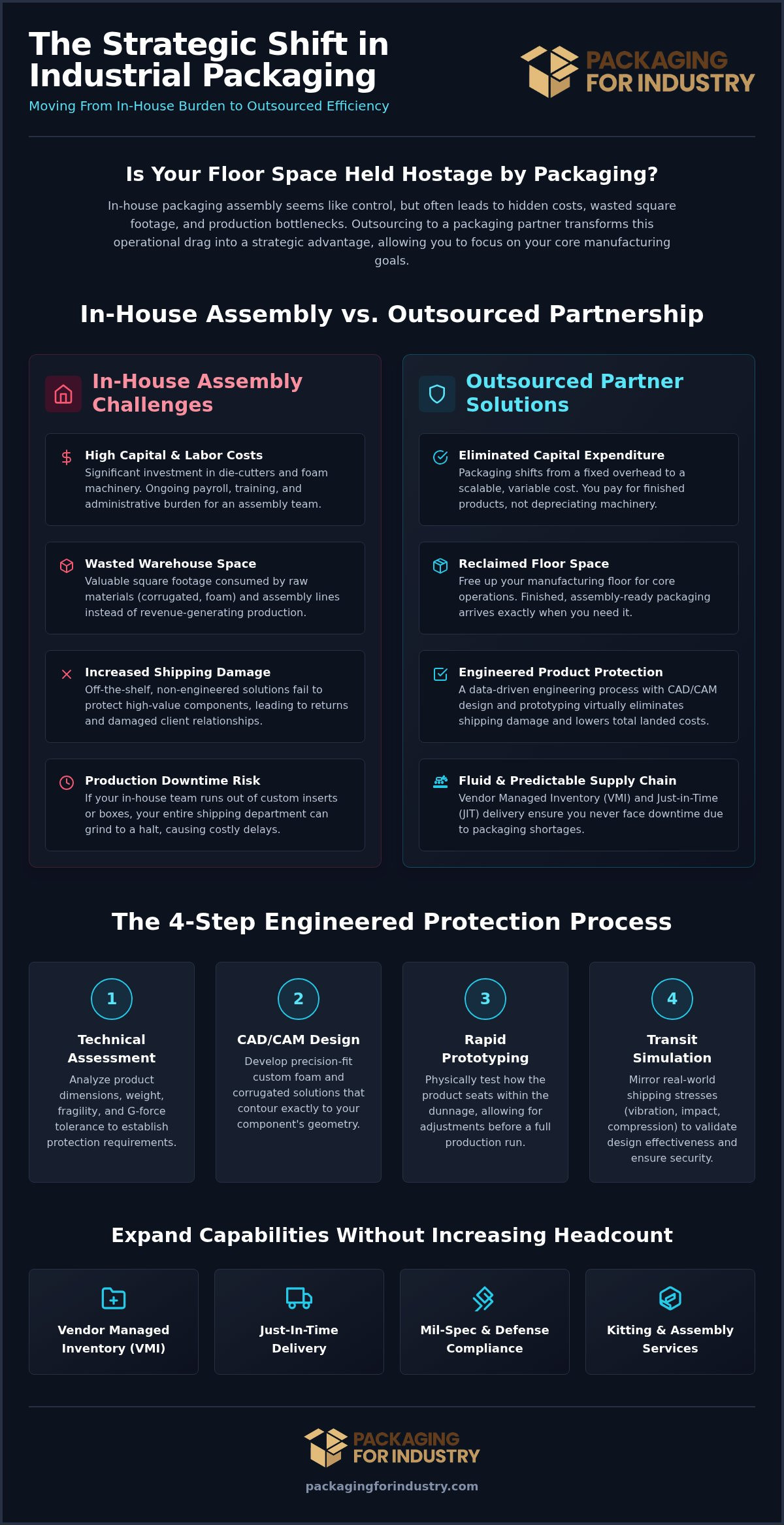
Hidden costs often lurk in the corners of your warehouse. Every pallet of raw corrugated material or bulk foam takes up square footage that could be used for revenue-generating production lines. You must also account for the price of shipping damage. Off-the-shelf, non-engineered solutions often fail to protect high-value components, leading to expensive returns and damaged customer relationships. Production downtime is another silent killer; if your in-house assembly team runs out of custom inserts, your entire shipping line grinds to a halt. Outsourcing ensures that your supply chain remains fluid and predictable.
Expanding Capabilities Without Increasing Headcount
Managing an internal design team is expensive. Between salaries, benefits, and training, the cost of keeping a senior packaging engineer on staff is prohibitive for many mid-sized manufacturers. Outsourcing gives you immediate access to advanced CAD/CAM support and engineering expertise without the payroll burden. This is particularly vital when you need precision-fit custom foam packaging for delicate electronics or aerospace parts. By utilizing packaging kitting services, you receive assembly-ready units that your team can use immediately. This allows you to scale your operations and handle complex projects without ever having to hire additional warehouse staff.
Engineering Custom Protection: The Design and Prototyping Process
Engineering protection isn’t a matter of trial and error. It’s a methodical process that begins with a technical assessment of your product’s dimensions, weight, and fragility. When you commit to outsourcing packaging design and production, you’re gaining access to a rigorous four-step engineering cycle. First, engineers analyze the product’s G-force tolerance. Second, they use CAD/CAM software to develop precision-fit custom foam packaging that contours exactly to your component’s geometry.
Third, the process moves into rapid prototyping. This stage allows you to physically test how the product seats within the dunnage before you authorize a full production run. Finally, the design undergoes transit simulation. This mirrors the real-world stresses of vibration, impact, and compression your shipments face in the global supply chain. This data-driven approach ensures that the first shipment is as secure as the thousandth. By identifying these variables during the design phase, you prevent the costly “over-packaging” that inflates material costs or the “under-packaging” that leads to damage claims.
Precision Foam and Corrugated Integration
A successful design relies on the synergy between internal cushioning and external shielding. We select engineered foam inserts like polyethylene (PE) for heavy items or polyurethane (PU) for delicate surfaces to prevent internal movement. For sensitive components, ESD-safe foam prevents static discharge. This cushioning is then paired with the appropriate corrugated wall strength. While double-wall boxes suffice for many industrial goods, triple-wall corrugated is often necessary for high-density loads. Structural integrity is the capacity of a packaging system to support vertical loads and resist deformation during long-term warehouse stacking.
The Role of Prototyping in Risk Mitigation
Prototyping serves as your final insurance policy against shipping damage. For high-value industrial rollouts, free prototyping is an essential tool to verify fit and function. It also provides an opportunity to optimize for ‘UPS/FedEx surcharges’ by refining the external dimensions to avoid dimensional weight penalties. If your operation requires aerospace packaging, prototyping ensures that every spec meets mil-spec or aviation standards early in the cycle. If you are facing recurring damage issues with a current product, you can request a packaging quote to begin the engineering assessment process.
Solving Lead-Time and Storage Issues with Managed Outsourcing
Traditional purchasing often follows a reactive “order-and-wait” model. You place an order when stock looks low, then hope the delivery arrives before your production line stops. This uncertainty leads many manufacturers to over-order, which results in bulky corrugated boxes and foam inserts clogging valuable warehouse floor space. By outsourcing packaging design and production to a proactive partner, you shift the burden of inventory management to the experts. This allows you to reclaim your square footage for revenue-generating assembly lines rather than letting it be held hostage by empty packaging.
A strategic packaging partner doesn’t just wait for your purchase order. They monitor your usage patterns and anticipate your needs based on your production schedules. This level of oversight prevents the “emergency” stockouts that can derail a shipping department. When you move production off-site, you’re not just buying a product; you’re securing a reliable supply chain that adapts to your volume fluctuations without requiring you to manage the logistics yourself.
Vendor Managed Inventory (VMI) for Packaging
The most efficient way to automate your supply chain is through Vendor Managed Inventory (VMI) programs. We establish “min-max” levels for your critical custom boxes and protective materials, ensuring that you always have a buffer without over-committing your storage space. This system removes the administrative burden from your procurement and purchasing teams. Instead of manually tracking every SKU, your inventory is replenished automatically based on real-time data, allowing your staff to focus on higher-level operational tasks.
Just-in-Time Delivery Logistics
Just-in-Time (JIT) delivery ensures that your packaging arrives exactly when it’s needed on the production floor. This is particularly beneficial for manufacturers in high-density industrial hubs where storage costs are at a premium. For those requiring reliable Southern California packaging delivery, local proximity is a massive advantage. Whether your facility is in Orange County, Los Angeles, or San Diego, a local partner can handle seasonal spikes or sudden production increases with next-day agility. This logistical flexibility means you don’t have to maintain a storage crisis every time your sales volume grows. You get the protection you need, exactly when you need it, without the warehouse overhead.
Specialized Outsourcing: Aerospace, Defense, and Electronics
Manufacturers in high-compliance sectors face a unique set of logistical hurdles. Standard packaging fails when confronted with the rigorous demands of military logistics or the sensitivity of semiconductor shipping. By outsourcing packaging design and production to a specialized partner, you ensure every component is protected by materials that meet specific technical certifications. This transition allows your team to focus on production while your partner manages the complex documentation and compliance tracking required for government and aviation contracts.
Precision is the baseline in these industries. Whether you are shipping sensitive medical sensors or heavy-duty automotive components, the packaging must perform under extreme conditions. A dedicated partner acts as a technical consultant, identifying the exact material specifications needed to prevent failure. This level of oversight is particularly critical when managing oversized machinery that requires custom crating solutions designed for stability and long-term durability.
Meeting Mil-Spec and Aerospace Requirements
Defense contractors must navigate a labyrinth of military-grade protection standards. These aren’t suggestions; they’re rigid requirements that dictate everything from box burst strength to chemical resistance. Specialized custom corrugated boxes designed for defense logistics must withstand extreme environmental shifts and rough handling. A seasoned packaging partner provides the necessary material certifications and quality assurance protocols to ensure your shipments aren’t rejected at the depot. This level of precision is essential for maintaining supply chain integrity in the aerospace sector where every ounce of weight and every inch of space impacts the bottom line.
Electronics and Medical Device Precision
Shipping sensitive electronics or medical hardware requires more than just cushioning. It requires a controlled environment. We combine anti-static ESD foam with moisture barrier bags to protect sensitive circuits from both physical shock and electrostatic discharge. For medical device manufacturers, designing multi-material kits simplifies the intake process for cleanrooms and assembly lines. Utilizing specialized corner and edge protection ensures that precision-machined surfaces remain pristine during transit. These engineered solutions prevent microscopic damage that off-the-shelf packaging simply cannot address, ensuring your high-value gear arrives in factory-perfect condition.
Choosing the Right Partner for Packaging Outsourcing
Selecting a partner for outsourcing packaging design and production requires a shift in perspective. You aren’t just looking for a vendor; you’re vetting a technical extension of your own production line. The most effective partners are those who offer an integrated model of both structural engineering and in-house manufacturing. When design and production happen under one roof, you eliminate the risk of a technical “hand-off” failure where a design looks good on a screen but fails on the factory floor. You should prioritize firms that demonstrate deep experience in your specific vertical, particularly within the manufacturing sector, to ensure they understand the nuances of industrial logistics.
The Local Advantage in Southern California
Manufacturers in Anaheim, Los Angeles, and San Diego gain a massive competitive edge by working with a local partner. Proximity allows for on-site packaging audits and face-to-face engineering reviews that simply aren’t possible with a distant national supplier. These audits allow engineers to observe your packing line in person, which helps identify ergonomic bottlenecks or material waste that a remote vendor would miss. If a production spike occurs, local next-day delivery prevents the bottleneck that happens when you’re waiting on long-haul freight. This agility is the difference between a fluid shipping dock and a costly production halt.
Total Landed Cost vs. Unit Price
It’s a common mistake to focus solely on the unit price of a box. Cheap boxes often lead to the highest total landed cost due to increased shipping damage and inefficient dimensional weights. A strategic partner focuses on how to lower packaging costs through smarter engineering, not just thinner materials. They should provide transparent reporting on how their designs impact your shipping spend and warehouse efficiency. Before signing a Vendor Managed Inventory (VMI) agreement, use this checklist to evaluate their capabilities:
- Prototyping: Do they offer free prototyping to verify fit and function before mass production?
- Technical Support: Can they provide a detailed analysis of total landed cost savings, including freight and labor?
- Compliance: Are they equipped to handle specialized mil-spec, aerospace, or ESD requirements?
- Inventory: Do they have local stocking and stocking programs for just-in-time delivery?
- Accountability: Is their design process integrated with their production machinery to ensure precision?
Choosing a partner who treats your budget with the same respect as your product protection is essential. By focusing on these criteria, you move from a transactional relationship to a lean, strategic partnership that secures your bottom line.
Optimize Your Supply Chain with Strategic Packaging Partnerships
Transitioning away from capital-heavy in-house assembly allows your operation to become leaner and more responsive. By outsourcing packaging design and production, you replace the burden of warehouse congestion and high labor costs with a system of engineered protection and predictable logistics. This move ensures that your high-value components receive professional-grade security while your team focuses on core manufacturing goals. You’ve seen how precision foam inserts and corrugated integration prevent shipping damage while Vendor Managed Inventory keeps your production lines moving without interruption.
Whether you need to meet rigorous aerospace standards or require local next-day delivery in Southern California, the right partner acts as a fixer for your logistical challenges. We provide free prototyping and design reviews to ensure your products are secure before the first shipment leaves the dock. It’s time to stop paying for wasted floor space and start investing in a scalable, efficient packaging strategy.
Let’s build a more reliable supply chain together. Our team is ready to help you lower your total landed costs and improve your operational efficiency starting today.
Frequently Asked Questions
What are the main benefits of outsourcing packaging design?
Outsourcing allows you to reclaim valuable warehouse floor space and access senior packaging engineers without the payroll burden. By shifting production off-site, you eliminate the need for expensive machinery like die-cutters and foam-slitting equipment. This transition converts a fixed overhead cost into a scalable, variable expense that aligns with your monthly production volume.
Is outsourcing more expensive than handling packaging in-house?
Outsourcing is generally more economical when you evaluate the total landed cost of your shipments. While a catalog box might have a lower unit price, outsourcing packaging design and production reduces expensive shipping damage and eliminates the overhead of managing an in-house assembly team. You also save on the hidden costs of material waste and inventory tracking.
How does Vendor Managed Inventory (VMI) work for custom packaging?
Vendor Managed Inventory (VMI) uses established “min-max” levels to automate your supply chain. We track your inventory levels and handle the replenishment of custom boxes and protective foam automatically. This system ensures you never face production downtime due to shortages and removes the administrative burden from your purchasing department.
Can an outsourced partner help reduce our shipping damage rates?
A specialized partner reduces damage by replacing generic boxes with engineered protection. We use CAD/CAM software to design precision-fit dunnage and perform transit simulations that mirror real-world shipping stresses. This methodical approach ensures your high-value components are secured against vibration, impact, and compression during the entire shipping cycle.
What industries benefit most from custom-engineered packaging?
Industries with high-value or sensitive components benefit most, including aerospace, defense, medical devices, and electronics. These sectors often require specialized materials like ESD-safe foam or mil-spec corrugated boxes that meet strict technical certifications. Custom engineering ensures these products remain pristine during complex global logistics and long-term storage.
How do I request a quote for custom packaging design and production?
You can request a packaging quote by providing your product dimensions and shipping requirements through our online form. For complex outsourcing packaging design and production projects, we can also perform an on-site audit at your facility to identify specific cost-saving opportunities in your current process.
Do you provide prototypes before we commit to a bulk order?
We offer free prototyping to ensure a precision fit before you commit to mass production. This allows your team to verify that the corrugated and foam integration works perfectly with your product geometry. Testing a physical prototype is the most effective way to mitigate risk and optimize for shipping surcharges before a full rollout.
What is the typical lead time for custom-produced corrugated boxes?
Custom production lead times depend on material complexity, but we prioritize agility for local manufacturers. For clients in Orange County, Los Angeles, and San Diego, we leverage our local delivery network to provide next-day delivery on stocked items. Our goal is to ensure your production lines stay on schedule without requiring you to store months of inventory on-site.