
What if the “cheaper” shipping box you just sourced is actually the most expensive item in your supply chain? For manufacturers in Los Angeles and Orange County, a comprehensive packaging cost reduction analysis Southern California often reveals that “budget” materials lead to higher total landed costs. You’re likely feeling the pressure of rising UPS and FedEx DIM weight surcharges, where paying to ship excess air becomes a major profit drain. It’s a frustrating reality when bulky catalog supplies crowd your warehouse floor but still don’t stop shipping damage from reaching your customers.
You deserve a logistics strategy that prioritizes both protection and fiscal efficiency. This guide outlines how to eliminate shipping waste and reclaim your margins through professional audits tailored for Southern California industries. We’ll examine how custom-engineered corrugated solutions, precision foam inserts, and Vendor Managed Inventory (VMI) can streamline your operations. By the end of this article, you’ll understand how to leverage localized JIT delivery to reduce overhead and ensure your packaging works for your bottom line rather than against it.
Key Takeaways
- Learn why focusing solely on per-unit pricing is a mistake and how a packaging cost reduction analysis Southern California uncovers the hidden expenses of transit damage and labor.
- Identify and eliminate “shipping air” through a DIM weight analysis to significantly lower your surcharges with major carriers like UPS and FedEx.
- Discover how custom-engineered corrugated and foam solutions provide better protection for specialized parts while removing the need for costly void fill.
- Understand how localized Vendor Managed Inventory (VMI) and JIT delivery from Anaheim can reclaim your warehouse floor space and improve operational cash flow.
Beyond the Unit Price: The True Cost of Industrial Packaging
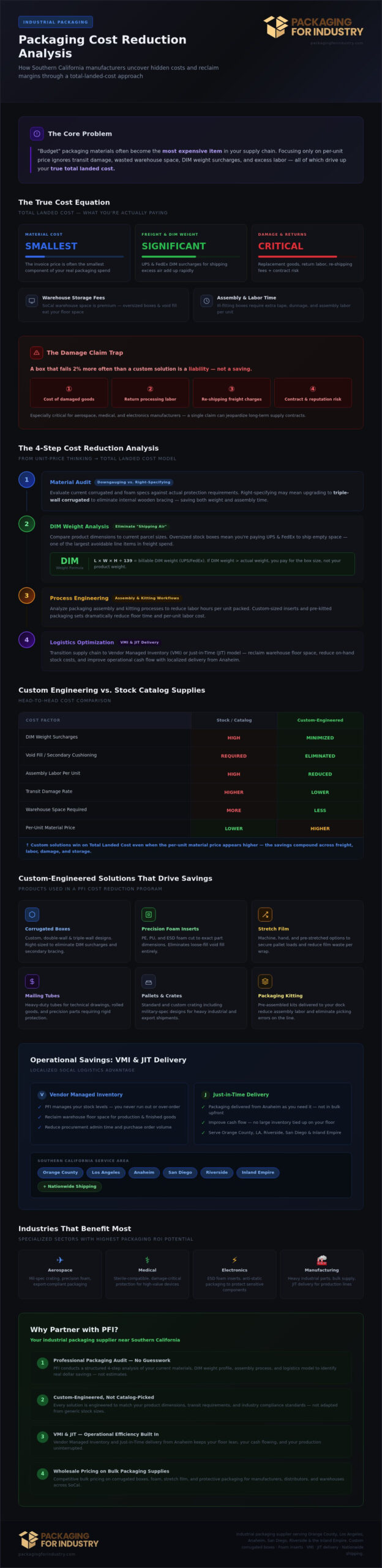
Many procurement managers make the mistake of selecting a supplier based solely on the lowest per-unit price listed on an invoice. This narrow focus often backfires because it ignores the logistical complexities that drive up your actual expenses. A professional packaging cost reduction analysis Southern California reveals that the material price is frequently the smallest part of the equation. To understand your real spend, you must evaluate the Total Landed Cost. This metric includes material costs, inbound freight, warehouse storage fees, assembly labor, and the financial fallout of shipping damage.
In Southern California markets like Orange County and the Inland Empire, warehouse space commands a significant premium. Storing oversized boxes or pallets of generic void fill means you’re paying high-rent prices to house “shipping air.” Every square foot of your facility should be dedicated to production or finished goods, not bulky, inefficient packaging supplies. When your materials don’t fit your product’s dimensions, you aren’t just wasting space; you’re also paying more in labor as your team spends extra time on assembly and tape application.
The “Damage Claim Trap” is another silent profit killer that a unit-price focus ignores. When a shipment fails during transit, the cost isn’t just the price of a replacement box. You must account for the labor required to process the return, the cost of the damaged goods, and the freight charges to ship a replacement. For specialized sectors like aerospace or medical manufacturing, these failures can also jeopardize long-term contracts and brand reputation. A cheaper box that fails 2% more often than a custom-engineered solution is actually a liability, not a saving.
Calculating Your Current Packaging ROI
Packaging ROI is the measurable balance between the cost of materials and the level of protection they provide to your specific products. Beyond the materials themselves, you must identify hidden costs like assembly labor, excess tape usage, and the waste generated by generic void fill. If your packaging footprint is larger than necessary, you’ll face higher fuel surcharges and freight rates from carriers who prioritize volume over actual weight.
Why Catalog Suppliers Often Cost Manufacturers More
Catalog suppliers offer the convenience of stock items, but they charge a premium for “one-size-fits-all” solutions that rarely meet industrial requirements. These generic boxes lead to excessive DIM weight charges from carriers like UPS and FedEx because you’re shipping more volume than necessary. When you compare packaging pricing between stock supplies and custom-engineered runs, the custom option often wins by eliminating the need for expensive secondary cushioning and reducing your overall shipping dimensions.
The 4-Step Packaging Cost Reduction Analysis Process
Transitioning from a unit-price mindset to a total landed cost model requires a structured methodology. A professional packaging cost reduction analysis Southern California allows manufacturers to identify specific inefficiencies across their entire operation, from the engineering table to the loading dock. This process doesn’t just look at the box; it evaluates how that box moves through your facility and the carrier networks. By following a disciplined four-step approach, you can uncover significant savings without compromising the safety of your high-value components.
- Step 1: Material Audit. We evaluate your current corrugated and foam specifications to see if they match the actual protection needs of your product.
- Step 2: DIM Weight Analysis. We identify “shipping air” by comparing your product dimensions to your current parcel sizes, targeting the surcharges that inflate your freight spend.
- Step 3: Process Engineering. Our team analyzes your assembly and kitting workflows to reduce the labor hours required for every unit packed.
- Step 4: Logistics Optimization. We transition your supply chain to a Vendor Managed Inventory (VMI) or Just-in-Time (JIT) model to reclaim your warehouse floor space.
The Material Audit: Downgauging vs. Right-Specifying
Effective cost reduction isn’t always about using thinner materials. In fact, downgauging can lead to higher damage rates if the material’s structural integrity isn’t sufficient for the transit cycle. Right-specifying involves choosing the correct material for the job. For heavy industrial parts, this might mean moving from a standard double-wall corrugated to a high-performance triple-wall design that eliminates the need for internal wooden bracing. When dealing with sensitive electronics or medical devices, evaluating the density and cell structure of custom foam packaging ensures you aren’t over-paying for protection while still meeting strict G-force requirements.
Analyzing Industry-Specific Requirements
Specialized sectors like aerospace and defense have unique cost drivers. In Aerospace packaging, the goal is often balancing extreme protection with minimal weight to control air freight expenses. Meeting Mil-Spec standards requires precision, but it shouldn’t result in over-packaging that wastes resources. For automotive distributors, cost reduction often comes from process engineering, such as designing multi-pack kits that reduce the number of individual touches during the shipping process. If you’re ready to see how these steps apply to your specific facility, you can request a packaging quote to begin a formal assessment of your current materials.
Custom Engineering vs. Stock Supplies: A Cost Comparison
While catalog supplies offer immediate availability, they often hide long-term operational inefficiencies that a packaging cost reduction analysis Southern California can quickly identify. Stock boxes are designed for a “best-fit” scenario, which usually means they’re slightly too large for your specific industrial components. This size discrepancy forces your team to use expensive void fill materials like bubble wrap or packing peanuts to prevent movement during transit. By switching to custom-sized corrugated boxes, you eliminate the material cost of secondary cushioning and the labor hours required to apply it.
The difference between stock and custom becomes even clearer when you look at international transit. Standard pallets often require excessive stretch wrap and additional strapping to secure irregular loads. In contrast, custom wood crates are engineered to the exact dimensions of your machinery or aerospace parts. These crates provide superior durability and stackability, ensuring you maximize every cubic inch of a shipping container. This precision engineering reduces the risk of transit damage while simultaneously lowering your total freight spend.
Eliminating ‘Shipping Air’ and DIM Surcharges
Major carriers like UPS and FedEx use a Dimensional (DIM) weight formula to calculate shipping rates, which essentially penalizes you for shipping empty space. For 2026, the standard DIM divisor remains a critical factor in your freight invoices. Small changes in box dimensions lead to massive savings; for example, a simple 2-inch reduction in box height can often save $10 or more per shipment by moving the parcel into a lower weight bracket. To maintain structural integrity in these smaller, lighter-weight boxes, we often integrate corner and edge protection. This allows you to use a lower-test corrugated material without sacrificing the stacking strength needed for palletized loads.
The Role of Prototyping in Reducing Risk
Precision engineering requires testing before you commit to a high-volume production run. PFI offers free prototyping to Southern California manufacturers to ensure every design meets “fit and function” requirements. This process allows your engineering and quality control teams to verify that custom foam inserts or corrugated dividers provide the exact clearance needed for sensitive electronics or medical devices. Prototyping also prevents the financial disaster of obsolete inventory. By refining the design in the CAD phase, you don’t end up with thousands of boxes that don’t fit your product after a minor revision. This methodical approach ensures your packaging remains a lean part of your manufacturing workflow.
Operational Savings: Leveraging SoCal Logistics and VMI
Manufacturers in Southern California face unique logistical hurdles, from port congestion at Long Beach to the unpredictable delays of the 405 and 5 freeways. A comprehensive packaging cost reduction analysis Southern California must account for these local variables. While national suppliers might offer competitive material prices, their lead times and shipping costs often fluctuate based on national freight trends. By partnering with an Anaheim-based manufacturer, you gain a local advantage that includes next-day delivery and a supply chain that isn’t derailed by regional traffic patterns.
One of the most effective ways to lower operational costs is through Vendor Managed Inventory (VMI). This program eliminates the stress of emergency rush orders by placing the responsibility for stock levels on your supplier. Instead of tying up your capital in thousands of boxes that sit on your floor for months, you pay for your packaging as you use it. This shift significantly improves cash flow and ensures you always have the right corrugated or foam supplies on hand when production ramps up.
Warehouse floor space in Orange County and Los Angeles is too valuable to be used as a storage unit for empty boxes. Reclaiming floor space is a primary outcome of a successful packaging cost reduction analysis Southern California. By leveraging VMI and JIT delivery, you can reclaim hundreds of square feet currently occupied by bulky inventory. This space can then be repurposed for additional production lines or finished goods storage, directly increasing your facility’s revenue potential.
Just-In-Time (JIT) Delivery for Manufacturing
Efficient manufacturing requires tight coordination between material arrivals and production schedules. JIT delivery ensures that your custom boxes and protective inserts arrive exactly when your team needs them. This removes the administrative burden of constant procurement tracking and reduces the risk of inventory damage during long-term on-site storage. We specialize in serving industrial hubs across Orange County, Los Angeles, and the Inland Empire with reliable, scheduled deliveries that bypass the “hidden freight” costs of regional traffic.
Packaging Kitting and Assembly Services
Labor costs are a major component of your total landed cost. Many manufacturers lose hours every week to on-site assembly and kitting. By utilizing off-site packaging kitting, your team receives components that are pre-assembled or organized for immediate use. This streamlines your “Ready-to-Ship” process and allows your skilled labor to stay focused on high-value production tasks rather than folding boxes or inserting foam. It’s a pragmatic solution for e-commerce and distribution centers looking to maximize their daily output without increasing headcount.
Why Partner with PFI for Your Cost Reduction Analysis?
Choosing a partner for your packaging cost reduction analysis Southern California requires more than just a list of products. It demands a consultant who understands the technical requirements of high-stakes industries like aerospace, medical device manufacturing, and defense. From our Anaheim headquarters, PFI serves as a central hub for manufacturers across Los Angeles, San Diego, and the Inland Empire. We don’t just sell boxes; we provide comprehensive engineering oversight that manages everything from custom corrugated designs to heavy-duty wood crates and precision foam inserts.
Our team focuses on the intersection of economics and engineering. We’ve seen how “cheap” catalog supplies fail under the rigors of industrial shipping, leading to the damage claims and logistical stress discussed earlier. By consolidating your packaging needs under one local partner, you eliminate the fragmentation that often hides waste. Whether you need Mil-Spec compliant crates or ESD-safe foam for electronics, our solutions are built to lower your total landed cost while maintaining the stability of your supply chain.
We pride ourselves on being a “fixer” for complex logistical problems. This means we take a proactive role in your operations, identifying where materials can be right-sized or where labor can be reduced through better design. Our proximity to the major industrial hubs of Southern California allows us to provide a level of service and accountability that national distributors simply can’t match.
Our Industrial Engineering Approach
Most suppliers stop at the quote, but we begin with a deep-dive audit of your current packaging line. We look for the “hidden” waste in your assembly process, such as excessive tape usage or redundant void fill. A key differentiator in our approach is our free prototyping service. We use these physical samples as a primary cost-reduction tool, allowing you to verify fit and function before a single production dollar is spent. This engineering-first mindset ensures your final design is optimized for both protection and freight efficiency. To see this process in action for your facility, you can request a custom packaging quote today.
The PFI Guarantee: Quality and Reliability
In essential industries like medical and defense, reliability isn’t optional. We maintain rigorous standards to ensure every custom run meets your internal quality controls. While we’re aggressive in pursuing cost savings, we never compromise the structural integrity of your protection system. Our local presence in Anaheim means we’re a proactive partner that can respond quickly to production shifts or inventory needs. If you’re ready to eliminate logistical waste and reclaim your warehouse space, contact our Anaheim team for a professional packaging cost reduction analysis.
Optimize Your Industrial Logistics and Reclaim Profit Margins
Real savings in the Southern California market require a move away from generic catalog supplies toward custom-engineered solutions. By focusing on the total landed cost, you can eliminate the shipping air that drives up DIM weight surcharges and reclaim valuable warehouse floor space through Vendor Managed Inventory. Our Anaheim-based manufacturing facility specializes in the rigorous standards of Aerospace and Defense; we ensure your components are protected while your logistics costs remain lean.
A professional packaging cost reduction analysis Southern California is the first step toward identifying these operational inefficiencies. We provide free prototyping and CAD design to ensure your custom corrugated or foam inserts are perfect before production begins. This engineering-first approach removes the risk of obsolete inventory and ensures your packaging works for your bottom line.
Partner with a local expert to stabilize your supply chain and eliminate the hidden waste in your current operations. We’re ready to help you streamline your facility for long-term growth.
Frequently Asked Questions
What is a packaging cost reduction analysis?
A packaging cost reduction analysis Southern California is a comprehensive audit of your current material specifications, box dimensions, and logistical workflows. This process identifies specific areas where you’re overpaying for materials or shipping excess air. It moves beyond simple unit pricing to evaluate the total landed cost of your supply chain, focusing on engineering out waste and reclaiming warehouse space.
How much can I save by right-sizing my corrugated boxes?
Savings depend on your shipping volume and current carrier brackets, but even minor dimensional changes often result in significant freight reductions. Removing just two inches from a box’s height can sometimes shift a parcel into a lower DIM weight tier, potentially saving $10 or more per shipment. These incremental savings accumulate quickly across high-volume industrial runs, especially when you factor in the eliminated cost of void fill.
Does custom packaging have a higher upfront cost than stock boxes?
Custom packaging may have a higher per-unit price than generic stock boxes, but it almost always results in a lower total landed cost. When you use stock sizes, you’re forced to pay for additional void fill, extra tape, and higher labor hours for assembly. Custom solutions eliminate these secondary expenses and reduce the risk of shipping damage, which provides a much better return on investment over time.
How does DIM weight affect my shipping costs in Southern California?
Dimensional (DIM) weight is a billing technique used by carriers like UPS and FedEx that charges based on the volume of a package rather than its actual weight. In the crowded logistics hubs of Los Angeles and Orange County, shipping oversized boxes means you’re paying a premium to transport air. A professional analysis helps you right-size your containers to ensure you’re billed for the actual product weight whenever possible.
What are the benefits of a Vendor Managed Inventory (VMI) program?
A VMI program allows you to reclaim expensive warehouse floor space by having your supplier manage stock levels for you. Instead of storing months of inventory on-site, you receive JIT deliveries from our Anaheim headquarters as you need them. This improves your operational cash flow because you only pay for the packaging materials you actually use, while also eliminating the stress of emergency rush orders.
Can PFI help with Mil-Spec or Aerospace packaging compliance?
Yes, we specialize in meeting the rigorous compliance standards required for the Aerospace and Defense sectors. We understand the technical nuances of Mil-Spec requirements and can engineer solutions that provide maximum protection while remaining cost-effective. Our team ensures that your high-value components are secure and compliant without the waste of over-packaging.
Do you offer local delivery in Orange County and Los Angeles?
We provide next-day local delivery to manufacturers across Orange County, Los Angeles, San Diego, and the Inland Empire. Because we’re based in Anaheim, we can bypass the long lead times and high freight costs associated with national catalog suppliers. This local advantage is a critical component of a successful packaging cost reduction analysis Southern California, as it stabilizes your supply chain against regional traffic delays.
How do custom foam inserts reduce my total shipping spend?
Custom foam inserts provide precision protection that allows you to use smaller and lighter outer corrugated boxes without risking product damage. By securing parts in a dedicated insert, you eliminate the need for bulky, inconsistent void fill. This not only reduces your DIM weight charges but also speeds up your kitting process, significantly lowering the labor cost required to prepare each shipment.