
Paying to ship air is one of the most common ways industrial manufacturers unknowingly inflate their logistics budget. You likely rely on big-box catalogs for speed, but you’ve probably noticed that “close enough” sizing leads to excessive void fill and shifting parts. Understanding Uline custom box limitations is the first step toward realizing that a stock catalog isn’t designed for specialized industrial equipment or high-value components.
We understand the pressure to keep the line moving, but settling for standard dimensions often results in higher dimensional weight fees and preventable product damage. This article will show you how moving beyond standard sizes to custom-engineered solutions can slash your freight costs and improve protection. We’ll explore the benefits of right-sized corrugated boxes, integrated protective foam, and how our VMI programs in Southern California provide the reliability a catalog simply can’t match.
Key Takeaways
- Identify how Uline custom box limitations can lead to inflated shipping budgets through excessive dimensional weight (DIM) charges and unnecessary void fill.
- Learn why standard single-wall catalog boxes often fail to protect heavy industrial components compared to custom-engineered double or triple-wall solutions.
- Discover the financial impact of oversized packaging and how right-sizing your corrugated boxes can significantly reduce freight costs.
- Explore how local prototyping and integrated foam packaging provide a level of precision and product security that off-the-shelf options can’t match.
The “Stock Box” Trap: Understanding Uline Custom Box Limitations
Uline is the giant of the packaging world; their catalog is on almost every warehouse manager’s desk. However, industrial buyers often hit a wall when their requirements move beyond basic storage. A critical point to understand is that Uline explicitly does not offer custom-sized or custom-printed corrugated boxes as of 2026. While they provide over 1,700 stock sizes, this catalog model is built for high-volume standard needs, not the precision required for specialized manufacturing and heavy industrial equipment.
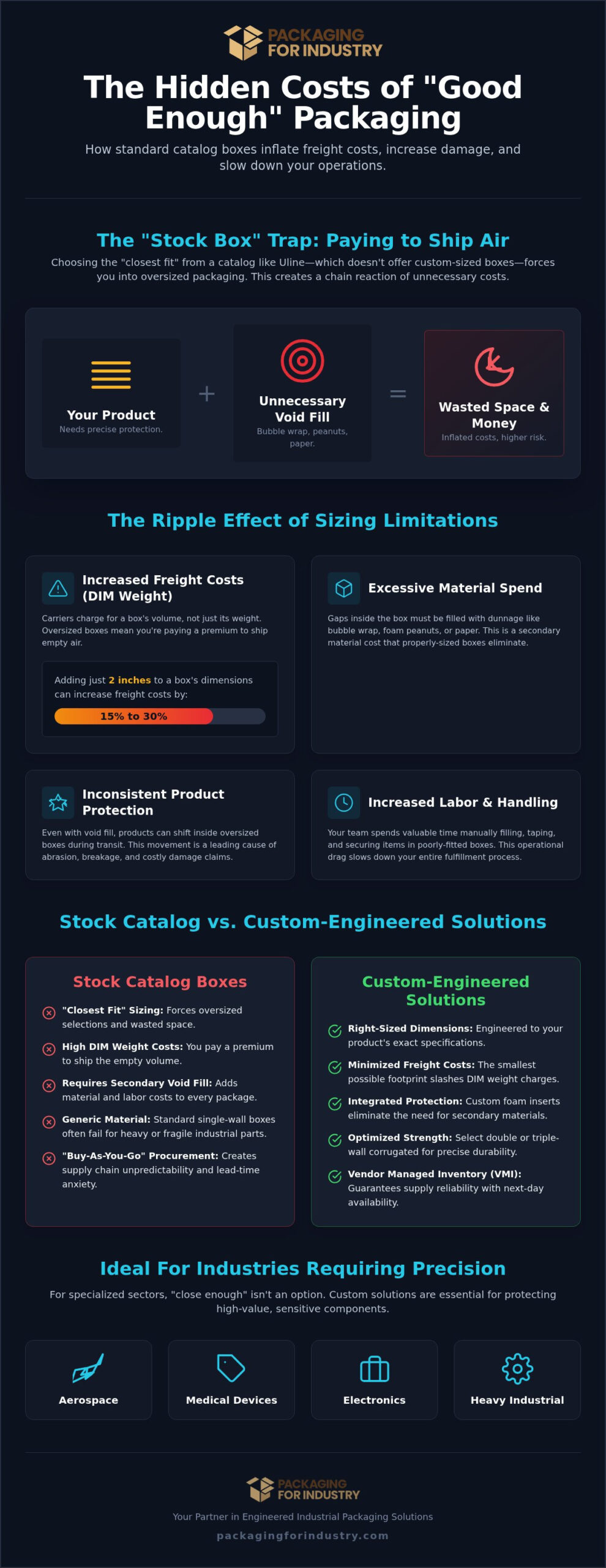
One major point of confusion involves branding and modification. Uline offers custom-printed tape and labels, which some buyers use to “customize” a standard container. This is a cosmetic fix, not an engineered one. A truly custom box is designed from the ground up to match your product’s dimensions, weight, and fragility. When you’re forced to choose the “closest” size from a catalog, you’re usually choosing a box that’s too big. This is the essence of the Uline custom box limitations; you end up paying for extra corrugated material and the freight costs to ship the empty space inside it.
Settling for oversized stock boxes introduces several hidden risks to your operation:
- Increased Freight Costs: Carriers charge based on dimensional weight, meaning you pay for the volume the box occupies, not just its actual weight.
- Excessive Material Spend: You’re forced to buy secondary materials like bubble wrap or packing peanuts to fill the gaps.
- Inconsistent Protection: If a part shifts inside an oversized box, the risk of transit damage increases regardless of how much tape you use.
When “Standard” Isn’t Standard Enough
Manufacturers in the aerospace and medical device sectors don’t have the luxury of “close enough.” These industries require exact tolerances to ensure that sensitive components don’t shift during transit. If you’re relying on a stock box that’s two inches too wide, you’re forced into a heavy reliance on void fill. This doesn’t just increase your material spend; it adds labor time as warehouse staff must manually pack and wrap every item. Relying on generic sizing creates a variable environment where protection is inconsistent and damage rates climb.
The Myth of Catalog Speed vs. Custom Engineering
The primary draw of a catalog is the perception of speed. You order today, and it arrives tomorrow. However, for a high-volume manufacturer, this “buy-as-you-go” approach creates lead-time anxiety and unpredictable supply chains. PFI offers a different path through custom design packaging and Vendor Managed Inventory (VMI). By engineering a box specifically for your product and stocking it locally in Southern California, we provide the same next-day availability without the compromises of a stock size. Stock boxes often lead to higher total procurement costs due to shipping inefficiencies and increased damage claims.
Calculating the Hidden Costs of Sizing Limitations
Procurement managers often view box costs as a simple line item on an invoice, but the true expense of a shipping container is realized at the loading dock. Because of Uline custom box limitations, industrial buyers are frequently forced to select the “closest fit” from a catalog. This small compromise creates a ripple effect of hidden costs that can quietly erode your profit margins. When a box is even slightly oversized, you aren’t just paying for extra cardboard; you’re paying to ship air.
The financial math behind shipping volume is staggering. Most major carriers like UPS and FedEx use Dimensional Weight (DIM) to calculate freight rates, meaning they charge based on the volume the package occupies rather than its actual weight. In many industrial applications, adding just two inches to a box’s height can increase freight costs by 15% to 30%. For a company moving thousands of units, that “close enough” stock size results in a massive annual budget leak that provides zero value to the end customer.
Beyond freight, consider the operational drag of non-optimized packaging. Oversized boxes require significant amounts of void fill to prevent product shifting. This dunnage must be purchased, managed in your inventory, and stored on valuable warehouse racking. You’re essentially paying for warehouse space to store air-filled plastic or paper just to compensate for a sizing problem. Labor costs also climb as warehouse staff spend extra time on excessive taping and dunnage application to ensure a secure fit. If your team is spending more than a few seconds securing a part, your packaging isn’t engineered for your process.
The DIM Weight Penalty
Carriers prioritize space efficiency in their logistics networks. By switching to custom corrugated boxes, you eliminate the dead space that triggers aggressive DIM weight surcharges. This is a mandatory strategy for 2026 as shipping rates continue to climb and carriers tighten their volume-based pricing models. Right-sizing your containers ensures you only pay for the protection your product actually needs, not the empty space surrounding it.
Reducing Transit Damage and Returns
Internal movement is the primary cause of high-value product failure during transit. When a part shifts inside a stock box, it gains momentum, which leads to impact damage even if the exterior of the box remains intact. Custom-engineered fitment eliminates the “crush zone” common in oversized catalog boxes, providing a snug fit that keeps components stationary. This precision drastically reduces return rates and protects your brand’s reputation for quality. For more detailed strategies on protecting your bottom line, explore our guide on packaging cost savings.
If you’re seeing high damage rates or shipping costs, it’s time to compare packaging pricing for a right-sized, engineered solution that fits your specific operational needs.
Custom Engineering vs. Off-the-Shelf: An Industrial Comparison
Choosing a shipping container from a catalog is a reactive process, while engineering a packaging system is a proactive one. The Uline custom box limitations become most apparent when you evaluate material integrity. A standard catalog box is typically a single-wall container with a 32 ECT (Edge Crush Test) rating, which is sufficient for light retail goods but often fails under the weight of industrial components. When you partner with a bulk packaging supplier like PFI, you gain access to heavy-duty double and triple-wall corrugated options designed specifically for high-density loads and overseas transit.
The difference lies in the design process. Catalog companies sell what they have in stock; we design what your product requires. Our team uses CAD/CAM prototyping to create precise internal fitments, ensuring that high-value goods are suspended and secured against impact. This integrated approach allows us to combine heavy-duty boxes, custom foam, and even pallets into a single, kitted SKU. This eliminates the need for your team to source five different items from a catalog and attempt to assemble them on the warehouse floor.
Heavy-Duty Requirements for Manufacturing
In high-stacking warehouse environments, the vertical compression strength of your packaging is the only thing protecting your inventory from being crushed. Standard boxes often lack the structural rigidity required for long-term storage or multi-stage shipping. Specialized manufacturing packaging requires significantly higher ECT ratings to withstand the rigors of industrial logistics. If you’re shipping heavy machinery or automotive parts, triple-wall corrugated provides the puncture resistance and stacking strength that off-the-shelf single-wall boxes simply cannot provide.
Custom Foam Inserts vs. Generic Bubble Wrap
Generic void fill like bubble wrap or packing peanuts offers inconsistent protection and requires significant manual labor to apply. We provide custom foam packaging inserts made from polyethylene (PE) or polyurethane (PU) that are engineered to specific G-force tolerances. For clients in aerospace and electronics, we also offer ESD (anti-static) foam to protect sensitive circuitry from electrostatic discharge. These kitted inserts arrive ready to use, which slashes your labor time and ensures that every package leaves your facility with the exact same level of professional protection. If you’ve been searching for an “industrial packaging supplier near me” in Southern California, our Anaheim facility provides the local engineering support and fast prototyping needed to move beyond the limitations of a catalog.
Procurement Strategy: Moving from Catalog to Custom
Transitioning from a standard catalog to a custom-engineered program is a fundamental shift in how you manage your supply chain. You start by auditing your current inventory to identify the boxes with the highest damage rates or those that consistently trigger DIM weight surcharges. These are the primary indicators of Uline custom box limitations in your current workflow. By replacing these problematic stock sizes with optimized containers, you immediately reduce the hidden costs discussed earlier in this article.
Warehouse efficiency also improves when you move from generic supplies to integrated packaging kits. Instead of your team spending time sourcing boxes from one pallet and foam from another, we provide kitted solutions that arrive ready for the line. This reduces labor hours and minimizes the footprint of packaging materials on your warehouse floor. Moving to an engineered solution means your packaging is no longer a generic commodity; it’s a precision tool designed for your specific operational flow.
The Role of Free Prototyping
You should never buy a custom industrial box without seeing a CAD sample first. We provide free prototyping to ensure every dimension is verified before a bulk run begins. For aerospace and defense manufacturers, physical testing with actual components is a requirement to meet strict quality standards. This process reduces the risk of bulk order errors and ensures your packaging is engineered for the specific G-force requirements of your product. Physical samples allow your team to verify the pack-out process on the warehouse floor before any capital is committed to a large order.
Optimizing Supply Chain Reliability
One of the biggest hurdles to custom packaging is the perceived risk of lead times. While catalog distributors offer fast shipping on generic items, they cannot guarantee availability for your specific needs during a supply chain disruption. Our Vendor Managed Inventory (VMI) programs solve this by keeping your custom stock on our shelves. By utilizing just-in-time inventory management, we provide next-day delivery across Orange County, Los Angeles, and the Inland Empire. Local Southern California partners offer a level of accountability and response time that national catalog distributors simply cannot match.
PFI: The Southern California Alternative to Catalog Limitations
National catalogs provide a broad range of generic supplies, but they lack the consultative depth required for complex manufacturing. While you can order a stock container from a website in minutes, you lose the opportunity to engineer a solution that addresses the Uline custom box limitations identified in your current workflow. Packaging For Industry (PFI) operates as an extension of your engineering team, offering a level of technical oversight that a catalog-based model simply cannot support. We don’t just sell components; we provide integrated assemblies that combine corrugated boxes, custom foam inserts, and custom crates into a single, optimized SKU.
Our approach centers on a comprehensive cost-reduction analysis. Instead of fulfilling a request for more stock boxes, we audit your shipping process to find where you’re losing money to damage or freight surcharges. You get direct access to seasoned packaging engineers rather than a general call center. This personalized service ensures that your packaging is precisely matched to your product’s fragility and your warehouse’s operational requirements. By focusing on the intersection of engineering and economics, we help you eliminate the professional stress of unreliable “close-enough” packaging.
Next-Day Local Delivery in SoCal
Incoming freight costs can quietly inflate your packaging budget when ordering from national distributors. As a local industrial packaging supplier, PFI maintains its own fleet to provide next-day delivery across Southern California. We serve specialized sectors in Anaheim, Orange County, Los Angeles, and the Inland Empire, as well as San Diego and Riverside. Having a local partner means you don’t have to worry about long-distance transit delays for emergency replenishment or last-minute design changes. This local presence allows us to offer Vendor Managed Inventory (VMI) programs that keep your production line moving without interruption.
Request a Custom Packaging Quote
To move beyond the Uline custom box limitations affecting your bottom line, you can start with a professional packaging review. We’ll help you identify which parts of your current system are underperforming and where engineered corrugated or foam can provide better ROI. To provide an accurate custom corrugated quote, our team typically needs your product dimensions, weight, and any specific protection requirements for sensitive components. We encourage you to request a quote for a free cost-reduction analysis and discover how right-sized, engineered packaging can transform your logistics efficiency.
Optimize Your Industrial Logistics with Engineered Packaging
Relying on a catalog for complex industrial needs often leads to unnecessary expenses and inconsistent protection. Navigating Uline custom box limitations requires a shift from buying generic commodities to implementing engineered systems. By right-sizing your containers and integrating custom foam inserts, you’ll eliminate the “shipping air” problem that inflates freight budgets and increases damage risks.
PFI provides the technical expertise and local infrastructure that national distributors lack. Through free CAD prototyping and aerospace-certified solutions, we ensure your high-value components arrive intact. Our Southern California fleet offers reliable next-day delivery, keeping your operations lean and your warehouse replenishment predictable.
It’s time to stop settling for “close enough” and start using packaging designed for your specific bottom line. We’re ready to help you optimize your warehouse flow and reduce your total cost of ownership through precision engineering.
Frequently Asked Questions
Does Uline offer custom sized boxes for industrial use?
No, Uline does not offer custom-sized or custom-printed corrugated boxes as of 2026. They operate strictly on a catalog-based model with approximately 1,700 stock sizes. If your industrial equipment doesn’t fit these specific dimensions, you’re forced to use an oversized container and fill the gaps with secondary packaging materials.
What are the main limitations of using Uline stock boxes for heavy machinery?
The primary Uline custom box limitations for heavy machinery involve material strength and internal fitment. Most catalog boxes are single-wall containers that lack the Edge Crush Test (ECT) ratings required for high-density industrial loads. Without a custom-engineered fit, heavy parts can shift during transit, causing impact damage that stock single-wall corrugated simply cannot prevent.
How much can I save by switching from stock boxes to custom-engineered sizing?
Savings vary based on your shipping volume, but right-sizing your containers can reduce freight costs by 15% to 30% through the elimination of dimensional weight (DIM) surcharges. You also lower your total cost of ownership by reducing the amount of void fill you need to purchase and store. Many manufacturers find that custom boxes pay for themselves through reduced damage claims alone.
Can I get custom printed logos on boxes from Uline?
Uline does not provide custom printing services for their boxes. They typically recommend using custom-printed tape or labels to add branding to a stock container. For industrial buyers who need professional, high-visibility branding or specific handling instructions printed directly on the corrugated material, a custom-engineered solution is the only viable option.
What is the lead time for custom corrugated boxes compared to catalog orders?
Catalog orders offer next-day delivery, while custom boxes require an initial design and production phase. However, we negate this gap for our Southern California clients through Vendor Managed Inventory (VMI). Once your custom design is finalized, we stock the inventory in our local warehouse to provide the same next-day reliability you expect from a catalog distributor.
How does custom foam packaging improve upon standard Uline void fill?
Custom foam inserts provide engineered G-force protection that generic void fill like bubble wrap cannot match. We use CAD/CAM technology to cut polyethylene or polyurethane foam to the exact shape of your part. This ensures every item is secured in the same position every time, which drastically reduces packing labor and eliminates the inconsistency of manual wrapping.
Do I need a custom box for military-spec or aerospace shipping?
Yes, aerospace and military-spec shipments almost always require custom-engineered packaging to meet strict compliance standards. These sectors demand specific material grades, such as triple-wall corrugated or ESD-safe foam, that aren’t available in standard catalogs. Using a stock box for these applications often leads to rejected shipments or failure to meet contract safety requirements.
Are there minimum order quantities for custom industrial boxes in Southern California?
Custom manufacturing runs do require minimum order quantities to remain cost-effective. We focus on serving high-volume industrial and manufacturing clients in Orange County, Los Angeles, and the Inland Empire. By establishing an ongoing replenishment program, we can provide custom-engineered boxes at a price point that competes with bulk catalog pricing while offering far superior protection.