
How much does a single hairline scratch on a mirror-finished aerospace component actually cost your operation when you factor in the return freight, the rework time, and the damaged client relationship? For manufacturers of high-value parts, generic cushioning isn’t a solution; it’s a liability. Implementing a precise packaging design to prevent surface scratching on polished metals is the only way to move beyond the cycle of constant repairs and material waste. You’ve likely found that standard bubble wrap or loose-fill materials fail to provide the absolute immobility required for stainless steel or polished aluminum.
We understand that your goal is to reduce damage rates to near zero while keeping the packing line moving at peak efficiency. This guide outlines how engineered systems, integrating custom-cut foam and specialized protective films, provide the structural integrity needed for sensitive surfaces. We’ll examine how to streamline your logistics and why partnering with a Southern California supplier for precision-engineered solutions can lower your overall packaging costs. By the end of this article, you’ll have a clear roadmap for protecting your most delicate finishes from the factory floor to the final destination.
Key Takeaways
- Understand how microscopic grit and transit vibrations cause surface scuffing and learn to calculate the true cost of rework.
- Compare protective films and non-abrasive foams to determine the most effective packaging design to prevent surface scratching on polished metals.
- Explore how custom CAD/CAM design and prototyping eliminate the movement that leads to abrasion on high-value components.
- Review specialized packaging protocols for aerospace and medical industries where surface integrity is a non-negotiable requirement.
- Discover how local next-day delivery in Anaheim and Orange County combined with Vendor Managed Inventory can prevent material shortages and lower your operational stress.
The Engineering Challenge: Why Polished Metals Scratch During Transit
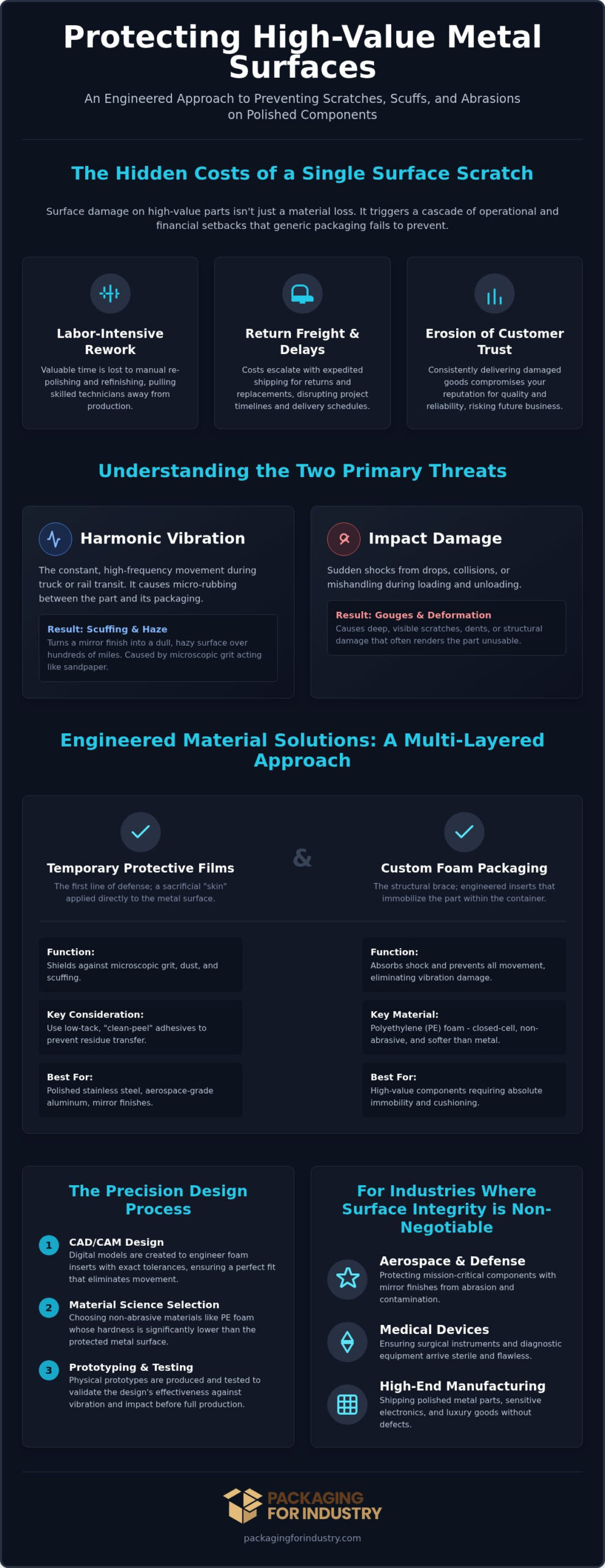
Surface abrasion on high-value metals is rarely the result of a single catastrophic event. Instead, it’s often the cumulative effect of microscopic grit and constant movement. When a polished part sits inside a container, even the smallest particles of dust or manufacturing debris can act like sandpaper. This process, known as scuffing, occurs when transit vibrations force these particles against the metal surface. Effective packaging design to prevent surface scratching on polished metals must account for these micro-movements before the first pallet is ever loaded.
The financial impact of surface damage goes far beyond the price of the part itself. Manufacturers often overlook the “Hidden Costs” associated with these failures. These include the labor-intensive process of manual rework, the expedited shipping costs for replacement parts, and the erosion of customer trust when a critical aerospace or medical component arrives with a compromised finish. Surface friction damage is the degradation of a material’s finish caused by the repeated relative movement between the component and its protective interface during the logistical cycle.
Many warehouses rely on standard bubble wrap, but this frequently fails for high-polish finishes. The circular pattern of the bubbles can actually transfer onto the metal, a phenomenon known as “ghosting.” This pattern transfer is often permanent and requires the part to be stripped and re-polished. To avoid this, a more sophisticated approach to cushioning is required to ensure the finish remains pristine.
Vibration vs. Impact: Two Different Threats
It’s vital to distinguish between vibration and impact when designing your protective system. Impact damage usually results in deep gouges or structural deformation from a drop or collision. However, harmonic vibration during truck or rail transit creates a constant micro-rubbing effect. This high-frequency movement can turn a mirror finish into a dull haze over hundreds of miles. To prevent this, your packaging must utilize non-abrasive contact points that maintain a secure grip on the part without allowing lateral movement.
The Material Science of Abrasive Contact
The materials you choose for your shipping containers matter as much as the cushioning inside. Standard corrugated liners are surprisingly abrasive to soft metals like aluminum because the wood fibers in the paper are naturally hard. Additionally, some low-grade plastics can “outgas” chemical vapors that react with sensitive metal finishes, causing staining or oxidation. Understanding the Mohs hardness of your packaging materials relative to your product is essential. Using a soft, non-abrasive polyethylene foam ensures the packaging interface is significantly softer than the metal it protects, which helps eliminate the risk of mechanical scratching.
Comparing Surface Protection Materials: Films, Foams, and Pads
Selecting the right materials is the foundation of any effective packaging design to prevent surface scratching on polished metals. You need to balance surface-level shielding with structural stability to ensure parts don’t shift during transit. While many suppliers suggest a single-product solution, our experience shows that a multi-layered approach usually yields the best results for high-value components. You can compare packaging pricing for these materials to see how they fit into your operational budget.
Temporary Protective Films: The First Line of Defense
Protective films act as a sacrificial “skin” for mirror-finished metals. For polished stainless steel or aerospace-grade aluminum, you should typically opt for low-tack adhesives. High-tack films provide a stronger bond but carry a higher risk of “adhesive transfer,” where residue is left behind on the metal surface. Selecting a “clean-peel” film ensures your team doesn’t waste time on secondary cleaning processes after the product is unpacked. Depending on your volume, these films can be applied via manual dispensers or automated laminating lines to speed up your packing flow.
Protective Foam Inserts: Structural Surface Isolation
While films protect against grit, custom foam packaging protects against movement. Polyethylene (PE) foam is a closed-cell material that is firm and moisture-resistant, making it ideal for heavy aerospace parts. In contrast, Polyurethane (PU) foam is softer and open-cell, which is better for lightweight, ultra-delicate items. Using die-cut foam allows for a precision fit that isolates each component, preventing them from knocking together. This level of packaging design to prevent surface scratching on polished metals is far more reliable than generic loose-fill options that settle during shipping.
For electronic metal housings, you must also consider anti-static (ESD) properties. Standard foams can generate static charges that damage sensitive internal circuitry. Using pink ESD-treated foam provides the necessary surface protection while safely dissipating static. If you are stacking flat sheets, spacer pads made of cork or felt can provide the necessary gap to prevent vibration-induced scuffing between layers.
Material Comparison Table
| Material Type | Protection Level | Application Speed | Best For |
|---|---|---|---|
| Protective Film | Surface Only | High (Automated) | Flat sheets, large panels |
| Custom Foam | Surface + Structural | Moderate | Complex geometries, heavy parts |
| Spacer Pads | Inter-layer Gap | High (Manual) | Stacking flat metal sheets |
| ESD Foam | Surface + Electrical | Moderate | Electronic metal housings |
If you’re operating in Southern California, our Anaheim facility can provide rapid prototyping for these materials to ensure a perfect fit for your specific metal components.
Custom Packaging Design Strategies for High-Value Metals
Developing a robust packaging design to prevent surface scratching on polished metals requires a methodical engineering approach rather than a trial-and-error method. The process begins with a comprehensive packaging review. We analyze your current shipping cycle to identify exactly where scuffing or haze occurs, whether it’s during internal transport or final delivery. Once the failure points are clear, our team utilizes CAD/CAM support for custom design packaging. This technology allows us to create precise geometries that hold parts securely in place, eliminating the friction that leads to damage. We then move to physical prototyping and drop testing to validate that surface isolation remains intact under stress. Finally, we implement kitting and assembly services to reduce handling time on your production line, ensuring that parts are protected as soon as they leave the final polish stage.
Eliminating Part-to-Part Contact with Die-Cut Inserts
Direct contact between components is a primary cause of surface damage during transit. We solve this by using custom corrugated boxes equipped with engineered partitions. These dividers ensure that even if a box is jostled, the parts cannot clash. For ultra-sensitive finishes, we design “floating” inserts. These structures are engineered to touch the component only on non-critical, internal surfaces or mounting points, leaving the polished exterior completely untouched. For larger palletized loads, adding corner and edge protection is essential to maintain load integrity and prevent strap abrasion from marring the metal edges.
Integrated Solutions: Combining Wood, Foam, and Corrugated
High-value polished machinery often requires more structural support than a standard box can provide. In these cases, you should move to a custom shipping crate. These heavy-duty wood structures provide the necessary rigidity for international or long-haul transit. We often line these crates with thick layers of polyethylene foam to maximize vibration dampening. In aerospace applications, we frequently provide multi-material kits that combine a wood base, foam cradles, and a corrugated shroud. This integrated approach ensures that heavy components remain stationary while their mirror-finished surfaces are isolated from the crate’s interior walls. This level of packaging design to prevent surface scratching on polished metals is the standard for high-stakes industrial shipping.
Industry-Specific Requirements: From Aerospace to Medical Devices
Each industrial sector maintains its own set of compliance standards and quality benchmarks. For many manufacturers, a generic approach fails to meet the strict regulatory audits required for high-stakes shipping. Implementing a precision packaging design to prevent surface scratching on polished metals is not just about protection; it’s about meeting the specific documentation and material requirements of your end-user. Whether you are shipping across Southern California or nationwide, your packaging must align with the specific rigors of your industry’s supply chain.
Aerospace and Aviation: Precision Surface Protection
Turbine blades and polished airframe components require absolute surface integrity. Even a microscopic scratch can lead to stress fractures under high-pressure flight conditions. For these parts, we utilize aerospace packaging systems that fulfill rigorous mil-spec requirements for both transit and long-term storage. These designs often include VCI (Vapor Corrosion Inhibitor) components to prevent oxidation alongside surface protection. PFI is a strategic partner for aerospace hubs in Orange County and Los Angeles because we understand the zero-tolerance nature of these contracts and the need for rapid, reliable delivery.
Medical Device Manufacturing: Cleanliness and Integrity
Surgical instruments and implants must arrive scratch-free and ready for sterilization. Our manufacturing packaging solutions for the medical sector focus on cleanroom compatibility. We use lint-free foams and specialized poly bags that don’t shed particles or outgas chemicals. This ensures that the polished finish remains pristine without introducing contaminants that could compromise the sterilization process. Every component is isolated within the kit to prevent any metal-on-metal contact during handling.
Automotive Tier 1 suppliers often face a choice between returnable dunnage and expendable packaging. High-volume parts like polished trim or engine components benefit from returnable plastic containers with custom fabric or foam liners that can be used for multiple cycles, helping to lower packaging costs over time. Conversely, for defense contractors, adhering to military packaging standards is mandatory. These specs dictate everything from the thickness of the barrier material to the specific grade of the corrugated box to ensure the contents survive extreme environmental shifts without surface degradation.
Optimizing Your Supply Chain with PFI Custom Solutions
Managing specialized protective materials requires careful inventory oversight. If you run out of custom foam or protective film, your production line stops or you risk shipping unprotected parts. Our Vendor Managed Inventory (VMI) program solves this by shifting the burden of stock monitoring to us. We track your usage rates and replenish supplies before a shortage occurs. This approach also allows you to reduce your warehouse footprint. Instead of storing months of bulky custom boxes and foam on-site, you can utilize our stocking programs to free up valuable floor space for manufacturing operations.
Efficiency is as much about economics as it is about engineering. We perform a detailed analysis to find the precise balance between adequate protection and over-packaging. Using too much material increases your shipping weight and waste. Conversely, under-packaging leads to expensive rework and returns. We help you find the “sweet spot” where your packaging design to prevent surface scratching on polished metals is both lean and effective. By optimizing the material usage, you can often lower packaging costs without compromising the safety of your high-value finishes.
Local Support for Southern California Manufacturers
Proximity is a major advantage for our regional clients. Being close to Orange County and Los Angeles hubs allows us to offer local next-day delivery in cities like Anaheim, Irvine, and Brea. This rapid response is essential for manufacturers running high-volume production lines that rely on just-in-time (JIT) delivery models. We also provide customized kitting services. By delivering pre-assembled kits of foam and corrugated components directly to your floor, we help your team speed up the packing process and reduce manual labor on the line.
Requesting a Quote and Prototyping
Our engineering process is designed to eliminate uncertainty. It begins with a consultation where we review your part geometry and finish requirements. We then move to CAD design and offer free prototyping to ensure a perfect fit before you commit to a full production run. This ensures that the final packaging design to prevent surface scratching on polished metals performs exactly as expected during the most rigorous transit cycles. You can also compare packaging pricing for different material densities to ensure the solution fits your budget.
To get started, you can request a packaging quote for your custom metal protection needs. Stop settling for generic supplies that leave your mirror-finished products vulnerable to abrasion. Engineer your protection with a partner who understands the intersection of logistics, material science, and fiscal responsibility.
Secure Your High-Value Components with Engineered Protection
Manufacturers can’t afford the high costs of rework and lost customer trust caused by inadequate surface protection. Moving beyond generic cushioning requires a strategic packaging design to prevent surface scratching on polished metals that addresses both microscopic abrasion and structural stability. By integrating custom-cut foams, protective films, and CAD-designed partitions, you create a system that isolates delicate finishes from the rigors of the industrial supply chain.
We specialize in meeting the zero-tolerance standards of the aerospace and medical device industries. Our team provides the technical expertise and logistical support needed to streamline your packing line while lowering your overall operational costs. With free prototyping for all custom designs and local next-day delivery available throughout Southern California, we ensure your high-value components arrive in pristine condition.
Our Anaheim-based specialists are ready to help you engineer a more reliable and cost-effective shipping solution that protects your bottom line and your reputation for quality.
Frequently Asked Questions
How do I prevent “ghosting” or patterns on my polished metal parts?
You can prevent ghosting by avoiding standard bubble wrap and low-grade plastics that transfer patterns or chemicals to the metal. Use high-quality, non-abrasive polyethylene foam or clean-peel protective films instead. These materials provide a uniform contact surface without the pressure points found in bubble-based materials. Proper material selection is a core component of packaging design to prevent surface scratching on polished metals and ensures mirror finishes remain pristine during storage.
What is the best foam density for protecting heavy stainless steel components?
High-density polyethylene (PE) foam, typically 1.7 lb to 2.2 lb density, is the best choice for heavy stainless steel parts. This firm, closed-cell foam provides the structural integrity needed to prevent heavy components from bottoming out or migrating within the box. While softer foams might seem safer, they often compress too much under weight, allowing the metal surface to contact abrasive corrugated walls during transit vibrations.
Can I use standard bubble wrap for mirror-finish aluminum?
You should avoid using standard bubble wrap for mirror-finish aluminum because the bubbles create localized pressure points that can leave permanent circular marks. This pattern transfer, or “ghosting,” is difficult to remove without re-polishing the part. Instead, use a combination of low-tack protective film and smooth-surface foam inserts. This multi-layered approach provides superior vibration dampening without the risk of pattern transfer or surface haze during long-distance shipping.
Are there anti-corrosive packaging options that also prevent scratching?
Yes, you can integrate Vapor Corrosion Inhibitors (VCI) into your protective packaging. We often provide VCI-treated poly bags or papers that can be used alongside non-abrasive foam inserts. This dual-action approach protects against both mechanical scratching and chemical oxidation. It’s particularly effective for aerospace and military-grade components that require long-term storage in humid environments where corrosion is a constant threat to polished surfaces and overall part integrity.
How does a Vendor Managed Inventory (VMI) program help reduce my packaging costs?
A VMI program allows you to lower packaging costs by optimizing your stock levels and reducing administrative overhead. We monitor your usage of custom foam and boxes, replenishing them only when needed. This eliminates the risk of emergency shipping fees and prevents you from tying up capital in excess inventory. By outsourcing inventory management, your team can focus on production while we ensure you always have the right materials on hand.
Do you provide custom foam inserts for small medical device parts?
We specialize in designing precision die-cut foam inserts for small medical instruments and electronic housings. These inserts utilize medical-grade, lint-free foams that are compatible with cleanroom environments. Each part is securely nested in its own cavity to prevent any metal-on-metal contact. Custom sizes available for these inserts ensure that even the most delicate surgical tools remain scratch-free and ready for final sterilization after they arrive at the medical facility.
What is the lead time for custom die-cut corrugated inserts in Southern California?
We offer rapid response times for manufacturers in the Inland Empire, Orange County, and Los Angeles. Once a design is approved through our free prototyping process, we can typically move into production within a few business days. Our local Anaheim facility allows for next-day delivery on established stocking programs, ensuring your high-volume production lines never experience a delay due to packaging shortages or unexpected spikes in demand.
Is protective film better than foam for flat polished sheets?
Protective film is often the most cost-effective primary solution for flat sheets because it provides a direct barrier against grit and light scuffing. However, if you are stacking multiple sheets on a pallet, you should also use foam spacer pads or corner protectors to prevent vibration-induced movement. Combining film with structural foam provides the most comprehensive packaging design to prevent surface scratching on polished metals during long-haul transit cycles.