
A small shift, surface abrasion, impact, or static exposure can damage a precise optical component during transit. The packaging for sensitive optical equipment Orange County manufacturers need should control fit and movement, not simply add more cushioning. An oversized stock box can leave room for components to shift, while a poorly fitted insert may put pressure on a surface that should remain untouched.
A practical packaging system protects the product and works for your packing process and repeat orders. This guide explains how to assess shipment risks, specify custom foam inserts and ESD packaging, select a corrugated box, and prepare a quote request. Start with the product’s dimensions and vulnerable areas, then account for the shipping route, packing workflow, and ongoing supply needs.
Packaging For Industry, headquartered in Anaheim, provides custom packaging design support, prototypes, and samples for industrial buyers. For Orange County operations, PFI can develop an integrated protective solution and support recurring packaging needs. Local next-day delivery is available throughout Southern California.
Key Takeaways
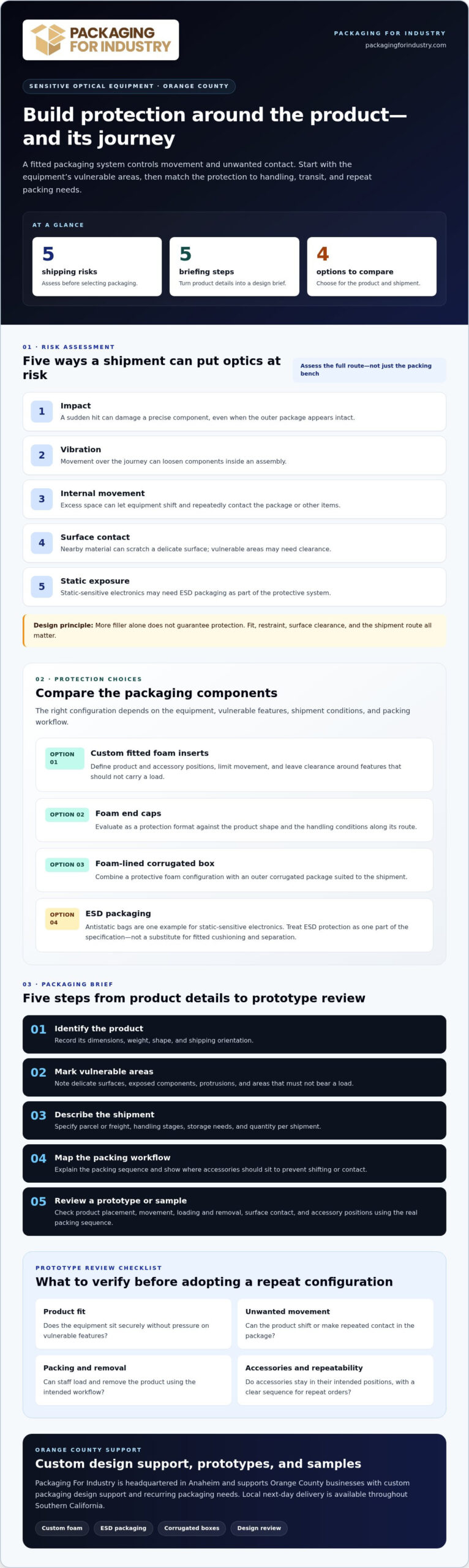
- Assess impact, vibration, internal movement, surface contact, and static exposure to identify the shipping risks for your optical products.
- Document product dimensions, vulnerable areas, and shipment conditions to guide a custom packaging design and prototype review.
- Compare fitted foam, foam end caps, foam-lined boxes, and ESD packaging according to the product and shipment requirements.
- Prepare a packaging quote request with drawings or dimensions, product photos, order quantities, shipping method, and packing workflow.
- For packaging for sensitive optical equipment Orange County operations, PFI combines custom foam, ESD packaging, corrugated boxes, and design support.
Packaging for Sensitive Optical Equipment in Orange County: Identify the Shipping Risks
Lenses, optical assemblies, instruments, and related industrial components can be vulnerable to more than a major impact. Vibration can loosen a component, movement inside a box can cause repeated contact, and an exposed surface can be scratched by nearby material. If an assembly includes electronic parts, static exposure may also be a concern. Effective packaging for sensitive optical equipment Orange County businesses ship should address these specific risks rather than rely on extra filler alone.
Protective optical packaging is a fitted system that limits product movement and unwanted contact throughout handling and transit. It may combine custom foam inserts with a corrugated box, but the configuration depends on the equipment and its route. Storage, transfers between work areas, parcel shipping, and freight transit involve different handling conditions. A package suited to controlled facility storage may not be suitable for repeated transfers or carrier handling.
Which optical equipment details affect packaging decisions?
Start with the product’s dimensions, weight, shape, delicate surfaces, and protruding features. A lens barrel, connector, or delicate edge may need clearance so it does not bear against the box or another component. If accessories ship with the equipment, plan separate positions for them to prevent shifting or contact during transit.
Include the shipment method and packing sequence in the design brief. Note how the product is placed into the package, what is packed alongside it, and how the completed box is handled. This information helps turn product geometry into a practical packaging concept. PFI provides custom design support, prototypes, and samples, and its foam packaging solutions can form part of an integrated protective configuration.
Why Orange County buyers should plan for the full shipping route
Optical products made or distributed in Orange County may pass through several handling stages before reaching their destination. Account for the journey beyond your facility, including transfers between handling points and whether the shipment moves by parcel or freight. Planning for the full route helps avoid a design that works at the packing bench but allows movement in transit.
A fitted package can also make repeat packing procedures more consistent. Defined positions for the product and accessories help warehouse staff follow the same sequence across orders, while custom sizes can limit excess space around the item. As an Anaheim-based industrial packaging supplier, Packaging For Industry supports Orange County businesses with design services and local next-day delivery throughout Southern California.
For components that include static-sensitive electronics, antistatic bags are one example of packaging designed to address electrostatic discharge. Consider them as one part of the specification, alongside cushioning, separation, and the outer corrugated package, not as a replacement for a fitted protective system.
How Orange County Buyers Can Specify Custom Optical Equipment Packaging
A useful packaging brief gives purchasing, engineering, and warehouse teams enough information to evaluate a design. For packaging for sensitive optical equipment Orange County operations, follow a clear sequence: identify the product, document its dimensions and weight, mark vulnerable areas, define shipping and storage conditions, then review a prototype. This ties the design to the actual equipment and handling workflow.
Geometry matters. CAD/CAM tools can help translate product shapes into packaging concepts, while custom design support connects those concepts to practical loading and restraint. SPIE’s discussion of packaging of photonic components highlights why optical products call for careful attention to alignment and protection during handling. The package should hold the product securely without placing pressure on surfaces or features that should not carry a load.
What information belongs in an optical packaging brief?
Build the brief around the finished product and the work required to pack it. Include dimensions, weight, shipping orientation, quantity per shipment, and packing workflow. Mark delicate surfaces, exposed components, protrusions, and areas that must not carry a load. Describe whether accessories ship with the product and where they should sit to avoid contact or interference.
Also specify parcel or freight shipping, handling steps, storage needs, and recurring order patterns. These details help align the packaging concept with both transit conditions and daily operations. A clear brief makes it easier to develop custom packaging that fits repeat orders and supports consistent packing.
How prototypes help assess fit before production
A prototype or sample gives your team a practical way to check product placement and packing steps before adopting a repeat configuration. Load the product as warehouse staff would, then look for unwanted movement, difficult loading or removal, and contact with vulnerable surfaces. Confirm that the packing sequence is clear and accessories stay in their intended positions.
PFI provides custom design support, prototypes, and samples. Reviewing a sample can help refine protective foam packaging and the fit between the insert and outer box. Once your design brief is ready, review custom packaging design support and request a packaging quote based on your product, shipment, and recurring supply needs.
Choosing Foam, ESD Protection, and Corrugated Packaging for Optical Shipments
For packaging for sensitive optical equipment Orange County businesses ship, materials work best as a coordinated system. A custom insert positions the product, cushioning helps limit movement, and a corrugated outer box provides the shipping enclosure. The right combination depends on the item’s shape, vulnerable surfaces, static sensitivity, and shipment conditions. No single foam or box configuration suits every optical product.
| Packaging option | Potential role in the system | Considerations |
|---|---|---|
| Fitted foam | Shapes around a product or assembly to support defined placement. | Consider product geometry, contact areas, and how staff load and remove the item. |
| Foam end caps | Provide support at selected ends of a product. | May suit items with suitable end surfaces; review where the product can safely bear contact. |
| Foam-lined box | Combines cushioning with a corrugated outer enclosure. | Assess fit, packing sequence, and the protection needed for the shipment route. |
| ESD packaging | Addresses static sensitivity as part of the packaging configuration. | Use where the product or its electronics require static protection; it does not replace cushioning or restraint. |
When custom foam inserts or end caps may be appropriate
Custom foam inserts can create shaped positions for fragile components and help staff place products consistently during repeat packing. End caps may work when the product’s geometry allows support at selected ends. Evaluate polyethylene foam, polyurethane foam, and other foam options against the product and packing requirements rather than treating them as interchangeable. PFI provides custom die-cut foam, and custom foam-lined crate designs can be considered for heavier equipment that calls for a crate-based configuration.
When ESD packaging and a corrugated outer box matter
ESD foam or other ESD packaging is a consideration for products with static-sensitive electronics. A protective insert positions and separates the item, foam lining adds cushioning within the box, and the corrugated carton serves as the outer enclosure. These components can be designed around the shipment, with the final material combination based on the product and handling needs.
For equipment that needs a crate rather than a carton, engineering foam-lined crates can be part of the design conversation. Orange County buyers can work with PFI for local packaging support, including in Irvine. To review materials and configuration for your shipment, request a packaging quote.
Prepare a Packaging Quote for Sensitive Optical Equipment in Orange County
A detailed brief helps a packaging supplier scope a practical solution and price it against your operating needs. For packaging for sensitive optical equipment Orange County businesses ship, include enough information to assess product fit, protection, packing steps, and repeat supply, not just the box dimensions.
What helps PFI scope custom packaging efficiently?
Share the information your team already has: drawings, product dimensions, weight, photos, or a representative sample. Identify delicate surfaces and components that must not carry a load. Then describe order frequency and quantities, shipping destinations, parcel or freight methods, and current packing steps. If the product has a damage history, note where issues occur, such as movement inside the package or contact with another component.
- Product information: Drawings or dimensions, photos, weight, shape, and vulnerable areas.
- Order profile: Quantity per shipment, order frequency, and expected repeat-order needs.
- Shipping and handling: Destinations, shipping method, storage conditions, and packing workflow.
- Current challenges: Damage observations, packaging changes, or carrier surcharge concerns related to package size or configuration.
These details help PFI assess custom sizes and material combinations alongside order volume and recurring purchasing needs. Design support, prototypes, and samples give your team a way to review fit and packing sequence. The resulting quote can reflect the project’s scope rather than assume every optical product needs the same configuration.
How to evaluate packaging proposals for operational fit
Compare proposals by how well the system addresses product protection, packing consistency, material combination, and storage footprint. Check whether the insert positions the product clearly, staff can load and remove it efficiently, and the outer package suits the shipping method. Use damage history and carrier surcharge exposure as review inputs, but treat potential cost or damage reduction as objectives to evaluate, not guaranteed results.
For repeat orders, assess whether the proposed packaging supports production timing, storage capacity, and predictable replenishment. A configuration that works for one shipment should also fit your ongoing order pattern. A complete quote request gives the packaging team a practical basis to compare packaging pricing and tailor a proposal to your workflow.
Why Choose PFI for Optical Equipment Packaging in Orange County
Packaging For Industry is an Anaheim-based industrial packaging supplier serving Orange County manufacturers and distribution operations. For sensitive optical equipment, PFI brings together custom foam, ESD packaging, corrugated boxes, and design support. This integrated approach helps packaging for manufacturers fit the product and workflow, with the goal of reducing shipping damage and lowering packaging costs without sacrificing protection.
An integrated approach to product protection and supply
Foam inserts can position optical components, ESD packaging can address static-sensitive items, and corrugated boxes can provide the outer enclosure. PFI’s custom design support, prototypes, and samples help teams review fit and packing steps. For recurring orders, custom sizes and planned quantities can support consistent packing and supply reliability. Buyers can also compare bulk packaging pricing against the materials and quantities their operation needs.
Local next-day delivery is available throughout Southern California, supporting ongoing packaging needs for Orange County businesses. PFI works with manufacturers and distribution operations on custom and repeat-order requirements.
A practical next step for Orange County purchasing teams
Prepare a product brief with available dimensions or drawings, photos, vulnerable areas, shipment method, packing workflow, and current packaging concerns. Include order frequency and expected quantities so the proposed solution can reflect your purchasing needs and local packaging delivery requirements.
Share those details with PFI to develop a project-specific quote for a packaging configuration tailored to your optical equipment and operation.
Build a More Practical Protection Plan for Your Optical Products
Protective packaging works best when it reflects the product’s geometry, vulnerable areas, and shipping route. A fitted foam insert, ESD packaging where static sensitivity is a concern, and a suitable corrugated box can work together to limit movement and contact. Documenting dimensions, quantities, packing steps, and repeat-order needs gives your team a useful basis for comparing packaging options.
Packaging For Industry is an Anaheim-based supplier serving Orange County and Southern California businesses, including operations in Los Angeles, San Diego, and Riverside. PFI provides custom design support, prototypes, and samples to help teams assess packaging fit and workflow. Local next-day delivery is available throughout Southern California for ongoing manufacturing and distribution needs.
Share your product and shipment details with PFI to develop a quote tailored to your operation and recurring supply requirements.
With a clear specification and a packaging system designed around your process, your team can take a practical step toward more consistent handling and fewer avoidable transit risks.
Frequently Asked Questions
What packaging is best for sensitive optical equipment?
The best configuration depends on the product’s shape, weight, sensitive surfaces, and shipping route. Packaging for sensitive optical equipment Orange County manufacturers need may combine a fitted foam insert, an outer corrugated box, and ESD packaging when static-sensitive components are involved. Consider how the equipment will be packed, handled, and shipped, then review a sample or prototype for fit and packing steps before placing repeat orders.
Can custom foam inserts protect optical equipment during shipping?
Custom foam inserts can help position equipment and separate it from accessories or other surfaces inside a package. The insert should reflect the product’s geometry and identify areas that must not carry a load. PFI provides custom die-cut foam and design support, along with prototypes and samples for review. Consider the insert as part of a complete package, together with the outer box and shipment method.
Does optical equipment need ESD packaging?
ESD packaging is a consideration when the product includes components sensitive to electrostatic discharge. Static-protection requirements vary by product, so base material choices on the equipment and its handling needs. ESD foam or other ESD packaging can be used alongside cushioning and a corrugated outer box. The ESD component addresses static concerns, while inserts and cartons serve separate positioning and enclosure functions.
What information should I provide for an optical packaging quote?
Provide available drawings or dimensions, product photos, weight, order quantities, and shipping method. Identify delicate surfaces, exposed components, and areas that must not carry a load. Include the packing workflow, destinations, storage needs, order frequency, and known damage or packaging concerns. This information helps PFI assess a suitable combination of foam, ESD packaging, and corrugated boxes for your operation and recurring supply needs.
Can a corrugated box be used with foam packaging for optical equipment?
Yes. A corrugated box can serve as the outer enclosure while foam inserts or lining position and cushion the product inside. The configuration should match the equipment’s geometry, handling process, and shipping conditions. A fitted insert can separate accessories and help limit movement, while the carton contains the assembled package. PFI supplies corrugated boxes and foam packaging that can be designed together as a custom packaging solution.
Does PFI provide packaging for businesses in Orange County?
Yes. Packaging For Industry is headquartered in Anaheim and serves industrial businesses in Orange County and across Southern California, including Los Angeles, San Diego, and Riverside. PFI offers custom packaging design support, foam packaging, ESD packaging, corrugated boxes, prototypes, and samples. Local next-day delivery is available throughout Southern California for production, warehousing, and distribution packaging needs.