
The fastest fix for recurring shipping damage may be less packaging, not more. A packaging redesign to reduce shipping damage should target the point of failure instead of adding material that increases package size, weight, or packing time. If claims keep coming in, identify which component is failing and whether added protection could create new costs or workflow problems.
Start with evidence. Damage patterns, product condition, and shipping method can help show whether the issue lies with the box, cushioning, product fit, or handling. Once the likely cause is clear, compare practical changes against protection needs and warehouse operations.
This guide explains how to diagnose transit damage, assess custom box, foam, and crate options, and match protection to your product and shipping conditions. It also covers how prototypes and samples can help your team review a custom solution before a wider rollout. The goal is packaging that protects products without unnecessary materials or disruption to the way your team packs and ships.
Key Takeaways
- Sort damage records by location, severity, route, handling stage, and packaging condition to narrow down the likely failure point.
- A packaging redesign to reduce shipping damage should address how the carton, cushioning, closure, and load work together, not simply add more material.
- Compare right-sizing, stronger corrugated boxes, cushioning, partitions, and crates against protection needs, freight impact, and packing workflow.
- Set review criteria before testing prototypes, including product condition, package fit, packing steps, and handling observations.
- Use packaging design support to develop a product- and shipping-specific solution, then review samples before a broader rollout.
Packaging Redesign to Reduce Shipping Damage Starts with Diagnosing the Failure
Repeated damage creates work beyond replacing a product. Returns, rework, claims, and shipment disruption draw time from production, customer service, and warehouse teams. Changing packaging before identifying the failure can add materials and packing steps without addressing the cause. Start by examining the product and package as they arrived, then look for patterns across shipments.
Packaging redesign is a change to the package based on documented product vulnerabilities and transit risks, not a general increase in protective material. The goal is to match protection to the failure while accounting for how the package moves through your operation.
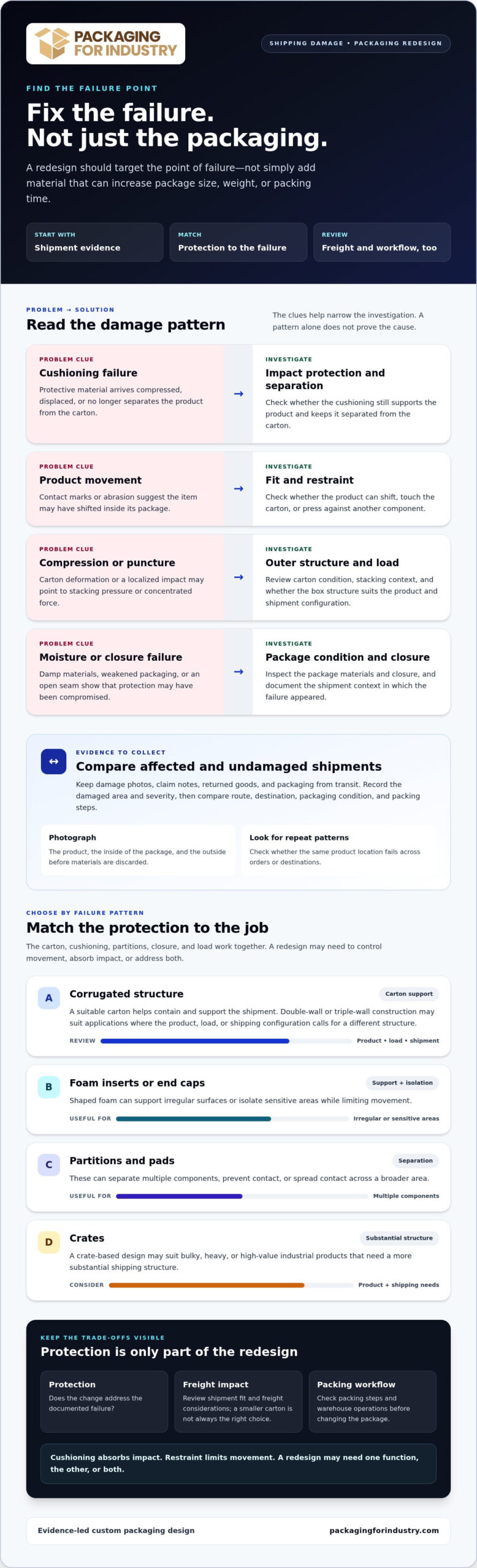
Classify damage by product location and severity, then compare it with the shipment route, handling stage, and packaging condition. A dented product corner alongside a crushed carton suggests a different issue than a scratched surface inside an intact box. Look for evidence of:
- Cushioning failure: Protective material is compressed, displaced, or no longer separating the product from the carton.
- Product movement: Contact marks or abrasion suggest the item shifted inside its package.
- Compression or puncture: Carton deformation or a localized impact may point to stacking pressure or concentrated force.
- Moisture exposure or closure failure: Damp materials, weakened packaging, or an open seam can help explain how protection was compromised.
Packaging serves several functions, including protection, as outlined in Packaging and labelling. For a redesign, use shipment evidence to identify which function failed.
What shipment evidence should a packaging team collect?
Create a record for each affected shipment using damage photos, claim notes, returned goods, and the packaging retained from transit. Photograph the product and the inside and outside of the package before discarding materials. Record the damaged area, severity, and whether the same location fails across orders or destinations.
Compare affected shipments with undamaged shipments packed for the same product using the same process. Note differences in destination, route, packaging condition, or packing steps. This helps distinguish a recurring design weakness from an isolated event and gives your packaging review concrete information to work from.
How do you distinguish a packaging issue from a handling issue?
Look for repeatable evidence, but don’t assume one handling event explains every failure. Similar damage across different destinations may point to a consistent fit or protection problem. Damage limited to a particular route or stage may call for closer review of that shipment context. Neither pattern proves the cause on its own.
Check whether the product can shift, touch the carton, or press against another component. Inspect whether cushioning arrives compressed or displaced, and document the packing steps, closure, and load condition. PFI’s custom packaging design uses this evidence to develop a product- and shipping-specific direction before selecting a material change.
How Packaging Design Choices Change Product Protection in Transit
A package protects a product through the way its components work together. The carton provides the outer structure, cushioning manages impact, partitions keep items separated, and the closure helps the package remain intact. Load and fit matter too: a product secured in its box behaves differently from one that can shift or press against another item in transit.
Cushioning absorbs impact; restraint limits movement. A redesign may need one function, the other, or both. Soft material alone won’t prevent damage if the product can build momentum inside the carton. A tight fit without adequate cushioning may leave vulnerable surfaces exposed to shock or concentrated contact.
Match the solution to the failure pattern and product geometry:
- Corrugated structure: A suitable carton helps contain and support the shipment. Double-wall or triple-wall construction may suit applications where the product, load, or shipping configuration calls for a different structure.
- Foam inserts or end caps: Shaped foam can support irregular surfaces or isolate sensitive areas while limiting movement.
- Partitions and pads: These can separate multiple components, prevent contact, or spread contact across a broader area.
- Crates: A crate-based design may suit bulky, heavy, or high-value industrial products that need a more substantial shipping structure.
How should the outer package match the shipment?
Consider product weight and dimensions alongside fragility, shipment configuration, and expected handling conditions. A box with excessive open space can allow movement and require more internal protection. A close-fitting design can help control movement, but it still needs room for cushioning where impact protection is required. Review freight considerations alongside protection, rather than assuming a smaller carton will always suit the product.
For custom corrugated boxes, choose the structure and size to fit the product and shipping requirements. A packaging review can help determine whether the current carton is appropriate or whether a different configuration should be evaluated.
When should a redesign combine a box with internal protection?
Combine components when the carton alone can’t prevent movement, separate parts, or protect specific product features. Foam inserts can cradle a shaped component; end caps can support its ends; pads can buffer contact points; and partitions can keep multiple pieces from striking one another. Evaluate how the box, insert, and closure work together during packing, not just how they appear separately.
Crates may suit bulky, heavy, or high-value industrial products, with the design tailored to the item and shipment method. For a packaging redesign to reduce shipping damage, packaging teams can use references such as ASTM D4169 Standard Practice for Performance Testing of Shipping Containers and Systems when considering how to evaluate shipping containers. To discuss packaging options for your product and shipping needs, request a packaging quote.
Compare Packaging Redesign Options by Protection, Freight, and Workflow
A packaging change should solve a defined problem without creating avoidable work elsewhere. Compare each option against the observed damage, materials added or removed, packing time, storage footprint, product presentation, and freight implications. The best choice addresses documented risk without unnecessary complexity. It isn’t automatically the heaviest or most protective-looking package.
Use a comparison like this to frame the review. Treat each option as a concept to assess against your product and packing process, not as a guaranteed fix.
| Current packaging | Targeted change | Protection objective | Workflow effect | Evidence to review |
|---|---|---|---|---|
| Oversized box with open space | Right-size the carton | Limit movement while maintaining needed protection | May reduce void fill; check carton storage and packing fit | Product movement, outer dimensions, pack steps |
| Carton deforms or arrives crushed | Evaluate corrugated structure | Provide a structure better suited to the load and shipment | Review box handling, storage, and assembly | Carton condition, product weight, shipment configuration |
| Product shows impact or contact marks | Add or revise internal cushioning | Buffer impact at vulnerable areas | Assess insert placement, pack time, and material storage | Damage location, cushioning condition, product fit |
| Multiple components contact each other | Add partitions or separators | Keep parts apart during shipment | Check assembly steps and access to components | Contact marks, component arrangement, packing sequence |
| Bulky product needs a different outer structure | Assess crate-based protection | Support the product and shipping configuration | Consider handling, storage footprint, and loading needs | Product dimensions, shipment method, observed package damage |
Should the redesign change the box, the cushioning, or both?
Let the failure evidence guide the scope. Carton damage with an intact, well-fitted product may warrant reviewing the outer structure. Marks on a product inside an undamaged carton point toward fit, restraint, or cushioning. Compare a box-only revision with an insert or combined design. Don’t add material by default if a better fit or restraint could address the movement.
How can packaging dimensions affect shipping economics?
Review outer dimensions alongside shipment configuration and carrier billing rules. Oversized packaging can create exposure to dimensional or other size-related charges, so assess UPS or FedEx surcharge concerns when they apply. Don’t assume a smaller box will lower freight costs: the product still needs appropriate space and protection. Compare dimensions, material use, packing time, and storage needs as one operating decision.
For products that need shaped internal support, evaluate protective foam packaging alongside the carton rather than treating foam as a standalone fix. A packaging redesign to reduce shipping damage should balance documented protection needs with practical packing and shipping requirements.
Use a Step-by-Step Process to Test and Roll Out the Redesign
A packaging change needs to work in transit and on the packing line. A clear test process helps teams check whether a proposed design addresses the documented failure, fits the product, and can be used consistently before wider adoption. Set review criteria in advance so the team can compare the prototype with the current package using the same measures.
- Document failures. Summarize recurring damage patterns, shipment context, and the condition of the product and package.
- Define objectives. State which risk the redesign should address and which operational needs it must preserve, such as packing steps, storage, or product presentation.
- Develop concepts. Compare options for the carton, cushioning, partitions, or crate. Focus each concept on the observed failure instead of adding materials without a reason.
- Build a prototype. Use a sample to check product fit and the packing sequence before a broader rollout. PFI’s custom packaging design services support development around the product and shipping method.
- Evaluate consistently. Where practical, compare the prototype and original package with equivalent products and shipment conditions. Record visible product condition, fit, packing steps, and handling observations.
- Implement with control. Finalize the revised specifications, communicate the new process, and monitor results as the design moves into regular use.
What should a packaging prototype prove?
A prototype should show that the product fits securely and stays positioned through the intended packing sequence. It should also address the specific failure identified during diagnosis, such as contact with the carton or movement within the package. Record what works, where the fit or handling needs adjustment, and what needs to change before approving broader use. A sample is a review tool, not proof of performance in every shipping condition.
Keep the evaluation practical. Note whether packers can follow the revised steps consistently, whether components stay in place during handling, and whether the product arrives visibly affected. If the result is unclear, refine the concept and review another sample rather than treating an incomplete assessment as approval.
How should teams manage a packaging changeover?
Purchasing, warehouse, production, and shipping teams should align on the revised specifications and packing instructions before the change reaches routine operations. Include the people who order materials and pack shipments in the review. They can identify storage constraints, confusing steps, or process changes that a design review alone may miss. For crate-based international transit, account for the shipment’s handling and destination needs without assuming one crate configuration fits every route.
Plan the transition of existing packaging inventory alongside the new design. Decide how old materials will be used or phased out, when the revised package enters production, and how teams will identify the correct version. This reduces the chance of inconsistent packing during the changeover.
Work with PFI on a Damage-Reduction Packaging Redesign
PFI helps industrial buyers review packaging damage and develop a solution around the product, shipping method, and operating requirements. The project may involve revising corrugated boxes, adding foam or cushioning, using crates, or coordinating components to fit the application. A focused review helps teams compare packaging pricing while considering material use, packing operations, and ways to lower packaging costs without compromising product protection.
PFI supports packaging needs nationwide through distribution and manufacturing partners, with local next-day delivery throughout Southern California. The company serves businesses in Orange County, Los Angeles, San Diego, and Riverside. Its supply capabilities support packaging for manufacturers, warehouses, and distribution centers that need packaging decisions to work alongside purchasing and replenishment.
What packaging options can support an industrial redesign?
Corrugated boxes can be designed around product dimensions, shipment requirements, and the packing process. Depending on the application, a redesign may also use custom foam inserts, cushioning, or crates. These options can support industrial products with specific fit or protection needs while keeping the solution practical for the people who pack, store, and ship them.
For manufacturing, aerospace, electronics, medical device, and machinery applications, PFI develops packaging suited to the product and the way it moves through the operation. The aim is to address the documented need while keeping material choices and workflow requirements in view.
What should buyers include in a packaging quote request?
For a useful quote, share product dimensions and approximate weight, current packaging details, and the damage pattern you’re seeing. Include how products are shipped and packed, recurring order volume, and any storage constraints. Photos or drawings can clarify product features and existing package fit. If you’re comparing options, note which operational requirements the redesign must preserve, such as packing steps or current storage practices.
Make the Next Packaging Decision Evidence-Led
Recurring damage is a signal to review whether your packaging still fits the products and shipping conditions your operation handles. A packaging redesign to reduce shipping damage can also prompt a regular review across purchasing and operations, so changes in product dimensions, order patterns, or shipping routes lead to timely packaging decisions.
Start with the information your team already tracks, then identify what needs closer attention before the next design decision. A clear record of damage patterns and packing requirements gives purchasing, warehouse, and shipping teams a stronger basis for evaluating options and maintaining reliable supply.
Share your packaging requirements with PFI to take the next step.
A focused packaging review gives your team a practical basis for choosing the next step.
Frequently Asked Questions
How do I measure whether a packaging redesign reduces shipping damage?
Use a damage rate rather than raw claim totals so periods with different shipment volumes can be compared fairly. Define what counts as damage, then group results by product family and shipping method to avoid masking a recurring issue in one category. Also assess process indicators, such as how often packers need to adjust or replace components during packing.
How much does a custom packaging redesign cost?
There isn’t one fixed price for a custom redesign. Project requirements and production volume affect the quote, so assess the proposal against the full operating picture rather than the package price alone. Consider material use, packing labor, freight implications, and the internal time spent managing damage claims. A clear comparison helps purchasing teams evaluate whether the design supports protection and cost-control goals.
Can changing box dimensions help reduce shipping damage and carrier surcharges?
It can if revised dimensions improve product fit or address a size-related billing concern. Measure the fully packed carton, including bulges or protrusions, and compare that measurement with the dimensions used on carrier invoices. Review charges by service and shipping lane, since billing rules can vary. Confirm that a dimensional change still accommodates the product and packing process before adopting it.
What information should I provide when requesting a packaging redesign quote?
Include existing packaging specifications or box identification codes, plus the product variants that need to use the design. If orders fluctuate, describe the typical order mix and how often packaging is replenished. Note whether the packing line uses particular equipment or has limits on package orientation or pallet arrangement. These details help shape a design and supply plan for real production conditions.
Can packaging prototypes be reviewed before a full production rollout?
Yes. PFI provides prototypes and samples for review before broader use. To make the review useful, assign an operations team member to record feedback and identify who approves the final design. Keep the sample’s version or revision information with the review notes, especially if the team requests changes. This gives purchasing and production a clear reference when updating packaging instructions or reordering materials.
When should a company replace standard packaging with a custom design?
Consider a custom design if standard packaging creates recurring workarounds, requires different materials for closely related products, or leaves the team managing too many package variations. Review the effect on ordering, storage, and replenishment as well as protection. If a standard option consistently fits the product and packing process, retaining it may be simpler. Base the decision on total operating complexity, not appearance alone.
Can PFI support packaging redesign projects outside Southern California?
Yes. PFI supports packaging needs beyond Southern California through distribution and manufacturing partners. For a project involving multiple facilities, share the ship-to locations, which products each site packs, and how packaging demand differs across locations. This information helps align the design and supply approach with site-level requirements, including receiving capacity and differences in production schedules, rather than treating every facility as an identical operation.