
Learning how to minimize air freight costs with smart packaging starts with checking whether your package is larger or heavier than the product and its protection require. Oversized cartons can take up unnecessary shipping space, while excess cushioning may add weight. Removing protection without testing the result can expose products to damage, so the goal is to find a practical balance between package size, weight, and protection.
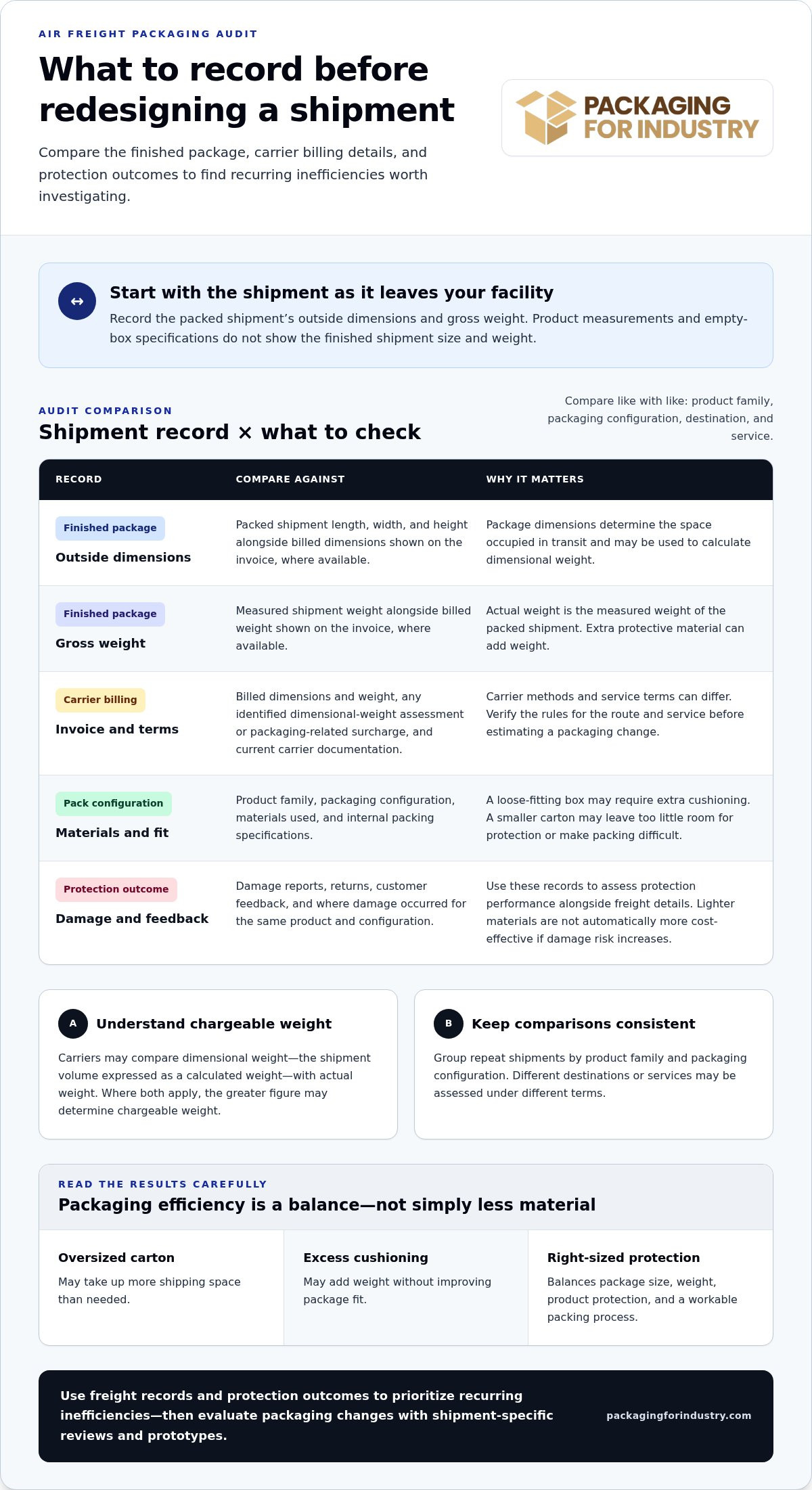
For packaging teams, the first step is to identify which parts of the finished shipment may be affecting charges. Depending on the carrier and service, air freight billing may reflect dimensional weight as well as actual weight. Record the packed shipment’s outside dimensions and gross weight, then compare them with invoice details and the applicable carrier terms.
This article explains how to audit shipments, compare packaging options, and test design changes. Custom corrugated boxes, foam, and crates can work together as an integrated solution, and prototypes can help teams evaluate a design before a broader rollout. The aim is to lower packaging costs while maintaining product protection and a reliable packing process.
Key Takeaways
- Document representative products, package measurements, and shipment details before changing a design.
- Compare options by package volume, total weight, protection, handling requirements, and suitability for repeat shipments.
- Lighter materials are not automatically more cost-effective if they increase the risk of damage.
- Use freight records and damage reports to prioritize recurring inefficiencies and preventable issues.
- Evaluate custom box, foam, and crate designs through packaging reviews and prototypes before expanding their use.
How Smart Packaging Can Reduce Air Freight Costs
Air freight charges can rise when packaging adds unnecessary volume or weight. A carton that is much larger than its contents may take up more space than needed, while extra protective material can add weight. Smart packaging means designing around the product, the protection it needs, and the way the shipment will be handled. The goal is not simply to use less material. It is to make each part of the package serve a purpose.
The term “smart packaging” also has broader uses. Smart packaging can refer to active or intelligent packaging formats. Here, it means making practical packaging design decisions to support efficient shipping. For manufacturers and distribution teams, that starts with understanding how the completed package may affect a carrier’s assessment of the shipment.
Which packaging characteristics can affect air freight charges?
Package length, width, and height determine its outside dimensions and the space it occupies in transit. Carriers may use those dimensions to calculate dimensional weight, then compare it with actual weight. Actual weight is the measured weight of the packed shipment. Dimensional weight represents shipment volume as a calculated weight. Where both apply, the greater figure may determine chargeable weight, the weight used to assess the shipment for billing.
Do not assume the same calculation applies to every shipment. Carrier methods and service terms can differ, so verify the rules for the route and service before estimating the effect of a packaging change. As a first check, record the finished package’s outside dimensions and gross weight. Product measurements and empty-box specifications do not show the final shipment size and weight.
Package design can influence chargeable weight by changing a shipment’s outside dimensions, its actual weight, or both. Reviewing package size and material selection can help identify opportunities to lower packaging costs.
Why reducing package size is not the only goal
A smaller carton may be a poor choice if it leaves too little room for protection, makes packing difficult, or increases the chance of damage. A loose-fitting box can create the opposite problem: it may need extra cushioning to control movement, adding material without improving the fit. Consider the product’s shape, fragility, and handling requirements alongside the space and materials needed to protect it.
Right-sized packaging is the objective, not the smallest possible carton. A custom corrugated box paired with appropriately designed foam may fit more efficiently than an oversized stock box filled with extra cushioning. A crate may be suitable for products with different structural or handling needs. PFI’s custom packaging design services bring box, foam, and crate options into a shipment-specific review.
When deciding how to minimize air freight costs with smart packaging, treat protection and shipping efficiency as connected requirements. A sound design reduces avoidable space or material while keeping the product secure and the packing process workable.
Audit Shipment Dimensions, Weight, and Protection Before Redesigning
Start with real shipments, not an assumed “typical” carton. Select representative products and packaging configurations, including repeat air shipments and products with different shapes or protection needs. For each one, record the product’s dimensions and weight, the packed shipment’s outside length, width, and height, its gross weight, the materials used, and the destination or service when available. Measure the shipment as it leaves your facility. Internal specifications may not reflect the completed package.
A useful packaging audit compares shipment data, package design, and damage outcomes. An invoice alone may not show whether a charge relates to package dimensions, shipment weight, or another factor. Box specifications alone may miss the effect of packing methods and protective materials on the finished shipment.
Build a usable shipment and packaging baseline
Group repeat shipments by product family and packaging configuration to make patterns easier to spot. Compare invoice details, including billed dimensions and weight where available, with internal packing specifications and current carrier documentation. Carrier rules and shipment terms can vary, so confirm the method for each service instead of applying one calculation to every shipment.
Keep the audit practical. A shared spreadsheet can capture the details needed for comparison:
- Product family, packed configuration, and packaging materials
- Outside package dimensions and gross shipment weight
- Destination or service, plus billed details shown on the invoice
- Any packaging-related surcharge or dimensional-weight assessment identified on the invoice
For repeat shipments, compare like with like. Shipments to different destinations or under different services may be assessed under different terms. Check unclear invoice entries against current carrier documentation before drawing conclusions. The goal is to identify patterns worth investigating, not to assume every difference signals a packaging problem.
Include protection performance in the audit
Compare freight records with damage reports, returns, and customer feedback for the same product and packaging configuration. Note where damage occurred and whether the product is fragile, heavy, high-value, or unusually shaped. These details can point to specific cushioning or restraint needs. Product-specific foam packaging may help create a closer fit, depending on the product and shipment.
Compare the full trade-off, not only the packaging material line item. Cryopak’s holistic cost modeling for packaging and freight discusses evaluating packaging and freight costs together. A reduction in package size or weight is not a sound improvement if damage, returns, or packing difficulties increase.
Once your baseline reveals a recurring issue, test a targeted change against the same shipment and protection records. To review an air freight packaging configuration, request a packaging quote with the product details, measurements, and protection requirements.
Compare Smart Packaging Options for Lower-Volume Air Shipments
Compare the complete shipment, not one material or measurement in isolation. A useful review considers package volume, total packed weight, protection, handling requirements, and whether the design works for repeat shipments. A lighter package may not lower costs if the product can shift, packing takes longer, or the risk of damage increases. The better option supports efficient transit and reliable handling together.
For each candidate design, assess:
- How closely the package dimensions fit the product and protective components
- How the packaging materials affect total packed weight
- Whether the product stays supported through expected handling
- How consistently the package can be assembled for recurring shipments
For example, a product that moves inside a large stock carton may need more cushioning to prevent shifting. A closer-fitting design could reduce unused space, provided it still protects the product and can be packed consistently. Compare the current package with alternatives using the same product and handling requirements. This helps teams weigh potential freight benefits against changes in material use, packing effort, and product risk.
Custom corrugated boxes versus stock box sizes
Stock boxes can work well when a standard size fits the product and protection plan. If a product repeatedly ships with substantial unused space, custom corrugated boxes can be designed around its footprint and protective components. Partitions, pads, or inserts can help separate or stabilize items. Choose double-wall or triple-wall construction to suit the product and handling requirements, rather than making it the default.
Foam inserts and crates for products needing tailored protection
Custom foam inserts can position and cushion specific components, which may suit delicate or irregularly shaped products. For some heavy or high-value industrial shipments, a crate may be an appropriate format. Evaluate each design against total shipment weight, package volume, product support, and handling needs. A foam-lined crate may fit a particular application, but include its materials and weight in the comparison.
Repeat shipments need particular attention. A design that works once may be less suitable if it slows routine packing or is difficult to assemble consistently. Test options against the actual packing process, including how staff load, close, and handle the package. This gives purchasing and operations teams a clearer basis for comparing protection and shipment efficiency.
Smart packaging is not simply a lighter box or a smaller footprint. It is a deliberate choice of box, cushioning, and, where suitable, crate that fits the product and shipping process. That comparison is central to minimizing air freight costs while keeping protection and repeatability in view.
How to Test and Implement Air Freight Packaging Changes
Treat a packaging redesign as a controlled operational change, not an assumption that a smaller or lighter package will perform better. Use your baseline of package specifications, freight billing details, and damage records to identify where a trial could address recurring excess volume, surcharges, or preventable damage. Prioritize repeat shipments, where a consistent shipment profile makes it easier to compare the current design with a proposed one.
Decide what a successful trial needs to achieve before testing begins. Criteria may include an efficient package footprint, reliable protection, consistent packing, and freight billing that compares favorably under the relevant carrier terms. Keep the current packaging specification and trial results together so purchasing, shipping, and operations teams can review the same information.
Use prototypes to validate design assumptions
Test representative products in the proposed package. Check that the item fits as intended, protective materials stay in position, and the package closes securely. Ask operations staff to pack and handle the prototype using the normal workflow. Their review can reveal fit or assembly problems that a drawing alone will not show. PFI’s custom packaging design services include CAD/CAM support and prototypes to help evaluate a design before broader production.
Before approving a rollout, compare the prototype with the current package under the same practical conditions. Record changes to dimensions, total packed weight, packing steps, and protection components. Gather feedback from the people who prepare and handle shipments, then document the approved materials and configuration. If the trial exposes a problem, revise and retest the design instead of treating the first prototype as final.
Track freight and damage outcomes over time
After implementation, compare actual package dimensions, billed shipment details, and damage records with the baseline. Where possible, review shipments with similar products, destinations, and services. Carrier, route, service, or product-mix changes can affect the comparison, so note them rather than attributing every difference to packaging. Review current carrier documentation if billing rules change during the assessment.
Make the packaging specification easy for warehouse and shipping teams to follow. Include the approved box, cushioning or insert arrangement, closure method, and any handling notes needed for consistent packing. Monitor freight efficiency and protection together. If billing outcomes do not support the redesign, or damage records show a protection problem, revisit the design and update the specification. This measured approach helps teams reduce air freight costs without losing sight of product condition and daily operations.
How PFI Supports Custom Packaging for Air Freight
Air freight packaging needs vary by industry and product. An aerospace component may need a tailored arrangement for its shape, while electronics and medical device manufacturers may have distinct product and handling requirements. PFI supplies custom and stock corrugated boxes, foam packaging, and crates for industrial shipments. Packaging reviews can consider shipment dimensions, product protection, and how teams prepare and handle orders.
For packaging used in warehouses and distribution centers, the design also needs to work in routine operations. PFI’s packaging reviews, CAD/CAM support, and prototypes help teams assess options before a wider rollout. Compare packaging pricing and consider how a proposed design will support repeat shipments. Bulk packaging pricing can also form part of the purchasing decision. PFI serves businesses in Orange County, Los Angeles, San Diego, and Riverside, as well as other Southern California locations.
What to include in a custom air freight packaging request
Provide product dimensions and weight, protection concerns, and the current packaging configuration. Include shipment measurements, freight-cost concerns, and recurring damage observations that can help define the project. Expected order volumes and whether the packaging will be used for repeat shipments are also useful. These details connect the quote to the product, packing process, and shipping requirements.
For aerospace, electronics, and medical device shipments, note product-specific handling or packing requirements that may affect the design. Clear information helps PFI evaluate the package as an operational solution, not just a set of materials.
Move from packaging review to a project quote
PFI can combine boxes, foam, and crates where an integrated design suits the shipment. A prototype or sample gives teams a practical way to assess the proposed configuration before expanding its use. Share shipment details and purchasing requirements to get a tailored packaging review and quote.
Make Packaging Improvements Part of Your Freight Plan
Treat packaging as an operating decision that can be revisited as products, order patterns, and shipping needs change. A design that suits one product configuration may not remain the right fit as requirements shift. Keep approved packaging specifications accessible to purchasing and warehouse teams, and assign responsibility for updating them when product or packing details change.
Applying how to minimize air freight costs with smart packaging means connecting packaging decisions to shipment performance over time. A clear review process helps teams assess proposed changes against operational needs and update designs without disrupting established workflows.
Start with one recurring shipment. Send PFI its product, package, and protection details to request a custom packaging quote.
Frequently Asked Questions
Does air freight charge for packaging weight as well as product weight?
Packaging contributes to the gross weight of a packed shipment. For an accurate internal record, weigh the complete package, including cushioning and closure materials, rather than relying on the product’s listed weight. The carrier may also apply dimensional billing under its service terms. If an invoice differs from your records, compare the billed shipment details with current carrier documentation before changing the packaging specification.
Can existing packaging be modified for air freight shipments?
Yes. A change can focus on the part causing a problem, such as replacing a box size or adjusting an internal divider, rather than redesigning the entire packout. Document the approved configuration and share it with purchasing and warehouse staff so substitutions do not undo the change. Keep the previous specification on file during the transition to identify which version was used if questions arise.
How often should a business review packaging dimensions for air freight?
Review dimensions when a product or its components change, when a new shipping service is introduced, or when shipment records show an unexplained shift. For stable repeat orders, include package specifications in the normal product or purchasing review cycle. Assign responsibility for keeping measurements current, especially when multiple teams pack the same product. A clear owner helps prevent outdated carton details from carrying forward.
Is lighter packaging always the best way to reduce air freight costs?
No. Compare the complete cost and workflow of the packed shipment, not material weight alone. A packaging change can affect purchasing, packing time, storage, and the work needed to resolve a damaged shipment. Track these operational effects alongside freight billing for the same product and service. This broader view helps teams assess how to minimize air freight costs with smart packaging without treating weight as the only measure.
Can custom foam inserts help protect products in air freight packaging?
Custom foam inserts can help protect products and standardize how a multi-part item is presented and packed. For a useful design review, provide a component list, product drawings or samples, and any orientation or separation requirements. Explain which parts ship together and which surfaces must remain clear. This information helps shape an insert around the product’s actual arrangement and makes the intended packout easier to follow.
What shipment information should I provide for a custom packaging quote?
Include product details, photographs or drawings showing its shape and components, and a sample of the current package if available. Note how the product is packed, whether accessories ship in the same carton, and any receiving or unpacking constraints. Identify variations if different product versions use the same packaging. These details help determine whether one design can serve multiple configurations or whether each needs its own specification.
Should I use a corrugated box or a crate for an air freight shipment?
Consider the full handling path, including how staff load the shipment, how the recipient unloads it, and whether the packaging needs to support repeat use. A corrugated box may suit a packout that works with internal supports and the recipient’s normal unpacking process. A crate may better fit different structural or handling needs. Include receiving practices and any return or reuse plan in the decision, not just the outbound shipment.