
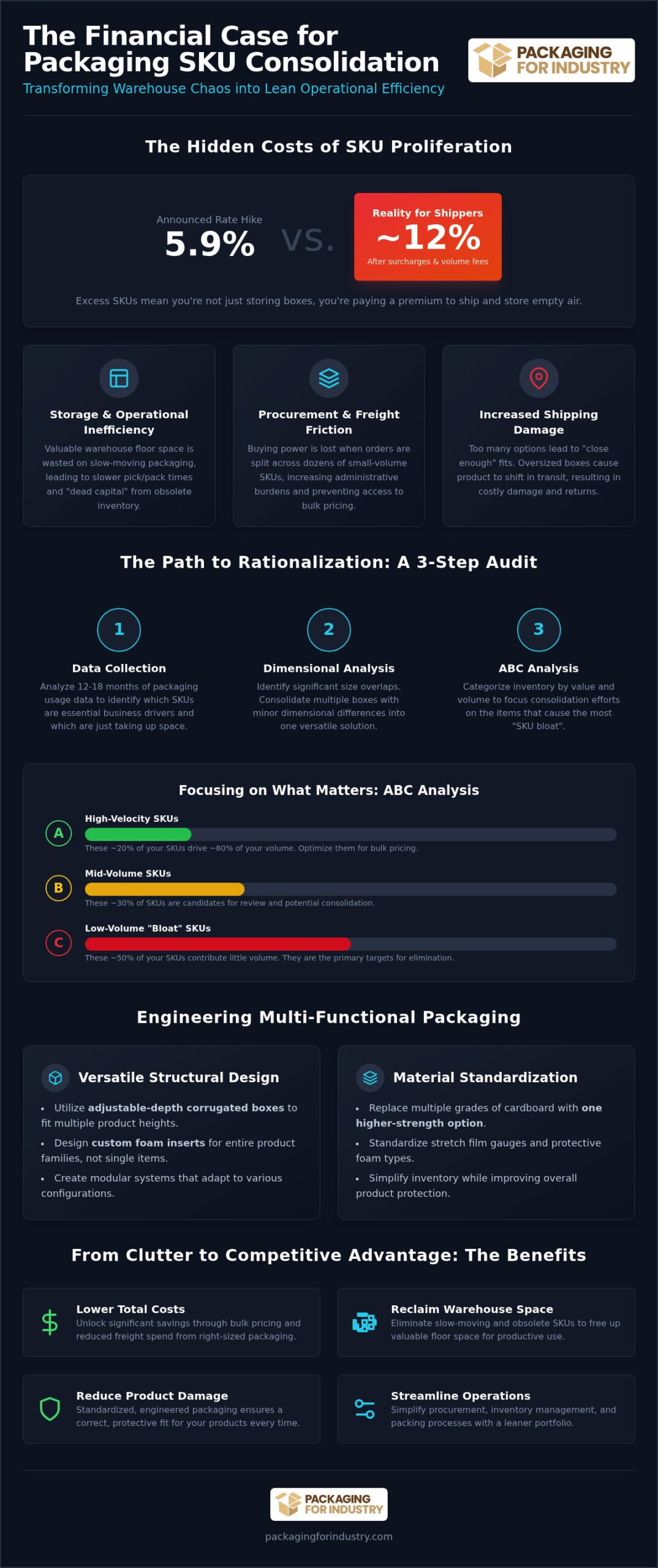
While carriers announced a 5.9% rate hike for 2026, the reality for most industrial shippers is a cost increase closer to 12% once dimensional weight surcharges and cubic volume fees are applied. If your facility is struggling with excessive warehouse space wasted on slow-moving packaging, you’re essentially paying a premium to store air. Implementing effective packaging SKU consolidation strategies isn’t just about cleaning up your floor; it’s a financial necessity in a market where shipping efficiency dictates profitability.
We understand the operational friction that comes with managing hundreds of different box sizes and protective foam inserts. It’s a cycle of high per-unit costs and frequent emergency orders that disrupt your production flow. This guide will show you how to reduce warehouse chaos by designing more versatile, multi-functional packaging. We’ll explore how to lower your total landed costs through bulk pricing and show you how a lean inventory setup prepares your business for reliable, local next-day delivery and just-in-time support.
Key Takeaways
- Identify how excessive SKUs increase procurement friction and learn how to conduct a dimensional analysis to find size overlaps in your current inventory.
- Discover how to engineer multi-functional packaging SKU consolidation strategies using adjustable-depth corrugated boxes and custom foam inserts designed for product families.
- Follow a structured implementation process involving cross-functional teams and transit testing to ensure consolidated packaging meets all industrial protection standards.
- Learn how to leverage Vendor Managed Inventory (VMI) and local Southern California delivery to eliminate stockout risks while reclaiming valuable warehouse floor space.
The Hidden Costs of SKU Proliferation in Industrial Packaging
SKU proliferation usually starts with a single specialized project. Over time, your warehouse racks fill with dozens of corrugated box sizes, specialized foam inserts, and various stretch film gauges that only fit one specific application. This “SKU bloat” acts as a silent tax on your operations. It drains your cash flow and complicates your inventory management by forcing your team to track items that might only move twice a year.
Beyond the balance sheet, excessive SKUs increase the risk of shipping damage. When a packer has ten different box options but is under pressure to meet a deadline, they often grab the nearest “close enough” fit. If that box is too large, it requires excessive void fill or, worse, allows the product to shift during transit. Implementing packaging SKU consolidation strategies helps eliminate this human error by standardizing your protection methods across product families.
Storage and Operational Inefficiencies
Every pallet position in your facility has a monthly carrying cost. Storing slow-moving or obsolete packaging is an expensive use of high-value floor space. This “clutter penalty” also slows down your picking and packing lines. Workers spend more time navigating around stacks of dusty, specialized crates or pallets than they do actually fulfilling orders. When product lines change, these hyper-specific SKUs often become “dead capital” that eventually ends up in a recycler at a total loss.
Procurement and Freight Friction
Managing too many items also erodes your buying power. You lose the ability to secure bulk packaging pricing when your spend is fractured across 50 different small-volume SKUs. There’s also a heavy administrative burden; processing 20 purchase orders for 20 different vendors is significantly more expensive than managing a few integrated partners. By consolidating, you can amortize the setup fees and custom tooling costs for specialized items over much larger production runs, reducing the per-unit price.
Perhaps most critically, non-optimized packaging portfolios lead to higher freight costs. With the 2026 General Rate Increase from UPS and FedEx effectively hitting 8% to 12% for most shippers, you can’t afford to ship empty space. Consolidating your SKUs into “right-sized” options helps you navigate the 139 dimensional weight divisor more effectively. You can lower packaging costs by ensuring every box is engineered for both protection and freight efficiency. This approach turns your packaging from a storage headache into a lean operational asset.
Performing a Comprehensive Packaging Audit for SKU Rationalization
A successful transition to a leaner inventory begins with a granular audit of your current packaging supplies. You can’t optimize what you haven’t measured. This process requires moving beyond simple spreadsheets to look at how each item actually performs on your warehouse floor. By collecting usage data over the last 12 to 18 months, you can identify which items are essential and which are simply taking up valuable rack space.
Dimensional analysis is the next critical step. You’ll often find significant overlap between box sizes that were ordered for specific, one-off projects but never phased out. If you’re stocking three different corrugated boxes with only a half-inch difference in width, you’ve found a prime candidate for consolidation. These packaging SKU consolidation strategies rely on identifying these redundancies to reclaim floor space and simplify your ordering process.
The ABC Analysis for Packaging Inventory
ABC analysis is a method for categorizing inventory based on value and volume. It helps you prioritize your consolidation efforts where they’ll have the most financial impact.
- ‘A’ Items: These are your high-velocity SKUs that drive your production line every day. They require the tightest inventory control but offer the best opportunities for bulk packaging pricing.
- ‘B’ and ‘C’ Items: These are mid-to-low volume items that often contribute to “SKU bloat.” ‘C’ items, in particular, are the primary targets for elimination. You should evaluate if a ‘C’ item can be replaced by a more versatile ‘A’ or ‘B’ SKU, even if the material cost is slightly higher, to save on storage and administrative overhead.
Specification and Material Review
Standardizing your material specifications is just as important as reducing the number of box sizes. Many facilities stock multiple grades of corrugated cardboard when one higher-strength option could serve all purposes. For instance, you might find that one heavy-duty double-wall box can replace three different single-wall sizes. This allows you to compare corrugated box options and settle on a single, versatile SKU that protects a wider range of products.
This standardization should extend to your protective materials as well. Using various types of polyethylene and polyurethane foam for different product lines often leads to ordering friction and higher per-unit costs. By engineering a “universal” foam insert or standardizing your stretch film gauges, you can lower packaging costs and reduce shipping damage through consistent packing methods. If your current inventory list feels unmanageable, you can request a packaging quote for a consolidated portfolio designed for your specific throughput.
Strategies for Engineering Multi-Functional Packaging SKUs
Most businesses view consolidation as a simple deletion exercise; however, the most effective packaging SKU consolidation strategies focus on engineering multi-functional items that serve multiple purposes. Instead of just removing a box size, you redesign a remaining SKU to be more adaptable. This proactive approach ensures you don’t sacrifice product protection for the sake of a leaner inventory list.
One practical method is the use of multi-depth corrugated boxes. By adding pre-scored lines at various intervals during production, a single box can be folded to different heights. This allows one stock item to replace three or four specialized sizes. It immediately reduces your inventory footprint while ensuring you always have a “right-sized” option available to avoid carrier dimensional weight surcharges. Similarly, kitting and assembly programs can reduce your internal SKU count. By having your supplier pre-assemble packaging components into a single unit, you eliminate the need to track ten individual parts in your system.
Custom Engineered Foam and Corrugated Solutions
CAD/CAM support is essential for creating versatile protection. We use precision engineering to create a single foam insert that accommodates a whole “family” of parts with slightly different dimensions. For example, die-cut foam end caps are often more effective than complex, multi-piece packaging sets. Rather than stocking a six-piece foam kit, two universal end caps can often secure a product just as effectively. This reduces the number of components your team has to pick and pack, which speeds up your fulfillment cycle. You can explore custom foam packaging solutions to see how precision design reduces material waste and inventory complexity.
Consolidating Protective Materials
Consolidation should also target your secondary materials. Many warehouses stock five different gauges of stretch film, which creates ordering friction and inventory confusion. Most of the time, you can standardize on a single high-performance, high-yield film that handles your heaviest loads while remaining cost-effective for lighter pallets. This principle applies to corner and edge protection too. Stocking one heavy-duty SKU instead of three lighter versions simplifies procurement and ensures every shipment has maximum reinforcement.
Standardizing on specific polyethylene or polyurethane foam densities also helps you secure better bulk packaging pricing. When you move to a single high-performance material, you gain more leverage with your supplier and reduce the risk of stockouts on specialized items. If your facility is currently overwhelmed by specialized components, you can request a packaging quote for custom designs to see how engineering can simplify your warehouse floor.
A Step-by-Step Guide to Implementing Consolidation
Success with packaging SKU consolidation strategies depends on a disciplined rollout. It isn’t a project you handle in a silo. You need to establish a cross-functional team that includes procurement, operations, and your shipping department. Procurement focuses on the bulk pricing advantages, while operations ensures the new designs don’t slow down the assembly line. Shipping provides the final word on whether the consolidated designs can withstand the rigors of your specific carrier network. This collaborative approach prevents the common mistake of choosing a cheaper box that fails in the field.
After finalizing your team, you must manage the transition of your existing inventory. This involves identifying slow-moving and obsolete (SLOB) stock and creating a systematic burn-off plan. Don’t simply discard old inventory; instead, phase it out while introducing the new multi-functional designs for your highest-volume lines. Clear communication with your production floor prevents errors during this transition and ensures that everyone is trained on the new standardized packing protocols. A clean break from old habits is necessary to reclaim your warehouse floor space.
Prototyping and Performance Testing
Before a full-scale rollout, you must verify that your consolidated designs provide adequate protection. We offer free prototyping to ensure your new multi-functional packaging fits your product family perfectly. This phase should include rigorous transit testing, such as drop tests and vibration tests, to mimic real-world shipping conditions. For clients in the aerospace or electronics sectors, this testing ensures that your consolidated SKUs still meet strict military or industry-specific compliance standards. It’s better to find a design flaw during a prototype test than after shipping a bulk order to a customer.
Vendor Consolidation and Partnerships
Consolidation is much more effective when you also streamline your vendor list. Moving from transactional buying to a strategic partnership with a full-service supplier reduces your administrative overhead. Instead of managing dozens of invoices and delivery schedules, you deal with a single partner who understands your entire workflow. A single-source partner in Southern California can provide local next-day delivery, further reducing the need for large on-site safety stocks. This approach significantly lowers your freight costs and improves supply reliability. You can learn about manufacturing packaging solutions that integrate seamlessly with your streamlined inventory.
After implementation, track your results closely. Monitor your cost per shipment and warehouse space utilization to quantify the improvement. A leaner inventory should lead to fewer stockouts, lower total landed costs, and a much more efficient fulfillment cycle.
Optimizing Your New Portfolio with VMI and Local Support
Consolidating your inventory is only half the battle; the other half is ensuring those core items are always available when your production line needs them. Advanced packaging SKU consolidation strategies work best when paired with a Vendor Managed Inventory (VMI) program. By reducing the number of specialized boxes and foam inserts you stock, you make it much simpler for a partner to monitor and maintain your levels. This transition moves your operation from a reactive “emergency order” cycle to a proactive, automated replenishment model.
VMI acts as a safeguard against stockouts while simultaneously lowering your administrative costs. Instead of your purchasing team spending hours every week tracking 50 different packaging vendors, you rely on a single integrated partner to manage the flow. This logistical precision allows you to maintain a truly lean warehouse, where every square foot of floor space is dedicated to manufacturing and revenue-generating activities rather than dusty stacks of unused corrugated boxes.
Implementing VMI for Consolidated Inventory
We manage stocking levels based on your actual usage patterns in Southern California, ensuring your facility never runs dry on essential supplies. This automated approach reduces the burden on your procurement staff and eliminates the human error often associated with manual inventory counts. By delegating oversight to PFI, you gain peace of mind and more time to focus on operational growth. You can Streamline with Vendor Managed Inventory to ensure your consolidated SKUs are always ready for the next shift.
Local Delivery and Nationwide Shipping
Proximity is a critical factor for facilities in the Inland Empire and Greater Los Angeles. We provide local next-day delivery across Anaheim, Orange County, and Los Angeles, which serves as the backbone for a reliable just-in-time (JIT) delivery strategy. This proximity means you don’t have to store months of safety stock on-site; you can rely on our local warehouse to hold your inventory and deliver it exactly when it’s needed. While our local support is a primary strength for Southern California businesses, we also offer fast nationwide shipping to help you scale your consolidated packaging strategy across all your distribution centers.
To maintain the “lean” status of your portfolio, we recommend setting up recurring review cycles. Industrial requirements change as your product lines evolve, and a quarterly audit ensures your standardized SKUs still provide the best protection and freight efficiency. Regular reviews prevent the slow creep of SKU proliferation from returning to your warehouse. If you’re ready to simplify your procurement, request a packaging review to lower your total landed costs and reclaim your valuable floor space.
Reclaim Your Warehouse Floor and Lower Total Landed Costs
Implementing packaging SKU consolidation strategies is a fundamental step toward operational excellence. By auditing your inventory and engineering multi-functional corrugated boxes and custom foam inserts, you eliminate the silent tax of storing slow-moving items. This strategic shift reduces your administrative burden and protects your profit margins against rising carrier surcharges. We specialize in helping manufacturers and aerospace firms simplify their procurement through precision design and automated replenishment systems that keep production moving.
Our team provides free prototyping to ensure your new standardized portfolio meets every protection requirement. With local next-day delivery across Orange County, Los Angeles, and the Inland Empire, you can maintain a lean inventory without the risk of production stops. Whether you’re managing a high-volume distribution center or a specialized manufacturing plant, we have the expertise to solve your most complex logistical challenges. We are ready to help you optimize your supply chain and improve your bottom line through data-driven inventory management.
Taking control of your warehouse floor leads to immediate cost savings and improved supply reliability. We look forward to partnering with you to design a more efficient, cost-effective packaging portfolio.
Frequently Asked Questions
What is the primary goal of packaging SKU rationalization?
The primary goal is to reduce operational complexity and lower total landed costs by eliminating redundant or underperforming packaging items. By focusing on multi-functional designs, businesses can reclaim valuable warehouse floor space and simplify their procurement process. This strategy ensures that your capital isn’t tied up in slow-moving stock. It also allows you to secure better bulk packaging pricing by concentrating your spend on fewer, higher-volume SKUs.
How do I identify which packaging SKUs to eliminate?
You identify candidates for elimination by performing a dimensional analysis and an ABC inventory review. Look for box sizes with significant overlap or items that haven’t been ordered in over 12 months. If you find multiple custom corrugated boxes that differ by only a fraction of an inch, these are prime targets for consolidation. Reviewing usage rates helps you separate high-velocity items from slow-moving stock that is better replaced by more versatile alternatives.
Can consolidating boxes lead to higher shipping costs due to oversized packaging?
Consolidation can lead to higher costs if not engineered correctly, but professional packaging SKU consolidation strategies use multi-depth boxes to prevent this. Pre-scored lines allow a single box to fold to different heights, ensuring you don’t ship empty space. This precision helps you avoid punitive UPS and FedEx dimensional weight surcharges. By using adjustable-depth designs, you maintain a lean inventory while keeping your billable weight as low as possible for every shipment.
How often should an industrial business perform a packaging audit?
An industrial business should perform a packaging audit at least once a year or whenever there is a significant change in product lines. Regular reviews prevent the slow creep of SKU proliferation that occurs as new projects are added. Quarterly reviews are even better for high-volume manufacturers in Southern California who need to maintain tight inventory control. These audits ensure your standardized portfolio continues to provide the best protection and freight efficiency for your current throughput.
What are the risks of having too few packaging SKUs?
The primary risks of over-consolidation include increased product damage and excessive material waste from over-packaging. If a box is too large for a product and lacks proper internal cushioning, the item may shift during transit. You might also find yourself using too much expensive void fill to compensate for a poor fit. The goal is to find the “sweet spot” where you have enough versatility to protect your goods without maintaining a cluttered warehouse.
How does custom foam design help in SKU consolidation?
Custom foam design allows you to create universal inserts that secure a whole family of parts with varying dimensions. Instead of stocking five different sets of foam pads, a single precision-engineered end cap can often protect multiple product models. We use CAD/CAM support to design these multi-functional inserts, which reduces the number of components your team has to manage. This engineering approach simplifies your assembly line and lowers your per-unit costs through higher-volume production runs.
What role does VMI play in managing multiple packaging SKUs?
Vendor Managed Inventory (VMI) takes the guesswork out of replenishment by having your supplier monitor and manage your stocking levels. This is especially effective after you’ve implemented packaging SKU consolidation strategies, as it becomes much easier to track a smaller number of core items. VMI prevents stockouts and eliminates the need for expensive emergency orders. It frees up your purchasing team to focus on higher-level operations while ensuring your warehouse floor stays organized and efficient.
How can a local Southern California supplier help with inventory management?
A local supplier in Anaheim or Los Angeles provides the geographic advantage of next-day delivery, which is essential for just-in-time inventory programs. We can store your consolidated SKUs in our warehouse and deliver them exactly when your production line needs them. This proximity reduces your on-site storage requirements and lowers your freight costs. Local support also means we can perform on-site audits and provide free prototyping quickly to keep your operations running without delays.