
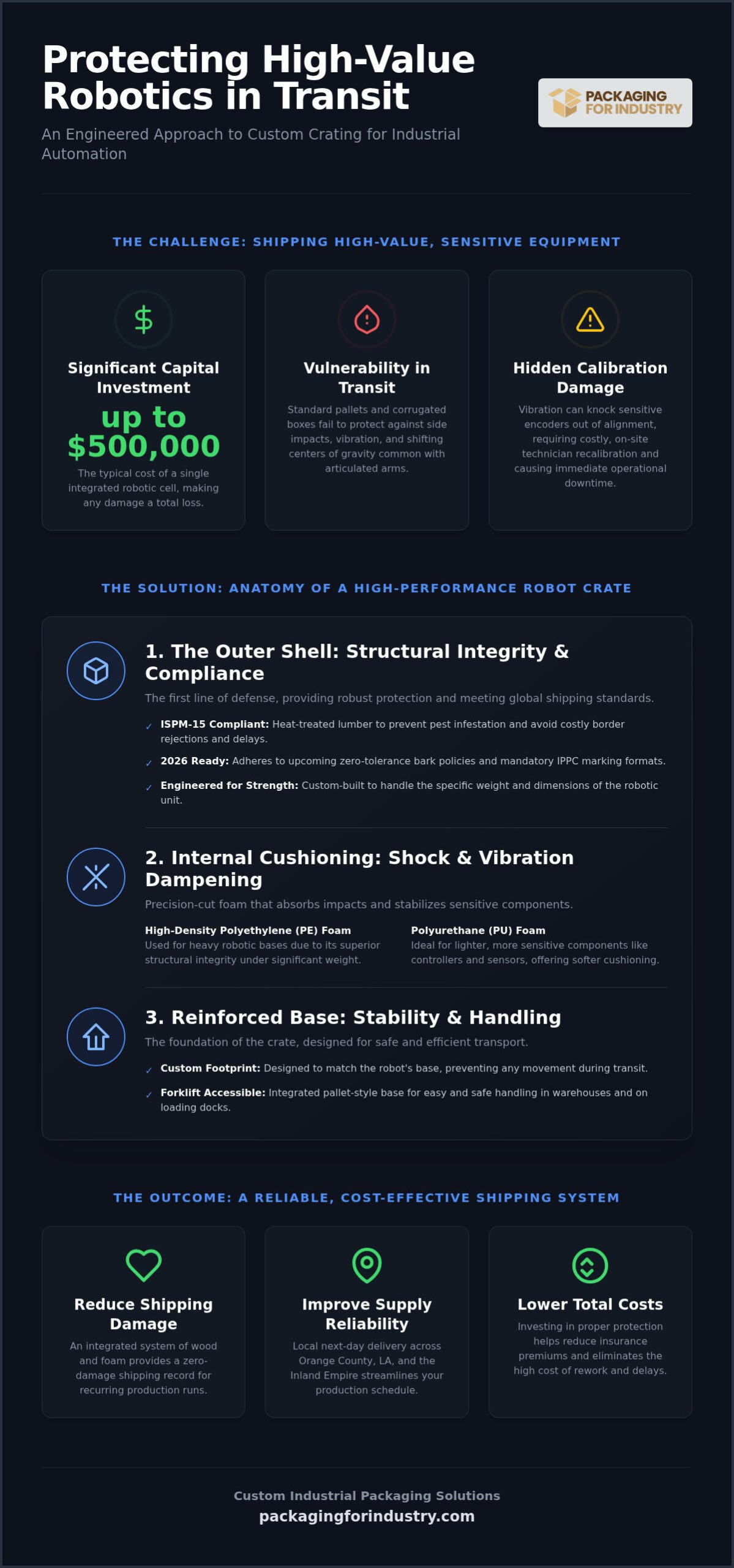
With a single integrated robotic cell often costing up to $500,000, your shipping container is the only thing standing between a successful deployment and a total loss. Relying on generic catalog vendors for custom crates for shipping industrial robots often leads to inconsistent protection and expensive transit damage. You shouldn’t have to coordinate between separate wood and foam suppliers while worrying about the latest ISPM-15 compliance updates or potential recalibration issues caused by vibration.
We understand that procurement managers need more than just a box; they need a reliable system that ensures a zero-damage shipping record for recurring production runs. In this guide, you will learn how to engineer the perfect custom crating solution to protect high-value robotics from impact while reducing your total shipping costs. We will examine integrated shock-dampening materials, mandatory international wood markings for 2026, and how to secure a reliable local packaging supply in Southern California. Whether you need a custom packaging quote for a single unit or a VMI solution for a manufacturing facility, this breakdown provides a clear path to logistical optimization and peace of mind.
Key Takeaways
- Learn how integrating custom foam inserts with heat-treated wood shells creates a comprehensive protective system to reduce shipping damage for articulated robotic arms.
- Understand the 2026 ISPM-15 compliance requirements for custom crates for shipping industrial robots to prevent costly border rejections and delays.
- Identify critical “No-Touch” zones and sensor locations to provide your supplier with the precise data needed to request a packaging quote that ensures a perfect fit.
- Evaluate the fiscal benefits of reusable crate designs versus one-way export containers to lower packaging costs across your entire logistics model.
- Discover how local next-day delivery across Orange County and Los Angeles can streamline your production schedule and improve supply reliability.
The Risks of Shipping Industrial Robots and Why Custom Crates are Mandatory
An Industrial robot represents a significant capital investment and the core of a modern production line’s efficiency. Shipping these units requires more than standard logistics; it demands custom crates for shipping industrial robots that function as engineered protective enclosures. Unlike static machinery, robotics feature delicate articulated limbs and high-precision sensors that are susceptible to minor misalignments. While a standard pallet might support the weight, it offers no protection against side impacts or environmental contaminants. Even heavy-duty triple-wall corrugated boxes often fail under the concentrated weight and shifting center of gravity of industrial arms, leading to structural collapse during transit.
Beyond Physical Damage: Protecting Internal Calibration
The most damaging transit issues aren’t always visible to the naked eye. Constant vibration during long-haul trucking or ocean freight can shake internal components loose or knock sensitive encoders out of alignment. If a robot arrives with its calibration compromised, the result is immediate operational downtime. You’ll face the hidden costs of flying in specialized technicians for recalibration before the first unit can even be powered on. Custom engineering accounts for these non-standard centers of gravity by using precision-cut foam packaging to dampen specific frequencies. Integrating G-force monitoring sensors into the crate design provides a verifiable record of handling, which is essential for maintaining warranty coverage and ensuring the unit is ready for immediate deployment.
The Financial Case for Custom Wood Crates
When you evaluate procurement options, compare the investment in a custom crate against the cost of a total loss. With integrated robotic cells often valued between $50,000 and $500,000, a single shipping failure can derail an entire project’s budget. Professional wooden crates help reduce insurance premiums by demonstrating a commitment to damage prevention. Carriers are also less likely to deny claims when the packaging meets or exceeds industrial standards. To protect your bottom line and ensure supply reliability, you should request a packaging quote that includes a comprehensive cost-reduction analysis. Investing in superior protection upfront eliminates the professional stress of transit damage and keeps your production schedule on track, especially when coordinated with a supplier offering local packaging delivery to minimize lead times.
Engineering the Anatomy of a High-Performance Robot Crate
A high-performance container is built on three essential pillars: the outer shell, internal cushioning, and a reinforced base. When designing custom crates for shipping industrial robots, these components must work in unison to meet rigorous international safety standards for machinery. PFI streamlines procurement by integrating these materials into a single SKU. This eliminates the logistical burden of coordinating with separate wood and foam vendors, ensuring that the protective system is structurally sound. For manufacturers in the Inland Empire or Orange County, our local next-day delivery ensures these integrated units arrive exactly when your production line needs them.
The outer shell must comply with current ISPM-15 regulations for international transit. As of 2026, customs authorities enforce a zero-tolerance policy for bark and require specific IPPC marking formats, such as “US-0000” with a mandatory hyphen. When we engineer custom crates for shipping industrial robots, we use heat-treated lumber to prevent shipment rejections and ensure your high-value assets clear border inspections without delay. This proactive approach to compliance is a core part of how we help our clients lower packaging costs and avoid the fees associated with rejected freight.
Custom Foam Inserts for Limb and Sensor Stabilization
Static protection isn’t enough; you need materials that stabilize articulated limbs during movement. We utilize high-density Polyethylene (PE) foam for heavy robotic bases because it maintains its structural integrity under significant weight. For more delicate sensor arrays or lighter components, Polyurethane (PU) foam provides superior shock absorption. If your equipment includes sensitive control boards, we integrate anti-static (ESD) foam to prevent electrostatic discharge. You can explore our specific custom foam packaging options to see how we tailor density to your robot’s payload and reach.
Shock Pallets and Vibration Dampening
The base of the crate serves as the primary defense against road and air transit vibrations. Heavy-duty Industrial Pallets with shock-absorbing skids are necessary to neutralize G-forces that occur during forklift handling or air turbulence. These skids are specifically designed for crane and forklift access, providing a stable foundation that prevents the crate from tipping. By isolating the robot from the transport floor, we protect internal calibration and reduce the risk of mechanical fatigue. To see how these engineered bases can reduce shipping damage for your next production run, you may request a packaging quote today.
Selecting the Right Crate Configuration for Your Logistics Model
The logistics model for your robotic deployment dictates the engineering requirements of your shipping container. If you are shipping a final product to a global end-user, a high-quality one-way export crate is the standard. However, for internal facility transfers or equipment leasing, reusable loops offer a superior return on investment. Designing custom crates for shipping industrial robots with a focus on their specific lifecycle allows you to lower packaging costs by selecting materials that match the expected number of transit legs. This strategic approach ensures you aren’t over-specifying for single trips or under-protecting for multi-leg journeys.
Beyond the outer shell, consider the “kitting” requirements of your robotic system. Most industrial robots require peripheral components like teach pendants, controllers, and specialized chargers. We design internal compartments that secure these accessories within the same crate, ensuring that the entire system arrives together and ready for installation. This integrated approach reduces the risk of lost components and streamlines the unboxing process for your operations team. By consolidating these items, you improve supply reliability and reduce the complexity of your warehouse inventory management.
Optimizing the external dimensions of your crate is a critical step in fiscal responsibility. Carriers calculate shipping rates based on dimensional weight (DIM weight), meaning an oversized crate can lead to hundreds of dollars in unnecessary surcharges. We engineer our crates to provide the maximum required protection with the smallest possible footprint. This precision reduces the total volume of the shipment without compromising the safety of the articulated arm or sensitive sensors. For companies running recurring production lines, these incremental savings on freight costs significantly impact the bottom line over time.
Reusable Crates with Ramps and Easy-Access Panels
Field technicians often work in environments where specialized tools are not readily available. We build reusable Custom Wooden Crates with tool-less entry features like heavy-duty latches and butterfly hinges. For heavy robotics that cannot be easily lifted, integrated ramps allow for safe roll-on/roll-off loading. These features reduce the physical strain on your team and prevent the accidental damage that often occurs during aggressive unboxing with pry bars. This design is ideal for trade show equipment or robots that require frequent relocation between manufacturing cells.
Export Crates and International Shipping Compliance
Global distribution requires strict adherence to ISPM-15 “Bug Stamp” requirements to prevent wood-boring pests from crossing borders. While we ensure all lumber is heat-treated, ocean freight introduces the additional risk of saltwater corrosion. We utilize vapor barrier bagging and desiccant packs to create a moisture-neutral environment inside the crate. For a deeper look at these specifications, you can read our guide on Engineering Custom Crates for International Transit to ensure your international shipments remain compliant and rust-free during long-haul transit.
How to Request a Custom Packaging Quote for Robotics
Securing an accurate quote for high-value machinery requires more than providing simple length, width, and height measurements. Because industrial robots are often top-heavy or feature asymmetrical weight distributions, we need specific data points to engineer a stable enclosure. To compare packaging pricing and secure the most competitive bulk packaging pricing, your request should detail the full scope of your project. Whether you are shipping a single prototype or managing a recurring production line, having custom sizes available for both the outer wood shell and the internal foam is mandatory for a zero-damage record.
- Provide exact dimensions: Include the full articulation range if the robot is shipped in a non-neutral pose.
- Identify ‘No-Touch’ zones: Mark specific sensor locations or delicate optical lenses where foam bracing or wood supports should never make contact.
- Specify total weight: Detail the mass of the robot and any required load-bearing capacity for stacking in the warehouse.
- Determine environmental needs: Note if the shipment requires ESD foam, moisture-blocking vapor barriers, or shock-absorbing pallets.
- Define delivery schedules: Identify if you need a single unit or a recurring supply via Vendor Managed Inventory (VMI) to support production runs.
Critical Measurements and Weight Distribution
The center of gravity is the most important specification for a crate builder. If the robot’s mass is offset, the crate base must be reinforced with specialized skids to prevent tipping during forklift maneuvers. You must also account for protruding cables, antennas, and peripheral attachments that extend beyond the main chassis. Because off-the-shelf boxes cannot accommodate these unique profiles, custom sizes available for crates and foam inserts ensure every component is stabilized. To eliminate the risk of a poor fit, we offer free prototyping for product fit. This design service allows you to verify internal clearances and load-bearing points before moving into bulk production, ensuring your custom crates for shipping industrial robots provide a precision fit for every articulated arm.
Environmental Protection: Vapor Barriers and ESD
Robotics destined for long-term storage or ocean freight require more than just physical bracing. We utilize moisture barrier bags to create a vacuum-sealed environment that prevents corrosion on sensitive metallic components. For semiconductor-grade or electronics-heavy robotics, anti-static (ESD) materials are a necessity to prevent latent damage from electrostatic discharge. When you request a packaging quote, specify these environmental factors so we can integrate the correct shielding into your crate design. This holistic approach ensures your equipment remains operational from the moment it leaves your facility until it reaches the end-user’s floor.
Why Packaging For Industry is the Preferred Southern California Supplier
PFI operates from our headquarters in Anaheim, positioning us at the center of the Southern California industrial landscape. If you are searching for a reliable packaging supplier near me to support a high-stakes robotics deployment, our proximity offers a distinct logistical advantage. We’ve built deep roots in the local manufacturing sector, understanding the specific pressures faced by aerospace, electronics, and medical device firms. Sourcing your custom crates for shipping industrial robots from a local partner eliminates the communication gaps and shipping delays inherent in working with distant catalog vendors. Our team provides rapid on-site consultations and a responsive prototyping phase to ensure your protective systems are tailored to your exact operational requirements.
We provide a comprehensive suite of packaging for manufacturers/warehouses/distribution centers, ensuring that high-value assets are protected from the moment they leave the assembly line. Beyond our local presence, we maintain a robust manufacturing and distribution network that provides nationwide support. This dual capability ensures that as your business scales, your packaging supply remains consistent across multiple regions. We focus on the intersection of engineering and economics, providing solutions that prioritize both physical protection and fiscal responsibility. By managing the end-to-end experience from design to final delivery, we offer total accountability that streamlines your entire procurement process.
Integrated Solutions: From Design to Stocking
Buying wood shells and foam inserts from separate vendors creates unnecessary supply chain friction. PFI provides integrated solutions where the crate and cushioning are designed as a single unit, reducing the administrative burden on your purchasing team. This single-source approach helps businesses lower packaging costs by optimizing material usage and streamlining the assembly process.
For companies with recurring production runs, our VMI Services offer a significant advantage. We monitor your inventory levels and restock your crates automatically, preventing stockouts that could halt your shipping schedule. This system improves supply reliability and allows your operations team to focus on core manufacturing tasks rather than packaging logistics.
Serving Southern California’s Industrial Hubs
Our local expertise extends across the primary industrial corridors of the region. We provide specialized support for businesses in Irvine, Huntington Beach, and Santa Ana. Our fleet provides local next-day delivery to the Inland Empire and San Diego, ensuring your production deadlines are met with precision. If you want to compare packaging pricing or see how better engineering can reduce shipping damage, our Anaheim team is ready to assist. Contact us today to discuss your specific requirements and request a custom packaging quote.
Optimizing Your Robotics Supply Chain with Engineered Protection
Protecting a high-value robotic cell requires a shift from standard packaging to an integrated engineering strategy. By combining ISPM-15 export certified heat-treated wood with precision-cut foam, you eliminate the risk of calibration drift and physical impact damage. This holistic approach ensures your equipment arrives ready for immediate deployment while simultaneously helping you lower packaging costs through reduced dimensional weight and optimized material usage.
Securing a reliable local partner provides the operational stability needed for recurring production runs and complex international distributions. Through free prototyping and CAD design, you can verify the fit of your custom crates for shipping industrial robots before committing to bulk production. Leveraging local next-day delivery across Orange County, Los Angeles, and the Inland Empire ensures your logistics move at the speed of your manufacturing floor. Our team is dedicated to providing the technical expertise and logistical flow required to eliminate professional stress and protect your bottom line.
We look forward to helping you stabilize your supply chain and achieve a zero-damage shipping record.
Frequently Asked Questions
How much do custom crates for shipping industrial robots cost?
Pricing is project-specific and reflects the complexity of the internal engineering required to protect articulated limbs. Beyond the crate itself, we look at the total bill of materials to identify fiscal savings. If your shipment also requires a corrugated box quote for smaller peripheral components or a high-volume stretch film quote for pallet stability, we can consolidate these needs to lower your overall shipping costs. Request a custom quote to get a precise breakdown for your specific robotic payload.
What is the lead time for a custom-engineered wood crate?
Lead times depend on the design complexity and production volume. For recurring production lines in Southern California, we utilize VMI programs to keep stock available for immediate use, eliminating the standard wait times associated with custom-engineered items. Whether you need a single crate or a bulk corrugated box quote for peripheral accessories, our Anaheim facility is optimized for local next-day delivery to keep your production and shipping schedules moving without any logistical interruption.
Do your crates comply with ISPM-15 international shipping standards?
Yes, all our wood packaging for export is heat-treated and IPPC stamped to meet global biosecurity regulations. This compliance is vital for clearing customs in 2026 without the risk of quarantine or rejection. We also provide integrated moisture barrier bagging for ocean transit. If your international shipment requires additional stabilization, we can include a high-performance stretch film quote as part of your comprehensive protective system to ensure total load security during long-haul transit.
Can you design crates for robots with sensitive sensors or fragile limbs?
We specialize in stabilizing articulated limbs and protecting sensitive sensor arrays through precision foam engineering. By identifying critical “No-Touch” zones, we ensure that internal bracing never compromises robotic calibration. This tailored approach is far superior to off-the-shelf options. If your deployment also involves shipping lighter peripheral electronics, we can provide a corrugated box quote for custom-sized containers with anti-static inserts to ensure every part of your system arrives in perfect working order.
Do you offer local delivery for businesses in Orange County and Los Angeles?
We provide local next-day delivery across Orange County, Los Angeles, and the Inland Empire. Our proximity to industrial hubs like Irvine and Santa Ana allows us to offer faster replenishment than national catalog suppliers. This local service is ideal for businesses that require a steady supply of custom crates for shipping industrial robots without the burden of storing excess inventory. Contact our Anaheim team to coordinate a delivery schedule that aligns with your production cycles.
What is the difference between a shock pallet and a standard crate base?
A shock pallet features integrated dampening materials designed to neutralize G-forces and road vibrations that a standard base cannot handle. This protection is mandatory for maintaining the mechanical alignment of high-precision robotics. Beyond the base, we ensure the entire load is secured. If you need to stabilize multiple units on a single pallet, we can provide a competitive stretch film quote for high-performance wrap that prevents shifting during the heavy-duty handling common in industrial freight environments.
Can PFI provide the foam inserts along with the wooden crate?
We provide fully integrated solutions that combine custom foam inserts with our wooden crates into a single SKU. This reduces supply chain friction and guarantees a perfect fit for your equipment. Managing both materials through one supplier ensures that the cushioning density is correctly matched to the crate’s structural integrity. If you are also kitting smaller parts, we can include a corrugated box quote for the internal compartments to keep your chargers and controllers organized.
Do you offer free prototyping for custom industrial packaging?
We offer free prototyping to ensure your robotic system fits perfectly before you commit to a full production run. This service includes CAD design and a physical sample to verify all sensor clearances and weight-bearing points. It is a critical step in our cost-reduction analysis, as it prevents expensive rework. If your project requires additional supplies like specialized wrap, we can include a stretch film quote to provide a complete, verified shipping solution for your facility.