
Paper can do more than fill empty space in a shipment. For California shipments from Orange County and Los Angeles to San Diego, paper-based protective packaging solutions can combine blocks and bracing to secure heavy or irregular products, cushioning to soften impacts, and wrapping to limit surface abrasions. The right design depends on product weight and fragility, carton dimensions, transit conditions, and packing speed.
It’s reasonable to expect protection that also supports practical disposal. Paper void fill can hold products in place and is easy for customers to recycle at the curb, while paper packaging is widely recyclable. Paper-based protective packaging solutions in California work best when materials match shipment risks and local disposal practices.
This article explains how paper blocks, bracing, cushioning, void fill, and wrapping address different shipping risks. You’ll learn how to assess paper-based protective packaging solutions in California alongside product testing, material use, presentation, and packing throughput, helping your team make informed packaging decisions.
Key Takeaways
- Match paper blocks and bracing to the product’s weight, shape, fragility, and transit conditions to limit shifting in the box.
- Consider recyclability alongside protective performance, and track material use per order to spot opportunities to reduce excess packaging.
- Use paper cushioning when the shipment needs impact absorption, while assessing whether the product’s specific risks call for another protective material.
- Test packaging with the actual product to evaluate protection, material use, presentation, and packing speed together.
- Use paper wrapping to help guard finished surfaces against minor abrasions during transit.
Paper block and bracing for heavy or irregular products
California shippers can use paper blocks, bracing, cushioning, void fill, and wrapping to protect products in transit. The right arrangement depends on product weight and fragility, transit conditions, carton dimensions, and packing speed.
Paper Blocks for Heavy or Irregular Products
Paper blocks and bracing are positioned around a product to limit movement inside its shipping container. For a heavy component with an uneven profile, fitted blocks can support open spaces and help keep the item from shifting during handling. Placement matters: support points should match the product’s shape, while the outer carton must fit both the item and its protective materials. This can reduce movement-related damage without relying on loose fill alone.
Fragile products need protection matched to their specific risks, not simply extra material. A glass instrument, for example, may need restraint against movement and cushioning against impact. Paper bracing can secure the item within the carton, while cushioning helps soften shocks during transit. If the product needs close-fitting support, fabricated foam can form a shaped cavity around it. The design should account for fragile edges, projecting parts, and contact points that could be damaged by pressure.
California’s SB 54 proposed extended producer responsibility for plastic packaging used to ship or transport products in or into the state. That proposal makes material choices relevant to packaging responsibility discussions, but it does not determine which protective design suits a particular load. Shippers can assess paper blocks and bracing by whether they secure the product, fit the shipping process, and suit the intended disposal route. Protection still needs to match the actual item and shipment conditions.
Packing productivity also depends on how consistently a design can be used. A repeatable paper-bracing layout helps workers place supports in the same locations across similar shipments. On a warehouse packing line, clear placement points and easy-to-handle materials can reduce avoidable pauses. Compare the time needed to position each support with the protection it provides. A complicated design may slow throughput, even if it limits movement effectively.
Moisture and Heavy-Load Limitations
Moisture can weaken paper packaging, while concentrated heavy loads can compress or deform it. These risks matter when shipments may encounter damp conditions or when a product places substantial pressure on a small support area. Paper is not a universal solution for every shipment. Assess weight distribution, moisture exposure, and transit handling together, then choose supports that keep the item stable without relying on paper alone.
Paper packaging recyclability and sustainability
Recyclable packaging can simplify disposal, but material choice alone doesn’t determine a shipment’s sustainability. Consider the complete packing setup: how much material it uses, whether components separate cleanly, and how customers can dispose of them. Paper void fill can hold an item in place and is easy for end customers to recycle at the curb. Start by identifying each component, from the outer carton to inserts and tape.
Molded pulp can form protective shapes around products such as small equipment, bottles, or replacement parts. Made from paper fibers, it can be recyclable and can biodegrade under suitable conditions. Those outcomes depend on the specific material and local processing, so don’t treat “biodegradable” as a promise that it can be disposed of that way everywhere. For procurement teams, compare how well a molded-pulp insert fits the product and whether it can replace multiple protective components.
Paperboard edge protection helps shield exposed corners and edges on boxed products or palletized loads. For example, corner boards can reinforce a stack of cartons and help distribute strap pressure across vulnerable edges. Paperboard versions can be recyclable when kept clean and accepted by the local recycling program. Their value depends on matching size and placement to the load, rather than adding protection without a clear purpose.
Paper packaging is widely recyclable, but adhesives, coatings, food residue, and mixed materials can affect sorting. A paper wrap around a clean metal component is easier to recover than a composite package with bonded layers. Separate components where practical, and give customers clear disposal guidance. These steps make a recyclable design more useful after delivery, rather than relying on a material label alone.
Reusable and recyclable packaging meet different operational needs. A durable returnable container may suit repeated shipments between facilities, while recyclable paper packaging suits one-way deliveries where recovery after use is the goal. Compare the route, return process, product protection, and handling requirements before choosing either approach. Tracking packaging use per order can also show how material consumption changes as a design is refined.
For a California shipment, a sustainable packaging decision should balance protection, material use, and practical end-of-life handling. Test the complete package with the actual product, then review whether the paper components stay intact in transit and separate easily at unpacking. If you’re assessing packaging options for a product line, request a packaging quote to discuss the design requirements and material choices.
Paper packaging is widely recyclable and supports consumer disposal choices. To make that benefit practical, keep disposal straightforward: identify what belongs in the paper stream, separate components when feasible, and give customers clear guidance. Review the complete package rather than judging it by its main material alone, and make sure each protective element has a defined role. Matching protection needs with a clear end-of-life route gives procurement teams a useful basis for comparing options and setting expectations after delivery.
Paper cushioning as an alternative to foam-in-place
Paper cushioning can soften impacts in common drop scenarios, while foam-in-place forms around a product. Compare options by the item’s fragility, transit risks, packing process, material use, and end-of-life handling.
Slit Paper and Expandable Cushioning
Slit paper is cut so sheets expand into a cushioning structure that can wrap or support products. This format lets packers create void fill from paper and adapt it to different parcel contents. For example, a warehouse shipping boxed components can use expanded paper to fill spaces around each item. The design matters because loose movement can cause products to contact one another or the carton.
Expandable paper can also be formed around a product to create a protective nest. A packer can place the item on a paper layer, fold the material around its sides, and fill the remaining gaps. This approach suits shipments that need both restraint and impact cushioning. Use enough material to hold the product securely without obstructing carton closure or slowing the packing station.
Paper cushioning compresses or deforms under impact, helping soften the force before it reaches the packed item. A small instrument or finished component may benefit from a paper cushion that keeps it away from carton walls. For items with projecting parts or unusually fragile surfaces, the design should prevent concentrated pressure. Paper void fill works best when movement is the primary transit risk.
Paper Cushioning Performance and Cost
Paper, foam, and plastic cushioning differ in how they protect products, fit their shapes, and move through a packing operation. Paper can be shaped by hand and supports recyclable disposal where local programs accept it. Foam-in-place conforms closely around an item, while plastic cushioning can provide a lightweight buffer. The suitable choice depends on product fragility, shipment conditions, and required packing speed.
Compare total material use, not just what goes into one package. A paper design may need more volume to restrain a product, while fitted foam can reduce movement around a complex shape. In a fulfillment line, material storage, packer handling, and parcel dimensions also affect operating costs. Trial each design with the actual product and compare protection, material consumption, and throughput.
Environmental goals should inform material selection without overriding protection needs. Paper cushioning can support recyclable disposal, while foam or plastic may suit products that need a closer fit or another performance characteristic. Review the complete shipment, including the outer carton and inserts. Testing representative products helps establish whether paper cushioning provides adequate impact protection and fits the packing workflow.
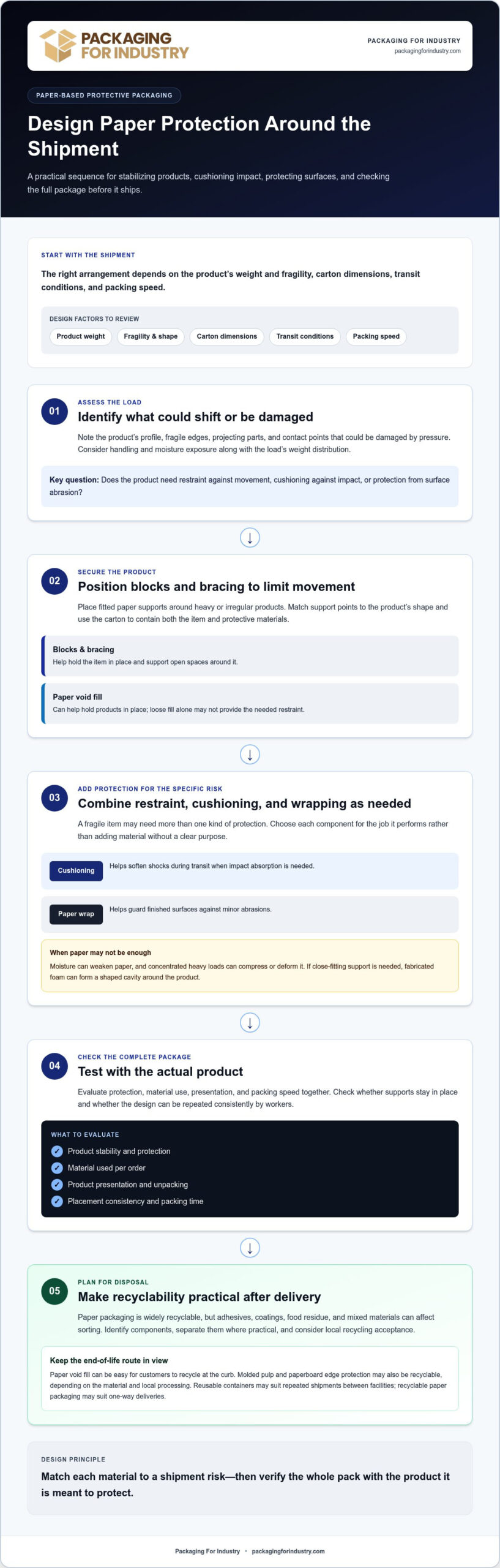
Packaging design to prevent shipping damage
A protective package should address the damage mechanism most likely to affect the product. For a boxed assembly that can slide during transit, paper void fill can limit movement. If direct impact is the primary risk, void fill alone may not provide enough cushioning. Start by examining how the product sits in its carton, where it can shift, and which surfaces or components are vulnerable.
Map the product’s contact points before choosing packaging materials. A metal part with a delicate finish may need separation from the carton and nearby components. A fragile instrument may need support around its base and protection for projecting controls. For each product, consider weight, shape, fragility, carton dimensions, and packing speed together. These factors help determine whether paper blocks, cushioning, wrapping, or a combination suits the shipment.
Keep the product stable without automatically filling every open space. Paper void fill works best when the main transit risk is movement inside the parcel. Place it where gaps allow the item to shift, such as beside a component that could slide from one carton wall to another. If the item stays in place but faces impact exposure, assess cushioning separately. The package needs to manage the relevant force, not simply contain more material.
Test the design with the actual product and the intended packing method. A useful comparison can examine four factors:
- Protection: Check whether the product stays positioned and its vulnerable areas remain supported.
- Material use: Record the paper and other packaging materials used for the packed item.
- Presentation: Inspect whether the product arrives clean, organized, and free from avoidable contact marks.
- Throughput: Observe whether packers can position the materials and close the carton consistently.
Use trial shipments to reveal weaknesses that a bench layout may miss. For example, a paper support may look secure before packing but shift after repeated handling. Inspect the product and package interior after testing, then note where contact occurred. If a component moved, adjust support placement or carton fit. If the package takes too long to assemble, simplify placement while maintaining the protection the product needs.
Compare results across representative product shapes rather than assuming one package works for every item. A compact part and a long, irregular component can behave differently in similar cartons. For each design, record the product configuration, support placement, material use, and packing observations. This gives purchasing and operations teams a practical basis for refining the package, reducing avoidable material, and preventing damage without sacrificing packing flow.
Separate movement-control needs from impact protection: paper void fill works best when the main transit risk is product movement rather than direct impact. Keep that distinction central when choosing and reviewing the arrangement. Added fill is not a substitute for assessing the specific risk. Evaluate the fit for the product being packed.
Testing paper packaging with actual products helps businesses assess protection, material use, presentation, and throughput together. Review these outcomes as a connected set for each product and packing method, so a change intended to improve one aspect can be assessed alongside the others. This gives the packaging decision a product-specific basis instead of relying only on how materials look before packing.
Paper wrapping for surface protection
Paper wrapping helps prevent minor surface abrasions by separating a product from nearby items or packaging. It suits applications where scuffs from rubbing are a concern, such as finished metal components, coated parts, or clean equipment. The wrap acts as a contact barrier; it does not replace cushioning against impact or support that keeps a product from shifting.
Start by identifying which surfaces need protection. A painted panel may need coverage across its broad face, while a machined component may need protection around exposed edges. Wrap items separately when neighboring parts could rub together in the carton. For grouped products, place a paper layer between contact surfaces, then arrange the items so they remain separated during packing.
Wrapping also depends on product shape and how workers handle it. A flat sheet can cover a broad surface, while folded paper can protect corners or protruding features. Keep the material between vulnerable areas and potential contact points. For example, wrap a finished component before placing it beside other parts, rather than relying on a loose sheet that could shift during packing.
Paper wrapping works best when abrasion is the main concern. By itself, it won’t prevent damage from a hard drop, crushing force, or movement inside an oversized carton. Pair the wrap with suitable restraint or cushioning when those risks also exist. A ceramic-coated part, for instance, may need a surface barrier as well as protection that keeps it from striking the carton wall.
- Separate: Wrap individual items that could scrape against one another.
- Cover: Protect exposed faces, edges, or finishes that contact other surfaces.
- Position: Keep the paper between the product and likely abrasion points.
- Assess: Inspect the item after packing and handling for contact marks.
Check the wrapped product at the packing station and after a representative shipment. If the paper has moved away from a vulnerable surface, adjust how it is folded or secured inside the package. If scuffs remain, identify where contact occurred and revise the separation or restraint. This targeted review helps teams use paper for the actual surface risk without adding unnecessary layers to every shipment.
Packaging For Industry (PFI): Foam Packaging
Packaging For Industry (PFI) offers foam packaging for manufacturers and businesses shipping fragile industrial, aerospace, electronics, and medical products. Consider it when paper cushioning doesn’t provide the fit or support your product needs. Better-matched protection can help reduce shipping damage and support reliable operations.
PFI also offers stretch film and Vendor Managed Inventory (VMI) for packaging. These options support product containment and recurring packaging supply needs across warehouses and production environments. PFI can help your team align packaging with its products and shipping workflow.
Put Your Packaging Plan Into Practice
Turn your paper-based protective packaging decisions into a clear packing standard for each product line. Document the selected materials, packing sequence, and disposal guidance so purchasing and warehouse teams can work from the same specification.
For operations in Orange County, Los Angeles, and San Diego, contact Packaging For Industry (PFI) to discuss your packaging requirements and identify a practical next step for your shipments.
A clear specification helps your team apply packaging decisions consistently as orders move through production and shipping.
Frequently Asked Questions
What is the recycled content and recyclability of paper protective packaging products?
Recycled content varies by paper packaging product, so no single percentage applies to all protective materials. Paper packaging is widely recyclable, but coatings, adhesives, mixed materials, or product residue can affect whether a specific item is accepted locally. For example, clean paper cushioning may be easier to recycle than paper bonded to a plastic layer. Separate components where practical and follow local recycling guidance.
How can businesses choose the right paper cushioning for their products and shipping needs?
Choose cushioning by matching it to the product’s movement, fragility, and packing process. A boxed assembly with room to slide may need paper fill around its sides, while a delicate component may need supports that keep sensitive surfaces from contacting other items. Consider carton fit and how workers will place the material during routine packing. Compare sample packs using actual products and normal packing procedures.
How well does paper-based protective packaging protect fragile goods during shipping?
Paper cushioning can soften impacts in common drop scenarios, but performance depends on package design and shipment risks. A fragile product with exposed controls, for example, needs those parts kept clear of pressure and contact. Paper fill can restrain movement, while cushioning addresses impact. For especially vulnerable items, assess whether paper alone provides enough protection or whether another protective material is more suitable.