
A raw-material increase may explain a packaging price change, but it doesn’t mean every item on your invoice should rise by the same amount. If my packaging supplier is raising prices, my options are to ask what changed, calculate the impact on spend per box, review specifications, and negotiate using the updated design and order plan.
It’s reasonable to ask for clear support before accepting higher prices, especially when small unit-price changes can affect purchasing budgets. The key question is whether the explanation matches the materials and services you actually buy.
This guide explains how to distinguish input-cost changes from other price adjustments, review invoices and packaging spend per box, and identify savings through specification changes. You’ll have a clearer basis for discussing pricing, order terms, and supply planning.
Key Takeaways
- Separate material, freight, and order-volume changes to judge whether the proposed increase matches the costs behind it.
- Compare invoices and track packaging spend per box to spot gradual price changes and identify your highest-impact items.
- Review packaging dimensions and protection requirements before negotiating; specification changes may improve total shipping cost, not just the unit price.
- Ask for a clear breakdown of changed cost lines, then discuss revised pricing, order terms, and supply planning from an informed position.
- When packaging design or inventory management needs attention, Packaging For Industry offers foam packaging, stretch film, VMI, and JIT inventory management for packaging.
Checking whether a price increase reflects input costs or lower order volumes
Compare the supplier’s explanation with your product mix and order history. Options may include resizing corrugated boxes, changing protective materials, or adjusting shipping methods to suit the product and its requirements.
-
Identify Key Input Cost Changes
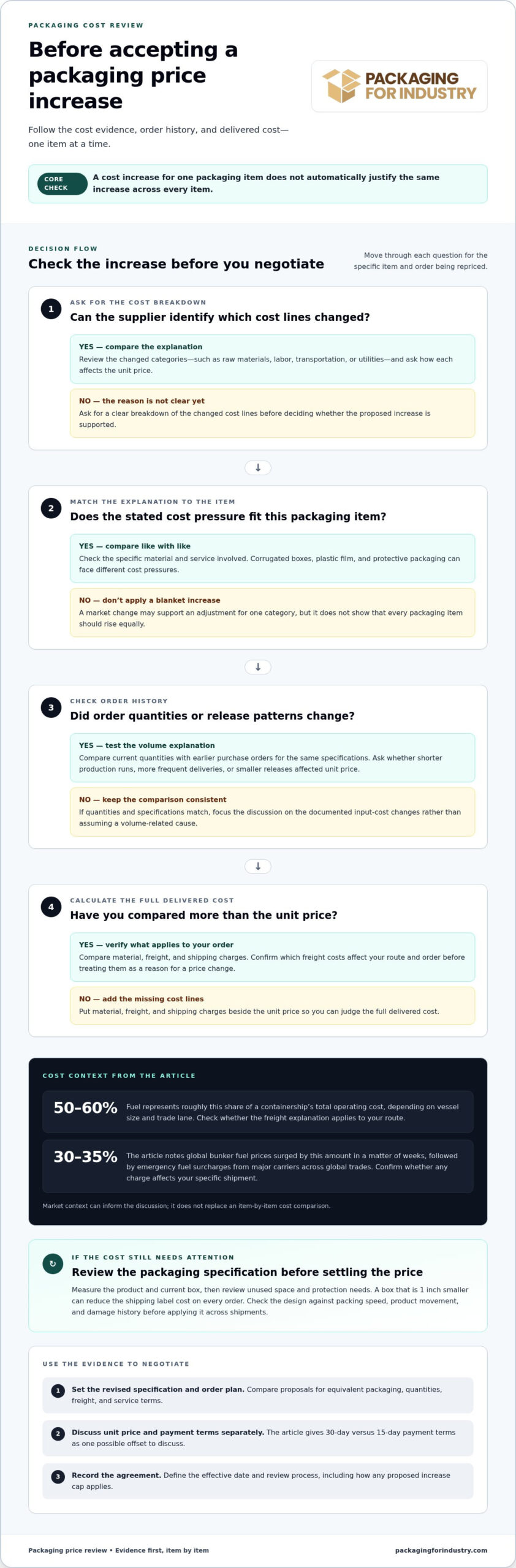
Ask which cost categories changed, such as raw materials, labor, or transportation. A market increase may support a corrugated price adjustment, but it doesn’t show that every packaging item should rise equally.
For plastic packaging, compare resin-related changes with oil and freight explanations. Fuel represents roughly 50-60% of a containership’s total operating cost, depending on vessel size and trade lane. Separate those pressures from labor or handling changes.
-
Check the Effect of Order Volumes
Compare current order quantities with earlier purchase orders for the same specifications. If volumes fell, ask whether shorter production runs, more frequent deliveries, or smaller releases affected the unit price. A volume-related adjustment doesn’t prove that material prices rose by the same amount.
Match the explanation to each item. Cost pressures may differ for corrugated boxes, plastic film, and protective packaging. Market context can inform your discussion, but it doesn’t replace an item-by-item comparison.
- Test a packaging resize. Measure the product and current box, then review unused space and protection needs. A box that is 1 inch smaller can reduce the shipping label cost on every order. Check the change against packing speed, product movement, and damage history before applying it across shipments.
- Compare the full delivered cost. Put material, freight, and shipping charges beside the unit price. In early March, global bunker fuel prices surged by 30-35% in a matter of weeks, and Maersk, CMA CGM, and Hapag-Lloyd introduced emergency fuel surcharges across global trades. Ask which freight charges affect your route and order.
- Choose how to handle the remaining increase. Calculate the impact on margin if you absorb it, then compare that with a targeted customer price adjustment. If your product prices stay the same while packaging costs rise, profit per sale falls. Use the verified cost breakdown and design review to negotiate instead of applying one blanket increase.
Negotiating after revising packaging specifications
Revise the packaging design first, then negotiate against the new specification and order plan. To find qualified packaging suppliers nearby in the United States, compare their material capabilities, delivery coverage, and ability to meet your operating requirements.
-
Revise Packaging Specifications
Document the revised dimensions, materials, protection requirements, and packing process before discussing price. Compare the proposed design with the current one, including product fit and warehouse handling. Don’t remove protection solely to use less material: damage risk and packing efficiency affect total cost.
Use the same specification to assess each proposal. This keeps the comparison focused on equivalent packaging and avoids mistaking a design change for a supplier discount.
-
Negotiate Prices and Payment Terms
Present the revised specification and ask for updated unit pricing at your planned order volume. Then discuss payment terms separately, so a change in cash timing doesn’t obscure the packaging cost. One negotiation approach compares a 30-day payment term with a 15-day payment term as a possible offset.
Agree in writing on the effective date and review process. If the supplier proposes an increase cap, define how it applies and when both parties will revisit it.
-
Explore Qualified Supplier Options
Identify suppliers serving your area, then compare their fit with your materials, specifications, delivery needs, and order patterns. For packaging used by manufacturers and warehouses, reliable replenishment and consistent product fit matter alongside the quoted unit price.
Share the same specification and forecast with each supplier under consideration. Compare quotes for equivalent items, freight, order quantities, and service terms. Don’t choose based on a headline price alone.
- Offer a practical trade in return for improved pricing. Bulk purchasing or a longer-term contract may help a supplier plan production, but commit only to quantities your operation can use. Match commitments to storage capacity, demand, and inventory controls. Set clear delivery releases so a lower unit price doesn’t lead to excess stock or warehouse congestion.
- Negotiate specific alternatives, not a blanket concession. Ask whether seasonal promotions, a different material, or revised order timing can improve the proposal. Set a review date and discuss an automatic rollback if the relevant board index falls. Keep the revised specification and agreed terms together for future quote comparisons. To evaluate a revised packaging design and pricing, request a packaging quote based on your updated requirements.
Separating input-cost increases from supplier margin
Use the supplier’s cost breakdown and your purchasing terms to distinguish documented input changes from other pricing decisions. Contract terms and notice requirements depend on the signed agreement, accepted quote, and purchase orders, so review those documents before negotiating.
-
Review Common Price Increase Causes
Ask the supplier to identify each changed cost line, the amount of the change, and its share of the unit price. Materials, freight, labor, and utilities can all affect packaging costs, but their impact varies by item. Compare the explanation for corrugated packaging with those for film and protective materials. Don’t assume one market change explains every product increase.
Separate input costs from supplier margin in the discussion. A material or freight change may support a cost increase, while a larger unit-price adjustment may involve other factors. Request a calculation for each affected item instead of accepting one percentage across the entire order.
-
Calculate the Increase’s Impact
Compare old and new unit prices, then calculate the percentage change for each item. These examples show why item-level calculations reveal differences a single blended percentage can hide.
Multiply the increase by annual volume to understand its budget impact. Use your own quantities and selling prices to assess whether to absorb the change, adjust pricing, or negotiate another term.
-
Review the Supplier’s Price Increase Letter
Review the letter alongside your agreement, quote, and purchase orders. Mark the affected items, new prices, effective date, stated reasons, and any notice or review terms. Check whether the letter explains an input-cost change or simply announces a new price. Keep it with the relevant invoices so you can compare the same products and units.
Reply with specific questions and keep a written record. Ask which cost line changed, by how much, and what share it represents in the unit price. If the letter conflicts with an agreed term, identify that term and request a revised proposal before accepting the new pricing.
-
Trade Increases for Volume or Payment Terms
Negotiate a defined exchange rather than agreeing to a general increase. Offer a realistic volume commitment, consolidated orders, or a changed payment term only after calculating the operational and cash-flow effects. Compare total cost and inventory exposure, not just the unit price.
For example, compare a 30-day payment term with a 15-day payment term as a possible way to offset an increase. Set the revised price, committed volume, effective date, and review process in writing. Avoid commitments that exceed expected demand or available storage.
Reviewing packaging spend per box
- Review the last twelve months of packaging spend before responding to a price increase. Gather invoices, purchase orders, and shipment records for the same box or packaging item. Divide total packaging cost by the number of boxes used to establish a baseline spend per box. Keep freight separate so material changes aren’t confused with delivery charges.
Compare like with like. Box size, material, order quantity, and delivery pattern can all affect unit cost. Record any differences alongside invoice dates to show what changed and when.
- Compare two or three invoices for the same products or services, ideally spaced one or two months apart. Check the item description, quantity, unit price, freight, and additional charges. Small, gradual increases of a few cents per unit can be easy to miss if you review only the latest invoice.
Use the comparison to trace each change to a specific item. If the unit price changed while specifications and order quantities stayed consistent, flag it for discussion with the supplier.
- Set a review schedule that matches your purchasing frequency. Review key invoices monthly, especially for regularly purchased or high-spend items, and review specialty items quarterly. A brief invoice check can catch a line-price change before it becomes the assumed baseline.
Track the effect in financial reports and key performance indicators. Compare packaging spend with shipped units, product sales, and damage-related costs. This context shows whether rising packaging expenses are affecting margins or operations.
- Calculate the annual impact of each unit-price change using actual volume. Apply the same calculation to every packaging line, then prioritize the largest annual increases rather than focusing only on the most noticeable invoice adjustment.
Compare packaging cost with product cost as another screening step. Packaging costs above about 10% of product cost may leave room for optimization. If packaging costs are 3% of product cost, focus optimization effort elsewhere and prioritize sales.
- Test whether a specification change improves the total economics of each shipment. Compare material, postage, fit, and product protection together. A lower unit price isn’t a saving if it increases other shipping costs or product damage.
After checking the numbers, respond with the affected items, invoice dates, annual quantities, and adjustment you’re requesting. This gives the supplier a specific basis for reviewing prices and helps your team track the result against the original spend-per-box baseline.
Finding out why a supplier is raising prices
Ask what changed in the supply chain, then connect that change to the items you buy. A material shortage, reduced production capacity, or shorter quote validity may affect pricing in different ways.
- Ask for the specific driver behind each increase. Request the affected material or cost category, when the change occurred, and which packaging items it affects. Separate raw-material changes from freight, labor, and other operating expenses. One explanation for corrugated boxes and plastic film may not show how costs changed for each product.
Compare the breakdown with your purchase records. If only one material category changed, ask why unrelated items received the same adjustment. This item-by-item review can distinguish a supply-chain cost shift from a broader pricing change.
- Check whether industry capacity changes support the explanation. North American producers retired close to 3.9 million tons of packaging capacity in 2026, around a tenth of the market. Reduced capacity can affect supply, but it doesn’t establish the exact impact on your supplier’s products.
Ask how the capacity change relates to the packaging grades or materials you purchase. The explanation should connect the market condition to affected items, rather than use it as a general reason for every increase.
- Review the timing of quotes and orders. Packaging suppliers are shortening quote validity periods and adjusting prices more frequently amid materials price volatility. Compare the quote date, order date, and effective date in the notice. A quote that expired before an order may not reflect the same pricing basis.
Use those dates to ask what triggered the revised price. If you placed the order within the stated quote period, compare the accepted quote with the new notice before approving a change.
- Check whether lower order volume changed the supplier’s costs. Compare recent quantities with those used for the earlier price. Smaller or less frequent releases may affect production planning and freight allocation. Ask the supplier to separate those effects from material changes, then compare unit prices at each volume.
For example, if box specifications stayed the same but your order quantity fell, ask whether the revised price reflects order size, a material change, or both. That distinction helps focus the discussion.
- Build a clear response from the evidence. List each affected item, the stated driver, the relevant quote or order date, and the explanation you need. If the supplier cites several causes, ask which one accounts for each item’s price change. This creates a useful record for your next quote review.
Use the findings to assess options around volume, timing, or specifications. Packaging buyers in Orange County, Los Angeles, or San Diego should compare the explanation with the purchasing and delivery conditions that apply to their operations.
Packaging For Industry (PFI): Foam Packaging
For buyers comparing packaging suppliers in Southern California, Packaging For Industry (PFI) serves Orange County, Los Angeles, and San Diego with industrial packaging solutions. Its offerings include foam packaging, stretch film, Vendor Managed Inventory (VMI), and Just-In-Time (JIT) inventory management. These services can help manufacturers and warehouses coordinate protective materials with recurring supply needs.
PFI serves industries including aerospace, electronics, medical device manufacturing, food and beverage, and logistics. Its industrial focus is relevant when product protection and dependable packaging supply are part of the purchasing decision. Contact Packaging For Industry to discuss your packaging requirements.
Turn the price review into a stronger packaging plan
If you’re asking, “My packaging supplier is raising prices; what are my options?” review more than the latest invoice. Use the opportunity to align packaging specifications, purchasing patterns, and supply planning with current operations. A focused redesign, more predictable replenishment, or a fresh comparison based on your requirements may be the right next step.
Packaging For Industry (PFI) offers foam packaging, stretch film, and Vendor Managed Inventory (VMI) for packaging. These options can support product protection and supply planning as part of your cost review. Share the packaging items, specifications, and order patterns you want to assess to keep the discussion focused on your operational needs.
A clear quote request gives you a useful starting point for evaluating packaging options and planning your next purchasing decision. Set out the requirements that matter most to your operation, then contact Packaging For Industry to discuss a practical next step.
Frequently Asked Questions
How much of the increase is actually justified?
Assess the increase against the purchasing terms and pricing method for each item. If a quote uses an adjustment formula, check that the stated trigger and calculation match it. Confirm that the proposal covers the same product configuration and delivery scope. A changed specification or service scope can make a direct unit-price comparison misleading, even if the product name looks unchanged.
How to negotiate with suppliers after spotting unexpected increases?
Assign one purchasing contact to collect questions and keep the discussion consistent. Prepare a short agenda covering affected items, requested clarification, and the decision deadline for your order cycle. After the supplier responds, share the agreed details with accounts payable and operations. This helps prevent an old price from being used on a new order or a revised price from being applied to the wrong item.
What steps improve transparency in pricing and prevent supplier surprises?
Create a supplier-change log with the notice date, affected item codes, approval owner, and date the new terms enter your purchasing system. Use the same fields for every change notice. Route each notice to purchasing, finance, and the team that uses the packaging. This creates an auditable handoff and reduces the risk that receiving or accounts payable discovers a price change after an order ships.
What’s the real impact on margins?
Identify which finished products use the affected packaging and review their sales mix before deciding how to respond. A packaging change may matter more for a low-margin product or high-volume shipment than for a premium item. Review the effect by product family and sales channel, then decide whether to absorb the impact, adjust selected prices, or prioritize a packaging review for specific lines.
When should you switch suppliers instead?
Consider switching when ongoing supply or service problems disrupt production, fulfillment, or customer commitments, not just because a quote changes. Before moving, assign owners for specification approval, sample evaluation, first-order scheduling, and inventory runout. Keep the existing supply active until replacement packaging passes your operation’s required checks. A staged transition helps avoid gaps while teams update purchasing and warehouse processes.
What are common reasons packaging suppliers raise prices?
Common drivers include changes in packaging input costs, transportation, labor, and the supplier’s operating environment. Order patterns or product requirements can also change the price. Distinguish an external cost shift from a change in scope or purchasing arrangements. That helps determine whether the right response is a price review or an operational adjustment.
How can I negotiate a packaging supplier price increase?
Ask for a proposal that shows the pricing basis for each affected item and the terms for future orders. If the increase takes effect during an open purchasing cycle, discuss how the supplier will handle orders already released or scheduled. Record the agreed treatment before submitting the next order so implementation is clear for both the supplier and your internal teams.
Can I switch packaging suppliers, and how do I compare quotes?
You can switch, but plan for qualification and transition as well as quote review. Confirm that the proposed packaging works with your packing equipment, storage locations, and shipping workflow. Include the internal effort required to approve samples, update item records, and train affected staff. A quote comparison is useful only if each option supports the operating process and handoffs your team relies on.