
Overpaying for heavy-duty shipping tubes when a lighter-weight paper core would provide superior internal support is a common procurement error that quietly drains your bottom line. You likely already recognize that selecting the wrong wall thickness leads to either crushed inventory or inflated freight costs, especially as the 7% price hike on converted paperboard products takes effect in July 2026. Mastering the technical distinction between paper cores vs cardboard tubes for product protection is no longer just a logistical detail; it’s a financial necessity for any Los Angeles manufacturer or distributor.
We understand that your goal is to balance maximum crush resistance with the lowest possible material weight to offset rising containerboard costs. This article provides the technical clarity you need to identify the exact specifications required for your specific load weights. You’ll discover how to optimize your tube dimensions to reduce shipping damage and learn why a local Southern California supplier is the key to bypassing the lead-time delays often found with national catalog distributors. By the end of this guide, you’ll have a clear framework for selecting the right materials to protect your products and your margins.
Key Takeaways
- Distinguish between paper cores used for internal structural winding and cardboard tubes designed as external protective enclosures to prevent impact damage.
- Learn how to calculate the necessary wall thickness and crush resistance to ensure your packaging meets industrial standards without overpaying for excess material.
- Compare the technical specifications of paper cores vs cardboard tubes for product protection to select the most efficient solution for your specific load weights.
- Identify strategies to mitigate rising material costs by optimizing tube dimensions and utilizing just-in-time delivery from a local Los Angeles supplier.
- Explore how custom-engineered solutions, such as integrating precision tubes with protective foam inserts, can safeguard high-value equipment during LTL freight or small parcel handling.
Understanding the Fundamental Differences Between Paper Cores and Cardboard Tubes
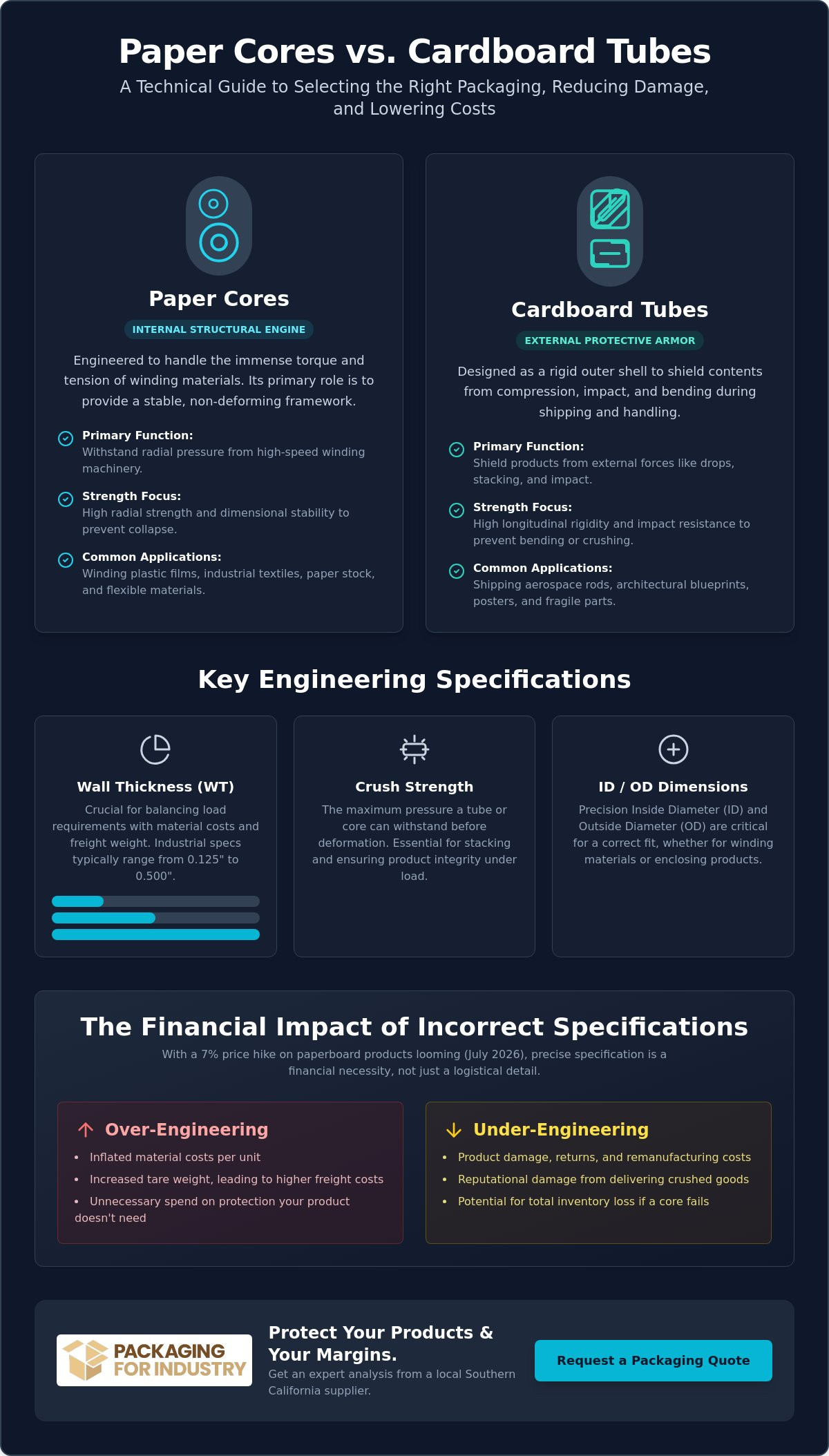
Within industrial manufacturing, the terms “core” and “tube” are frequently used as synonyms. This is a mistake that leads to procurement errors and wasted spend. A paper core serves as an internal structural engine. It’s designed to handle the torque and tension of winding materials like plastic films, industrial textiles, or paper stock. Conversely, a cardboard tube acts as an external protective armor. Its primary function is to shield a product from compression, impact, or bending during transit. Understanding the nuances of paper cores vs cardboard tubes for product protection allows your operations team to specify the correct wall thickness without over-engineering the solution.
Both products rely on high-grade Kraft paper for their foundation. This material is layered and bonded with specialized adhesives to create high crush strength. However, the engineering focus differs between the two. Cores prioritize dimensional stability and radial strength to prevent collapsing under the weight of wound material. Tubes prioritize longitudinal rigidity and impact resistance. With major suppliers like Sonoco and Greif implementing price increases between 6.5% and 7% in July 2026, choosing the wrong specification isn’t just an engineering error. It’s a direct hit to your shipping budget. Precise specification is the only way to maintain margins as material costs rise across North America.
The Internal Role of Paper Cores
Industrial paper cores provide the essential framework for rolled goods. They must withstand immense pressure from high-speed winding machinery without deforming. If a core fails, the entire roll of material can become unusable, leading to significant production waste. Manufacturers in the textile and plastic film sectors require precision-engineered tubes and cores that maintain their shape under heavy loads. These components are often recycled or reused within closed-loop manufacturing systems. This makes high-ply construction essential for resisting the repeated stress of winding and unwinding cycles.
The External Protection of Cardboard Tubes
Cardboard tubes serve as the first line of defense for long, fragile items. This includes everything from aerospace rods to architectural blueprints. Unlike standard corrugated boxes, which can buckle under vertical pressure, a cylindrical tube distributes force evenly across its circumference. These shipping and mailing tubes often feature plastic or metal end-plugs. These closures secure the contents and provide a barrier against moisture and dust during storage. For Southern California shippers, using a dedicated protective tube ensures that specialized parts arrive at their destination without the surface scratches or structural bending common in less rigid packaging formats.
Engineering Specifications: Wall Thickness, Crush Strength, and ID/OD
While understanding the general purpose of these materials is the first step, engineering success depends on specific technical tolerances. Spiral winding is the primary manufacturing method used to create these products. During this process, multiple plies of Kraft paper are wound at a precise angle to create a continuous cylinder. This ensures uniform strength along the entire length of the product. This structural consistency is what allows a high-quality tube to maintain its integrity under the stresses of industrial shipping and storage.
Calculating Wall Thickness for Load Requirements
Selecting the correct wall thickness (WT) is a critical decision for procurement managers. Common industrial specifications range from 0.125″ for light protection to 0.500″ for heavy-duty load bearing. A thinner wall reduces the tare weight of your shipment. This is a significant factor in controlling freight costs for high-volume LTL shipments. However, choosing a wall that is too thin risks product damage. Crush strength is the maximum pressure a tube can withstand before deforming. When analyzing paper cores vs cardboard tubes for product protection, you must account for radial pressure from wound materials and axial pressure from warehouse stacking. Adhering to Sustainable packaging guidelines means optimizing these dimensions to use the minimum amount of material necessary to achieve the required protection levels.
Dimensional Precision for Automated Lines
For sectors like aerospace and advanced manufacturing, dimensional precision is non-negotiable. The Inside Diameter (ID) must be exact to ensure compatibility with manufacturing mandrels. If the ID is off by even a few thousandths of an inch, it can cause immediate downtime on an automated line. Likewise, the Outside Diameter (OD) must remain consistent to ensure tubes fit properly within secondary packaging or specialized storage racks. PFI maintains strict quality control to ensure consistency across high-volume production runs. By specifying custom lengths, you can also eliminate the labor costs and material waste associated with cutting down standard catalog sizes on-site. If you’re unsure which specifications your application requires, you can request a packaging quote to consult with our engineering team.
Application Analysis: Internal Support vs. External Shielding
Selecting the correct component requires a precise analysis of force direction. If your operation involves winding materials under high tension, you need the radial strength of a core. If you’re shielding a finished product from the physical hazards of LTL freight, you need the longitudinal rigidity of a tube. Misidentifying these needs often leads to over-engineering, where businesses pay for high-density cores when a lighter protective tube would suffice. This distinction is central to evaluating paper cores vs cardboard tubes for product protection and maintaining a lean procurement strategy.
Environmental stability is another critical factor for Southern California manufacturers. Humidity levels near the ports of Los Angeles and Long Beach can compromise the structural integrity of lower-grade paper products. High moisture softens paper fibers, which drastically reduces crush resistance. Specifying moisture-resistant adhesives or high-ply Kraft paper ensures that your packaging remains stable during long-term warehouse storage. In closed-loop industrial supply chains, the durability of a heavy-duty core becomes a cost-saving asset. These components can often be reused across multiple production cycles, whereas a single-use shipping tube is typically recycled once it reaches the end user.
When to Choose Heavy-Duty Cores
Heavy-duty cores are essential for high-tension winding applications where a core collapse would cause immediate production downtime. These components provide the internal framework for master rolls of stretch film, metal foils, and industrial textiles. The core must resist the cumulative compressive force of thousands of feet of tightly wound material. PFI engineers these cores with custom inside diameters to match specific industrial mandrels, ensuring a seamless fit that prevents slippage during high-speed manufacturing processes.
When to Opt for Protective Cardboard Tubes
Protective tubes are the superior choice for shipping high-value, long-form items that are prone to bending or surface damage. This includes everything from specialized aerospace components to industrial rods. Beyond standard shipping, these tubes can be repurposed as corner and edge protection within larger wooden crates to provide an extra layer of impact resistance. By customizing tube lengths to the exact dimensions of your product, you eliminate the need for excessive void fill. This reduces material waste and lowers the overall dimensional weight of your shipments, directly improving your freight efficiency.
Industrial Selection Criteria for Southern California Manufacturers
Selecting the optimal packaging specification requires a thorough assessment of your specific operational environment. With major manufacturers like Sonoco and Greif implementing price increases of up to 7% in July 2026, precision in material selection is now a financial priority. You must evaluate whether your product will travel via LTL freight or small parcel handling. LTL shipments involve multiple touchpoints and stacking cycles that necessitate higher crush resistance. Conversely, small parcel shipping prioritizes impact protection against drops and automated conveyor sorting. When debating paper cores vs cardboard tubes for product protection, Southern California manufacturers must also consider regulatory shifts like SB 54. This law mandates a 25% reduction in single-use plastic packaging by 2032, making recyclable paper-based tubes an increasingly attractive alternative to plastic enclosures.
For those serving the defense and aerospace sectors, meeting military packaging (Mil-Spec) requirements is a mandatory baseline. These standards dictate specific adhesive types and wall densities to ensure performance in extreme logistical environments. Ensuring your supplier can provide documented compliance is essential for maintaining these high-value contracts. By matching the engineering of the tube to the actual weight and fragility of the product, you avoid the common mistake of overpaying for heavy-duty tubes when a lighter-weight core would provide sufficient internal support.
Environmental and Durability Factors
The proximity to the Port of Los Angeles and Port of Long Beach introduces high humidity levels that can degrade standard paper fibers over time. Moisture absorption softens the Kraft paper, which leads to a significant loss in crush strength during warehouse stacking. To combat this, specify tubes engineered with high-performance ply-bonding adhesives. These specialized adhesives determine the ultimate rigidity of the tube and provide a critical barrier against moisture ingress during sea freight or long-term storage in non-climate-controlled facilities.
Sourcing Locally for Supply Reliability
Sourcing from a local Anaheim packaging supplier provides a distinct advantage in supply chain agility. Local sourcing minimizes the risk of lead-time delays often associated with national catalog suppliers. By utilizing Vendor Managed Inventory (VMI) or just-in-time delivery, you can recover valuable warehouse space and reduce the overhead costs associated with bulk storage. This local approach also lowers the total carbon footprint of your industrial supply chain by reducing transport distances. If you’re ready to optimize your procurement and reduce shipping damage, request a packaging quote for a custom assessment of your specific load requirements.
Custom Industrial Tube and Core Solutions from Packaging For Industry
PFI provides more than just a catalog of products; we offer engineered systems designed for your specific logistical challenges. We manufacture custom tubes and cores to meet the exact industrial tolerances required by your automated machinery or high-value shipments. By analyzing the structural requirements of your application, we help you navigate the choice between paper cores vs cardboard tubes for product protection to ensure you aren’t over-engineering your packaging. For high-sensitivity gear, we provide integrated protection by combining rigid tubes with custom foam inserts. This multi-layered approach isolates your product from both external impact and internal vibration during transit.
Our consultative approach focuses on fiscal responsibility and operational efficiency. We don’t just sell materials; we implement systems like Vendor Managed Inventory (VMI) to streamline your procurement process. This ensures you have the necessary supplies on hand without tying up excessive capital in stagnant stock. By delegating inventory oversight to our team, you can focus on core manufacturing goals while we maintain the stability of your packaging supply chain.
The PFI Design and Prototyping Process
Our engineering team collaborates directly with your operations staff to define the necessary crush strength and wall thickness for your specific load weights. We provide free prototyping and CAD/CAM support to ensure a perfect fit for complex automotive or aerospace components. This rigorous design phase includes a cost-reduction analysis where we identify the sweet spot between maximum protection and the lowest possible material price. Refining these specifications before full-scale production eliminates the risk of shipping damage while maintaining lean procurement standards.
Inventory Support for High-Volume Users
Operational downtime caused by stockouts is a significant hidden cost in manufacturing. We eliminate this risk through Just-In-Time (JIT) delivery programs across San Diego, Riverside, and the greater Los Angeles area. Our stocking programs allow you to free up valuable warehouse floor space, as we maintain your inventory and deliver precisely when needed. This logistical flow is essential for high-volume users who must balance rapid fulfillment with limited on-site storage. To start optimizing your supply chain and lowering your procurement costs, request a custom packaging quote today for a technical assessment of your requirements.
Optimize Your Industrial Packaging Strategy
Successfully navigating the technical differences between paper cores vs cardboard tubes for product protection is essential for maintaining a lean supply chain in Southern California. By matching the specific wall thickness and crush resistance to your application, you prevent product damage without incurring the unnecessary freight costs of over-engineered materials. Whether your operation requires high-tension winding cores or protective tubes for high-value aerospace components, precision remains the primary driver of fiscal efficiency and operational reliability.
Packaging For Industry provides the technical expertise needed to meet strict Mil-Spec and Aerospace standards. We offer free prototyping for custom industrial designs to ensure your specifications are verified before full-scale production begins. With our local next-day delivery across Los Angeles, Orange County, and San Diego, you can reduce warehouse overhead and rely on just-in-time fulfillment to keep your lines moving. Our team is ready to help you eliminate professional stress by delivering stable, high-performance packaging solutions.
Request a Custom Packaging Quote for Tubes and Cores to begin optimizing your procurement process and lowering your total shipping costs. We look forward to partnering with you to improve your logistical flow.
Frequently Asked Questions
What is the difference between a paper core and a cardboard tube?
A paper core is an internal structural component used for winding materials, while a cardboard tube is an external protective enclosure. The primary difference lies in the direction of the force they are designed to withstand. When comparing paper cores vs cardboard tubes for product protection, cores focus on radial tension from materials wound around them. Tubes focus on shielding the contents from external impact and bending during the shipping process.
How is the crush strength of a paper tube measured?
Crush strength is measured by the maximum amount of pressure a tube can withstand before deforming or collapsing. We test for both radial strength, which is critical for winding tension, and axial strength, which determines how many units you can safely stack in a warehouse. These measurements ensure your packaging meets the specific load requirements of your industrial application without risking product damage during LTL freight transit.
Can I get custom-sized cardboard tubes for industrial shipping?
We manufacture custom industrial tubes to your exact specifications, including precise inside diameters and cut lengths. This custom approach ensures a perfect fit for specialized manufacturing parts and eliminates the labor costs of trimming standard tubes on-site. By optimizing the dimensions to your product, you can reduce shipping damage and lower your procurement costs through more efficient material usage and reduced dimensional weight.
What wall thickness do I need for heavy industrial parts?
Heavy industrial parts typically require a wall thickness ranging from 0.250″ to 0.500″ to ensure maximum crush resistance. The correct specification depends on the weight of the item and the stacking requirements in your warehouse. When evaluating paper cores vs cardboard tubes for product protection, our engineering team analyzes the load weights to determine the minimum ply count needed. This ensures your parts are secure without overpaying for unnecessary material.
Do you provide plastic or metal end caps for shipping tubes?
We provide a variety of closure options, including heavy-duty plastic plugs and metal end caps. These closures are essential for securing high-value items and providing a barrier against moisture or dust during storage. For specialized manufacturing parts, we can also integrate custom foam inserts to provide additional cushioning within the tube. This ensures the product remains stationary throughout the delivery process and arrives without surface damage.
How do paper tubes compare to corrugated boxes for long items?
Paper tubes offer superior structural integrity for long, narrow items compared to standard corrugated boxes. A cylindrical shape distributes external pressure evenly across the surface, which prevents the bending and buckling that often occurs with rectangular boxes. This makes tubes the more reliable choice for shipping architectural plans, metal rods, or aerospace components that require consistent protection against impact and compression during the shipping cycle.
Does PFI offer next-day delivery in Orange County or Los Angeles?
We provide local next-day delivery for stocked items across Orange County and Los Angeles. Our Southern California location allows us to support just-in-time inventory management, helping you reduce the amount of warehouse floor space dedicated to packaging storage. By sourcing locally, you can improve your supply reliability and avoid the long lead times often associated with nationwide catalog distributors who ship from outside the region.
Can you manufacture tubes that meet Mil-Spec requirements?
We specialize in manufacturing tubes and cores that meet rigorous Mil-Spec and aerospace requirements. Our production process utilizes specialized adhesives and high-ply Kraft paper to ensure compliance with military standards for durability and environmental resistance. We provide the necessary documentation and quality oversight to ensure your packaging meets the strict specifications required for government and defense contracts. Our engineers work with you to verify all tolerances.