
Pre-assembled foam and corrugated packaging kits may simplify packing by bringing the outer box and protective foam together in a ready-to-use system. For manufacturers looking for custom packaging solutions in San Diego, a custom-fit kit can help keep products supported and organized during shipment.
Packaging should protect the product while fitting your warehouse team’s packing process. The right design depends on the item’s dimensions, weight, handling needs, and shipping process. This article explains how custom corrugated kits are designed, fitted with foam, assembled, and shipped pre-assembled in San Diego. You’ll also learn what information helps shape a practical kit, how the design may support efficient packing, and when a combined corrugated-and-foam solution may suit your operation.
Key Takeaways
- Match the corrugated box and foam insert to the product’s dimensions, weight, handling needs, and shipping process.
- Plan the kit around how warehouse teams pack orders, including which components should arrive assembled and ready to use.
- Use packaging kitting to organize compatible materials and make packing workflows more consistent.
- Share product details, expected usage, and known damage points when requesting a custom packaging quote.
- Explore foam packaging design and packaging kitting to simplify operations and help reduce shipping damage.
Packaging Products
Custom kits combine a corrugated outer box with foam or corrugated components selected for the product. Buyers in San Diego can specify kit dimensions and assembly requirements to fit their packing operations. For pre-assembled foam and corrugated packaging kits in San Diego, the design should account for both product protection and how staff will use each kit.
Kit Types and Sizes
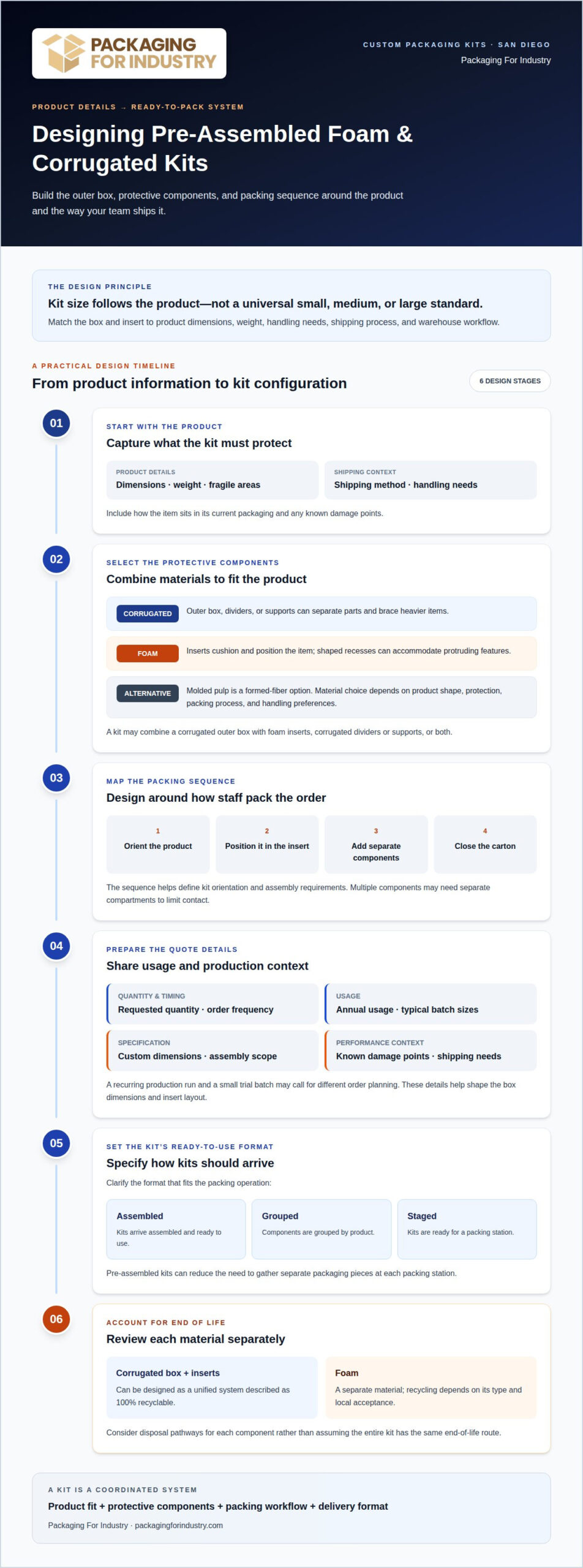
Kit size follows the product, not a universal small, medium, or large standard. A compact electronics part may need a close-fitting foam insert inside a small carton, while a larger industrial component may need a wider corrugated box with foam supports. Custom dimensions are based on the product and its packing layout.
Custom corrugated packaging kits can combine an outer box, foam inserts, and corrugated dividers or supports. Foam cushions and positions an item, while corrugated components separate parts or brace heavier items. Molded pulp offers a formed-fiber alternative. Choosing between these materials depends on product shape, protection needs, packing process, and material handling preferences.
Product Selection Information
To select a kit, provide the product’s dimensions and weight, fragile areas, shipping method, and how the item sits in its current packaging. Include annual usage, typical batch sizes, and known damage points when requesting a quote.
These details help determine box dimensions, insert layout, and whether the kit needs foam, corrugated supports, or both. A product with a protruding feature may need a shaped recess, while multiple components may need separate compartments to limit contact. A useful design also reflects how the product is loaded and removed.
Corrugated boxes and inserts can be designed as a unified system described as 100% recyclable. Foam is a separate material, so its recycling depends on its type and local acceptance. San Diego businesses should consider disposal pathways for each component rather than assuming the entire kit has the same end-of-life route.
Supplier and Bulk Options
San Diego buyers can source custom foam inserts with corrugated boxes from an industrial packaging supplier that handles both materials and packaging design. Packaging For Industry (PFI) coordinates foam packaging and custom packaging design for businesses seeking pre-assembled foam and corrugated packaging kits in San Diego.
For wholesale or bulk packaging pricing, share the requested quantity, order frequency, custom dimensions, and assembly scope. A recurring production run differs from a small trial batch, so include expected usage and batch sizes when comparing quotes. Clarify whether kits should arrive assembled, grouped by product, or ready for staging at a packing station.
Before selecting a kit, map the packing sequence. Identify which side of the product faces down, position it in the insert, add separate components, then close the carton. This sequence helps define kit orientation and assembly needs without relying on a generic box size.
Industries Served
Foam-and-corrugated kits suit operations that ship products needing organized, repeatable protection. The right configuration depends on what the business moves, how employees pack it, and where the package travels. A manufacturer shipping one assembled component has different packing needs from a distributor shipping several smaller parts together. A tailored kit supports each workflow without treating every product as interchangeable.
Aerospace companies handle components with specific shapes, surfaces, and packing orientations. For example, a machined bracket may need stable support to keep it from contacting other parts inside the carton. A kit can organize the component and related hardware as one packing unit. The design should account for the product’s dimensions, weight, handling, and shipping route, rather than relying on a box chosen by general category.
Medical device manufacturers can use fitted packaging to keep a device and its accessories arranged during storage and distribution. A shaped insert gives the main item a defined position, while separate compartments hold cords or removable components. The design should reflect the device’s specific fragility and handling needs. Products within the same operation may need different layouts, even when shipped in similar outer cartons.
Electronics businesses may need kits that separate delicate assemblies, housings, and related parts. A custom layout helps prevent loose components from rubbing against each other during shipment. The design can also account for how packing staff load and close each carton. Where static-sensitive products require ESD foam packaging, material selection should be part of the packaging design rather than an afterthought.
Food companies and construction suppliers have different shipping priorities. A food-equipment manufacturer might ship a control component with fittings, while a construction supplier may send a finished fixture alongside mounting hardware. In both cases, compartments can keep associated parts together and make order contents easier to manage. The kit should reflect the shipped product and its handling requirements, not assumptions based only on the industry label.
Warehouses, distributors, and fulfillment centers also benefit when packing materials match their order flow. A warehouse handling one product repeatedly may use a consistent kit layout, while a distributor assembling mixed orders may need compartments for multiple components. Pre-assembled kits can reduce the need to gather separate packaging pieces at each packing station. Businesses can explore a custom packaging quote based on their products, packing process, and shipment needs.
Benefits of Pre-Assembled Packaging Kits
Pre-assembled kits move packaging work upstream from the shipping station. Instead of gathering a box, foam pieces, and dividers for every order, staff receive components grouped for a specific product or packing task. A consistent kit can reduce material handling at the workstation and help teams follow the same packing sequence across repeat shipments.
Packaging kitting brings selected materials together as one ready-to-use set. Assembly can include placing inserts inside cartons, matching parts by product or order, and grouping each kit for storage or dispatch. For example, a kit for a replacement assembly might include its carton, fitted protective components, and a separate compartment for accompanying hardware.
A practical assembly workflow follows the product’s packing sequence:
- Confirm the product or order identifier and the required kit configuration.
- Gather the corrugated carton, foam components, and any dividers.
- Position the protective pieces as designed, then check their orientation.
- Group the completed kit and label it for the intended packing operation.
These steps help reduce searching and sorting during production or order fulfillment. A warehouse team can store assembled kits near the relevant packing area, while a distributor can organize them by shipment or product family. Clear identifiers also help staff distinguish similar cartons with different insert layouts. The result depends on a packing method that fits the actual workflow, not simply on assembling materials in advance.
Shipping pre-assembled kits requires attention to how components travel before use. Kits can be grouped by destination, production schedule, or order type, then prepared for delivery to the facility or packing area. For example, a manufacturer receiving kits for a scheduled production run can stage them beside the line instead of collecting separate materials during each packing cycle. Planned deliveries can also support steadier inventory use.
San Diego packaging orders can be planned around PFI’s next-day delivery in Southern California, including San Diego County. This gives operations a practical way to plan replenishment without relying on unplanned same-day collection.
For recurring demand, align kit quantities and delivery timing with actual consumption. Vendor Managed Inventory (VMI) and Just-In-Time (JIT) inventory programs can help coordinate replenishment with production needs. Start by identifying which kits are used regularly, where staff store them, and which steps currently slow packing. This information helps shape assembly and delivery around the facility’s operating rhythm.
For a tailored packaging quote, include the kit contents, assembly requirements, delivery location, and expected usage pattern.
Which San Diego Suppliers Sell Pre-Assembled Foam and Corrugated Packaging Kits?
San Diego buyers need a supplier that can coordinate corrugated boxes, foam inserts, and assembly. PFI provides custom packaging design and foam packaging to help businesses develop a complete kit. When sourcing custom ready-to-use packaging kits in San Diego, define product fit, assembly scope, and how the kits will be used on the packing line.
Define “pre-assembled” for your operation before comparing suppliers. One buyer may need foam placed inside each carton, while another needs the box, insert, and dividers grouped together. A manufacturer shipping a component with accessories, for example, may want those items organized in one ready-to-pack set. Spell out the configuration so quotes cover comparable work.
Assess whether a supplier can coordinate these project elements:
- Corrugated box dimensions that match the product and shipping setup.
- Foam insert design that positions the item and separates components.
- Assembly instructions, grouping, and identification for each kit.
- Delivery planning that accounts for receiving space and production demand.
Use one project description when requesting quotes. Include product dimensions and weight, shipping method, annual usage, typical batch size, and known damage points. Then describe the assembly, such as foam fitted inside each box or complete kits grouped by product identifier. This clarifies which materials and services each quote includes, making packaging pricing easier to compare consistently.
Consider how the supplier’s design will work at your packing station. A warehouse shipping one product repeatedly may stage kits by item number. A distributor preparing mixed orders may need components separated and labeled for quick identification. The kit should support the actual loading sequence and storage method. These operating details distinguish a useful packaging solution from a carton and insert that merely fit the product.
For bulk packaging pricing, specify order quantity and expected reorder patterns. A recurring production schedule may call for planned replenishment, while a project shipment may need a separate batch arrangement. A quote for pre-assembled foam and corrugated packaging kits in San Diego should identify kit contents, assembly scope, and delivery destination. Include the required arrival window to support practical planning.
A supplier discussion is most productive when purchasing and operations share the same requirements. Bring a representative product description, packing sequence, and usage estimate. These details give the supplier a basis for addressing fit, assembly, and supply needs together. They also help your team assess whether the proposed kit supports repeat shipments and reduces extra handling at the packing station.
Choose an industrial packaging supplier that can coordinate corrugated boxes, foam inserts, and kit assembly. Define the ready-to-use configuration your packing operation requires, including how each kit should be assembled and grouped.
Seek an industrial packaging supplier that can coordinate box dimensions with custom foam insert design and assembly. Share product dimensions, weight, shipping method, and known damage points so the supplier can plan a suitable configuration.
The guide frames these packaging recommendations around optimizing manufacturers’ supply chains in 2026, placing kit decisions within that broader supply-chain focus.
Why Choose Packaging For Industry (PFI) for Foam Packaging?
Packaging For Industry (PFI) helps manufacturers address product protection and packaging supply needs through foam packaging, stretch film, Vendor Managed Inventory (VMI), and Just-In-Time (JIT) inventory management. Contact PFI when existing cushioning leaves products moving in transit, packing teams repeatedly handle loose foam pieces, or packaging replenishment disrupts production. A clear description of the product and packing workflow gives the conversation a practical starting point.
Foam packaging can support products that need cushioning or a more organized position inside a shipping package. For example, a manufacturer shipping a finished component can explain which surfaces need protection and how staff currently place it into the carton. That context helps frame the foam requirement around the item and its handling, rather than choosing material based only on a broad product category. Explore foam packaging options for industrial shipping needs.
PFI also offers stretch film to help contain palletized loads. Buyers can discuss foam and stretch film together when their operation handles both individual product protection and outbound pallet loads. The right supply arrangement depends on the products being packed, material usage, and how the warehouse replenishes its work areas. Sharing those details helps connect packaging needs with purchasing and operations.
For recurring packaging demand, PFI’s VMI and JIT inventory programs can help coordinate supply with usage and production schedules. VMI suits businesses seeking managed packaging replenishment, while JIT inventory management can align packaging supply with production timing. Both approaches focus on the flow of packaging materials, rather than treating each order as an isolated purchase.
Before contacting PFI, gather practical details to define the requirement:
- Product dimensions, weight, and areas that need cushioning.
- Current packaging method and any known shipping damage points.
- How the packing team uses foam and stretch film.
- Typical order quantities, usage patterns, and production timing.
These details help PFI understand whether the main need involves foam packaging, stretch film, or a steadier replenishment approach. They also make it easier to discuss packaging purchasing as part of the wider operating process. For example, if workers pause production to find packaging, the discussion can focus on supply timing. If a product shifts inside its package, it can begin with fit and cushioning needs.
Contact Packaging For Industry (PFI) to discuss foam packaging for your products and operation.
Set Up Your Next Packaging Run
Use your next packaging review to connect product protection with purchasing and warehouse workflow. A kit should work for the item being shipped and for the people preparing it. For teams sourcing pre-assembled foam and corrugated packaging kits in San Diego, define how packaging should support the next production or fulfillment run.
Packaging For Industry (PFI) offers foam packaging and stretch film, along with VMI and JIT inventory programs for packaging. These services can support a broader conversation about product protection and keeping packaging supply aligned with operational needs. A focused quote request gives the team a clear starting point for discussing the application.
Share the products you ship, how your team packs them, and where packaging interruptions occur. That context makes the next step specific to your operation, rather than a generic materials inquiry.
A well-planned packaging project can help your team build a more consistent packing process.
Frequently Asked Questions
What lead times and shipping options do local packaging suppliers offer?
Lead times depend on whether an order uses stock materials or requires custom design, foam fabrication, and kit assembly. Shipping can be planned around order size, destination, and production schedule. For an accurate estimate, include the required arrival date, kit quantities, and assembly needs in your request. This gives PFI practical details for aligning the order and shipping plan with your operation.
Which San Diego suppliers offer wholesale or bulk pricing for packaging kits?
San Diego industrial packaging suppliers that handle both foam and corrugated materials can quote wholesale or bulk kits. Provide the requested quantity, order frequency, custom dimensions, and assembly requirements.