
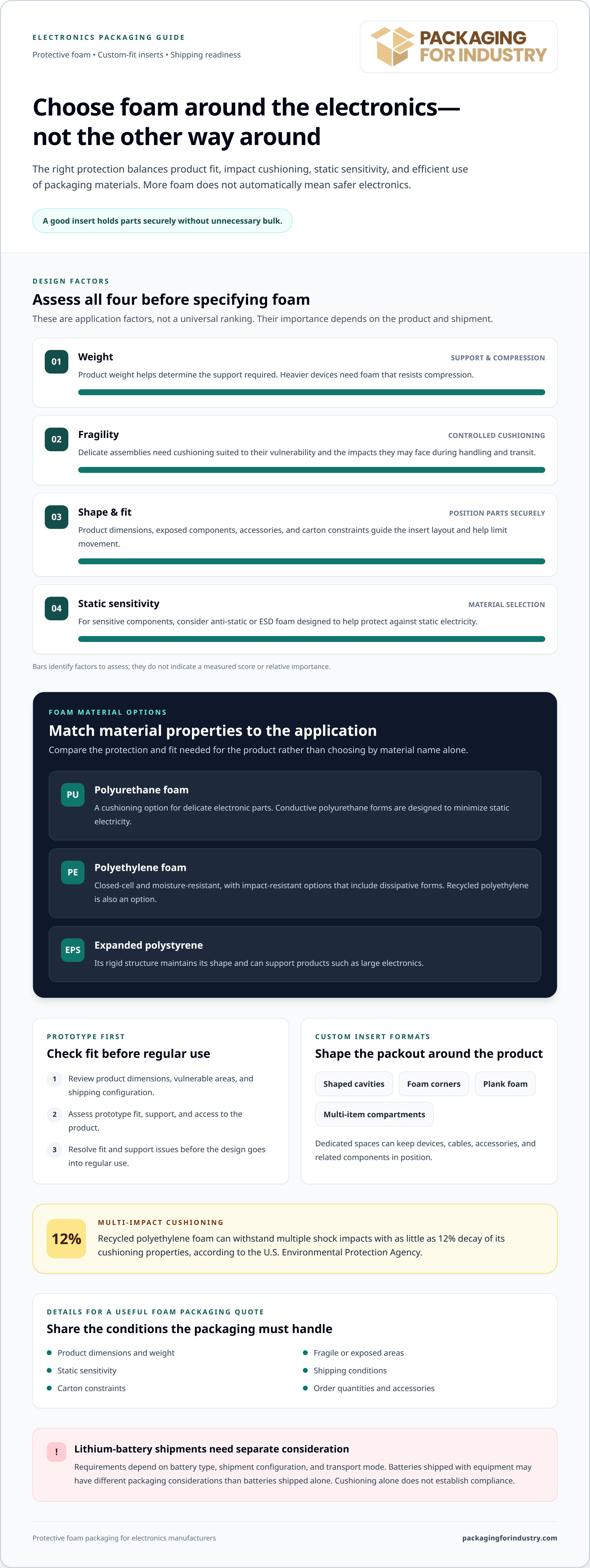
More foam doesn’t automatically mean safer electronics. Protective foam packaging for electronics manufacturers works best when cushioning suits the product’s weight, fragility, shape, and static sensitivity. A well-designed insert holds parts securely, while anti-static or ESD foam can help protect sensitive components from static electricity. Foam also cushions products against impact during transit.
Choosing protection for electronics shipped from Los Angeles means balancing product fit, impact protection, and efficient use of packaging materials. The aim is to protect delicate parts without unnecessary bulk. This guide explains how to select foam for different products, specify custom inserts, and match cushioning to the carton. It also covers the product and shipping details that help a packaging professional design a solution for your electronics and supply needs.
Key Takeaways
- Match foam cushioning to the electronics product’s weight, fragility, and sensitivity to static electricity.
- Compare polyurethane, polyethylene, and expanded polystyrene based on the protection and fit the application requires.
- Custom inserts and a well-fitted carton can help limit movement and reduce shipping damage.
- Product dimensions, shipping conditions, and order requirements help shape a useful foam packaging quote.
- Packaging For Industry can help Los Angeles manufacturers with foam packaging and custom packaging design for electronics.
Protective Foam Products and Custom-Fit Electronics Packaging
Protective foam packaging for electronics manufacturers should match each product’s weight, fragility, shape, and static sensitivity. The insert, cushioning, and carton work together to secure parts without relying on excess void fill.
Designing and Prototyping Custom Inserts
A packaging design should account for product dimensions, vulnerable areas, and shipping configuration. Prototypes help assess fit, support, and access before production. For example, a circuit board insert should hold the board without pressing against exposed components. Reviewing a prototype gives the team a chance to resolve fit and support issues before the design goes into regular use.
Anti-Static Foam Protection
Anti-static and ESD foam are designed to help protect electronic components from static electricity, which can damage circuit boards, chips, and other sensitive parts. Conductive polyurethane and dissipative polyethylene foam are designed to minimize static electricity. Shock and vibration can also move or damage components, and moisture may affect products during transit. A suitable design considers each component’s static sensitivity alongside the physical support it needs.
Impact and Multi-Impact Cushioning
Foam absorbs impact energy and can recover to provide further cushioning during handling and shipment. Product weight and fragility guide the support required: a delicate assembly needs controlled cushioning, while a heavier device needs foam that resists compression. Recycled polyethylene foam can withstand multiple shock impacts with as little as 12 percent decay of its cushioning properties, according to the U.S. Environmental Protection Agency.
Custom-Fit Packaging Requirements
Custom-fit packaging positions each device or component to limit movement inside its carton. Inserts can use shaped cavities, foam corners, plank foam, or compartments for multiple items. For a useful quote, share product dimensions, weight, fragile areas, static sensitivity, quantities, and shipping conditions. Include carton constraints and any accessories that need separate spaces. Protective foam packaging for electronics manufacturers can then be designed around the actual packout.
Lithium-battery shipping requirements depend on battery type, shipment configuration, and transport mode. Batteries shipped with equipment may have different packaging considerations than batteries shipped alone. Cushioning alone does not establish compliance.
Comparing Foam Materials
Polyurethane foam can be a cushioning option for delicate electronic parts. Polyethylene foam is closed-cell and moisture-resistant, with impact-resistant options that include dissipative forms. Expanded polystyrene has a rigid structure that maintains its shape and supports products such as large electronics. Choose material based on the application’s weight, fragility, moisture exposure, and static-control needs. The National Bureau of Standards reports that rigid polyurethane foam has its greatest compressive strength in the direction of foam rise and its minimum strength perpendicular to it.
Sustainable and Recyclable Options
Recycled polyethylene foam is one option, and reusable inserts may protect products during return shipments when their condition and fit remain suitable. Recycling access varies by location, so recovery depends on local collection and processing. The Federal Trade Commission’s Green Guides, 16 CFR Part 260, address environmental marketing claims about recyclable, compostable, and degradable products. These considerations help buyers describe packaging materials accurately without overstating environmental benefits.
Industries Served
Electronics packaging needs vary by product, production flow, and destination. Manufacturers, warehouses, distributors, and fulfillment operations need packaging that protects goods while fitting their handling and shipping processes. For businesses in Los Angeles, the right approach can support repeatable packing, organized inventory, and reliable movement through the supply chain.
Electronics and Industrial Manufacturers
Electronics manufacturers ship finished devices, subassemblies, and replacement parts through different channels. A component headed to an assembly line may need organized compartments, while a finished unit may require a dedicated packout for outbound shipment. Protective packaging also matters for manufacturers in aerospace, medical, and industrial markets, where products may have delicate parts or specific handling needs. Packaging plans work best when they reflect how each item moves from production to storage and shipment. Manufacturers can align foam packaging with their broader packaging needs for manufacturing, rather than treating the insert as a separate purchasing decision.
Aerospace and Medical Operations
Aerospace businesses move equipment and components between production, storage, maintenance, and distribution. Packaging should account for the item’s shape and how staff handle it at each stage. Medical device companies also ship electronic equipment and components through business supply chains. A clear, repeatable packout helps staff place parts consistently and keep related components together. For recurring orders, predictable packaging and assembly can make workstations more efficient than a one-off shipping setup.
Warehouses, Distributors, and Fulfillment Centers
Warehouses and distributors manage incoming stock, storage, order preparation, and outbound freight. Their packaging should support accurate picking and efficient packing without adding unnecessary steps. Fulfillment centers may handle multiple device models or accessory combinations, so distinct insert layouts can help separate products and reduce packing errors. For example, a kit containing an electronic unit, cables, and related components benefits from dedicated spaces that keep each item in position.
Packaging for distribution centers should also fit the operation’s inventory practices. Bulk supplies support recurring demand, while packaging kitting and assembly can group components into ready-to-pack sets. The right configuration depends on order patterns, storage limits, and how products arrive at the packing station. These operational factors matter alongside the protection required during transit.
Food, Construction, and Other Industrial Businesses
Food companies, construction suppliers, and other industrial businesses may ship electronic controls, instruments, or equipment as part of their operations. A food producer might need packaging for monitoring or production equipment, while a construction supplier may distribute electronic components alongside jobsite materials. In each case, packaging should suit the product and shipping workflow, not just the industry. Clear identification and organized packouts can help receiving teams locate parts and put them to use.
For businesses in Los Angeles sourcing foam packaging, industry is only a starting point. Product type, order frequency, shipping route, warehouse handling, and the number of components in each packout all shape the solution. Matching these details to the operation helps manufacturers and distribution teams protect electronics while keeping packaging practical to store, handle, and replenish.
Benefits of Protective Foam Packaging for Electronics
Protective foam packaging for electronics manufacturers depends on the complete package, not cushioning alone. The insert supports the device, while the carton limits movement and contains the packed product during handling. A packaging design can align insert geometry, carton dimensions, and packout sequence with the product and production flow to support shipping, storage, and assembly.
Match the Carton to the Product and Insert
A carton that is too large leaves room for the device and insert to shift. An undersized carton can compress cushioning or press against product surfaces. For example, a desktop computer with foam corner supports needs a carton that holds the supports in place without pressing them against vulnerable areas. Custom carton dimensions can reduce unused space and help stabilize the packed product.
Carton fit also affects warehouse handling. A consistent package footprint can help teams stack, store, and identify electronics efficiently. When a shipment contains several components, a planned layout can give each item its own space. Product dimensions, insert thickness, and the final packout determine the space needed inside the carton. These details matter for manufacturers shipping repeat product configurations.
Choose Box Strength for the Shipping Route
Carton strength should reflect product weight, shipping route, and handling conditions. A heavier device places different demands on the package than a lightweight circuit assembly. The carton and cushioning must work together: foam supports the item, while the box contains the packed load during storage and transportation.
Product downgauging can increase fragility and reduce structural integrity. Direct-to-consumer shipping also involves a more rigorous and less predictable fulfillment chain. That makes the route and handling pattern important design inputs, especially for electronics moving through parcel networks. ISTA Procedure 3A is designed for packaged products moving through parcel delivery systems.
Control Empty Space and Product Movement
Void fill occupies gaps, but its type and placement matter. Foam corners can support cubic, square, or rectangular products with moderate fragility, including desktop computers. Plank foam can block and brace products or separate several items inside one package. These configurations help prevent a device from moving freely without filling every gap with loose material.
Foam peanuts can shift to the bottom of a shipping box, reducing their protective function and increasing the risk of breakage. A fitted insert holds the product in a defined position. For a shipment containing a monitor and accessories, separate cavities can prevent cables or adapters from moving against the screen during transit.
Plan Protection for Shipping, Storage, and Assembly
Packaging needs often extend beyond the carrier journey. Electronics may wait in warehouse storage, move between production stations, or enter automated packing processes. A repeatable insert layout helps make product placement consistent, while distinct compartments help packers keep components together. For an assembly line, the package should let staff or equipment access items in the required sequence.
Custom foam can reduce packaging waste while providing suitable protection. The design should account for product shape, vulnerable surfaces, and how the item enters and leaves the carton. A compact configuration can make better use of storage space and may reduce shipping costs because foam packaging is generally lightweight. These outcomes depend on the complete package design, not foam alone.
Evaluate the Complete Packout
Review the carton, insert, and product as one assembled unit. Check whether the device stays seated, accessories remain separated, and the carton closes without compressing critical areas. For example, an insert for a control unit should accommodate its connectors and keep them from bearing against the carton wall. This complete-package view is central to protective foam packaging for electronics manufacturers.
Shipping conditions, product changes, and packing methods can alter the protection required. When product dimensions change, the insert and carton fit may need adjustment as well. Assessing the full packout helps identify movement, excess void, and handling issues before they contribute to shipping damage or inconsistent assembly.
Why Choose Packaging For Industry (PFI)
Packaging For Industry (PFI) helps electronics manufacturers in Los Angeles connect protective foam packaging with dependable supply planning. Its foam packaging, stretch film, Vendor Managed Inventory (VMI), and Just-In-Time (JIT) inventory management support different parts of a packaging operation. The right combination depends on the product, packing workflow, and how consistently the business uses its packaging materials.
Electronics packaging may need review when an existing insert no longer holds a product securely, packing takes too many steps, or the package has changed along with the product. PFI supplies foam packaging for industrial applications, giving manufacturers an option for cushioning designed around their packaging needs. The goal is to align the protection with the item and the way staff pack and ship it, rather than treating every device as interchangeable.
Packaging supply can also affect production continuity. A manufacturer using foam regularly may benefit from coordinating replenishment with actual consumption. VMI supports managed packaging inventory, while JIT inventory management can coordinate supply with production or shipping schedules. These approaches are useful when purchasing teams spend time tracking repeat orders or packaging availability affects the packing floor.
Stretch film can complement foam packaging when cartons are grouped into pallet loads. It helps secure packaged goods together for handling and transport. Businesses shipping electronics on pallets can treat carton protection and load containment as connected requirements. The right setup depends on shipment configuration, warehouse practices, and replenishment frequency.
PFI may be a practical fit for manufacturers that need to:
- Review an existing foam arrangement that no longer suits the electronics product.
- Coordinate packaging replenishment with production, shipping, or warehouse consumption.
- Manage foam and stretch film as parts of the same palletized shipping workflow.
- Improve visibility into recurring packaging needs and supply planning.
For a useful packaging discussion, outline the product type, application, current packaging concern, and purchasing pattern. Foam requirements are easier to assess when you provide product dimensions, weight, fragile areas, and static sensitivity. For inventory planning, usage patterns and storage constraints help determine whether VMI or JIT may suit the operation. These details focus the conversation on the work packaging needs to support.
Electronics manufacturers in Los Angeles may need a solution that addresses product protection and recurring supply together. PFI can connect its relevant packaging offerings with the operation’s workflow, from foam used at the packing station to inventory planning for repeat consumption. This can help when packaging changes, supply interruptions, or avoidable packing complexity affect day-to-day shipping.
For a custom packaging quote, contact Packaging For Industry (PFI) with your electronics packaging requirements.
Frequently Asked Questions
What types of protective foam packaging are used for electronics?
Electronics shipments can use die-cut inserts, foam end caps, pads, planks, convoluted foam, and foam-lined boxes or crates. A small circuit assembly may need a shaped cavity that keeps connectors clear, while a larger instrument may use end caps to support its edges. Anti-static and ESD foam are options for static-sensitive parts. The package layout should also account for accessories, packing order, and how receiving staff remove each item.
How do packaging providers determine foam density, thickness, and cushioning for electronics?
A packaging design should account for product weight, fragility, shape, and expected handling during shipment and storage. The foam must support the product without allowing excessive movement or placing pressure on sensitive areas. Thickness and density aren’t selected in isolation: insert geometry, carton space, and product orientation also matter. Reviewing a complete prototype helps reveal whether connectors, screens, or other vulnerable surfaces need different support.
How do ESD-safe foam and conductive foam protect electronic components?
ESD-safe foam is selected to reduce the risk of static-related damage to sensitive components. Conductive polyurethane and dissipative polyethylene foam are designed to minimize static electricity, but the material should match the component’s handling requirements. For example, a circuit board shipped with other parts may need an insert that controls static while keeping each item separate. The packaging specification should identify which components are static-sensitive and how they’ll be handled.
What testing standards apply to protective packaging for electronics, including ISTA and ASTM tests?
The appropriate test depends on the shipment route and the hazards the package needs to withstand. ISTA Procedure 3A is designed for packaged products moving through parcel delivery systems. ASTM methods address defined packaging or material properties, so the relevant method depends on the test objective. A useful evaluation tests the assembled carton, insert, and product together, rather than treating foam performance as the only measure of package protection.