
Foam alone isn’t a complete protection plan for a circuit board. Anti-Static Foam Packaging for Circuit Boards can help manage static risk and cushion the board, while an appropriate ESD-safe bag adds protection around exposed circuitry.
A close-fitting insert helps limit movement and cushion the board during handling and shipping. The right combination depends on the board’s sensitivity and how it will be packed. Anti-static foam and shielding bags serve different purposes, so it matters how they work together.
This guide explains how foam type and insert fit affect protection, when to pair foam with an anti-static or shielding bag, and what information helps develop a suitable solution. It also covers how custom foam packaging can support consistent handling and help reduce shipping damage for electronics operations in Southern California.
Key Takeaways
- Match foam fit and ESD properties to the circuit board’s sensitivity and handling requirements.
- Pair foam with an anti-static or shielding bag when the packaging setup needs an added layer around exposed circuitry.
- Custom inserts can help keep boards positioned and supported through packaging and shipping.
- Electronics, aerospace, medical, and other industrial operations use protective foam for different component and shipping needs.
- PFI’s foam packaging, VMI, and just-in-time services can support more consistent packaging supply and handling.
Anti-Static Foam Products and Custom Packaging Solutions
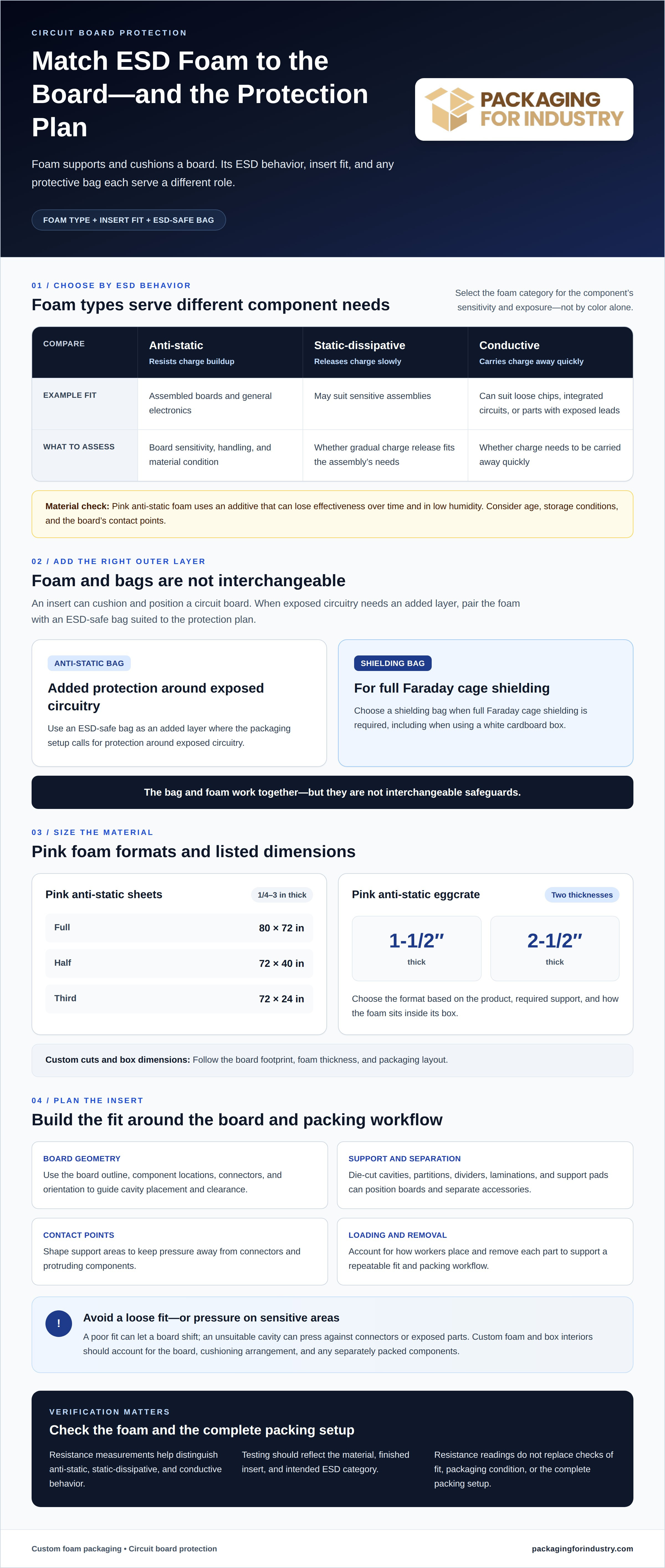
Pink anti-static foam sheets come in full, half, and third sizes: 80 by 72, 72 by 40, and 72 by 24 inches. Available thicknesses range from 1/4 inch to 3 inches, while custom cuts and box dimensions follow the board and packaging layout.
A packaging provider uses the board outline, component locations, connectors, orientation, and stacking plan to position and secure each board. These details guide cavity placement, support points, and clearance around sensitive areas.
Custom Foam Fabrication Options
A custom insert can combine die-cut cavities, partitions, dividers, laminations, and support pads. Each board can sit in its own cavity, with dividers separating boards or accessories in the same container. The design should account for board orientation and how workers load and remove each part. These choices determine the fit and support an efficient packing workflow.
Cutting Inserts to Fit Circuit Boards
For a custom insert, the packaging provider turns the board outline and component layout into a cutting plan. Die-cut cavities hold individual boards, while shaped support areas keep pressure away from connectors and protruding components. The design also accounts for how each board enters and leaves the insert, helping create a repeatable fit for production packaging.
Foam type matters as much as the cut. Anti-static foam resists charge buildup during handling and suits assembled boards and general electronics. Static-dissipative foam releases charge slowly and may be appropriate for sensitive assemblies. Conductive foam carries charge away quickly and can suit loose chips, integrated circuits, or parts with exposed leads. Choose the type based on component sensitivity.
Conductive cross-linked polyethylene foam requires attention to both the material and the ESD requirement. XLPE foam is used for industrial electronics and sensitive instruments, including applications where moisture or chemical resistance matters. Conductive foam, meanwhile, carries charge away quickly. Specify the required foam category and fit rather than assuming every XLPE insert has the same ESD behavior.
Anti-Static Foam Packaging for Circuit Boards can cushion a board, but exposed circuitry also needs ESD-safe packaging. Pair the insert with an anti-static or shielding bag suited to the protection plan. Use a shielding bag when full Faraday cage shielding is required, including with a white cardboard box. The bag and foam work together, but they are not interchangeable safeguards.
Custom box sizes should fit the insert, board, and cushioning arrangement without leaving avoidable space. The interior dimensions depend on the board’s footprint, foam thickness, and any separate components packed alongside it. Foam packaging can be designed around that interior. Pink anti-static eggcrate foam is another format, available in 1-1/2-inch and 2-1/2-inch thicknesses.
For aerospace projects, the Federal Aviation Administration identifies § 25.853 Compartment interiors as the FAR 25.853(a) regulatory section reference. This is a reference for compartment interiors, not a general specification for circuit-board shipping foam. Select packaging based on the board’s ESD sensitivity, handling, and shipping needs. Custom foam packaging designs can bring those fit and material decisions together.
Industries Served
Anti-static foam can help protect electronics, but the wrong material, fit, or handling process can create risks. A packaging provider assesses the component, selects suitable foam, and evaluates its ESD performance using resistance measurements.
Protection from Electrostatic Discharge
Static charge can damage electronic components, including circuit boards and microchips, sometimes without leaving a visible mark. Prevention matters during packing and storage. Anti-static foam resists charge buildup during handling. Static-dissipative foam releases charge more gradually, while conductive foam carries it away quickly. The appropriate type depends on component sensitivity and exposure.
Foam can cause problems if it does not suit the component. A poor fit can let a board shift, while an unsuitable cavity may press against connectors or exposed parts. Pink anti-static foam also uses an additive that can lose effectiveness over time and in low humidity. Account for material condition and the board’s contact points when planning packaging.
Pink Foam for Electronics Packaging
Pink anti-static foam is a familiar packaging option for assembled boards and general electronics. Sheets are available from 1/4 inch to 3 inches thick, allowing different cushioning layouts. Pink eggcrate foam is also available in 1-1/2-inch and 2-1/2-inch thicknesses. The choice depends on the product, the required support, and how the foam sits inside its box.
Color alone does not show whether foam is suitable for every sensitive component. A packaging design should distinguish among anti-static, static-dissipative, and conductive requirements. Assembled circuit boards, for example, may need a different foam category from loose chips with exposed leads. Handling and storage conditions matter too, particularly if foam may age or experience low humidity.
Resistance and ESD Performance Testing
To evaluate foam, a packaging provider measures its electrical resistance with test equipment and compares the reading with the intended ESD category. Testing should match the material and the component’s protection needs. Resistance measurements help distinguish anti-static, static-dissipative, and conductive behavior, but do not replace checks of fit, packaging condition, or the complete packing setup.
Testing should reflect how the foam will be used. A flat liner, a cut insert, and foam surrounding exposed leads serve different roles. A provider can assess representative material and finished inserts, then determine whether the foam suits the intended application. Because pink foam’s additive can lose effectiveness over time, age and storage conditions matter.
Electronics and Other Applications
Electronics manufacturers and contract assemblers use foam for boards, semiconductors, and electronic instruments. Other applications include computer hardware, data center equipment, medical devices with electronic components, aerospace and defense electronics, automotive sensors, and telecommunications equipment. Each product has distinct contact points, handling requirements, and component sensitivities.
Common packaging mistakes include choosing foam by color alone, leaving boards loose, or assuming cushioning provides full ESD protection. Boards with exposed circuitry need ESD-safe packaging; an anti-static or shielding bag can add protection around them. Use a shielding bag when full Faraday cage shielding is required, including with a white cardboard box.
Pink anti-static foam can work for routine electronics packaging, but it is not the answer for every device. Packaging for a medical control module, data center component, or automotive sensor should reflect the component’s sensitivity and shipping configuration. Matching foam behavior with the bag, box, and board placement helps address static and handling risks together.
Benefits of Anti-Static Foam Packaging
Good packaging protects circuit boards while supporting predictable packing and shipping workflows. The practical benefit comes from matching the package to the product, handling process, and shipping conditions.
Anti-Static Foam Packaging for Circuit Boards can help reduce static-related risk while cushioning components. Its effectiveness depends on the complete package during storage, packing, and transit.
Foam Properties for Circuit Board Protection
Foam cushioning helps limit impact and movement inside a shipping package. This is important for boards with attached connectors, delicate solder joints, or components that extend above the board surface. A considered support layout can keep pressure away from vulnerable areas and help hold the product in place during routine handling.
Consistent packing is another part of protection. If operators pack the same board differently from shipment to shipment, its placement and cushioning can vary. A defined insert gives each board a repeatable position and makes packing more straightforward. That consistency can help reduce handling errors without adding unnecessary steps.
Density and Thickness Selection
A packaging provider evaluates board size, weight, component locations, shipping method, and the package’s interior space. These factors help determine the cushioning and support required. Foam thickness must allow room for the board and protective layers, while the material should support the product without pressing on sensitive areas.
The design should also reflect how the package moves through the operation. A board packed individually for parcel shipment may need a different layout from several boards packed together for a larger shipment. Design Anti-Static Foam Packaging for Circuit Boards around the actual packing configuration, not thickness alone. This can help avoid excess material and a loose fit.
ESD Standards and Packaging Requirements
ESD packaging requirements depend on product sensitivity and any handling or customer specifications for the shipment. Define those requirements before selecting materials. This keeps the design focused on the intended protection level and avoids treating one type of foam as a universal solution for every circuit board.
A packaging specification can identify the board, packing orientation, required cushioning, and packaging layers used for shipment. It can also clarify how products move between production, storage, and dispatch. Clear requirements give purchasing and operations teams a consistent basis for reviewing designs and maintaining repeatable packing practices.
Treat the package as a complete system. The board’s position, the fit of surrounding materials, and the outer container all affect how the shipment handles movement and routine impacts. An insert with excess space can let a board shift, while an overly tight cavity can press against components. A practical design balances support with clearance.
Documenting the approved packing arrangement can help operations. A clear work instruction can show where each board sits, which packaging components surround it, and how the packed product fits into its shipping container. This helps different shifts follow the same process and makes it easier to assess changes to the board design or shipping method.
For purchasing teams, a fit-for-purpose design can manage material use while meeting product protection needs. Consider the board, packing labor, storage conditions, and shipping method together. This helps manufacturers assess the complete packaging process instead of choosing foam based on a single material attribute.
Why Choose Packaging For Industry (PFI)
Packaging For Industry (PFI) helps electronics operations connect protective packaging with purchasing and supply needs. Its foam packaging supports board packaging requirements, while stretch film, Vendor Managed Inventory (VMI), and Just-In-Time (JIT) inventory management address other parts of shipping and replenishment.
Consider foam packaging when standard materials do not suit the product or workflow. Custom sizes can align packaging with specific products and shipping methods. A packaging review can consider the board, packing configuration, handling process, and recurring supply needs to develop a practical setup for product protection and consistent packing.
Stretch film serves a separate purpose: stabilizing packaged goods for pallet movement. It does not replace protective packaging around a circuit board. Electronics shipments may need appropriate inner packaging as well as a stable outer load. Coordinating these materials addresses protection at the product level and handling at the pallet level.
For businesses with recurring packaging needs, VMI can coordinate replenishment with actual consumption. It suits operations looking to simplify routine purchasing and manage packaging stocks. JIT inventory management can align packaging supply with production timing. Both approaches can help when inconsistent replenishment, excess stock, or urgent purchasing disrupts workflow.
These services support manufacturers and distribution operations with recurring demand. A packaging plan can identify which materials need ongoing replenishment and how supply fits production or shipping schedules. Foam and stretch film protect products at different stages, while inventory programs help organize supply. Each serves a distinct part of the packaging process.
When reviewing a packaging project, useful details include:
- The product being packed and its packaging configuration.
- How the package moves through handling, storage, and shipping.
- Which materials are used now, including foam and stretch film.
- How often packaging is consumed and replenished.
These details keep the discussion focused on fit, handling, and inventory flow. Purchasing teams can compare packaging costs against the materials and replenishment approach their operation needs. For bulk orders, quantities and recurring usage help define purchasing requirements. The goal is reliable supply and practical ways to lower packaging costs and reduce shipping damage.
Operations in Orange County, Los Angeles, and San Diego can consider product protection alongside warehouse and purchasing needs. Circuit-board shipments may require protective inner packaging, while palletized goods need load stabilization. Manufacturers with regular material consumption may also benefit from coordinated replenishment. Matching the solution to the operation keeps packaging decisions grounded in business needs.
For a useful discussion, outline the product, current packaging setup, shipping conditions, and supply issue to address. These details help clarify whether foam packaging, stretch film, VMI, or JIT inventory management best fits the need. To request a packaging quote from Packaging For Industry (PFI), share the packaging requirements and purchasing priorities.
Frequently Asked Questions
What types of anti-static foam are used to package circuit boards?
Common choices include pink anti-static, static-dissipative, and conductive foam, supplied as sheets, pads, or fitted inserts. Identify whether boards ship individually, in stacked layers, or alongside accessories, since that determines the useful format and layout. Include board dimensions, protruding components, and the shipping container’s interior size in the specification. These details help match the foam configuration to the packing process.
What is the difference between conductive and dissipative foam packaging?
Conductive and dissipative foam transfer electrical charge at different rates, so they suit different components and handling needs. Specify the required material behavior and which parts will contact the foam. A supplier can consider those requirements alongside insert fit and packing configuration. Keep the approved material and packing layout consistent across repeat orders, especially when circuit boards move between production and shipping.