
What if glass is damaged in transit not because the box is weak, but because the cushioning, restraint, and outer packaging aren’t working together? Chipped or cracked components can disrupt production and add replacement and shipping work. Choosing protective packaging for glass components Orange County buyers can rely on starts with the part’s geometry and the conditions it will face in transit.
Compare foam, corrugated boxes, and crates against the specific shipping risk. A package may look full yet leave a component free to shift, while extra material can add cost without addressing the cause of damage. This guide explains how to assess cushioning, restraint, and outer packaging as a system, then compare options with your shipping method and repeat-order needs.
To prepare for a useful quote, gather component dimensions, handling requirements, and order patterns. Packaging For Industry offers custom packaging design support, prototypes and samples, protective foam, corrugated boxes, and custom crates for evaluation. For Orange County manufacturers, documenting a packaging specification and planning repeat supply with a local packaging supplier can support more consistent protection and purchasing.
Key Takeaways
- Identify where glass could contact packaging or shift during packing, transit, or handling before selecting cushioning.
- Compare foam-only, foam inside a corrugated box, and foam-lined crate options against the shipping method and operating requirements.
- Prepare drawings or dimensions, component weight, fragile areas, order quantities, and handling instructions for a more useful quote.
- For protective packaging for glass components Orange County, ask suppliers about design support, material options, samples, order quantities, and replenishment.
- Evaluate a prototype or sample with the component and packing workflow before a wider rollout. Confirm availability and delivery timing for your location and repeat orders.
Protective Packaging for Glass Components in Orange County: Define the Shipping Risk
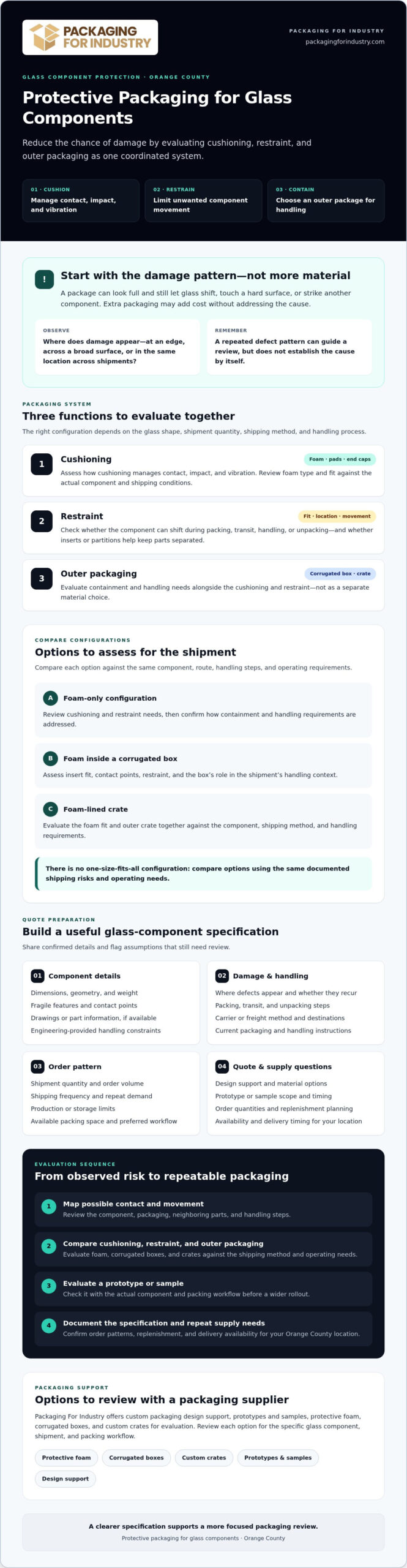
Glass components need packaging matched to their geometry and shipping route. A box can look full and still leave a part free to shift, press against a hard surface, or strike another component. The goal isn’t simply to add material. It’s to manage contact and movement while accounting for each handling step between the production floor and the destination.
Protective packaging is a coordinated system of cushioning, restraint, and outer packaging designed around the component and its shipping conditions. Cushioning helps manage impact and vibration, restraint helps limit movement, and the outer package supports containment and handling. For background on cushioning’s role, see Package cushioning. The appropriate configuration depends on the glass shape, shipment quantity, shipping method, and handling process, not just the material selected.
For buyers evaluating protective packaging for glass components Orange County, start by documenting what is arriving damaged and where. A chip at an edge suggests a different contact concern than a crack across a broad surface. Repeated damage in the same location can help focus a packaging review, although the pattern alone doesn’t establish the cause.
Which glass-component risks should buyers assess?
Map possible contact points during packing, transit, and unpacking. Could the component touch the box, an insert, another part, or a neighboring component? Record dimensions, geometry, weight, fragile features, and any engineering-provided handling constraints. Note where defects appear and whether they recur across shipments. These details give a packaging supplier a clearer starting point for assessing fit and restraint.
What should an Orange County packaging supplier learn first?
Share shipment destinations, carrier or freight method, handling steps, and shipping frequency. Clarify order volume, repeat demand, current packaging, and production or storage limits, such as available packing space or the preferred packing workflow. Separate confirmed requirements from assumptions that still need review. Packaging For Industry offers protective foam to assess alongside other packaging elements. Its foam packaging options should be evaluated for the specific component and shipping method.
If dimensions or contact points are uncertain, flag them for review rather than treating them as settled specifications. A prototype or engineering review may help assess fit before a broader packaging decision. Confirm the prototype scope and timing, as well as delivery availability for your Orange County location, with the supplier.
How Foam, Corrugated Boxes, and Crates Work Together for Glass Protection
Each packaging layer addresses a different part of the shipping challenge. Foam can cushion contact points and help locate a component. A corrugated box or crate contains the package and provides an outer structure. Partitions can separate multiple components to prevent contact. Assess these options as a system rather than choosing materials in isolation.
Packaging performance depends on how cushioning, restraint, and outer packaging work together for the specific component and shipping conditions. A fitted insert may help control movement, but the package still needs an appropriate outer layer for its handling and transport context. Buyers developing a repeatable specification can consult the International Safe Transit Association (ISTA) for information on transport packaging testing. Select any testing approach for the specific shipment and confirm it with qualified packaging professionals.
When should buyers evaluate custom foam packaging?
Consider inserts, end caps, or pads when the component’s shape or fragile contact areas call for a more considered fit than general cushioning can provide. For example, an insert could support designated areas while leaving sensitive edges clear, but the design needs to be reviewed against the actual part. Ask the packaging designer to assess foam type for the component and shipping conditions. PFI offers protective foam packaging for evaluation as part of a broader packaging design.
Fit matters during packing and unpacking, too. A design should account for how staff place and remove the component, whether the same package holds one part or several, and how the cushioning will be positioned consistently. A prototype or sample can help your team review those practical details before a wider rollout. Confirm its scope and timing with the supplier.
When should corrugated boxes or custom crates enter the comparison?
Evaluate corrugated boxes and crates against component dimensions, shipment method, handling steps, and packaging quantity. Corrugated partitions may help separate parts inside a box. A foam-lined crate may be worth assessing for a component, load, or shipping context that calls for a more substantial outer package. Neither option is automatically right for every glass shipment. PFI’s custom packaging design support can help buyers compare configurations. Discuss crate requirements directly rather than assuming a particular design will fit.
When comparing options, ask how the cushioning locates the part, how the package limits unwanted movement, and whether the outer layer suits the route and handling process. For protective packaging for glass components Orange County, share component details and shipment context when you request a packaging quote. This gives the supplier a practical basis for assessing foam, corrugated, and crate options together.
Foam-Only, Boxed, or Crated: Compare Glass Packaging Options
No configuration is right for every component. Compare options against the part’s shape, quantity, shipping route, handling steps, and the way your team packs and stores materials. A custom design isn’t automatically more protective or efficient. Evaluate it for fit, handling, repeatability, and the complete packaging requirement. For a performance-evaluation reference, buyers can review ASTM D4169 and ask qualified packaging professionals whether a relevant evaluation applies to their shipment.
How do component and shipment requirements change the choice?
A single component may need a different layout from a set of parts that must be separated and organized. Ask how each option fits the shipping method, handling stages, and storage process. Distinguish recurring production shipments from a one-time project. Demand patterns can affect packaging quantities, replenishment planning, and whether custom or stock packaging merits comparison.
How can buyers balance protection and packaging efficiency?
Review package dimensions, material use, assembly steps, and storage footprint together. Ask whether a custom size could improve fit or address dimensional concerns, then verify possible carrier implications for the specific shipment. If available, request a prototype or sample and assess it with the component and packing workflow before a broader rollout. Packaging For Industry offers custom packaging design support to help evaluate options. Share the part and shipment details when you request a packaging quote.
Build a Glass-Component Packaging Specification Before Requesting a Quote
A clear specification helps a packaging supplier recommend options and prepare pricing around your component and shipping needs. For protective packaging for glass components Orange County, gather the details below before requesting a quote. If a measurement or requirement is unknown, flag it for review rather than presenting it as confirmed.
- Component information: Provide a drawing or dimensions, weight, shape, fragile areas, and engineering handling instructions. Note whether the shipment contains one component, a set, or multiple parts that need separation.
- Quantity and demand: State the initial order quantity, expected order frequency, and whether demand is recurring or project-based. Request bulk pricing based on the quantities you expect to purchase.
- Shipping context: Identify destinations, carrier or freight method, handling stages, and any known conditions that may affect the packaging review.
- Current damage and packaging: Describe existing materials and workflow, where damage occurs, and whether the issue recurs. Include photos or examples if available.
- Operational constraints: Explain packing-space, storage, assembly, or production requirements, including needs specific to packaging for warehouses or packaging for distribution centers.
Use these details to discuss custom packaging design services, including a design review and whether a sample or prototype could help assess fit. Confirm prototype availability, scope, and timing with the supplier.
What details should a glass packaging quote include?
Ask the supplier to describe the proposed material combination, package configuration, and how parts will be positioned or separated. The quote should state the quantities and order assumptions it uses, along with any sample or prototype scope and repeat-order considerations. Clarify which component measurements, handling requirements, or design decisions need your confirmation before finalizing the specification. Clear assumptions make it easier to compare proposals and assess cost-saving opportunities without overlooking operational needs.
How can buyers evaluate a prototype or sample?
Review the package with the actual component and your usual packing process. Check fit, insertion and removal, assembly steps, and compatibility with the workflow. Record contact concerns or steps that are difficult to repeat, then request adjustments as needed. Don’t assume an unevaluated design is suitable for production shipments. Confirm with the supplier what prototype evaluation is available for your project.
A complete specification gives both sides a stronger basis for evaluating fit, comparing packaging pricing, and planning repeat orders.
Choose an Orange County Packaging Supplier for Glass Components
A supplier should understand the component, shipping conditions, and packing workflow before recommending a configuration. For protective packaging for glass components Orange County, evaluate more than material availability. Ask how design decisions are reviewed, how samples are assessed, and whether the supplier can support your order pattern after the initial shipment.
What should buyers verify before selecting a supplier?
- Design review: How will the supplier use component drawings, damage observations, shipping conditions, and packing steps to assess a design?
- Material options: Can they compare foam, corrugated boxes, and crates, and clarify which configurations may suit your part and shipment?
- Samples and prototypes: Are prototypes or samples available, and what scope and timing should you expect? Confirm how your team can review fit and workflow before broader use.
- Order and supply assumptions: What quantities are included in the quote, how are repeat orders handled, and what local delivery coverage and timing apply to your address?
Compare packaging pricing alongside fit, assembly effort, storage needs, and supply reliability. A proposal should address the complete packaging requirement and your purchasing pattern, not just the material line item.
How can PFI support an Orange County packaging project?
Packaging For Industry is a Southern California industrial packaging supplier serving manufacturers, aerospace and aviation businesses, and warehouse and distribution operations. Its custom and stock packaging includes protective foam, corrugated boxes, and custom crates. PFI also offers custom packaging design support, prototypes, and samples. These are options to assess, not a predetermined glass-specific solution. Confirm the suitable configuration and prototype scope and timing for your component and shipping method.
PFI offers local next-day delivery throughout Southern California. Confirm availability and timing for your Orange County location, and discuss how repeat orders can be planned to support production continuity. Orange County buyers can also ask about support for their location and packaging needs.
Share your component information, shipment details, and expected order quantities to discuss options for your operation.
Build a Better-Fit Glass Packaging Plan
Reducing glass-component shipping damage starts with matching cushioning, restraint, and outer packaging to the part and its shipping conditions. Compare foam-only, boxed, and crated configurations based on component fit, handling steps, order quantities, and repeat demand. Don’t assume one option suits every shipment.
A useful quote request includes component dimensions or drawings, weight, fragile areas, shipping method, destinations, and current damage concerns. Packaging For Industry offers custom packaging design, prototypes and samples, and foam, corrugated boxes, and crates for evaluation against your requirements. Local next-day delivery is available throughout Southern California. Confirm coverage and timing for your Orange County location.
With those details in hand, you can discuss protective packaging for glass components Orange County with a supplier and compare options for fit, workflow, and replenishment needs. A well-defined specification is a practical starting point for more consistent protection and supply planning.
Bring your component and shipping details to the conversation. Request a quote from Packaging For Industry to discuss a packaging plan for your operation.
Frequently Asked Questions
What is the best protective packaging for glass components?
The best option depends on the component’s shape, fragile areas, shipping method, and handling process. Buyers can compare foam-only protection, foam inside a corrugated box, or a foam-lined crate. Consider how the package cushions contact, limits unwanted movement, and fits packing and storage operations. A packaging supplier can assess these factors together, but the material and configuration should be confirmed for the specific component and shipping conditions.
How do you package glass components for shipping?
Start by identifying where the component could contact the package, another part, or a handling surface. Select cushioning and a way to restrain or separate the part, then assess an outer package suitable for the shipment. Follow engineering-provided handling instructions and review the packing steps with the actual component. Check that the package fits the shipping method and workflow instead of relying on extra fill alone.
Is custom foam packaging suitable for every glass component?
No. Custom foam may be worth evaluating when a component’s geometry or contact points call for a tailored fit, but it isn’t automatically right for every part or shipment. Review the foam type and insert design against component details and transit conditions. Ask the packaging designer to assess the foam alongside the outer package and packing process, and confirm whether a sample or prototype is available for review.
Should glass components ship in a box or a crate?
Choose based on the component, shipping method, handling stages, order quantity, and operational requirements. A foam-and-corrugated-box configuration may fit some shipments, while a foam-lined crate may be worth comparing for other loads or shipping contexts. Neither is a universal solution. Ask the supplier to explain how each proposed package fits the part, limits movement, and works with your packing, storage, and replenishment process.
What information do I need for a glass packaging quote in Orange County?
Provide component drawings or dimensions, weight, shape, fragile areas, and relevant engineering handling instructions. Include the quantity, shipment destinations, carrier or freight method, order frequency, current packaging, and recurring damage concerns. For protective packaging for glass components Orange County projects, also describe packing and storage constraints and whether demand is ongoing or project-based. These details help the supplier clarify design assumptions and prepare a relevant quote.
Can a packaging supplier create a prototype for glass components?
Some packaging suppliers offer prototypes or samples so buyers can review fit before a wider rollout. Packaging For Industry provides prototypes and samples, along with custom packaging design support. Availability, scope, and timing depend on the project, so confirm those details directly. During review, use the actual component and assess insertion, removal, package assembly, and fit with the intended workflow. Record concerns and request design changes before finalizing the specification.
How can manufacturers reduce recurring glass packaging problems?
Track where damage appears, which shipments are affected, and whether the same issue recurs. Review the package against the component, handling process, and shipping method, then document the agreed design and packing steps so teams can apply them consistently. For recurring orders, clarify quantities, replenishment needs, and delivery timing with the supplier. A local Southern California packaging supplier can discuss supply planning. Confirm coverage and timing for your specific location.