
A low unit price can become an expensive choice when packaging doesn’t fit the product, arrives inconsistently, or costs more to ship than expected. If you’re deciding how to vet a new packaging supplier, look beyond the quote. Damage, inconsistent quality, and unreliable replenishment can disrupt warehouse and shipping operations.
A supplier should be able to meet your specifications, cost targets, and delivery needs. The challenge is confirming that capability with evidence before you commit. This checklist explains how to compare packaging suppliers on product fit, total delivered cost, quality controls, and supply reliability, so you can assess value rather than unit price alone.
You’ll learn what to confirm about materials, custom sizes, samples and prototypes, inspection processes, freight, order quantities, and lead times. You’ll also see how to assess support for recurring demand, including scheduled replenishment through programs such as vendor-managed inventory. A structured review can help you choose a supplier that supports custom packaging and keeps supplies moving as demand changes.
Key Takeaways
- Use a documented qualification sequence to check a supplier’s capabilities, sample process, specification handling, and response to quality concerns.
- Compare equivalent specifications and order quantities, then account for freight, lead times, and order terms to assess total cost.
- Start with a controlled first order and assess execution against agreed measures before approving recurring demand.
- Choose a supplier that can adapt to changing needs and coordinate packaging across boxes, foam, film, crates, and cushioning.
- Consider whether scheduled replenishment or a combined packaging solution could better support your operation’s purchasing and supply needs.
Why vet a new packaging supplier before switching or placing a bulk order?
Packaging problems rarely stay within the packaging budget. A box that doesn’t fit the product or cushioning that fails to protect it can lead to damage, rework, and shipping inefficiencies. If replenishment slips, production, fulfillment, or dispatch schedules may be affected. Emergency orders and unplanned freight can add further pressure.
A low unit quote doesn’t confirm that packaging fits your product, that quality will remain consistent, or that the price includes freight and relevant order terms. A first order can show whether a specific shipment meets expectations, but it doesn’t automatically qualify a supplier for recurring demand. Repeat orders also depend on reliable communication, replenishment, and change management.
Start by defining success measures, not by choosing a preferred price. Decide what acceptable fit, quality, delivery communication, responsiveness, and cost visibility mean for your operation before requesting quotes. A structured supplier evaluation process helps teams assess a supplier against agreed criteria rather than general assurances. For Southern California operations, confirm delivery coverage and timing for your location and order instead of assuming every shipment follows the same schedule.
What can go wrong when packaging supplier checks are skipped?
Packaging that’s too large may waste space in storage or transit. A poor fit or unsuitable cushioning may leave a product exposed to movement and impact. An unreviewed substitution can change how a package is packed, handled, or protected. These risks are especially relevant when packaging works as a system of boxes, foam, film, crates, and cushioning.
Supply gaps create a different set of problems. If packaging doesn’t arrive when needed, teams may have to adjust production or shipping plans, place emergency orders, or use a substitute that hasn’t been evaluated. Before relying on a supplier for repeat orders, check how it communicates changes, potential shortages, and replenishment needs.
Set evaluation criteria before requesting quotes
List the products being packed, shipping methods, handling conditions, and materials in scope. Separate must-haves from preferences and future possibilities, such as custom sizes or packaging for a new product. If design support is relevant, specify what your team needs to assess fit. Packaging For Industry describes its custom packaging design services as including prototypes and samples.
Give each reviewer a defined role. Purchasing can assess quote assumptions and order terms; operations and warehouse teams can review packing and handling; quality can verify that packaging meets documented requirements. Agree on measures before supplier discussions begin, including:
- Specification and product fit
- Quality consistency and issue response
- Delivery communication and replenishment
- Freight assumptions and total cost visibility
How to vet a new packaging supplier: verify capability and quality
Turn documented requirements into checks you can verify. A product list or verbal assurance won’t show whether packaging will fit your product, work with your shipping method, or arrive consistently. Use this qualification sequence to assess capability before approving broader use.
- 1. Confirm the requirements. Share current packaging specifications, product details, shipping method, handling conditions, and material requirements. Ask the supplier to explain how it interprets each requirement and identify any gaps or assumptions.
- 2. Review relevant capability. Look for experience with the packaging type and operating conditions you need. Ask how the supplier assesses box dimensions, foam fit, cushioning, and combinations of materials, and whether it can support custom designs.
- 3. Evaluate a sample or prototype. Agree on which sample will be reviewed and what acceptance criteria apply. Test fit and handling with the product and packing process before approving a wider rollout, especially for custom packaging.
- 4. Confirm operating processes. Ask how the supplier records approved specifications, manages revisions, communicates order changes, and responds to defects or mismatches. Clarify who your contact will be and how concerns are tracked through resolution.
Check product fit, materials, and custom design capability
Supplier experience should match the actual application, not just the general product category. A corrugated box for warehouse handling may have different requirements from packaging for a product shipped through parcel networks. For combined solutions, confirm how boxes, foam, crates, film, and cushioning work together. For custom work, review the supplier’s custom packaging design support, including whether samples or prototypes can help your team assess fit before approval.
If crates are in scope, ask how the design will account for the product, handling, and transit requirements. Share relevant constraints such as the product’s shape, how it will be packed, and the shipping method. Keep the discussion tied to your documented application rather than assuming one crate design suits every shipment.
Evaluate samples, revisions, and quality communication
Before testing, record the sample version and acceptance criteria so purchasing, operations, and quality teams review the same design. Check whether the supplier can document the approved specifications and identify which changes require review and approval. Harvard Business Review discusses audits to assess compliance; for packaging qualification, apply the same practical discipline by verifying that agreed requirements are followed and concerns receive a clear response.
For a Southern California operation, you can request a packaging quote that includes the specifications and sample requirements your team will use to evaluate the supplier.
Compare packaging suppliers on total value, not just unit price
Compare packaging prices only after confirming that each supplier is quoting the same requirements. Align specifications, quantities, delivery locations, and order assumptions first. Then weigh the quoted price alongside freight, lead time, order terms, and packaging performance. This gives purchasing teams a clearer view of delivered value and helps identify ways to lower packaging costs without overlooking fit or supply needs.
Build a like-for-like packaging quote comparison
Give each supplier the same material, dimensions, printing requirements, quantity scenarios, and delivery location. For box sourcing, compare the same configuration and review relevant corrugated box options. If custom sizes are available, make sure specifications match across quotes. Separate product pricing from freight, minimum order conditions, and other assumptions. Request bulk packaging pricing for equivalent quantities, and clarify missing details before deciding which quote best fits your requirements.
- Specification fit: Do the materials and dimensions match the documented requirements?
- Price and freight: Are product charges and delivery assumptions clear for each order scenario?
- Lead time and terms: What timing, minimums, and ordering conditions are included?
- Open questions: Which assumptions still need confirmation?
Include package dimensions in your shipping cost review. Depending on carrier rules and shipment details, a larger package may affect charges or result in dimensional pricing or UPS and FedEx surcharges. Consider protection as well. A lower unit price may not represent better value if the packaging increases damage risk or creates extra handling. These comparisons matter for packaging for manufacturers, warehouses, and distribution centers, where freight, handling, and storage all affect the operating picture.
Assess supply continuity and inventory fit
For recurring items, ask how the supplier plans replenishment for stock and custom packaging. Discuss ordering patterns, demand changes, and available storage. Ordering too little can leave teams short; ordering too much can take up warehouse space and leave excess inventory if requirements change.
Ask whether scheduled reviews and planned replenishment based on actual usage could fit your operation. A vendor-managed inventory program may help coordinate recurring supply, but confirm review processes, responsibilities, and item scope before comparing it with standard ordering. Review frequency can be part of that discussion; Packaging For Industry’s VMI programs can be set up for weekly, biweekly, or monthly review cycles. Also verify local delivery assumptions for each location and order. The strongest comparison reflects actual demand and storage capacity, not unit price alone.
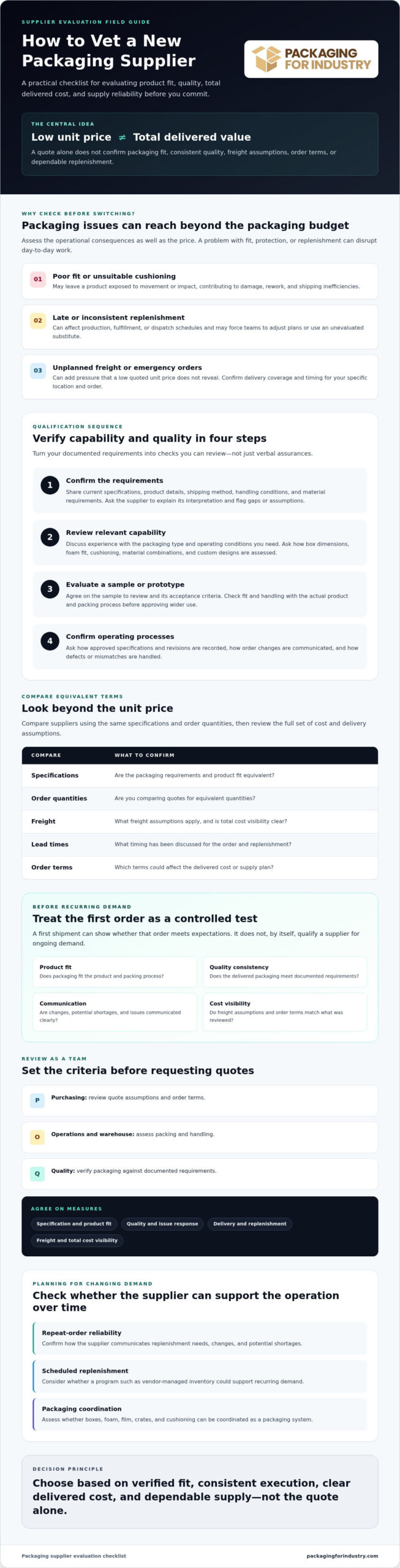
How to test a packaging supplier before approving an ongoing order
A successful sample review is only one part of supplier approval. Use a controlled first order to see whether the packaging performs in your operation and whether the supplier executes the order as agreed. Keep the trial scope manageable, involve the teams that handle and inspect the packaging, and define acceptance criteria before placing the order.
Compare the results with your documented baseline. Check specification conformance, order accuracy, delivery communication, and how the supplier handles any issue. Don’t expand volume until the acceptance criteria are met. Record exceptions, unresolved risks, and corrective actions so approval reflects evidence, not an informal impression. This makes how to vet a new packaging supplier a repeatable purchasing process rather than a one-time judgment.
Create a practical supplier scorecard
Use a scorecard to organize evidence from the quote, sample review, order records, and stakeholder feedback. Rate each area against criteria your team agreed on in advance, and include notes to explain the rating. For example, packaging may meet its specification while order communication still needs improvement. Keep those findings distinct.
- Technical fit: Does the packaging meet documented requirements and work in the packing process?
- Quality consistency: Does the delivered order match the approved sample and specifications?
- Quote clarity: Are pricing assumptions, freight, and order terms understood?
- Delivery performance: Did the order arrive as coordinated, with useful status communication?
- Responsiveness: Were questions and issues acknowledged, assigned, and resolved clearly?
For every exception, record the evidence, assign an owner, and set a follow-up action. If a defect or delay remains unresolved, document the operational impact and decide whether it blocks approval or requires a specific corrective step.
Check delivery coverage and day-to-day coordination
Confirm that the supplier can serve every required shipping location, and ask what delivery assumptions apply to each site and order. Southern California buyers should verify current local delivery availability and timing for their specific location rather than assume coverage is identical across the region.
Agree on the day-to-day process before recurring orders begin. Identify who submits orders, who receives forecast updates, and whom to contact about a supply concern. Set a clear escalation path for changes or potential shortages. These details help purchasing and warehouse teams coordinate replenishment and respond before a packaging issue affects production or shipping.
Choose a packaging supplier that can support your operation as it changes
Choose a supplier that meets documented requirements and fits how your operation buys, stores, and uses packaging. The right fit may change as product lines, order patterns, or shipping locations change, so consider both immediate needs and the supplier’s ability to support recurring demand.
Products: Packaging For Industry supplies custom and stock corrugated boxes, foam packaging, stretch film, pallets, crates, tubes and cores, and corner and edge protection. When these materials need to work together, a coordinated solution may simplify purchasing and help keep product protection consistent. Industries served: PFI supports manufacturers, warehouses, distribution operations, and aerospace and aviation businesses, among other industrial customers.
Benefits: Matching packaging to the product and shipping method can support protection, smoother handling, and more informed purchasing decisions. A combined solution isn’t necessary for every operation, so compare the value of coordinating multiple materials with your current sourcing approach.
When custom packaging or multiple materials matter
Consider custom boxes, foam inserts, or crates when stock options don’t meet product fit or shipping needs. Ask whether design support, samples, and related materials can be assessed together. PFI’s custom packaging design services include CAD/CAM support, prototypes, and samples. Why choose PFI: These capabilities can help your team review a tailored packaging approach before broader use, where appropriate.
When recurring supply needs call for a managed program
Frequent orders may create purchasing workload or pressure to hold more inventory than your operation can use or store. Ask whether vendor-managed inventory or just-in-time packaging fits your needs. Discuss how usage will be reviewed, which items are in scope, and how stocking and replenishment responsibilities will be agreed. PFI’s VMI programs use scheduled reviews and planned replenishment based on actual usage.
To evaluate a potential fit, share your current packaging items, specifications, usage patterns, quantities, and delivery locations. Confirm delivery availability and timing for each location and order.
Make your next packaging decision with confidence
A sound supplier decision comes from evidence: confirm packaging fit and quality, compare equivalent quotes using freight and order terms, then assess supplier performance with a controlled first order. This process helps you look beyond unit price and check whether supply, communication, and replenishment match your operation.
If you’re deciding how to vet a new packaging supplier, consider how its capabilities fit both current requirements and recurring demand. Packaging For Industry supplies custom and stock industrial packaging across multiple materials, with design support that includes CAD/CAM, prototypes, and samples. For ongoing needs, its vendor-managed inventory programs use scheduled reviews and planned replenishment based on actual usage. Evaluate these options against your specifications, order patterns, and delivery locations.
Bring your packaging requirements into the next conversation. Share specifications, quantities, and delivery needs with Packaging For Industry to request a quote and discuss an approach that fits your operation.
A clear evaluation now can help you build a packaging supply relationship that supports dependable operations as demand changes.
Frequently Asked Questions
How do I vet a new packaging supplier?
Start by documenting packaging specifications, order volumes, shipping conditions, and delivery locations. Ask each supplier to explain relevant capabilities, quote assumptions, quality communication, and replenishment approach. Review samples or prototypes when they can help verify fit, then use an agreed trial and scorecard before expanding orders. Include purchasing, operations, warehouse, and quality stakeholders so your decision reflects how the packaging performs throughout your workflow.
What should I ask a packaging supplier before placing an order?
Ask whether the supplier can meet your material, size, protection, quantity, and delivery requirements. Clarify what the quote includes, which freight assumptions apply, and how specification changes or quality concerns are handled. For recurring orders, discuss lead-time assumptions, replenishment planning, and order contacts. If fit is uncertain, ask whether a sample or prototype is available for review before committing to a larger order.
How can I compare packaging supplier quotes accurately?
Compare quotes only after aligning specifications, quantities, materials, delivery locations, and order assumptions. Separate product pricing from freight and other stated charges, then check for missing details before ranking offers. Consider whether package dimensions could affect carrier charges, including possible UPS or FedEx surcharges, and weigh the protection offered against potential damage risk. Account for the operational impact of shortages or excess stock, not just the unit price.
Can a packaging supplier help reduce shipping damage?
A packaging supplier may help assess whether box dimensions, corrugated construction, cushioning, foam fit, or crate design suit your product and shipping method. Share product details, handling conditions, and known damage patterns so recommendations address the actual application. Review proposed changes with the teams that pack and ship the product. Samples or prototypes can help you assess fit, but evaluate them against your operation’s requirements before wider use.
What is a packaging supplier trial order, and what should it prove?
A trial order is a limited purchase used to assess the packaging and supplier execution against criteria agreed in advance. Check specification conformance, order accuracy, delivery coordination, communication, and issue resolution. Involve the people who handle, store, and use the packaging, then record their findings and any unresolved concerns. Approve wider or recurring orders only after reviewing the trial results against your acceptance criteria.
When should a manufacturer consider vendor-managed packaging inventory?
Consider vendor-managed inventory when your operation uses packaging repeatedly and purchasing needs a structured replenishment process. Discuss actual usage, lead-time assumptions, storage limits, review frequency, and which items belong in the program. Packaging For Industry’s VMI programs use scheduled reviews and planned replenishment based on usage. Before deciding, compare the proposed responsibilities and stocking approach with your current shortages, excess inventory, and warehouse capacity.
Should I choose a local packaging supplier or a nationwide supplier?
Base the decision on the locations that need service, products required, delivery expectations, and consistency across your supply chain. A Southern California supplier may fit nearby operations, while nationwide support may suit businesses with multiple sites. Packaging For Industry serves Southern California and supports nationwide customers through distribution and manufacturing partners. Confirm current coverage and delivery assumptions for each site and order before selecting a supplier.