
Piling rolls of void fill into an oversized stock carton won’t solve transit damage; it usually just inflates your billable weight and frustrates your end customer. High-performance protective packaging design for e-commerce fulfillment isn’t about stuffing more dunnage into a box, but engineering multi-material precision that locks products securely in place.
You already know that parcel drops, sorting conveyor shocks, and transit vibration eat away at operational margins. At the same time, strict carrier dimensional weight rules penalize every cubic inch of dead air, while manual, multi-step wrapping stations drag down outbound warehouse throughput.
You don’t have to choose between transit survivability and rapid pack speeds. This engineering guide shows you how to design custom corrugated boxes and precision foam inserts to eliminate shipping damage, slash dimensional weight surcharges, and deliver a clean, professional unboxing experience. We’ll examine structural cushioning geometry, transit impact dynamics, and kitted assembly workflows designed to lower packaging costs across your entire fulfillment operation.
Key Takeaways
- Mastering protective packaging design for e-commerce fulfillment requires engineering against specific parcel courier hazards, such as conveyor drop shocks and transit vibration, rather than relying on generic dunnage.
- A structured five-step engineering process lets you calculate exact product fragility and cushioning curves to verify component fit with rapid prototyping before volume production.
- Engineered custom foam inserts reliably outperform loose void fill by stabilizing products, slashing carrier dimensional weight surcharges, and eliminating messy unboxing experiences.
- Optimizing pack stations with pre-assembled kitted inserts and quick-fold corrugated cartons drastically reduces operator touch points and accelerates warehouse throughput.
- Partnering with an integrated supplier for dual-manufactured corrugated boxes, precision foam, and vendor managed inventory programs lowers total packaging spend while securing supply reliability.
Fundamentals of Protective Packaging Design for E-Commerce Fulfillment
Single-parcel shipping subjects goods to a far more hostile distribution cycle than palletized freight. Parcels navigate automated distribution hubs, manual drops, and high-frequency vehicular vibration. While consumer packaging often prioritizes superficial graphics, industrial logistics demands physical shock absorption and vibration damping. Applying core fundamentals of packaging to single-parcel transit ensures your goods survive unpredictable handling. Successful protective packaging design for e-commerce fulfillment engineers a measurable barrier against multi-axis transit forces while keeping package volume compact and transit spend controlled.
The Parcel Transit Lifecycle and Drop Shock Dynamics
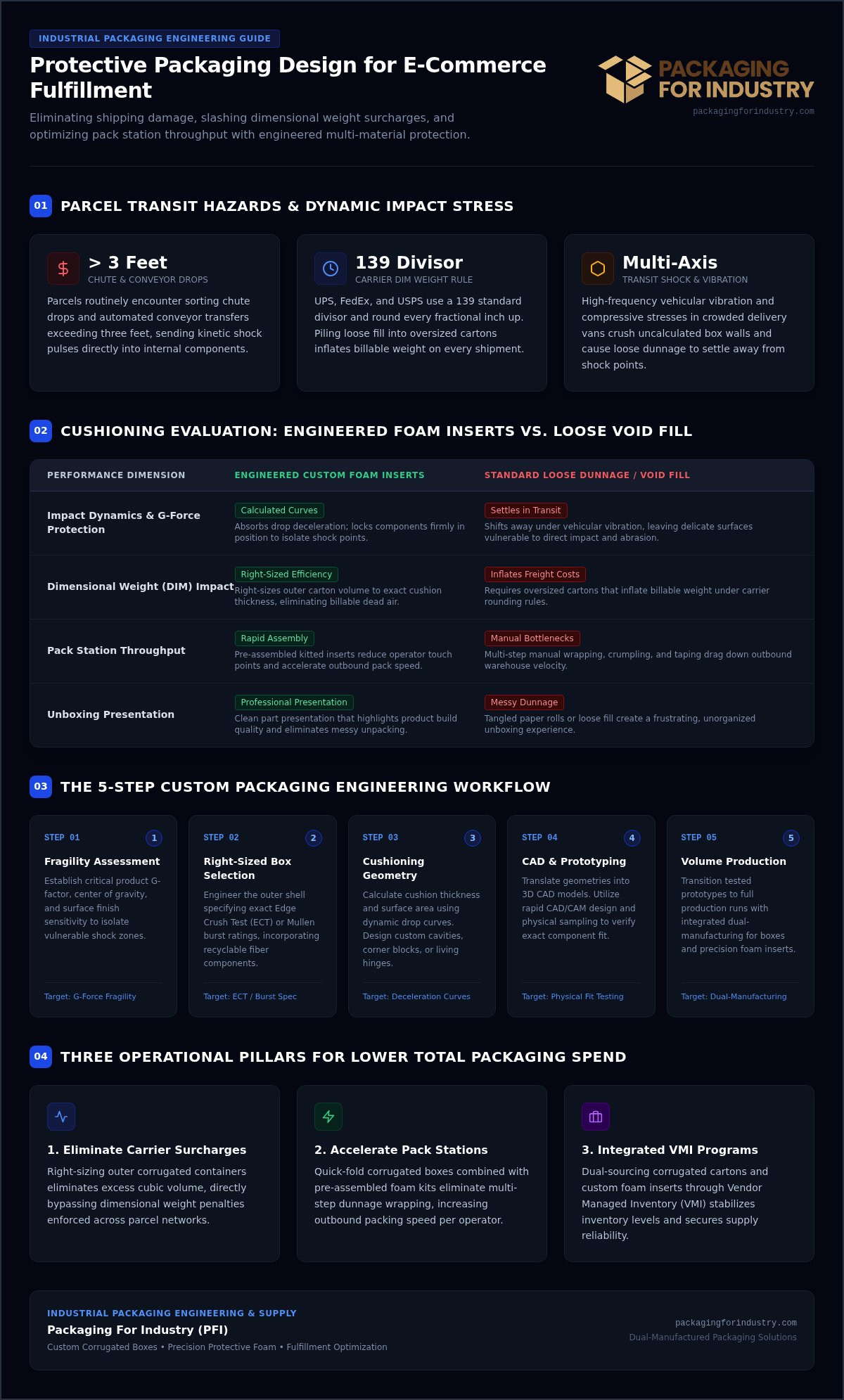
Parcels routinely encounter sorting chute drops, manual hand-offs, and transfers between automated conveyors from heights exceeding three feet. Each sudden drop generates a kinetic shock pulse that travels through the outer carton directly into the product. Protecting sensitive components requires matching cushion deceleration curves to the product’s maximum allowable G-force fragility rating. Without calculated cushioning geometry, dynamic compressive stresses inside crowded delivery vans quickly crush weak walls and damage internal components.
Balancing Transit Protection with Dimensional Weight Costs
Carriers heavily penalize oversized packaging. UPS, FedEx, and USPS all utilize a standardized dimensional weight (DIM) divisor of 139, with carrier rules rounding every fractional inch up to the next whole number. Piling loose dunnage into an oversized stock box inflates your billable weight on every single outbound parcel. Partnering with a specialized supplier for engineered custom design packaging lets operations right-size the outer corrugated carton to the exact cushion thickness required, eliminating dead air and carrier surcharges.
Unboxing Aesthetics vs. Industrial Structural Integrity
Loose void fill settles during transit, shifting away from critical impact points and leaving delicate surfaces vulnerable to abrasion. Beyond mechanical failure, loose paper or tangled fill creates a frustrating, messy unboxing experience for the receiver. Engineered, structured interior packaging secures components firmly in place. This clean-part presentation safeguards critical finishes, prevents transit abrasion, and immediately signals professional build quality to your commercial or direct-to-consumer clients.
How to Engineer Custom Protective Packaging: A 5-Step Process
Transitioning from off-the-shelf packaging to engineered protection requires a systematic workflow. Successful protective packaging design for e-commerce fulfillment links material science directly to parcel transit physics. By following a sequential five-step engineering process, fulfillment operations eliminate transit damage while actively trimming excess carton volume.
Step 1 & 2: Fragility Assessment and Right-Sized Box Selection
The engineering process begins by establishing product fragility. Determine your product’s critical G-factor, center of gravity, and surface finish sensitivity to isolate vulnerable shock points. Next, engineer the outer shell. Instead of picking an oversized stock carton, specify an exact Edge Crush Test (ECT) or Mullen burst-rated custom corrugated container. Factor in circular lifecycle principles early by designing for recyclability through clean, separable fiber components that minimize environmental footprints.
Step 3 & 4: Cushioning Geometry and Physical CAD Prototyping
Step three calculates the exact cushion thickness and surface area required using dynamic drop curves. Packaging engineers design custom cavities, corner blocks, or living hinges to secure delicate edges and distribute deceleration forces evenly. Step four translates these geometries into 3D CAD models. At Packaging For Industry, our technical team provides rapid CAD/CAM design alongside free prototyping and sampling to verify component fit before you commit to production tooling. This allows warehouse managers to inspect physical tolerances and refine component retention through full-service custom design packaging support.
Step 5: Pack Station Assembly and Verification
The final stage validates real-world performance on the packaging line and inside courier networks. Test the prototype packaging at warehouse pack stations to ensure operators can complete insertion in a single motion without multi-step manual wrapping. Next, subject the packaged assembly to drop and vibration testing to confirm shock absorption limits. Once validated, standardize assembly instructions across shifts to eliminate operator variance. If your team wants to resolve parcel damage and streamline fulfillment touch points, request a packaging quote to review engineered CAD prototypes for your high-value SKUs.
Evaluating Protective Cushioning: Custom Foam Inserts vs. Void Fill
Relying on loose dunnage creates unpredictable shipping outcomes. When items experience continuous courier transit vibration, loose void fill shifts and compacts, allowing heavy or sharp products to migrate directly against carton walls. Comprehensive protective packaging design for e-commerce fulfillment evaluates cushioning mechanics through material density, structural blocking, and resilience under repeated impacts.
Polyethylene vs. Polyurethane: Selecting Foam Density
Matching the correct cellular material to your payload prevents shock transmission. Closed-cell polyethylene foam offers high compressive strength and non-abrasive surface contact, making it the benchmark for heavy components, industrial tools, and machined parts. Open-cell polyurethane foam provides flexible, low-load deceleration suited for lightweight electronics, calibrated instruments, and delicate optics. For sensitive printed circuit boards and electronic assemblies, specialized pink or black static-dissipative ESD foam packaging prevents electrostatic discharge alongside physical drop cushioning.
Structured Inserts vs. Loose Air Pillows and Paper Fill
Loose paper and plastic pillows function primarily as spatial dunnage rather than engineered shock absorbers. Under severe dynamic loads, air pillows burst and crumpled paper crushes flat without rebounding. By contrast, engineered foam end caps hold goods in continuous suspension away from carton faces.
- Shock Absorption: Custom foam distributes deceleration forces predictably; loose void fill compresses unevenly and allows bottoming out.
- Pack Station Velocity: Pre-cut inserts drop into cartons instantly, eliminating time-consuming manual paper crumpling or multi-layer wrapping.
- Customer Unboxing: Molded or routed cavities present clean, organized components without the mess of shredded paper or deflated film.
Total Landed Cost: Cushioning Performance per Dollar
Evaluating packaging materials solely on raw piece-part cost ignores the financial impact of transit failures. Loose dunnage demands oversized master cartons, running up courier dimensional weight billing and carrier surcharges on every lane. Engineered custom inserts fit the product tightly, enabling substantial carton right-sizing. By cutting outer box dimensions, operations reduce billable parcel weight, eliminate damaged product returns, and wipe out expensive reshipment costs.
Fulfillment Optimization: Packing Speed, Storage, and Unboxing Flow
Engineering a protective container addresses only half the operational challenge. If an insert requires complex folding maneuvers or excessive tape strips, packing benches become severe warehouse bottlenecks during peak shipping volume. Effective protective packaging design for e-commerce fulfillment integrates line-level pack ergonomics directly into the structural design, balancing transit survivability with rapid dispatch speeds.
Pack Station Ergonomics and Assembly Touch Times
Every unnecessary operator movement inflates fulfillment labor costs. Traditional packing lines waste time assembling multi-flap boxes, dispensing dunnage, and taping multiple seams. Switching to pre-glued auto-lock bottom corrugated cartons allows pack station operators to erect an outer box in a single motion. Pairing these containers with snap-in foam end caps eliminates manual wrapping entirely. Workers position the protective cushions onto the product and slide the unit directly into the box, drastically cutting cycle time per package.
Designing the Unboxing Sequence for High-Value Goods
Industrial performance does not require sacrificing the receiver’s unboxing experience. For high-value electronics, medical sensors, or precision components, structured interior layouts guide the customer through an intuitive unboxing sequence. Tiered inserts keep critical accessories, documentation, and hardware organized above the primary unit. Incorporating molded finger-pull tabs and clear release points allows receivers to extract sensitive products safely without tugging on fragile connectors. Delivering pristine, dust-free components builds long-term customer confidence and reinforces product quality.
Managing Packaging Warehouse Footprint and Inventory Flow
Bulky custom foam sets and corrugated blanks quickly occupy valuable warehouse pallet racking if not managed systematically. High-volume operations overcome floor congestion by partnering with packaging specialists offering tailored e-commerce packaging solutions. Leveraging staged deliveries and pre-kitted packaging sets ensures pack stations have immediate access to matched box-and-foam sets without tying up warehouse staging lanes. This inventory coordination protects floor space and guards against packaging stockouts when seasonal volume surges hit distribution centers.
Sourcing Custom Fulfillment Packaging: Scaling with Packaging For Industry
Managing multiple packaging vendors creates administrative drag and operational disconnects. When corrugated boxes arrive from one converter and foam inserts from another, dimensional tolerances often drift, leading to pack station friction. Packaging For Industry (PFI) operates as a full-service industrial packaging supplier, providing dual manufacturing capabilities across custom corrugated cartons, precision foam cushioning, tapes, and stretch wrap under one roof. Sourcing complete packaging assemblies through an integrated partner ensures your protective packaging design for e-commerce fulfillment performs seamlessly from production lines to the end customer’s door.
Custom Engineering and Prototyping Capabilities
PFI functions as an engineering partner rather than a transactional catalog distributor. Our team analyzes your product line to tailor board grades, flute profiles, and multi-layer cushioning geometries. Before investing capital in custom production tooling, fulfillment teams receive free physical prototyping and sampling to test component fit and verify real-world drop survivability. This hands-on validation ensures precision retention for sensitive assemblies without guesswork.
Reliable Supply Chain and Vendor Managed Inventory
Packaging supply disruptions quickly stall fulfillment output. PFI solves inventory bottlenecks through tailored Vendor Managed Inventory (VMI) programs. Packaging specialists monitor your burn rates, conducting scheduled reviews to align restocks with real-time outbound volume. By replenishing inventory on a just-in-time schedule, warehouses gain key operational advantages:
- Eliminate safety stock build-up to recover valuable warehouse rack space.
- Prevent expensive packaging shortages and pack station downtime during seasonal volume spikes.
- Consolidate purchasing across corrugated, foam, and pallet supplies to streamline administrative overhead.
Local Delivery in Southern California and Nationwide Shipping
Supply reliability depends on fast, localized logistical support. PFI maintains rapid regional fulfillment, offering next-day local delivery across Anaheim, Orange County, Los Angeles, and the Inland Empire via a dedicated delivery fleet. For multi-facility distribution networks, our nationwide shipping infrastructure ensures uniform packaging standards across all fulfillment nodes. When you are ready to lower packaging costs, protect sensitive goods, and improve packaging reliability, request a packaging quote to build an engineered packaging program tailored to your distribution operations.
Engineer Higher Margins and Zero-Damage Parcel Delivery
Relying on loose void fill and oversized boxes erodes fulfillment margins through inflated dimensional weight fees and preventable transit damage. Shifting to an engineered protective packaging design for e-commerce fulfillment replaces guesswork with multi-material precision. By pairing right-sized corrugated cartons with custom foam inserts, operations isolate dynamic shock, eliminate dead air, and cut pack station assembly times.
Packaging For Industry serves as your technical manufacturing partner, delivering dual in-house capabilities across custom corrugated containers and fabricated foam inserts. We provide free prototyping and sampling to verify component fit before full rollout, backed by next-day local delivery across Southern California and dependable nationwide distribution support.
Taking control of your packaging structural design today protects your operating margins, stabilizes warehouse throughput, and builds lasting customer loyalty across every shipping lane.
Frequently Asked Questions
What is the best protective packaging design for shipping fragile e-commerce items?
The best design integrates custom-cut foam end caps inside a right-sized, heavy-duty corrugated carton tailored to the product’s fragility rating. Instead of relying on loose dunnage, high-performance protective packaging design for e-commerce fulfillment isolates impact shock using calculated deceleration space. Combining an ECT-rated outer box with resilient polyethylene or polyurethane inserts suspends the item away from box walls, ensuring fragile electronics, medical devices, or industrial components survive courier sorting impacts intact.
How does custom protective packaging reduce dimensional weight shipping fees?
Custom protective packaging slashes dimensional weight fees by eliminating excess cubic volume and dead air inside the shipping container. Because major parcel carriers calculate billable weight using the standard dimensional formula divisor of 139 and round up fractional dimensions, oversized stock boxes incur steep surcharges. Engineering exact-fit foam cushioning allows warehouses to shrink master carton dimensions down to the minimum necessary footprint, directly reducing billable parcel weight and avoiding oversize handling penalties.
What is the difference between polyethylene and polyurethane foam inserts?
Polyethylene is a high-density, closed-cell foam built for heavy loads, while polyurethane is an open-cell, flexible foam suited for lighter, delicate goods. Polyethylene delivers superior compressive strength and multi-drop shock absorption, making it ideal for machined parts, tools, and industrial equipment. Polyurethane provides softer, progressive deceleration that cradles sensitive components like circuit boards or laboratory optics without marring finishes. Both materials can also be formulated with anti-static ESD properties.
How do engineered foam inserts improve warehouse packing station speed?
Engineered foam inserts boost packing speed by replacing multi-step manual wrapping routines with simple, one-motion component placement. Pack station workers lose valuable seconds measuring, tearing, and bunching paper or winding bubble film around irregular parts. Custom die-cut foam sets allow operators to slide components directly into form-fitting cavities and drop the entire assembly into the carton in seconds. This streamlined assembly sequence standardizes pack times and increases daily order throughput.
Can custom protective packaging be tested for transit drops before ordering bulk quantities?
Yes, professional packaging manufacturers provide physical CAD samples and rapid prototypes to validate drop performance before you commit to production runs. At Packaging For Industry, our engineering team supplies free prototyping and sampling to verify component fit, cushioning geometry, and retention tolerances. Operations teams can inspect part clearances, test warehouse packing workflows, and conduct drop tests on physical mockups, eliminating operational guesswork and tooling risk before placing wholesale packaging orders.
Why is loose void fill less effective than custom-engineered interior packaging?
Loose void fill settles and migrates during vehicular transit, leaving products unprotected against carton sidewalls during courier drops. Materials like air pillows and crumpled paper easily compress, burst, or shift under repeated transit vibration. This movement creates empty space inside the box, allowing heavy or sharp products to bottom out on impact. Structured protective packaging design for e-commerce fulfillment permanently anchors items in fixed positions, maintaining continuous clearance and uniform shock dampening.
How do Vendor Managed Inventory programs prevent e-commerce packaging stockouts?
Vendor Managed Inventory (VMI) programs track real-time packaging burn rates to schedule planned replenishment before cartons or foam inserts run out. PFI partners with fulfillment centers, distributors, and manufacturers across Southern California and nationwide to conduct scheduled weekly or monthly inventory reviews. By monitoring usage trends and holding stock locally, VMI programs prevent emergency order surcharges, eliminate warehouse floor clutter, and ensure packing lines never face downtime during unexpected seasonal fulfillment volume spikes.