
Between rigid carrier dimensional weight rules and volatile venue drayage fees, packaging is often the difference between a profitable multi-city tour and a massive budget overrun. Most logistics and event managers know the sinking feeling of unlatching a container on the convention floor only to find crushed aluminum frames or gouged panel graphics. Investing in engineered custom crates for trade show exhibits turns your display components into resilient, reusable assets that survive rough LTL transit.
You shouldn’t have to battle carrier surcharges, complicated hardware, or frantic teardowns when the show floor closes. In this guide, you will discover how to specify, design, and source durable crates that eliminate transit damage and streamline booth setup. We will examine dimension optimization strategies, precision foam inserts, and tool-free access systems that reduce shipping damage and lower packaging costs across every venue.
Key Takeaways
- Learn why engineered custom crates for trade show exhibits eliminate structural racking and graphic damage during aggressive LTL freight transfers.
- Discover how integrating high-density foam cushioning with reinforced exterior framing protects delicate mechanics from road vibration.
- Master footprint and dimension optimization strategies that reduce carrier dimensional weight penalties and lower venue drayage fees.
- Use our industrial supplier checklist to evaluate custom CAD prototyping, hardware configurations, and material durability before requesting a quote.
Why Custom Crates for Trade Show Exhibits Outperform Standard Packaging
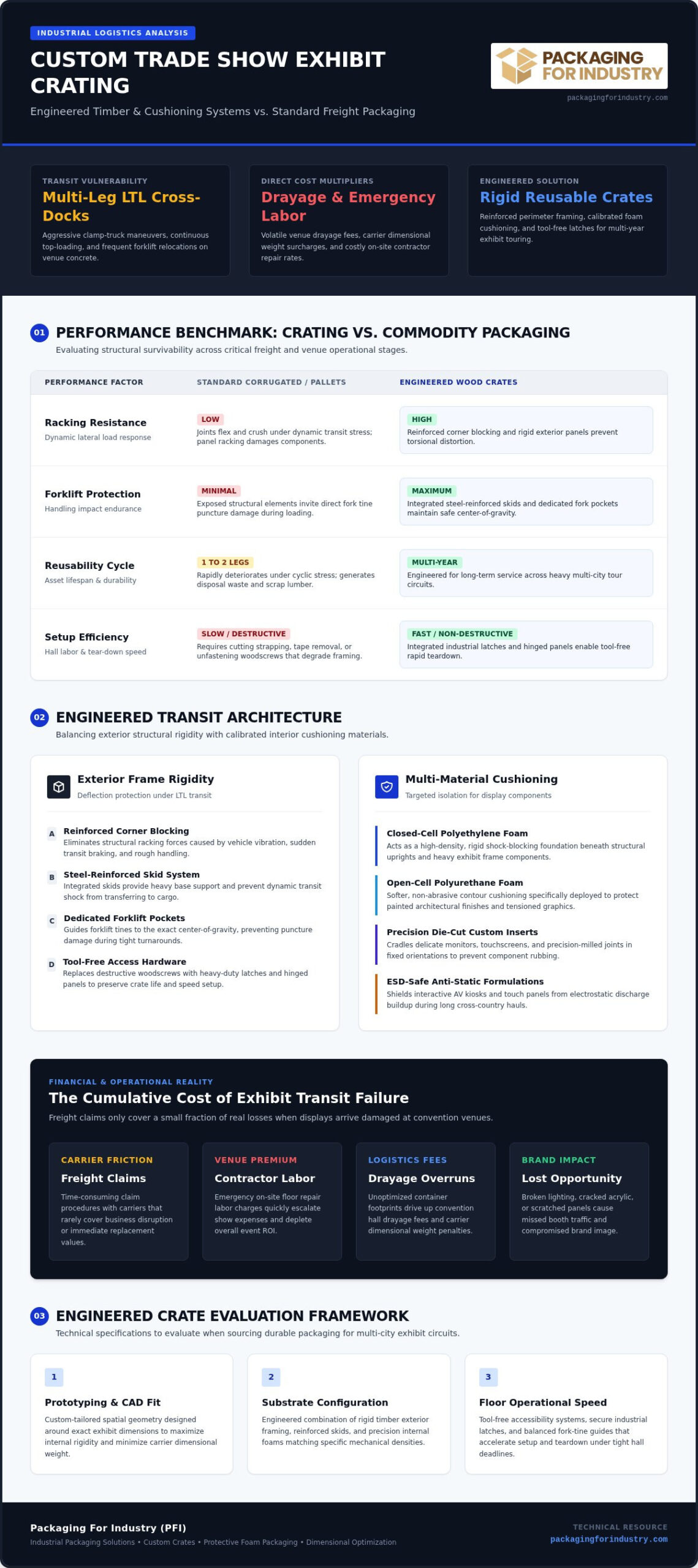
Trade show logistics demand more structural endurance than traditional dock-to-dock freight. Over a typical circuit, an exhibit moves through multiple LTL cross-dock facilities, withstands aggressive clamp-truck maneuvers, and endures frequent forklift relocations on convention hall concrete. Standard packaging cannot handle this abuse. Off-the-shelf corrugated containers buckle under top-loaded cargo, while commodity wooden pallets leave high-value exhibits vulnerable to edge impacts, structural racking, and cyclic transit fatigue. Engineered custom crates for trade show exhibits solve these liabilities by providing rigid, precision-fitted containment designed for continuous nationwide transit.
The Real Cost of Exhibit Transit Damage
A damaged display carries hidden expenses that far exceed carrier freight claims. Discovering crushed structural uprights or cracked acrylic fascias during hall setup forces your team into frantic emergency repairs. Local on-site contractor labor rates quickly erode show ROI, and if replacements can’t arrive before the opening bell, your brand loses valuable booth traffic. Deploying tailored custom packaging solutions safeguards delicate electronics, thin LED displays, and custom-tensioned graphics. Proactive crating eliminates the recurring expense of filing freight claims and rebuilding broken elements between city tour stops.
Engineered Crating vs. Stock Shipping Containers
Generic packaging assumes smooth, single-destination freight movement. In contrast, heavy-duty exhibit transit operates much like equipment handling in live events, where teams rely on durable enclosures like an ATA case to survive continuous setup cycles. Industrial-grade crating applies this same survivability mindset through robust lumber, shock-absorbing bases, and custom skid placement.
| Performance Factor | Standard Corrugated / Pallets | Engineered Wood Crates |
|---|---|---|
| Racking Resistance | Low; joints flex and crush under dynamic transit stress | High; reinforced corner blocking and rigid exterior panels |
| Forklift Protection | Minimal; exposed loads invite direct tine puncture damage | Maximum; integrated steel-reinforced skids and dedicated fork pockets |
| Reusability | Fails after 1 to 2 transit legs; generates scrap | Multi-year service life across heavy multi-city tours |
| Setup Efficiency | Slow; requires tearing tape, wrap, and loose strapping | Fast; integrated latches and hinged panels enable tool-free breakdown |
Custom skids and reinforced fork pockets ensure lift operators maintain stable center-of-gravity control during tight turnarounds. Rather than piecing together stock boxes that deteriorate under load, exhibitors utilize PFI-engineered wooden crates. These containers withstand repetitive handling, reduce shipping damage, and lower packaging costs across every trade show appearance.
Essential Design Features of High-Performance Trade Show Crates
A rugged exterior shell provides necessary impact resistance, but structural framing alone cannot prevent freight damage. True transit protection requires an integrated engineering approach that balances rigid external lumber with precision-calibrated interior cushioning. By pairing exterior durability with internal stability, high-performance custom crates for trade show exhibits preserve delicate finishes, protect mechanical fasteners, and streamline labor on active exhibit hall floors.
Precision Interior Cushioning and Foam Inserts
Freight vibration quickly loosens hardware and mars high-gloss surfaces when components rub inside a moving container. Addressing this requires multi-material engineering using dense protective foam packaging. Closed-cell polyethylene foam acts as a rigid shock blocker under heavy frames, while softer, non-abrasive polyurethane wraps around fine architectural textures and painted finishes.
Die-cut custom foam inserts cradle touchscreens, monitors, and precision-milled joints in fixed orientations. For sensitive electronics, interactive AV kiosks, and touch panels, ESD-safe anti-static foam formulations prevent electrostatic discharge buildup during dry winter transit or cross-country hauls.
Hardware Built for Fast Convention Hall Turnaround
Teardown speed directly influences labor costs. Using standard woodscrews ruins container integrity after just two stops and forces your team to scramble for power tools during floor egress. High-performance crates feature reusable hardware designed for quick cycling:
- Recessed Butterfly Twist Latches: Heavy-duty link locks secure exterior panels tightly without snagging adjacent freight, allowing fast, tool-free access.
- Hinged Drop-Down Ramps: Integrated end-wall ramps permit rolling heavy display modules and base cabinets directly into the crate rather than lifting them over high sidewalls.
- Steel Ball Corners and Recessed Handles: Heavy-gauge corner caps absorb edge strikes from neighboring pallets, while spring-loaded handles protect handlers and stay flush during transit.
International Transit Compliance and ISPM-15 Standards
Operating a global exhibition tour introduces strict agricultural regulations. Historical data from the Center for Exhibition Industry Research highlights that logistics and booth operations make up substantial shares of overall event spend; customs delays or cargo rejections instantly balloon those costs. Any solid wood framing traversing global borders requires certified heat treatment to eliminate wood-boring pests, verified by an official ISPM-15 quality stamp.
Beginning January 1, 2026, USDA APHIS fully enforces the requirement that every ISPM-15 wood packaging mark includes a hyphen between the country code and facility code. Crates lacking this compliant stamp face mandatory border rejection or costly destruction at the port of entry. When preparing multi-city tours that cross borders, partnering with an experienced industrial packaging supplier ensures every skid and brace meets international export standards.
If you need to optimize your touring crates for structural durability and rapid assembly, request a packaging quote to evaluate custom sizes and engineered cushioning options tailored to your display footprint.
Sizing Trade Show Crates to Minimize Freight and Drayage
Every extra inch and pound on an exhibit crate triggers compounded logistical fees. Long before a display reaches the convention floor, freight carriers evaluate volume against scale weight, while general service contractors audit incoming tonnage at the marshal yard. Specifying custom crates for trade show exhibits with exact outer dimensions prevents these hidden overhead costs while maintaining vital structural rigidity.
Understanding Convention Drayage and Dimensional Weight
Material handling, commonly billed as drayage, covers unloading freight at the dock, staging containers at your booth, storing empties, and returning crates after the show. Venue contractors bill drayage based on gross weight rounded up to the nearest hundredweight (CWT), often imposing a 200-pound minimum charge per individual piece. Shipping ten loose cases results in ten separate minimum charges. Consolidating components into a single multi-bay crate eliminates fragmented piece penalties, consolidating your shipment under a single, predictable line item.
Over-the-road freight carriers enforce their own pricing hurdles through Dimensional Weight (DIM). Major parcel and LTL freight networks determine billable weight by comparing actual scale weight against dimensional cubic volume using standard DIM divisors. Additionally, major carriers round each exterior dimension up to the nearest whole inch before calculating volume. An unengineered container with two inches of unnecessary height or protruding exterior batten boards can push an entire shipment into higher freight tiers or trigger oversize surcharges. Utilizing 3D CAD modeling eliminates dead interior air, matching the exterior container volume directly to nested booth hardware.
Balancing Structural Ruggedness with Tare Weight
Heavy framing prevents impact damage, but overbuilding with solid timber drives up both freight line-haul and venue drayage fees. Modern industrial crating solves this trade-off by combining high-strength materials strategically:
- Engineered Plywood Sheathing: Replacing heavy solid-sawn dimensional lumber with multi-ply exterior plywood maintains shear strength and impact deflection while reducing empty container tare weight.
- Low-Profile Steel Skid Runners: Installing steel-capped wooden skids allows smooth four-way forklift tine entry without adding excess vertical height to the overall package footprint.
- Segmented Internal Dividers: Modular plywood partitions secure separate frame components vertically, maximizing interior density without requiring solid wood bulkheads.
Right-sized custom crates for trade show exhibits align structural safety with commercial logistics, lowering packaging costs and drayage fees across consecutive multi-city exhibit tours without risking frame deflection.
Step-by-Step Buying Checklist: Selecting the Right Industrial Crate Supplier
Sourcing protective containers for an exhibition tour requires more than finding a basic carpenter. You need an engineering partner capable of translating fragile booth geometry into reliable, field-tested containment. Evaluating manufacturing precision, hardware integration, and delivery infrastructure upfront prevents costly logistical delays. Use this checklist when vetting suppliers for custom crates for trade show exhibits:
- CAD/CAM Prototyping: Does the supplier provide 3D component modeling and physical sample testing before cutting full lumber runs?
- Material Integration: Can they fabricate custom die-cut polyethylene foam cradles, metal brackets, and ISPM-15 export lumber under one roof?
- Convention-Floor Hardware: Do they install tool-free butterfly latches, link locks, and drop-down loading ramps suitable for rapid union breakdown?
- Logistical Reliability: Does the vendor offer regional direct delivery and flexible inventory programs for ongoing multi-city exhibition tours?
Evaluating Custom Design and Prototyping Capabilities
Never commit capital to full production without validating interior fitment. Professional fabricators use CAD/CAM design platforms to map interior clearances around complex architectural uprights, delicate graphics, and integrated electronics. Whether protecting sensitive AV hardware or large-format trade show signage printed by Banner 4 Sale, precise internal compartmentalization prevents scuffing, creasing, and surface abrasion. Requesting a physical prototype lets your setup crew verify center-of-gravity balance and component accessibility. Review past industrial packaging work across aerospace, manufacturing, and commercial displays to confirm the fabricator understands structural load distribution.
Event deadlines leave zero margin for supply chain delays. Working with a regional manufacturing hub ensures your containers arrive on dock weeks before freight marshalling begins. For exhibitors across Orange County, Los Angeles, and Riverside, partnering with a local packaging supplier provides dedicated next-day site delivery, eliminating long-distance freight transit risks before your tour even starts.
Marketing teams and exhibit houses managing multiple booth footprints across concurrent tours also benefit from structured fulfillment. Programs like Vendor Managed Inventory (VMI) and just-in-time inventory management maintain spare panels, customized inserts, and pre-built crates in stock, ready for immediate dispatch when tour schedules expand.
Custom Trade Show Exhibit Crating Solutions from Packaging For Industry
Packaging For Industry (PFI) engineers heavy-duty packaging systems engineered specifically around complex commercial displays. Operating out of Anaheim, California, PFI provides end-to-end design, CAD/CAM prototyping, and precision manufacturing for exhibit builders, marketing agencies, and industrial manufacturers. Instead of relying on commodity wooden boxes, our team fabricates custom crates for trade show exhibits that lower packaging costs, eliminate freight damage, and accelerate booth setup on active convention floors.
Comprehensive Multi-Material Packaging Capabilities
Delicate architectural displays require an integrated approach to protective packaging. Rather than sourcing framing from one vendor and cushioning from another, PFI integrates multi-material solutions under one roof:
- Precision Foam Fabrication: We design custom die-cut polyethylene and polyurethane foam inserts to securely position lighting trusses, fragile graphic panels, and interactive display kiosks.
- Structural Lumber and Hardware: Heavy-duty exterior framing pairs with recessed handles, steel twist latches, and internal divider walls engineered to survive aggressive LTL transfers.
- Ancillary Shipping Supplies: Streamline your operational prep by bundling protective packaging essentials, including heavy-duty stretch film, reinforced strapping, and durable corner and edge protection.
This single-source procurement model eliminates the operational friction of juggling multiple vendors. Your team receives completely kitted, ready-to-load containers tailored to your exact display hardware.
Southern California Manufacturing with Nationwide Distribution
Timing dictates trade show success. PFI delivers rapid turnaround times and dependable logistics throughout the region. We offer local next-day delivery across Orange County, Los Angeles County, Riverside County, and San Diego. Whether your operations are based in Anaheim, Irvine, or Carson, your packaging arrives directly on your dock without freight transit delays.
For brands managing multi-city circuits across Chicago, Las Vegas, Orlando, and beyond, our nationwide logistics network ensures consistent supply reliability. We support expanding exhibition schedules with custom design verification, rapid repeat production runs, and managed inventory replenishment.
Protect your display investment and streamline your floor operations for the upcoming season. Request a packaging quote to collaborate with PFI packaging specialists on custom sizes, CAD prototypes, and volume pricing.
Upgrade Your Exhibit Logistics for Reliable Multi-City Touring
Trade show displays represent significant capital investments, and their packaging must function as a precision operational asset. Deploying engineered custom crates for trade show exhibits eliminates transit damage claims, minimizes hundredweight drayage fees through dimensional optimization, and accelerates booth teardowns when convention floor timers start running. You don’t have to risk your brand presence on flimsy commodity packaging.
Packaging For Industry serves as your single-source provider of heavy-duty wood crates, precision die-cut foam inserts, and essential packaging supplies. Our engineering team supports your operations with free CAD design and physical prototyping, backed by dependable local next-day delivery across Orange, Los Angeles, and Riverside counties.
Protect your booth components before your upcoming tour stops so your field crew can focus entirely on driving attendee engagement and event revenue.
Frequently Asked Questions
What makes custom crates for trade show exhibits better than standard shipping crates?
Standard crates use generic footprints and light fasteners that loosen under repetitive LTL freight handling. Custom crates for trade show exhibits are engineered around your exact booth geometry with heavy-duty framing, internal partitions, and shock-absorbing foam. This precision design prevents structural racking, eliminates panel scuffing, and includes integrated forklift skids that reduce drop risks during aggressive cross-dock transfers.
How many trade show trips can a custom reusable wooden crate typically handle?
A well-engineered custom wooden crate easily handles dozens of exhibition trips across multiple years of touring. Unlike commodity boxes or standard pallets that degrade after one or two legs, industrial reusable crates feature exterior plywood sheathing, heavy-gauge steel ball corners, and recessed latching. This durable construction withstands repeated forklift handling, intermodal transfers, and harsh freight conditions while keeping exhibit panels securely aligned.
Can custom trade show crates be engineered for tool-free assembly and breakdown?
Yes, custom crates can be fabricated with recessed butterfly twist latches, link locks, and hinged access doors that require zero power drills or pry bars. Tool-free hardware speeds up teardowns on the convention floor, allowing booth crews to pack up quickly without searching for tools or stripping screw holes. Integrated drop-down ramps also allow wheeled exhibit elements to roll directly in and out.
What types of protective foam are recommended inside trade show exhibit crates?
High-performance crates generally combine closed-cell polyethylene and open-cell polyurethane foam. Rigid polyethylene provides firm base support and shock absorption beneath structural trusses and heavy frame bases. Non-abrasive polyurethane cushions sensitive graphic finishes and painted acrylic from vibration scuffs. For touchscreens, monitors, and interactive kiosks, anti-static ESD foam prevents static electricity buildup during long cross-country hauls.
How do custom crate dimensions affect trade show drayage and material handling costs?
General contractors bill drayage per hundredweight (CWT), often enforcing a 200-pound minimum per individual piece. Consolidating modular components into custom crates for trade show exhibits prevents multiple minimum piece charges. In addition, engineering outer dimensions via CAD eliminates wasted cubic volume. This tight footprint prevents freight carriers from bumping your shipment into higher dimensional weight brackets or assessing oversized package surcharges.
Are custom wooden trade show crates certified for international shipping?
Yes, export-ready trade show crates use heat-treated solid lumber certified under international ISPM-15 standards. Compliant crates receive an official bug stamp displaying the country code and facility number separated by a hyphen to clear border inspections. Manufactured engineered woods like plywood are exempt from treatment, but integrated solid base skids, internal blocking, and external cleats must carry verified treatment stamps.
How quickly can custom trade show crates be engineered and manufactured?
Turnaround times depend on design complexity and production volume, but working with a regional manufacturer streamlines lead times significantly. PFI provides rapid 3D CAD modeling and physical prototyping from our Anaheim facility to validate fitment before full production runs. For exhibitors across Orange County, Los Angeles, and Riverside, local next-day delivery ensures your completed crates reach your warehouse dock well before freight staging begins.