
Why do fragile parts still arrive damaged when they’re already packaged for protection? Often, the packaging doesn’t match the part, the shipping method, or the way teams handle it along the way. Effective protective packaging for fragile industrial parts starts with understanding those factors, not simply adding more cushioning.
If your current packaging isn’t preventing damage, you’re right to question whether a change will add material, freight, or handling costs. A better fit can protect the part while working with your shipping and production processes. This guide explains how to assess shipping risks, compare protective options, and specify a solution based on the part’s dimensions, fragility, and shipment requirements.
You’ll also see how foam inserts, corrugated boxes, and crates can work together as a protective system, and how custom packaging design, prototypes, and samples can help evaluate fit before wider implementation. Whether you’re considering stock packaging or custom packaging solutions, the goal is practical: reduce shipping damage without making operations more complicated.
Key Takeaways
- Assess the part’s dimensions, weight, fragile features, and shipping conditions before selecting materials.
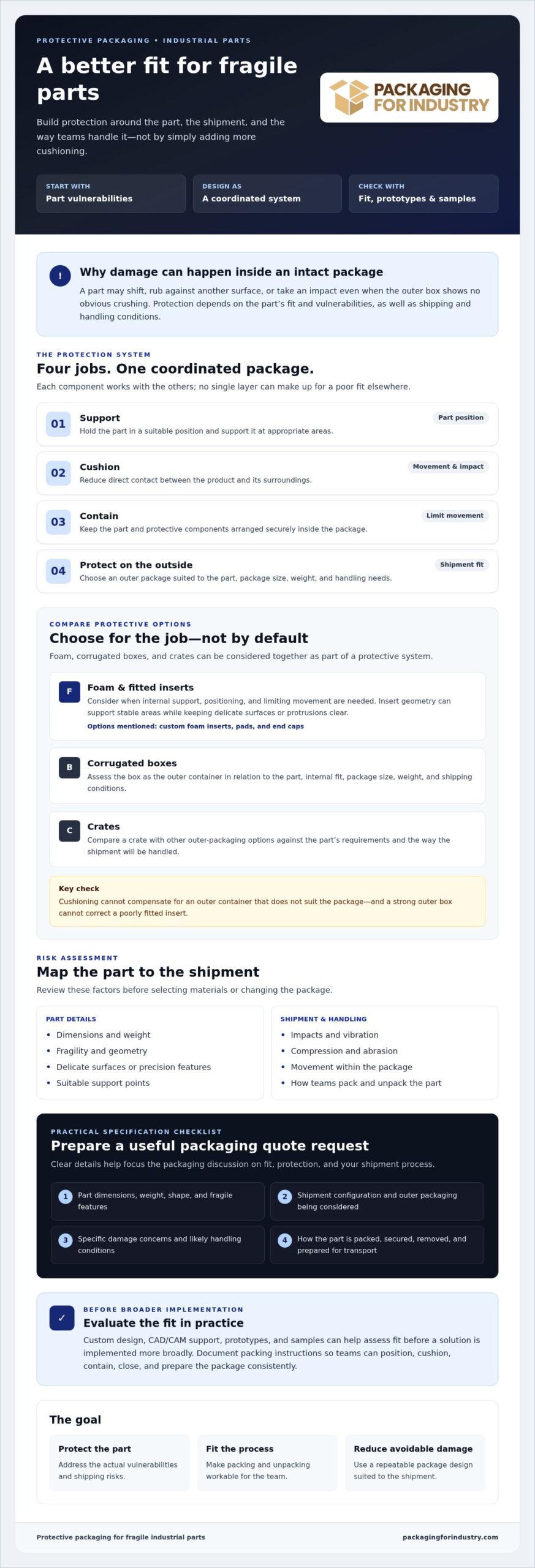
- Choose protective packaging for fragile industrial parts as a coordinated system, with support, cushioning, containment, and outer packaging working together.
- Compare foam, corrugated boxes, and crates against the part’s needs and handling process rather than assuming one option fits every shipment.
- Prepare a useful quote request with part details, shipment configuration, and specific damage concerns to support a practical packaging discussion.
- Explore custom design, CAD/CAM support, prototypes, and samples to evaluate fit before broader implementation.
Why fragile industrial parts need packaging designed around shipment risks
A damaged industrial part can trigger replacement work, production delays, rework, reshipments, and extra customer service effort. The packaging may look intact while a precision feature inside has shifted, rubbed against another surface, or taken an impact. Reliable protection starts by assessing the part and its shipping conditions, not by adding cushioning without a clear purpose.
Protective packaging for fragile industrial parts is a coordinated arrangement of support, cushioning, containment, and outer packaging designed around a part’s vulnerabilities and the handling it may encounter in transit. That definition puts the focus on the whole package. The outer container, internal fit, and shipping configuration all contribute to protection.
What makes an industrial part vulnerable during shipping?
Consider the part’s fragility, geometry, weight, and likely handling. A delicate surface may need protection from abrasion, while protrusions or precision features may be vulnerable to contact or impact. An irregular shape can be difficult to support evenly, and a heavy part can shift if the package doesn’t hold it securely.
Assess exposure to impacts, vibration, compression, abrasion, and movement within the package. Look beyond visible external damage: a box can arrive without obvious crushing, yet internal movement may have caused scuffing or stress to a sensitive feature. The right protection depends on the product and shipment, so avoid assuming one material or design will suit every part.
How packaging problems affect manufacturing and logistics
When damage occurs, the consequences can extend beyond the affected item. Teams may need to arrange a replacement, repeat work, interrupt production, coordinate a reshipment, and address customer concerns. For recurring shipments, inconsistent packing can make these problems harder to diagnose and prevent.
Documented packing instructions help teams prepare each shipment consistently. They should explain how the part sits in its support, how cushioning and containment are arranged, and how the completed package is closed and prepared for transport. PFI’s foam packaging options can be considered as part of a broader design discussion when internal support is needed.
Packaging also needs to work across the full shipping configuration, from the way the part is positioned inside the container to the outer packaging used for transport. This reflects packaging’s role as a coordinated system of preparing goods, rather than a single layer of cushioning. Treat damage reduction as a packaging and process objective: assess the risks, make packing repeatable, and review whether the solution fits actual handling needs.
How protective packaging works as a coordinated system
A protective package has several jobs: support the part, cushion it, keep it contained, and provide an outer layer suited to the shipment. Each component affects the others. An insert that fits poorly can allow movement inside a strong box, while cushioning can’t compensate for an outer container that doesn’t suit the package’s size, weight, or handling needs.
Cushioning manages movement and impact within a package by reducing direct contact between the product and its surroundings. It works alongside product support and containment, not as a substitute for them. The right materials and configuration depend on the actual part and shipping application.
How foam inserts and cushioning materials support fragile parts
A fitted insert can hold a part in position, limit movement, and support vulnerable features. Its geometry should reflect the part’s shape and suitable support points, while allowing the item to be placed into and removed from the package without unnecessary contact. PFI offers custom foam inserts, pads, and end caps. Review its protective foam packaging options when considering internal support.
For example, an insert might locate a component by stable areas while leaving a delicate surface or protruding feature clear of contact. The design discussion should also account for how employees pack and unpack the part, so protection doesn’t create avoidable handling steps.
When the outer box or crate is part of the protection plan
Corrugated packaging contains and organizes the protected component, and can work with foam to create a combined solution. A custom box can be considered when the part or insert doesn’t fit a suitable stock option. For shipments whose size, weight, or handling needs warrant evaluation, a crate may also be part of the design. Neither option is automatically right for every application.
Think through the full configuration: where the part sits, how the internal materials locate it, how the outer container closes, and how the completed package will be handled. A change to one element may affect fit, packing steps, or shipment dimensions. That’s why protective packaging for fragile industrial parts should be assessed as an integrated design, rather than a choice of cushioning material alone.
The International Safe Transit Association provides information about transport packaging and testing protocols. Whether a particular protocol applies depends on the product and shipment, so confirm requirements before using one as a design criterion.
If you’re evaluating a configuration, share the part’s dimensions, weight, vulnerable features, and shipping method when you request a packaging quote. Those details help frame a practical discussion about foam, corrugated packaging, crates, and how the components may work together.
Compare foam, corrugated boxes, and crates for fragile industrial parts
Each packaging option serves a different role. Foam can support and cushion a part, corrugated packaging can contain it, and a crate may suit a larger or specialized shipping configuration. The right choice depends on the part, how it will be shipped, and how the team needs to pack and handle it. A combined design may be worth evaluating when a part needs both a fitted interior and a tailored outer container.
Protective foam
- Use case: Supporting or positioning a part within its package.
- Design flexibility: Inserts, pads, and end caps can be considered for the part’s geometry.
- Handling needs: Check how the part is loaded, located, and removed.
- Verify: Do the support points and insert layout suit the part and packing process?
Corrugated boxes
- Use case: Containing and organizing a protected component for shipment.
- Design flexibility: Stock or custom options can be evaluated for fit and internal layout.
- Handling needs: Consider the package’s size, weight, closure, and shipment configuration.
- Verify: Does the selected container accommodate the part and any cushioning?
Crates
- Use case: A potential option for larger or specialized shipping configurations.
- Design flexibility: Custom crate needs depend on the shipment and part requirements.
- Handling needs: Review how the completed package will be moved and transported.
- Verify: Does the shipment warrant a crate, and how should it work with internal protection?
When to evaluate custom foam packaging
Consider custom inserts when the part’s geometry or repeatable positioning is central to the packaging need. Polyethylene and polyurethane are foam material categories, not automatic recommendations; suitability should be reviewed for the application. PFI’s custom packaging design can include CAD/CAM support, prototypes, and samples to help assess fit. A prototype can also help teams review placement and removal before broader implementation.
When to evaluate corrugated boxes or custom crates
Custom corrugated boxes may be appropriate when a stock option doesn’t fit the part or its internal layout. Review corrugated box options as part of that comparison. Evaluate a custom crate if the shipment’s size, weight, or handling needs call for a different outer configuration. For a relevant distribution-testing reference, ASTM D4169 describes a practice for evaluating shipping units through distribution hazards; confirm whether it applies to your product and shipment before specifying it.
Stock versus custom is a fit-and-repeatability decision. Compare how each option accommodates the part and supports consistent packing, then consider how foam, box, or crate components may work together. To discuss dimensions, shipping configuration, and order needs, request a packaging quote.
How to specify protective packaging and prepare a useful quote request
A useful quote request gives a packaging supplier enough context to assess both the part and how your team ships it. For protective packaging for fragile industrial parts, dimensions alone aren’t enough. Include shipment conditions, packing routines, and recurring supply needs so the proposed design can be evaluated against real operations, including opportunities to compare packaging pricing and review ways to lower packaging costs.
Information to gather before requesting a packaging quote
Collect the details you have available. Photos of the part or current packaging can help explain the application, but they’re not required. Note any damage patterns you’ve observed, such as scuffing, a shifted component, or a feature that arrives bent.
- 1. Document the part. Record its dimensions and weight, quantity per shipment, and features that need protection. Identify delicate surfaces, protrusions, or precision areas that should not bear contact.
- 2. Describe the shipment. Share the shipping method, shipment configuration, and known handling conditions. Include how the package is moved or stored in your warehouse or production environment.
- 3. Explain the order pattern. Note shipment frequency and expected order volume. Clarify whether this is a one-time need or recurring packaging, and whether stock packaging or custom sizes are under consideration.
- 4. Share current evidence. If available, provide damage examples, photos, or a sample of existing packaging. Point out what works and what doesn’t, including packing steps that slow the team down.
- 5. Review a proposed design. Assess a prototype or sample for fit, support, containment, and practical packing and unpacking. Confirm the configuration suits the shipping and warehouse process before repeat production.
How to review a proposed packaging design
Check how the part sits in the package and whether the design keeps it properly located without making removal awkward. Ask the supplier to explain material choices and any assumptions behind the proposal. For packaging for manufacturers, include production and packing requirements so the design can be reviewed alongside day-to-day workflow.
PFI can assess custom design needs and discuss CAD/CAM support, prototypes, or samples as part of the design process. These steps give your team an opportunity to evaluate fit and workflow before broader implementation. Include part details, shipment configuration, order needs, and available examples of current packaging when requesting a quote.
Work with PFI on protective packaging for fragile industrial parts
Choosing packaging for a fragile part involves more than selecting a material. The solution needs to fit the part, shipment, packing routine, and purchasing requirements. Packaging For Industry (PFI) supplies custom and stock corrugated boxes, foam packaging, cushioning materials, and crates for industrial businesses. PFI supports manufacturers and companies in aerospace, electronics, and medical device manufacturing with packaging options suited to their shipping needs.
Why industrial buyers consider a packaging supplier with design support
Design support helps buyers consider fit and repeatability alongside shipping and packing needs. PFI’s custom packaging design services can include CAD/CAM support, prototypes, and samples. These provide a way to review a proposed design and discuss whether it suits the product and team workflow. When the application calls for it, boxes, foam, and crates can be considered together as a coordinated solution.
PFI also offers packaging reviews and cost-reduction analysis to help identify opportunities to reassess a current configuration, without promising a specific result. PFI serves industrial businesses nationally and offers local next-day delivery across Southern California.
What to include when requesting a PFI quote
Share the part’s dimensions and weight, fragile features, packaging goals, and shipping method. If available, describe current damage or cost concerns and provide details about packaging now in use. For recurring shipments, include expected order quantities and frequency. Note whether you’re considering stock packaging or custom sizes, along with any warehouse or purchasing requirements that affect how packaging is ordered and used.
These details help PFI discuss options and clarify what may need further review, including custom design, prototypes, or samples. A quote request is a practical starting point for matching packaging to your part and process.
Build a packaging plan around your parts and process
Protective packaging for fragile industrial parts works best when it reflects the part’s geometry, the shipment, and the way your team packs and handles it. Foam, corrugated boxes, cushioning materials, and crates each serve different roles, and some applications may benefit from combining them. A consistent, practical configuration can support damage reduction without overlooking warehouse and shipping requirements.
PFI supplies custom and stock packaging for industrial businesses and can discuss packaging reviews and cost-reduction analysis. For custom designs, CAD/CAM support, prototypes, and samples can help your team assess fit and workflow. Local next-day delivery is available across Southern California.
Share the part’s dimensions, weight, fragile features, shipping method, and order needs to start a practical conversation about your packaging requirements.
With clear application details and the right design discussion, you can take a considered step toward packaging that supports reliable shipments and smoother operations.
Frequently Asked Questions
What is the best protective packaging for fragile industrial parts?
The best option depends on the part’s shape, fragility, shipment configuration, and handling needs. Compare fitted foam, corrugated packaging, and crates, including combinations where an inner support and outer container may work together. For protective packaging for fragile industrial parts, share dimensions, weight, and recurring shipment details with a packaging supplier. That context helps assess the application instead of defaulting to one material for every part.
How do I choose packaging for a fragile industrial component?
Start by documenting the component’s dimensions, weight, vulnerable features, and any known damage concerns. Describe how it’s packed, shipped, and handled, including the number of parts per shipment and whether the need is recurring. Compare options against these requirements and consider whether the design supports consistent packing. A packaging supplier with custom design capabilities can discuss material options and whether a prototype or sample would help you review fit.
Can foam inserts prevent damage to industrial parts during shipping?
Foam inserts can support and position a part inside its package, but they can’t guarantee that damage won’t occur. Suitability depends on the part, insert design, outer packaging, and shipping conditions. A fitted insert should be considered as one element of the complete package. To assess custom foam packaging, provide the part’s shape, fragile areas, shipping configuration, and details of how employees pack and unpack it.
When should I use a custom box instead of a stock box?
Consider a custom box if the part, protective insert, or shipping configuration doesn’t fit a suitable stock option. A stock box may work if its dimensions and intended use match the application. Compare fit, packing workflow, repeat-order requirements, and shipping needs before deciding. A packaging supplier can review these details and discuss whether custom corrugated packaging is worth evaluating for your recurring or one-time shipment.
What information should I provide for a protective packaging quote?
Provide the part’s dimensions and weight, features needing protection, shipping method, expected order pattern, and known damage issues. Include details or photos of current packaging if available, but you can start without them. Explain whether the packaging supports recurring production or a specific shipment, and note any custom-size needs. These details help a supplier assess stock and custom options and clarify assumptions for the quote.
Can PFI help design packaging for fragile industrial parts?
Yes. Packaging For Industry offers custom packaging design services with CAD/CAM support, prototypes, and samples. Its options include corrugated boxes, protective foam, cushioning materials, and crates, which can be assessed individually or as a combined solution. Share your part and shipping requirements to discuss a practical approach. PFI serves industrial businesses nationally and offers local next-day delivery across Southern California, supporting buyers with regional packaging needs.