
If catalog boxes don’t fit your product or shipping method, you may be searching for how to get a custom packaging prototype with fast turnaround times. A rapid shipping promise for stock packaging doesn’t necessarily mean a custom prototype will move just as quickly. To keep a custom project moving, provide complete specifications, assign a decision owner, and agree on how the sample will be reviewed. Custom design and sampling follow a different process from selecting an in-stock item.
A useful prototype starts with clear information about the product, its weight, shipping conditions, and protection requirements. It also depends on timely decisions when questions arise and consolidated feedback after the sample is reviewed. These steps won’t guarantee a particular completion date, but they can reduce avoidable pauses and revision rounds.
Packaging For Industry (PFI) supports custom packaging design with CAD/CAM, prototypes, and samples, then connects an approved design to recurring industrial packaging needs. This guide explains what to include in a focused prototype brief, how to compare custom and stock packaging, and how to review a sample for fit and protection. It also covers how to distinguish design, approval, and sample-production delays so your team can manage each stage clearly.
Key Takeaways
- Move a custom packaging prototype forward by preparing key project details and decisions before design begins.
- Use a focused brief to reduce clarification rounds and help engineers account for product orientation, handling, and shipping needs.
- Compare stock packaging with a custom prototype to identify where standard sizes work and where specific constraints call for an engineered design.
- Assign one decision owner and follow a clear sample review plan to assess fit, closure, cushioning, and handling.
- Turn an approved prototype into a repeatable packaging specification, coordinating corrugated boxes, foam, or crates where needed.
How to Get a Custom Packaging Prototype Faster Than Uline
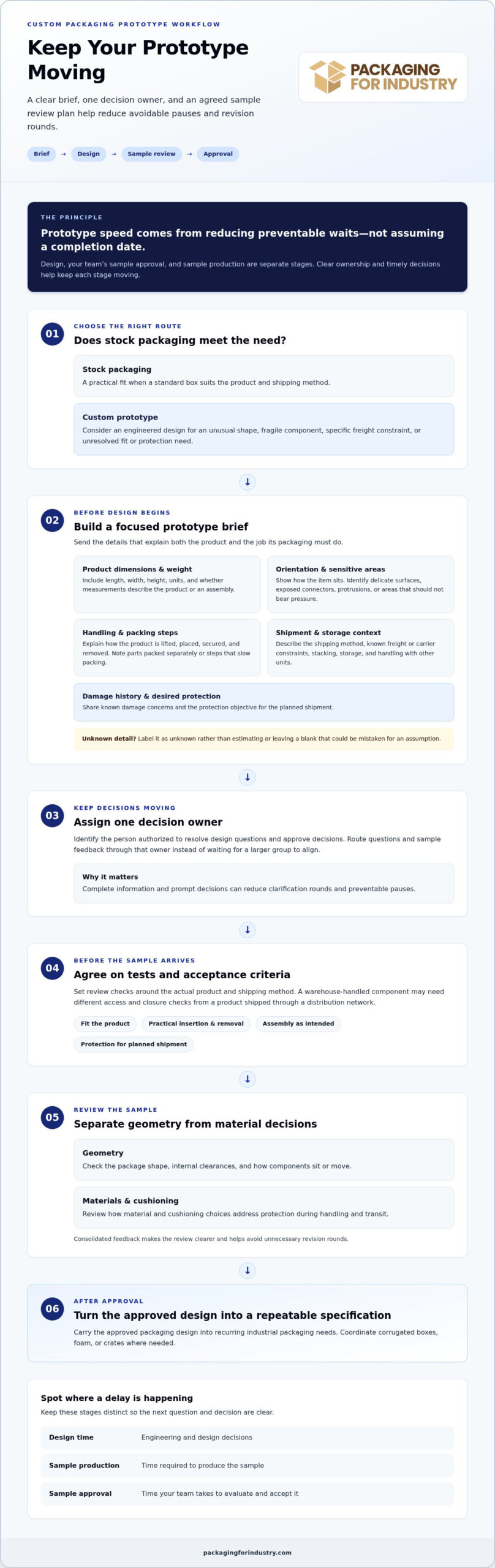
A practical way to move a prototype request forward is to treat it as a sequence of decisions, not just a request for a sample. First, send product dimensions, weight, drawings or photos, shipment details, and known damage concerns. Next, identify the person who can approve design decisions. Before the sample arrives, agree on the tests and acceptance criteria your team will use. This gives the design and review process a clear path without assuming that any supplier can promise a fixed turnaround.
Why a Custom Packaging Prototype Can Move Faster Than a Catalog-Only Process
A faster prototype process means removing preventable pauses between the initial request, design decisions, sample review, and approval. Stock packaging can be selected from existing options, while a custom prototype requires project-specific engineering. Buyers can help keep the work moving by supplying complete information and making decisions promptly.
Catalog selection is efficient when a standard box suits the product and shipping method. For an unusual shape, fragile component, or specific freight constraint, a stock size may leave important needs unresolved. Missing measurements, unclear protection goals, and delayed internal approvals can lead to questions or revisions that postpone a useful sample.
Prototype speed comes from reducing preventable waits, not from assuming a completion date. A complete brief gives an industrial packaging supplier a stronger starting point. A designated decision-maker can resolve design questions without waiting for a larger group to align.
What a custom packaging prototype is meant to prove
A prototype lets your team assess whether the package fits the product, allows practical insertion and removal, assembles as intended, and provides appropriate protection for the planned shipment. Define those checks around the actual item and shipping method. A component handled by operators at a warehouse may need different access and closure checks from a product shipped through a distribution network.
Separate geometry from material decisions. Geometry covers the package’s shape, internal clearances, and how components sit or move. Material and cushioning choices address how the package protects those components during handling and transit. Reviewing these factors separately makes feedback more precise. PFI’s custom packaging design services support development around product dimensions and protection needs.
Where a catalog-first workflow can add friction
A stock box may work well for a standard product, but a nonstandard item can leave excess space or fit poorly. A team might fill the gap with improvised cushioning or change how the item is positioned. Those workarounds can complicate packing, reduce consistency, or prompt a redesign after testing. Stock packaging isn’t wrong for every application; these are signs that the package may need to be engineered around the product.
To avoid unnecessary back-and-forth, gather the product’s dimensions and weight, note its orientation and handling points, and describe the shipping method and protection objective. If a detail is unknown, label it as unknown instead of leaving a blank that could be mistaken for an assumption. Route design questions and sample feedback to the person authorized to make decisions.
Sample approval time is the time your team takes to evaluate and accept a sample. It is separate from design time and the time required to produce that sample. Keeping these stages distinct helps buyers see whether a delay is in engineering, internal review, or sample production, and where a timely decision can keep work moving.
Build a Complete Custom Packaging Prototype Brief Before Requesting Design
A clear prototype brief helps a designer understand both the item being packed and the job the package must perform. Instead of sending only a product name or rough box size, organize the details that affect the structure, packing process, and shipment. PFI’s custom packaging design services use engineering support to develop packaging for industrial products and applications. A useful brief gives that work a defined starting point.
Before requesting a custom packaging quote, assemble the information below. If a detail isn’t available, label it as unknown rather than estimating. That makes open questions easier to identify early.
- 1. Product dimensions and weight: Provide length, width, height, and weight with units of measure. Note whether dimensions describe the product alone or an assembly, and identify any versions that differ in size.
- 2. Orientation and sensitive areas: Show how the item should sit in the package. Identify delicate surfaces, exposed connectors, protrusions, or other areas that shouldn’t bear pressure.
- 3. Handling and packing steps: Explain how the product is lifted, placed, secured, and removed. Note parts that need to stay together, components packed separately, or steps that slow down packing.
- 4. Shipment and storage context: Describe the shipping method and any known freight or carrier constraints. Include whether packages are stacked, stored before shipment, or handled with other units.
- 5. Damage history and desired result: Describe the observed issue and where it occurs. For example, note if a component shifts, a corner arrives damaged, or a surface shows abrasion. State the protection outcome the design should achieve.
- 6. Supporting references: Attach product drawings, photos from multiple angles, and details of the current package. If you have a failed package or cushioning sample, explain what it demonstrates.
Translate problems into measurable prototype criteria
Turn each concern into an observable check. A fit issue might require the product to sit in a defined orientation without contacting a vulnerable area. A cushioning concern might call for specific components to remain separated. For a packing challenge, identify the step an operator should be able to complete without repositioning the product or improvising extra materials.
Keep criteria tied to the actual shipment. Record relevant package-size or freight restrictions provided by your carrier or operations team rather than assuming a general surcharge rule applies. Agree on what counts as pass or revise. For instance, reviewers can assess whether the package closes correctly, parts remain in their intended positions during planned handling checks, and the packing sequence works as documented.
One consolidated set of requirements gives the design team a clear basis for its work and gives your reviewers a consistent reference. Once the brief is assembled, request a packaging quote with the project details and supporting materials.
Compare a Custom Prototype Workflow With a Stock Packaging Order
Stock packaging and a custom prototype address different purchasing needs. An existing box can be a straightforward choice when its dimensions and protection approach fit the product and shipping method. A prototype adds design and sample review, but lets your team evaluate a package built around constraints an off-the-shelf option may not address. Choose based on what the package must do, not on an assumption that one route is always faster.
For industrial buyers, compare how each path handles fit, protection, revisions, and future orders. A stock option avoids a new design cycle if it works as intended. A custom design requires coordination, and progress depends on the package’s complexity, any issues found during review, and how quickly the team makes decisions.
| Decision factor | Stock packaging selection | Custom prototype |
|---|---|---|
| Fit | Uses available dimensions; appropriate when the product fits without awkward positioning or excess space. | Can be designed around the product’s shape, orientation, and operating constraints. |
| Protection | Uses a familiar package and established packing method when they already meet the need. | Lets the team assess how structure and cushioning work together for the shipment. |
| Revisions | Usually involves selecting a suitable existing option rather than revising a design. | May require changes after the sample reveals a fit, packing, or protection issue. |
| Repeatability | Can support recurring orders if the selected size and packing method remain suitable. | An approved design can provide a reference for repeat production and packing instructions. |
Corrugated construction can be part of either route. PFI supplies stock and custom corrugated boxes; the useful choice depends on the product’s dimensions, handling, and shipment requirements.
When stock packaging is a practical fit
Stock packaging is practical when an available size holds the product in its intended orientation and works with the established cushioning and closure method. For example, if operators can pack the item consistently without improvised filler or changes to the packing sequence, a new design cycle may not add value. Check how the package fits at the packing station and through the planned shipment before making it the recurring choice.
When custom engineering is the better decision
Unusual dimensions, fragile components, or repeated damage can indicate that a standard package leaves an unresolved constraint. A package may need a fitted insert to keep parts separated, or a crate as well as a box for the planned handling conditions. PFI can coordinate a corrugated structure with protective foam packaging or crates as one industrial solution, then use sample review to assess how the components work together.
For either path, record the reason for the decision and any conditions that could change it, such as a product revision or different shipping method. That gives purchasing and operations a clear basis for reassessing the package without assuming that a previously suitable option fits every future requirement.
Review the Prototype Quickly With a Clear Test-and-Approval Plan
A prototype review moves efficiently when the right people are ready to assess it. Before the sample arrives, assign one decision owner, identify the operators who will handle the package, and set an internal review window that fits your purchasing process. The owner can gather feedback in one place and return a consolidated response instead of leaving the designer to reconcile conflicting comments.
Prepare a simple review record tied to the project’s acceptance criteria. Capture the sample revision, reviewer, date, observations, and decision. This creates a useful record for design changes and future purchasing, especially when several teams handle packaging between the packing station and shipment.
Run a repeatable physical sample review
Use the actual product and normal packing sequence, including the components and closure method your operation intends to use. Test the package in order so reviewers can pinpoint where an issue occurs:
- Load: Place the product in the package as an operator would during routine packing. Note any contact with exposed or sensitive areas.
- Position: Check that cushioning and restraints hold the product where the design intends, without interfering with packing.
- Close: Assemble and close the package using the planned steps. Record difficult folds, closures, or adjustments.
- Access: Remove the product using the expected handling method. Check whether the package or cushioning makes access awkward or risks contact with the item.
Document observations with clear photos and precise notes. Instead of “the insert needs work,” identify the affected surface or component and what change would address the problem. Separate a functional issue, such as a component shifting, from a preference about appearance or handling. This helps the designer prioritize revisions that affect performance and daily packing consistency.
Approve, revise, or return to the design brief
Approve the sample only when it meets the criteria your team set for fit, protection, assembly, and access. If it falls short, group requested changes by priority: first address issues that could affect the product or shipment, then consider packing workflow improvements. The decision owner should confirm who can approve structural, material, or process changes so the next review doesn’t stall over unclear authority.
Sometimes testing reveals that the original requirements no longer describe the job. A new product version, changed packing sequence, or different shipment condition may require revisiting the design brief before producing another sample. Record what changed and why, then evaluate the revised design against updated criteria. That keeps feedback tied to current operations rather than accumulating disconnected edits.
When your review team is ready to define the next packaging step, request a packaging quote.
Move From an Approved Prototype to Reliable Custom Packaging Supply
Prototype approval should leave your purchasing and operations teams with more than a sample. It should create a clear production reference that helps reproduce the approved fit and protection across future orders. To keep the transition moving, plan for what happens after the sample passes review, including the records and replenishment details your team will need.
Prepare the approved design for production and repeat orders
Capture the approved configuration in a production specification. Include the final package dimensions, materials, cushioning components, assembly sequence, and packing instructions. Record the sample’s revision status so buyers and production staff can distinguish the approved design from earlier versions. If the product, shipping method, or protection requirement changes later, document the change rather than relying on an informal adjustment.
Next, connect packaging quantities to the way your operation runs. Share typical order quantities and how packaging demand relates to production or shipping patterns. That context helps your packaging supplier plan around recurring requirements instead of treating each purchase as an isolated request. PFI supports industrial customers with both custom and stock packaging, so teams can use engineered packaging where needed and standard supplies where they fit.
For manufacturers, warehouses, and distribution operations, a consistent specification also makes purchasing easier to repeat. It gives buyers a shared reference when requesting a quote, planning bulk packaging supplies, or communicating a packaging change between purchasing and the people who pack the product.
Use one packaging plan for connected protection needs
A product’s protection may depend on several components working together. A corrugated box provides the outer structure, foam can locate and cushion the product, and a crate may suit a shipment that needs a more substantial enclosure. Coordinating these elements as one packaging plan helps the approved design account for how the product is positioned, protected, and prepared for shipment.
When a crate is part of the approved solution, PFI’s wooden crate options can be considered alongside the box and cushioning requirements. The right combination depends on the product, handling, and shipping conditions established for the project, not on adding materials without a defined purpose.
Packaging For Industry is based in Anaheim and supports industrial buyers across Orange County, Los Angeles, San Diego, and Riverside, as well as nationwide business requirements. After your sample is approved, PFI’s custom packaging design, corrugated boxes, foam, and crate supply can support the transition from prototype decisions to recurring packaging needs. Share the approved requirements and the supply pattern your team needs to support.
Make the Prototype Your Next Clear Packaging Decision
Getting a custom packaging prototype moving is about building a process your team can act on. Use the prototype not only to assess a package, but to align engineering, operations, and purchasing on what the final design needs to do. When those teams agree on priorities, decisions about changes and future orders become more straightforward.
Packaging For Industry works with industrial buyers on packaging design and supply, from initial engineering through recurring packaging needs. Bring together the product and shipment requirements your team has defined, along with any questions about repeat orders. That gives the project a useful foundation for moving from an approved concept toward packaging that supports daily operations.
Use the quote request to share your project requirements and packaging needs.
A well-defined packaging decision gives your team a practical reference for production and repeat orders.
Frequently Asked Questions
How can I speed up a custom packaging prototype request?
Submit a decision-ready request and resolve open questions before design begins. Along with product and shipping details, identify whether the sample must accommodate multiple product versions, optional components, or a particular packing sequence. Name one person to consolidate technical and purchasing feedback. The practical way to get a custom packaging prototype moving is to prevent avoidable clarification and approval delays, rather than assume a fixed turnaround.
Can a custom packaging supplier prototype faster than Uline?
A custom prototype’s timing depends on the design requirements, sample review, and approval process, so a faster result than Uline cannot be assumed. Stock orders and custom engineering are different workflows: an in-stock package can be selected without designing a new structure, while a bespoke sample requires project-specific decisions. Compare the steps involved in your request, including design complexity and how quickly your team can review and approve the sample. PFI develops custom packaging designs, prototypes, and samples for industrial applications.
What information should I provide for a custom packaging prototype?
Provide accurate product dimensions and weight, along with the expected orientation and any components that ship together. Explain how the product is packed and identify known failure points, such as a control panel that gets struck or a finished surface that gets scratched. Include drawings or photos if available. If measurements vary between product versions, label each version clearly so the proposed package accounts for the right configuration.
How do I know whether I need a prototype or stock packaging?
Use stock packaging if an existing size accommodates the product and your established packing method protects it without improvised adjustments. Consider a prototype when the package must fit an unusual shape, isolate delicate parts, or address a recurring damage issue. Also consider whether the same packaging will serve a repeat production run. Testing a custom design can help resolve fit and handling questions before you standardize recurring supply.
What should I test when a custom packaging sample arrives?
Use the people and tools involved in normal packing, not just a desk review. Have an operator pack the product, close the package, and remove it using the routine process. Look for contact between components, difficult closures, loose cushioning, and steps that require extra handling. Record the sample revision and note which observations affect product protection versus operator workflow. This distinction helps the designer prioritize useful changes.
Can a prototype include both a corrugated box and foam insert?
Yes. A prototype can evaluate a corrugated box together with foam designed to position or cushion the product. The box provides the outer enclosure, while the insert can separate components or limit movement inside it. Assess the combination as a working package, including whether the product can be packed consistently and the foam stays in its intended position. PFI develops integrated industrial packaging solutions using corrugated boxes, foam, and crates.
What happens after I approve a packaging prototype?
Approval establishes the design your team can use as the reference for repeat orders. Keep the approved revision, final configuration, and packing instructions available to purchasing and operations, then align order planning with your production or shipping pattern. Packaging For Industry supports buyers in Orange County, Los Angeles, San Diego, and Riverside, as well as nationwide business requirements. Its custom and stock packaging options support ongoing industrial supply needs.