
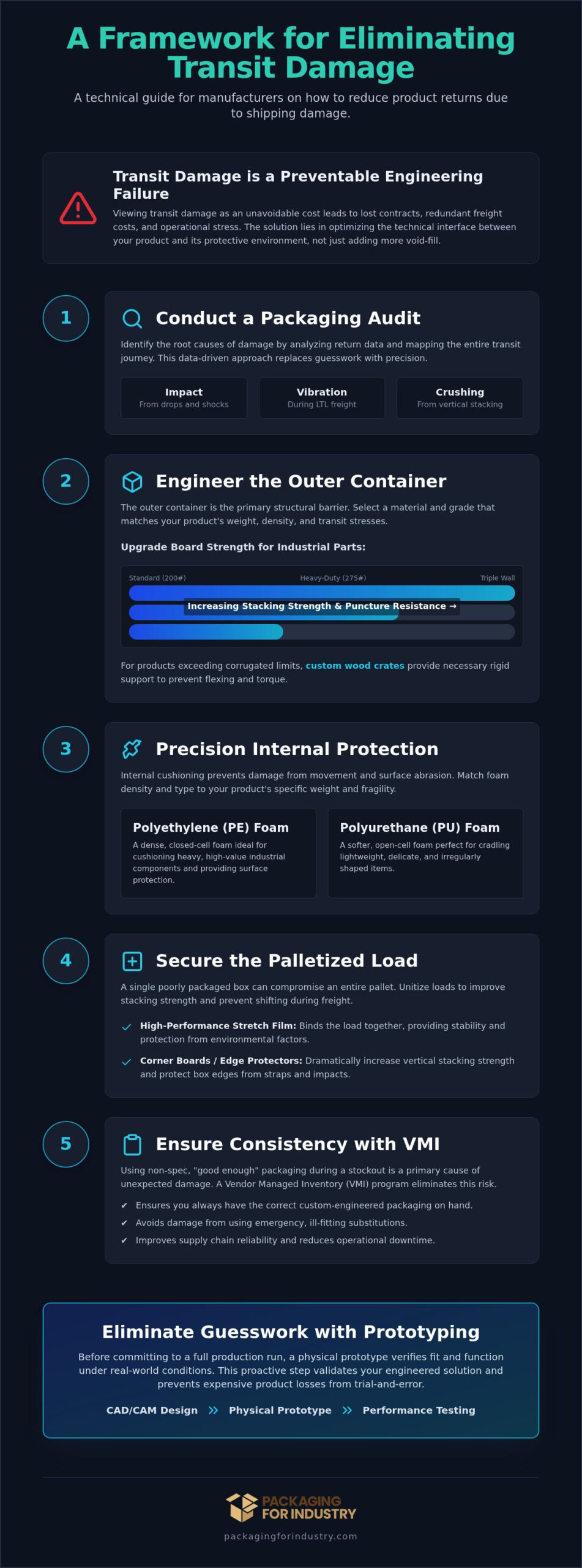
Most manufacturers view transit damage as an unavoidable cost of doing business, but this shrinkage is actually a preventable engineering failure. Learning how to reduce product returns due to shipping damage isn’t just about adding more void-fill; it’s about optimizing the technical interface between your product and its protective environment. You likely already understand the frustration of seeing high-value industrial components fail at the finish line because of a crushed corner or vibration damage. These failures lead to lost contracts, redundant freight costs, and operational stress that your team shouldn’t have to manage.
This guide provides the exact material strategies and engineering frameworks used by industrial leaders to eliminate transit damage and slash return rates. We’ll examine how custom-engineered foam, heavy-duty corrugated boxes, and integrated packaging systems create a more reliable supply chain while lowering your total cost of ownership. From Southern California warehouses to nationwide distribution centers, these repeatable steps ensure your products arrive in factory-perfect condition. We will explore the precision engineering and material selection required to turn your packaging from a cost center into a competitive advantage.
Key Takeaways
- Identify specific failure points like vibration or crushing through a technical packaging audit to eliminate the root causes of transit loss.
- Learn how to reduce product returns due to shipping damage by selecting the correct board grade, such as heavy-duty triple-wall corrugated boxes or custom crates.
- Match foam density to product weight using custom polyethylene or polyurethane inserts to prevent internal movement and surface abrasion.
- Stabilize palletized loads with high-performance stretch film and corner boards to improve vertical stacking strength and prevent load shifting during freight.
- Utilize Vendor Managed Inventory (VMI) to ensure you always have the correct custom sizes on hand, avoiding the damage risks associated with emergency packaging substitutions.
Conducting a Packaging Audit: Identifying the Root Causes of Damage
Identifying the root cause of transit failure is the first step toward operational efficiency. Most manufacturers react to damage by simply adding more tape or bubble wrap; however, these are band-aid solutions that often increase costs without solving the underlying problem. A professional packaging audit begins with your return data. By categorizing failures into impact, vibration, or crushing, you can determine if the weakness lies in the outer container or the internal cushioning. Refining your strategy on how to reduce product returns due to shipping damage starts with this data-driven audit.
One of the most common issues we see in Southern California warehouses is an inefficient “ship-to-box” ratio. When a product has too much room to move within a container, it generates kinetic energy during transit. This movement often leads to internal damage that standard catalog solutions cannot prevent. If you’re shipping high-value or heavy industrial parts, relying on generic boxes often results in compromised structural integrity. We analyze the entire journey from your loading dock to the final mile to identify where standard materials fail.
Mapping the Transit Journey and Stress Points
Your packaging must be engineered for the specific stresses of your shipping method. Parcel carriers utilize high-speed conveyors and frequent drops, which demand superior impact resistance. In contrast, LTL freight involves long-duration vibration and heavy vertical stacking. Understanding these differences is vital when learning how to reduce product returns due to shipping damage. Environmental factors also play a role. If your shipments move through humid climates, standard corrugated materials can lose significant stacking strength. We also look for “over-packing” during audits. Using excessive material doesn’t just waste money; it can actually increase freight costs by bumping your shipment into a higher dimensional weight bracket.
The Role of Prototyping in Damage Reduction
Guesswork has no place in industrial logistics. Utilizing CAD/CAM design allows us to simulate how complex geometries will sit within a protective environment. This precision ensures that every corner and sensitive surface is shielded from external forces. Before committing to a full production run, a physical prototype is essential to verify fit and function. You can request a free prototype to test your specific product fit and ensure your new strategy will perform under real-world conditions. This proactive step eliminates the “trial and error” phase that often leads to expensive product losses.
Engineering the Outer Container: Corrugated and Crating Solutions
The outer container serves as the primary structural barrier between your product and the harsh realities of the logistics chain. Selecting the right shell is a fundamental step when you’re looking at how to reduce product returns due to shipping damage. While standard RSC (Regular Slotted Carton) boxes are efficient for uniform loads, industrial components often require custom die-cut designs that provide reinforced corners and a tighter fit. If your products are destined for international transit or outdoor storage, you should consider weather-resistant corrugated materials that maintain their integrity in high-humidity environments.
For heavy machinery that exceeds the physical limits of paper-based packaging, custom wood crates become necessary. These provide the rigid support needed to prevent flexing and internal torque during transit. If you aren’t sure which board grade or container style fits your weight requirements, you can request a packaging quote to get a professional recommendation based on your specific application.
When to Upgrade to Heavy-Duty Corrugated
Standard 200# test corrugated boards are often insufficient for dense industrial parts. Upgrading to a 275# test board significantly increases stacking strength, allowing your pallets to be tiered without the bottom layers collapsing. For bulk shipments of loose parts or exceptionally heavy components, triple-wall bulk bins offer the puncture resistance and vertical support typically associated with wood, but at a lower tare weight. You can explore our full range of industrial corrugated boxes to find a solution that matches your load requirements. Choosing the correct wall thickness is one of the most effective ways to ensure your goods survive the vibration and compression of long-haul freight.
Custom Crating for High-Value Aerospace and Industrial Goods
Aerospace and medical device manufacturers often deal with sensitive electronics that cannot tolerate even minor vibrations. In these cases, we engineer custom wood crates lined with specialized foam to isolate the product from the crate’s frame. These systems often include custom skids for oversized components, ensuring that forklift operators can handle the load safely without risking a tip-over or side-impact damage. For companies shipping across borders, we ensure all wood packaging complies with ISPM-15 standards to prevent customs delays and rejections. Integrating these robust containers into your workflow is a proven method for how to reduce product returns due to shipping damage in high-stakes industries.
Internal Protection Strategies: Precision Foam and Cushioning
While the outer box provides structural support, the internal cushioning manages energy absorption. Many logistics managers mistakenly believe that more padding always equals better protection. In reality, effective strategies on how to reduce product returns due to shipping damage rely on matching foam density to the product’s static loading. If the foam is too soft, the product bottoms out during an impact; if it’s too rigid, the shock is transmitted directly to the component. It’s a technical balance that requires precision engineering.
Polyethylene (PE) foam is a closed-cell material ideal for heavy industrial parts because of its high load-bearing capacity and moisture resistance. Conversely, Polyurethane (PU) is an open-cell foam designed for lighter, more fragile items that require a softer deceleration during a drop. For precision electronics or semiconductors, anti-static (ESD) foam is a non-negotiable requirement. It prevents electrostatic discharge from damaging sensitive circuits during transit. Using foam end caps is another high-efficiency strategy. By suspending the product in the center of the box, you create a dedicated crush zone. This allows the outer container to deform without ever touching the high-value contents inside.
Selecting the Right Foam Packing Material
The choice between closed-cell and open-cell foam depends entirely on the fragility and weight of your shipment. Closed-cell foams provide superior cushioning for multiple impacts, which is critical for long-haul freight. For recurring high-volume orders, pre-cut foam planks or die-cut inserts offer better consistency than manual wrapping. You can explore our full range of protective foam packaging to see how different densities support various industrial applications. Custom-fit inserts don’t just protect; they also present a professional image to your customers.
Integrated Kitting for Complex Assemblies
Packaging kitting is a strategic method for managing multi-component shipments. Instead of wrapping parts individually, we engineer custom inserts with dedicated, secure slots for every piece of an assembly. This approach is a primary tactic in how to reduce product returns due to shipping damage because it prevents parts from colliding with one another inside the box. Beyond protection, kitting improves warehouse throughput. Your production line staff can see immediately if a part is missing, and the end-user receives an organized, professional package. We design these inserts to maximize space, which helps you lower packaging costs by reducing the overall box size needed for complex orders.
Securing the Load: Stabilization with Stretch Film and Edge Protection
While the previous sections focused on the primary container and internal cushioning, the final stage of transport reliability happens at the pallet level. Even the best-engineered boxes can fail if the entire load shifts during transit. One of the most effective methods for how to reduce product returns due to shipping damage is implementing a rigorous pallet stabilization protocol. This involves more than just wrapping a pallet; it requires the correct combination of high-performance stretch film and structural reinforcements like corner boards.
Industrial freight is subject to significant centrifugal forces during sharp turns and sudden braking. Without proper stabilization, a palletized load can lean or “topple,” leading to side-impact damage or crushed containers. For high-volume operations, transitioning to machine stretch film ensures consistent tension that hand-wrapping simply can’t replicate. This consistency is vital for maintaining the structural integrity of the entire stack throughout the supply chain.
The Critical Role of Corner and Edge Protection
Vertical stacking is a common practice in modern warehouses to maximize space. For many of our clients in Orange County and Los Angeles, double-stacking pallets is a necessity for maximizing a limited warehouse footprint. However, without reinforcement, the bottom layer of boxes often suffers from “box-squash” due to the cumulative weight of the pallets above. Cardboard edge protectors distribute this vertical load across the corners of the boxes, which are their strongest points. These protectors also prevent straps or stretch film from cutting into the edges of your corrugated containers. You can explore our full range of corner and edge protection to find the right thickness for your specific pallet weights. These simple additions provide the rigidity needed for double-high warehouse configurations and long-haul transport.
Optimizing Pallet Wrap for Maximum Stability
Choosing the right film is a technical decision. Cast stretch film offers excellent clarity and a quiet release, while blown stretch film provides superior puncture resistance and “cling” for irregular loads. To truly understand how to reduce product returns due to shipping damage, your team must master the “lock to pallet” technique. This involves wrapping the film around the base of the pallet itself to ensure the load can’t slide off the wood during transit. You can compare stretch film pricing for both bulk machine and hand-wrap applications to determine which fits your operational volume. Proper containment force is the final line of defense against transit loss.
Ensuring Consistency: Inventory Management to Prevent Damage
Engineering a perfect packaging solution is only half the battle. The most sophisticated foam insert or triple-wall box is useless if it’s out of stock when a critical order needs to ship. One of the most overlooked factors in how to reduce product returns due to shipping damage is the consistency of your material supply. When a warehouse faces a stockout, staff often fall into the “emergency substitution” trap. They use a box that’s too large or a foam density that’s insufficient for the product weight. These compromises lead directly to transit failure.
How VMI Reduces Operational Risks
Implementing a Vendor Managed Inventory (VMI) program shifts the burden of stock monitoring from your purchasing department to our logistics team. We ensure your custom sizes and specialized materials are always available; this eliminates the risk of using improper substitutes. This proactive approach improves your cash flow because you only pay for the packaging you consume. You can learn how our VMI services keep Southern California manufacturers moving by removing the stress of inventory tracking.
Our VMI programs focus on three core operational benefits:
- Elimination of stockouts: We monitor your levels so you never run out of critical protective materials like specialized foam or heavy-duty RSC boxes.
- Improved cash flow: You only pay for what you use, freeing up capital for other areas of your manufacturing process.
- Space optimization: We store the bulk inventory in our facilities, allowing you to use your warehouse floor for production rather than empty boxes.
Just-In-Time Packaging for Southern California Manufacturers
Warehouse space in areas like Orange County and Los Angeles is at a premium. Devoting vast sections of your floor to bulky corrugated inventory isn’t an efficient use of capital. Our just-in-time delivery model allows you to maintain a lean shipping department without compromising on product safety. We leverage local next-day delivery in Anaheim, Irvine, and across the Inland Empire to keep your production lines flowing. By receiving exactly what you need when you need it, you prevent the clutter that often leads to warehouse-level product damage before the goods even reach the truck.
Operational needs change as your product lines evolve. A box that worked for last year’s model might not provide the same protection for a redesigned component. We recommend regular review cycles to adjust your packaging designs alongside your manufacturing updates. You can contact PFI for a custom packaging review and cost-reduction analysis. This continuous oversight ensures that your strategy on how to reduce product returns due to shipping damage remains effective as your business grows. We treat your supply chain as a living system that requires constant optimization to maintain peak reliability.
Strengthening Your Industrial Supply Chain
Reducing transit loss requires a shift from reactive padding to proactive engineering. By conducting technical audits and utilizing CAD/CAM design, manufacturers move beyond generic void-fill to precision-engineered protection. Implementing these strategies doesn’t just protect the product; it protects your bottom line by eliminating the hidden costs of replacement freight and lost contracts.
Mastering how to reduce product returns due to shipping damage involves ensuring your team has the right materials at the right time. Our specialized services, including free prototyping and vendor-managed inventory, provide the stability needed for high-stakes industries like aerospace and medical manufacturing. We provide local next-day delivery across Southern California, ensuring your warehouse stays lean without risking stockouts of critical protective supplies.
As a cost-saving alternative to large catalog suppliers, we focus on custom-tailored solutions that fit your specific logistics journey. Our team is dedicated to providing the technical expertise and material consistency your operations demand.
We’re ready to help you streamline your shipping operations and improve your long-term reliability.
Frequently Asked Questions
What are the most common causes of shipping damage in industrial logistics?
The primary causes include excessive vibration, impact from drops, and vertical compression. Vibration typically occurs during long-haul LTL freight, while impact is more common in parcel environments with high-speed conveyors. Compression damage happens when pallets are double-stacked without adequate structural reinforcement. Identifying these specific stress points is the first technical step in learning how to reduce product returns due to shipping damage through better material engineering.
How do I choose between double-wall and triple-wall corrugated boxes?
Weight capacity and stacking requirements dictate the choice. Double-wall boxes are sufficient for most industrial components up to a certain density. However, triple-wall corrugated is necessary for exceptionally heavy items or bulk loose parts that exert significant outward pressure. Triple-wall containers offer a high-strength, lower-tare weight alternative to wood crates while providing the puncture resistance required for harsh transit environments and high-stacking warehouse configurations.
Is custom foam packaging more expensive than standard bubble wrap?
While bubble wrap has a lower initial unit price, custom foam inserts often result in a lower total cost of ownership. Custom foam reduces assembly labor on the production line and eliminates the high cost of replacement shipments and lost contracts. By using custom sizes available in precise foam densities, you create a repeatable protective framework that provides superior shock absorption compared to the inconsistent application of manual wraps.
How does a Vendor Managed Inventory (VMI) program help reduce product returns?
A VMI program ensures that your shipping department never runs out of the specific protective materials engineered for your products. This eliminates the “emergency substitution” trap, where workers use incorrect box sizes or insufficient cushioning because the right supplies are out of stock. Consistency in material usage is a core component of how to reduce product returns due to shipping damage, as it maintains the integrity of your established protection protocols.
What is the difference between polyethylene and polyurethane foam for shipping?
Polyethylene is a closed-cell foam designed for heavy, durable items that require high load-bearing support and moisture resistance. Polyurethane is an open-cell, softer foam ideal for lighter, fragile goods that need sensitive shock absorption and deceleration during a drop. Matching the foam density to your product’s static load is essential for effective energy management, ensuring the product doesn’t bottom out or receive too much vibration during transit.
Do I need edge protectors if I am already using high-quality stretch film?
Yes, because stretch film provides lateral containment but lacks vertical stacking strength. Corner boards and edge protectors distribute the weight of stacked pallets across the strongest points of the corrugated containers. This prevents “box-squash” in double-high warehouse configurations. Additionally, edge protectors prevent high-tension stretch film or plastic strapping from cutting into the corners of your boxes, maintaining the structural integrity of the entire palletized load during long-haul freight.
Can custom packaging help me avoid UPS and FedEx dimensional weight surcharges?
Custom packaging significantly reduces dimensional weight surcharges by eliminating wasted space within the container. Standard catalog boxes often require excessive void-fill, which increases the cubic volume and triggers higher freight rates. By engineering a box that fits your product’s exact dimensions, you lower packaging costs and avoid “DIM weight” penalties. This precision approach ensures you aren’t paying to ship air while simultaneously improving the security of the components inside.
How can I get a prototype for a custom-engineered shipping solution?
You can begin the process by requesting a packaging quote through our contact portal. We provide expert CAD/CAM design support and free prototyping to ensure your product fits perfectly within its protective environment. Our engineering team analyzes your product’s geometry, weight, and transit journey to create a physical sample. This allows you to perform real-world testing and verify the protection levels before committing to a full production run of custom materials.