
The assumption that only plastic can provide the necessary shock absorption for high-value industrial components is a misconception that many manufacturers can no longer afford to hold. With the Virginia and New York polystyrene bans taking effect in 2026 and California’s SB 343 tightening recycling label requirements by October 2026, the shift toward eco-friendly materials is now a regulatory necessity rather than a choice. We understand the professional stress caused by corporate sustainability mandates, particularly the fear that moving away from proven materials will result in increased transit damage and inconsistent supply chains.
You don’t have to sacrifice protection for compliance. Discover how high-performance sustainable alternatives to polyethylene foam packaging can protect your most sensitive equipment while significantly lowering your company’s carbon footprint. This guide provides a pragmatic look at engineered solutions like custom corrugated inserts and molded fiber that maintain zero-damage shipping rates. We’ll explore how precise CAD design allows these materials to match the vibration dampening of traditional foam, ensuring your logistics remain efficient and your end customers enjoy a simplified recycling process.
Key Takeaways
- Learn how to evaluate sustainable alternatives to polyethylene foam packaging that meet rigorous G-factor and vibration dampening requirements for medical and aerospace components.
- Understand how technical engineering and CAD/CAM design allow structural corrugated and honeycomb solutions to replace traditional plastic foam without increasing damage rates.
- Discover methods to lower packaging costs and improve fiscal efficiency by right-sizing cushioning through professional packaging reviews and custom prototyping.
- Maintain supply chain reliability and meet corporate sustainability mandates through Vendor Managed Inventory (VMI) programs tailored for custom eco-friendly materials.
- Leverage specialized industrial expertise and local next-day delivery to streamline the transition for manufacturers in Orange County, Los Angeles, and the Inland Empire.
The Industrial Shift: Why Move Away from Polyethylene (PE) Foam?
Industrial logistics has long relied on polyethylene (PE) foam for its exceptional energy absorption and durability. As a petroleum-based plastic, PE foam remains a staple material for foam packaging because its closed-cell structure provides a consistent barrier against shock and vibration. However, its non-biodegradable nature creates a massive environmental footprint. Most curbside recycling programs don’t accept PE foam, resulting in material that persists in landfills for centuries. For manufacturers across Southern California, including those in the Inland Empire and Orange County, corporate ESG mandates are transforming plastic reduction from a “nice-to-have” into a primary operational requirement. The central difficulty is identifying sustainable alternatives to polyethylene foam packaging that can match the resilience required for high-value industrial components.
Understanding PE Foam vs. Sustainable Alternatives
PE foam offers unique properties like moisture resistance and high energy absorption in a lightweight format. This makes a simple material swap inherently risky for sensitive medical devices or aerospace hardware. If you replace a custom-engineered foam insert with a generic biodegradable padding without proper testing, you invite transit damage. The goal of modern sustainable packaging is to find circular materials that offer high performance. We focus on engineered solutions that can be reused, recycled, or composted without compromising the safety of the product. This transition requires a methodical approach to material selection and design to ensure the replacement performs under pressure.
The Regulatory Landscape in the United States
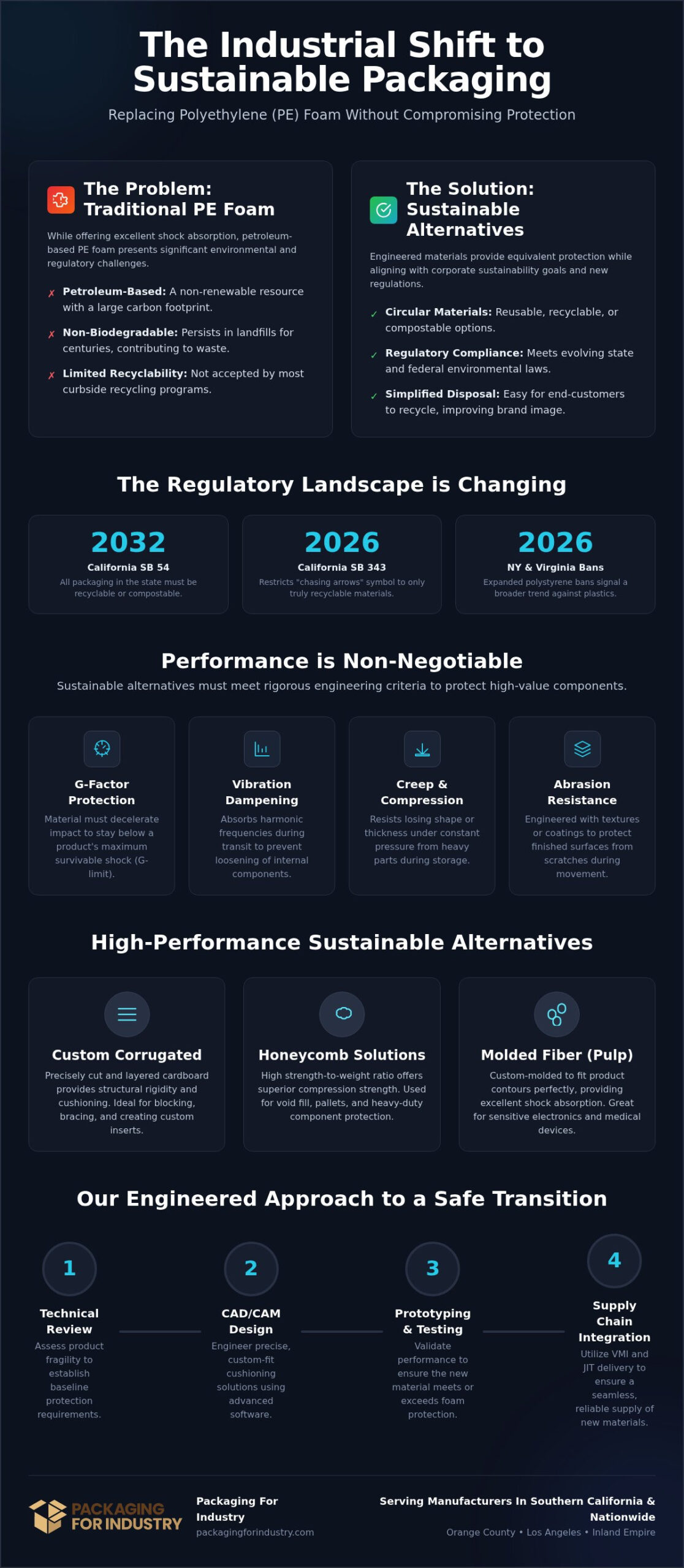
Compliance is a critical driver for the current industrial shift. California’s SB 54 mandates that all packaging in the state be recyclable or compostable by 2032. Additionally, enforcement of SB 343 begins after October 4, 2026, which restricts the “chasing arrows” symbol to materials that meet strict state-mandated recyclability criteria. Beyond California, states like New York and Virginia are implementing expanded polystyrene bans that signal a broader trend against non-recyclable plastics. Staying ahead of these regulations is a matter of fiscal responsibility. Companies that delay their transition face higher waste disposal fees and potential supply chain disruptions. By adopting sustainable alternatives to polyethylene foam packaging today, industrial shippers can lower packaging costs over the long term and protect their brand reputation.
Performance Metrics: What Sustainable Alternatives Must Achieve
Replacing traditional plastic isn’t just a material swap; it’s an engineering challenge. When evaluating sustainable alternatives to polyethylene foam packaging, the primary goal is maintaining the same protection levels for high-value industrial parts. Fragility is the starting point. The G-Factor represents the maximum acceleration a product can withstand without breaking. If you ship sensitive medical electronics or aerospace sensors, the alternative material must provide enough deceleration during a drop to stay below that critical G-limit. Without this data, you risk over-packaging or, worse, under-protecting sensitive cargo.
Industrial logistics also demands specific material behaviors during long-haul transit:
- Vibration Dampening: The material must absorb harmonic frequencies that can loosen internal components or cause fatigue in metal parts.
- Creep and Compression: Heavy machinery parts exert constant pressure. Sustainable materials must resist “creep,” ensuring they don’t lose their shape or thickness over several weeks in a warehouse.
- Abrasion Resistance: Polyethylene is naturally soft. Fiber-based alternatives must be engineered with coatings or specific textures to protect finished surfaces from scratches during movement.
If you are unsure of your product’s fragility rating, you can request a packaging quote to begin a technical material review.
The Engineering Behind Protective Cushioning
PE foam is prized for its ability to handle multiple impacts, whereas many fiber-based materials are “crushable” and lose effectiveness after the first shock. To overcome this, we utilize CAD/CAM design to create structural geometry that maximizes the strength of the material. A cushioning curve is a graphical representation that shows how much shock a material transmits at specific static loads, allowing engineers to select the exact thickness required for protection. By optimizing these curves, we can often reduce the total volume of packaging while maintaining plastic-level safety.
Environmental Certifications to Look For
As companies look to reduce environmental impacts, they must verify material claims through recognized standards. Don’t rely on generic “eco-friendly” labels. Look for the FSC (Forest Stewardship Council) mark on corrugated inserts to ensure responsible sourcing. For bio-foams, BPI Certification confirms the material is industrially compostable according to ASTM D6400 standards. Additionally, verify post-consumer recycled (PCR) content percentages to ensure the sustainable alternatives to polyethylene foam packaging you select are contributing to a truly circular economy.
Top 4 Sustainable Alternatives for Industrial Cushioning
Selecting sustainable alternatives to polyethylene foam packaging requires a pragmatic look at material science and engineering. For industrial shippers, the goal isn’t just to find an “eco-friendly” material; it’s to find a substrate that survives the rigors of the supply chain without failing. Unlike consumer-level solutions like paper peanuts, industrial-grade alternatives must provide reliable block-and-brace capabilities. We focus on four primary materials that offer the necessary durability for manufacturing and distribution.
Engineered Corrugated: The Most Reliable Alternative
Recycled corrugated material is often the most budget-friendly and operationally efficient choice. By using custom corrugated boxes designed with internal die-cut partitions and engineered folds, you can eliminate the need for foam entirely. These structural inserts create air gaps and crumple zones that absorb shock effectively. One major advantage is single-stream recycling. Your customers don’t have to separate plastic foam from the cardboard; they simply toss the entire unit into a single bin. This simplifies the end-of-life process while maintaining high-performance protection for your goods.
Honeycomb Cardboard: This material utilizes a vertical cell structure that provides exceptional compression strength. It’s a superior choice for protecting heavy machinery, large industrial parts, and palletized loads. When used as corner protection or as a base layer in a crate, honeycomb resists crushing under significant weight, ensuring that heavy items don’t shift during transit.
Molded Pulp and Fiber: For electronics and medical devices that require a contoured fit, molded fiber is an excellent substitute for custom foam inserts. It’s manufactured by pressing recycled paper fibers into precise 3D shapes. This allows for a “nesting” effect that holds components securely in place, mirroring the precision of traditional plastic foam inserts.
Bio-Foams and Mycelium-Based Solutions
Bio-based foams, including starch and mushroom-based materials, are the closest functional match to the “give” and resilience of PE foam. These materials are fully compostable and offer excellent vibration dampening for high-value items. However, a pragmatic buyer must consider the trade-offs. Starch-based foams are effective but can be sensitive to high moisture environments. Mycelium (mushroom) packaging offers high performance and a unique aesthetic, though it currently carries higher lead times and unit costs compared to corrugated. We typically recommend these for high-value, low-volume tech items or medical components where the unboxing experience and total sustainability are paramount. Evaluating these sustainable alternatives to polyethylene foam packaging ensures your company meets its ESG goals while keeping transit damage at zero.
Switching to Sustainable Inserts Without More Damage
Transitioning away from plastic requires more than just swapping one material for another. It demands a methodical engineering process to ensure your high-value components remain protected. The first step involves a comprehensive packaging review to identify which PE foam components are currently over-engineered. Many industrial shippers use more plastic than necessary simply because it’s a legacy standard. By analyzing the actual fragility of your product, we can often replace thick foam planks with precisely placed sustainable alternatives to polyethylene foam packaging that offer equivalent protection with less mass.
Once we identify the material requirements, we move into CAD/CAM prototyping. This allows us to create 3D models of sustainable inserts, ensuring an exact fit for complex geometries. Validation is the final safeguard. We utilize drop testing and ISTA standards to simulate the stresses of the modern supply chain. You shouldn’t find out your new material fails during its first long-haul shipment. Testing provides the data needed to move forward with a full production rollout confidently.
The Role of Custom Packaging Engineering
Standard foam planks are forgiving, but fiber-based materials require precision to be effective. This is why custom design packaging is essential for a successful transition. We utilize CAD/CAM support to engineer structural integrity into corrugated or molded fiber inserts, which reduces both material waste and total shipping volume. Right-sizing your packaging through custom engineering reduces your total carbon footprint while simultaneously lowering UPS and FedEx dimensional weight surcharges. By optimizing the design, you maintain zero-damage shipping rates while actually improving your logistical efficiency.
Piloting the New Design
We recommend starting with low-risk product lines to gather real-world data on transit performance. This pilot phase allows your team to analyze the total cost of ownership (TCO) beyond the mere unit price of the insert. You must consider labor costs, storage requirements, and assembly speed. Gathering feedback from your warehouse and logistics teams ensures the new design doesn’t create bottlenecks on the packing floor. To maintain supply reliability, our VMI and stocking programs ensure your new custom materials are always available at your Anaheim facility, preventing any shortages during the transition.
Custom Engineering Sustainable Solutions with Packaging For Industry
Packaging For Industry (PFI) provides the technical expertise manufacturers need to transition to sustainable alternatives to polyethylene foam packaging without sacrificing reliability. We operate from our Anaheim headquarters, serving as a proactive partner for companies that require high-performance protection. Our approach integrates custom corrugated structures with advanced cushioning to create cohesive, single-stream solutions. We specialize in high-stakes sectors like Aerospace, medical device manufacturing, and industrial electronics, where precision is non-negotiable and zero-damage rates are the standard.
One of the primary barriers to adopting specialty eco-materials is supply chain inconsistency. Our Vendor Managed Inventory (VMI) programs solve this by maintaining stock levels of your custom inserts at our facility. This prevents shortages and ensures your production lines never stall due to material lead times. By managing the flow of custom-designed sustainable alternatives to polyethylene foam packaging, we allow your team to focus on manufacturing rather than logistics, providing peace of mind through a steady supply of critical materials.
Our Local and Nationwide Support
We provide local next-day delivery throughout Orange County, Los Angeles, and the Inland Empire, including key hubs like Irvine, Torrance, and Carson. PFI acts as a direct, cost-saving alternative to large, generic catalog distributors. While mass-market suppliers offer stock items that often lead to over-packaging, we provide custom-tailored responses that optimize material usage and reduce shipping volume. Our nationwide shipping capabilities ensure that multi-site manufacturing operations receive the same high-quality sustainable inserts regardless of their location, maintaining consistency across your entire logistical network.
Request a Sustainable Packaging Review
We offer free prototyping and design consulting for recurring industrial orders to ensure your new sustainable design fits perfectly before you commit to a full production run. Our team helps you compare packaging pricing and identify opportunities to lower packaging costs through right-sized engineering. This “Just-In-Time” delivery model keeps your warehouse clear and your capital fluid. To begin your transition and improve your supply reliability, you can request a packaging quote for a custom sustainable review today.
Optimizing Your Industrial Transition to Sustainable Packaging
Transitioning to eco-friendly materials doesn’t mean compromising on the safety of your high-value components. By utilizing sustainable alternatives to polyethylene foam packaging, you can meet strict ESG mandates while maintaining your zero-damage shipping rates. Success lies in professional engineering and rigorous testing to ensure your new inserts match the performance of traditional plastic. We’ve seen how precise material selection and structural design allow manufacturers to lower their carbon footprint without increasing transit risks.
PFI provides the technical expertise required for this shift, specializing in the demanding requirements of aerospace and medical device packaging. We offer free CAD/CAM prototyping to ensure an exact fit before you commit to a full production run. For manufacturers in Orange County, Los Angeles, and the Inland Empire, our local next-day delivery ensures your operations remain efficient and your inventory stays lean. You can lower packaging costs and simplify the recycling process for your end customers through a single, integrated solution.
Take the first step toward a more efficient and responsible supply chain. We’re ready to help you protect your products and enhance your company’s sustainability profile today.
Frequently Asked Questions
Is sustainable packaging as strong as polyethylene foam?
High-performance alternatives can match the protective qualities of traditional foam through advanced structural engineering. While materials like corrugated or molded fiber have different physical properties than plastic, custom-designed folds and air gaps provide equivalent shock absorption. We use CAD/CAM design to ensure these materials meet specific G-factor requirements for your products. This allows your high-value components to remain secure during the most rigorous transit conditions without relying on non-biodegradable plastics.
How much more does sustainable industrial packaging cost?
The unit price of bio-based materials can be 20% to 50% higher than petroleum-based plastics, but the total cost of ownership often balances out. When you account for rising plastic taxes and Extended Producer Responsibility (EPR) fees, the price gap narrowed significantly in 2026. Additionally, right-sizing your packaging through custom engineering can lower packaging costs by reducing dimensional weight and shipping surcharges. We help you compare packaging pricing to find the most fiscally responsible solution.
Can I recycle corrugated inserts with my standard cardboard waste?
Yes, most paper-based sustainable alternatives to polyethylene foam packaging are fully compatible with standard industrial recycling streams. Unlike PE foam, which requires specialized drop-off points, corrugated inserts and molded fiber can be placed directly into standard cardboard bins. This simplifies waste management for your end customers and helps your company meet corporate sustainability mandates. It eliminates the need for labor-intensive material separation on the receiving dock or at the customer’s facility.
Does PFI provide free prototypes for sustainable packaging designs?
Packaging For Industry (PFI) provides free prototyping and CAD/CAM design support for recurring industrial orders to ensure an exact product fit. This allows you to validate the performance of sustainable materials before committing to a full production run. Our engineering team works with your specific product dimensions to create custom inserts that maintain zero-damage shipping rates. This proactive approach eliminates the professional stress of switching materials and ensures your logistics remain efficient from day one.
What is the best alternative to PE foam for aerospace components?
For aerospace components, we typically recommend engineered corrugated inserts or heavy-duty honeycomb cardboard. These materials offer the high compression strength and vibration dampening required for sensitive aviation hardware. Because aerospace parts often have complex geometries, we utilize custom die-cuts to create a precise block-and-brace system. This ensures that even the most fragile sensors or mechanical parts stay secure during long-haul transit without the use of non-recyclable foam planks.
Can sustainable packaging handle moisture and temperature changes?
Many sustainable alternatives to polyethylene foam packaging are now engineered to withstand environmental fluctuations. While starch-based foams can be moisture-sensitive, corrugated materials can be treated with eco-friendly coatings to resist humidity. Molded fiber also maintains its structural integrity across varying temperature ranges common in international shipping. We evaluate your specific supply chain conditions during the design phase to select materials that won’t fail in high-humidity warehouses or during sea freight transit.
How does switching to paper-based inserts affect my shipping weight?
Switching to paper-based inserts generally has a negligible impact on total shipping weight because we focus on “right-sizing” the design. While fiber materials are denser than foam, a well-engineered corrugated insert often uses less total volume to achieve the same protection level. This optimization can actually reduce your dimensional weight, helping you avoid standard carrier surcharges. Our goal is to maintain protection while improving the overall efficiency of your logistical flow and reducing shipping expenses.
What Southern California areas does PFI serve for local delivery?
PFI provides local next-day delivery throughout Orange County, Los Angeles, San Diego, and the Inland Empire from our Anaheim headquarters. We serve key industrial areas including Irvine, Torrance, Santa Fe Springs, Carson, and Fontana. Unlike national catalog distributors that rely on third-party freight for generic items, we use our own fleet for many local routes to ensure reliability. We also offer nationwide shipping to support multi-site operations with consistent, custom-engineered protection.