
Need custom or bulk spiral-wound paper tubes for your operation? Compare tube quotes against the dimensions, construction, and order quantities you need, and check that the supplier can meet your delivery schedule.
For manufacturers, warehouses, and distributors in Orange County, Los Angeles, and San Diego, fit, bulk pricing, supply reliability, and delivered cost all matter. Product specifications and feedback from customers with similar applications can help you evaluate options before placing an order.
This guide covers practical purchasing considerations for spiral-wound tubes, including intended use, custom sizing, order volume, and packaging costs. Use it to compare suppliers and decide which option fits your operation, then request a quote for the quantities and specifications you need.
Key Takeaways
- Use published tube dimensions and construction details alongside customer reviews to judge whether a product fits your packaging requirements.
- Heavy-walled paper tubes use multiple spiral-wound layers of Kraft paperboard; the material and adhesive choices affect how a tube performs.
- Compare spiral-wound, convolute-wound, and plastic cores by their construction and intended application before selecting a format.
- Tube pricing depends on the specifications and order requirements, so understand what drives the quote before comparing options.
- For related packaging needs, PFI offers foam packaging, stretch film, VMI, and JIT inventory management to support supply planning.
Spiral-Wound Paper Tube Materials and Adhesives
Heavy-walled paper tubes are made from multiple layers of spiral-wound Kraft paperboard. As the paperboard winds around a mandrel, adhesive bonds adjacent layers, creating a tube wall rather than a single rolled sheet. Kraft paperboard describes the main material, while the layers contribute to the finished wall. When comparing products, assess material, adhesive, and dimensions separately, because each describes a different specification.
Adhesive bonds the paperboard layers as the tube is wound, holding adjoining plies together during forming and handling. Manufacturers select adhesive to suit the paper stock and winding process, so formulations can vary by application. A product description may identify Kraft paperboard without naming the adhesive. This distinction is useful when comparing specifications. For applications involving moisture or heat, check that the stated adhesive performance suits the operating conditions.
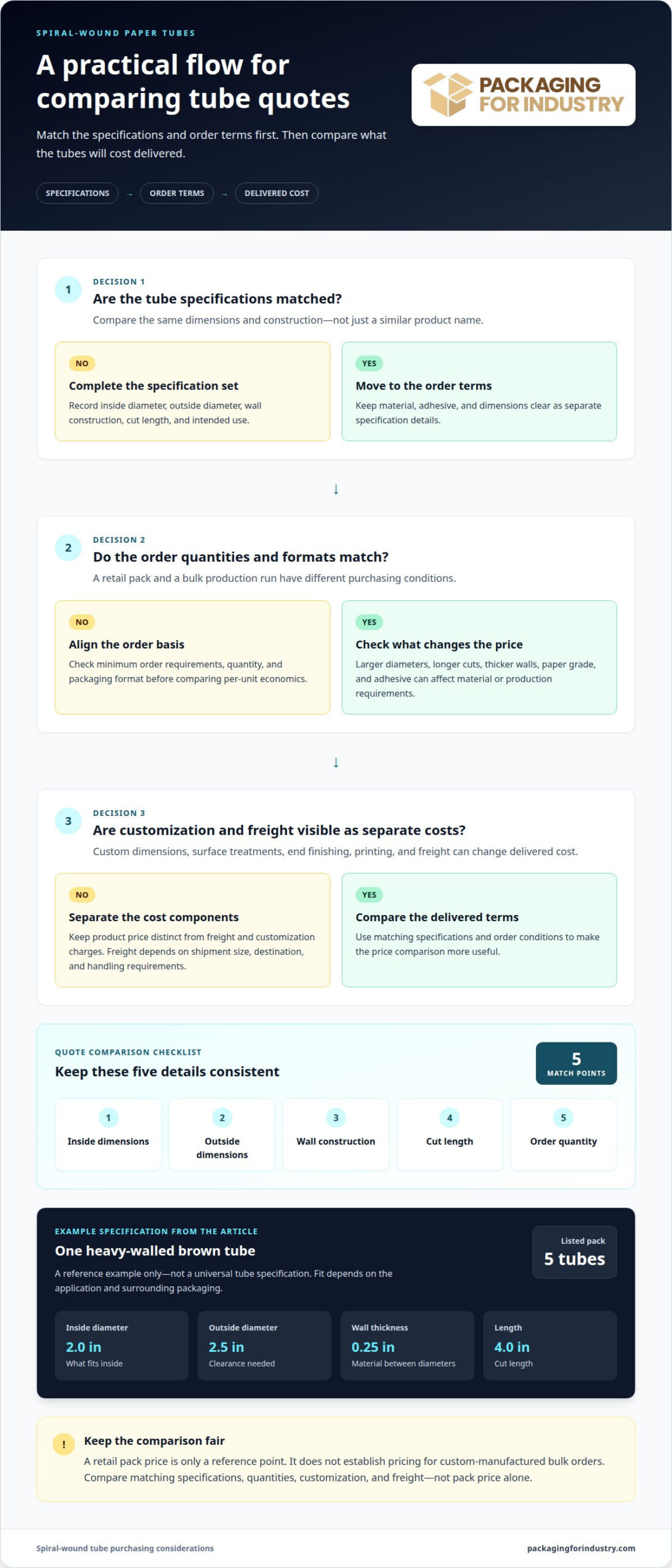
A heavy-walled brown tube example has a 2.0-inch inside diameter and a 2.5-inch outside diameter. Its wall thickness is 0.25 inches, and its length is 4.0 inches. The inside diameter determines what fits within the tube; the outside diameter affects clearance in surrounding packaging. Wall thickness describes the material between those measurements. These specifications help buyers compare physical fit without assuming every paper tube shares the same construction.
This brown tube is sold in a pack of five, with listed uses including rocket motor casings, heavy shipping cores, structural spacers, and do-it-yourself craft projects. These examples illustrate why material and dimensions need to be considered together: a core, spacer, and casing perform different jobs. For industrial or shipping use, assess the paperboard description, adhesive information, and measurements as separate specification details.
Spiral-Wound Paper Tube Costs in the United States
A U.S. retail pack price is just one reference point, not a universal market rate or a reflection of industrial quantities. It does not establish pricing for custom-manufactured bulk orders. Buyers should view retail figures as a starting point before comparing exact specifications and order terms.
Spiral-wound paper tube cost varies with its specifications. Larger diameters and longer cuts use more paperboard. Thicker walls require more layers, while paper grade and adhesive selection affect material and production requirements. Custom dimensions may involve different setup, and surface treatments, end finishing, or printing can add processing steps. Tubes designed for different uses are not direct price comparisons.
Order quantity also affects per-unit economics. A retail pack and a bulk production run from Packaging For Industry (PFI) have different purchasing conditions. Minimum order quantities, packaging format, and freight can all change the delivered cost. Buyers in Southern California should compare delivered terms, not just listed prices. Freight depends on shipment size, destination, and handling requirements, which also affect warehouse planning and receiving.
For a useful price comparison, match five details: inside dimensions, outside dimensions, wall construction, cut length, and order quantity. Separate the product price from freight and customization charges. In a quote request, describe the tube’s application, target dimensions, and expected volume. This gives suppliers a consistent basis for pricing and helps purchasing teams avoid choosing on pack price alone.
U.S. Manufacturers and Suppliers of Custom Spiral-Wound Paper Tubes
U.S. buyers can source custom tubes from manufacturers or through industrial packaging distributors. Manufacturers produce or convert paperboard tubes to order; distributors may coordinate sourcing alongside other packaging materials. The right route depends on the dimensions, application, volume, and delivery needs. For example, a tube used to ship a cylindrical product may need a different interior fit from a winding core used in manufacturing.
Assess suppliers using a consistent specification sheet. Include inside and outside diameter, wall construction, cut length, paperboard material, and intended use. Ask how custom cuts are handled and which details appear in the product specifications. Customer reviews can provide context about ordering and delivery, but they cannot replace matching the product to the application. Compare feedback for the same product type and order format.
Before choosing a source, clarify whether it manufactures or resells the tubes. Compare minimum order requirements, customization options, packaging format, and freight terms. A pack of five is not equivalent to a recurring industrial order, so compare matching quantities and specifications. Keep product cost separate from freight and customization charges for a more useful purchasing comparison.
Packaging requirements can also extend beyond the tube itself. A tube may need coordinated cushioning or an outer shipping package to protect its contents. Custom packaging design services can help develop those surrounding packaging components around a product and its shipping needs. This is distinct from sourcing the tube itself. Documenting the full packaging setup helps buyers assess fit, handling, and supply requirements before choosing a sourcing route.
Spiral-Wound Tubes, Convolute-Wound Tubes, and Plastic Cores Compared
Spiral-wound tubes form paperboard layers at an angle around a mandrel. This construction is used for products such as shipping cores and structural spacers. Convolute-wound tubes use paper wound around the mandrel in a different orientation, with layers following the tube’s length. Both are paper-based, but their winding patterns differ. Match the construction to the tube’s task instead of relying on the shared word “paper.”
A winding core supports material as it is rolled, while a spacer separates components in transit. These uses place different demands on fit and handling. A spiral-wound tube can be specified by wall thickness and diameter; a convolute-wound tube also needs to suit its dimensions and intended load. The product specifications matter more than the winding label alone.
Plastic cores use plastic instead of paperboard. The material category changes, but that alone does not establish suitability for every operation. Compare core dimensions, equipment compatibility, handling conditions, and how the used core fits into your return or disposal process. For example, a production line replacing a paper core should assess whether the new material works with its existing winding equipment.
Choose a tube by application. A paper tube used for shipping or spacing may need to cushion its contents and fit the package. A winding core must match the machine and the material being wound. For a practical comparison, record the function, inside and outside diameters, length, wall construction, and handling environment. Compare each candidate with those requirements. This separates construction differences from application needs and helps purchasing teams avoid choosing by material name alone.
Designing, Cutting, and Customizing Spiral-Wound Paper Tubes
Start with the tube’s job. A winding core must fit its machine; a shipping tube must accommodate its contents. Record the required inside and outside diameters, length, and wall construction. These measurements describe fit and build, and are not interchangeable. For a cylindrical product, measure its widest point and allow room for insertion and removal.
Next, define the handling conditions. A structural spacer has a different role from a tube protecting a long component in transit. Note the contents’ weight, how staff handle the tube, and whether it sits inside another package. These details help determine whether the design needs a heavier wall or particular dimensions. Tie each requirement to an actual use case.
After specifications are set, the manufacturer winds paperboard around a mandrel to form the tube, then cuts it to the requested length. A clean, consistent cut matters when tubes must fit packaging or production equipment. For example, a core feeding into a winding line needs a length that suits the setup. Specify the finished tube length, not just the overall dimensions of the product’s packaging.
Customization can cover diameter, wall construction, cut length, and an application-specific finish. Provide a written specification with units and identify the dimensions that control fit. State any required tolerance separately, rather than assuming a nominal measurement defines the acceptable range. For repeat orders, retain and consistently reference the approved specification. This reduces ambiguity for purchasing, production, and receiving teams. It also makes supplier proposals easier to compare, since each addresses the same design and use.
Products
Packaging for manufacturers often needs to combine product protection with efficient handling. Foam packaging cushions products inside a shipping package and can help limit movement during transit. For an irregularly shaped component, a fitted foam layout can hold it in position instead of relying on loose fill. The appropriate design depends on the product’s geometry, handling, and outer package.
Packaging For Industry provides foam packaging solutions for business packaging needs. Foam can be part of a broader packaging setup, rather than a stand-alone material choice. For example, a manufacturer may need cushioning around a product, while its warehouse team also needs a repeatable process for packing that item. Coordinating the package design with the packing workflow helps keep operations consistent.
Packaging kitting and assembly can support operations that use multiple packaging components. A kit can group the items needed for a defined packing task, reducing separate picking steps. This may suit fulfillment or distribution teams preparing recurring orders. Just-in-Time inventory management and Vendor Managed Inventory can also support packaging supply planning by aligning replenishment with operational needs.
Custom packaging design is useful when a standard configuration does not fit the product or workflow. Design can account for the product’s shape, the available shipping package, and how staff pack it. A useful specification identifies the item to protect, the shipping process, and any handling constraints. Foam, design, and inventory services can help businesses coordinate protection with daily packaging operations, while accounting for differences between products and orders.
Industries Served
Packaging needs vary across manufacturing, warehousing, and distribution operations. In Orange County, Los Angeles, and San Diego, manufacturers may need packaging that fits production workflows and protects goods during shipment. Aerospace suppliers, electronics companies, and medical device manufacturers handle distinct products and processes. The packaging approach should reflect the item, how teams handle it, and where it moves next. Packaging for manufacturers should support the transition from production to shipping.
Warehouse and fulfillment teams need practical packing workflows, suitable storage, and dependable access to supplies. A fulfillment center handling varied orders may use packaging kitting to group materials for recurring tasks. Vendor Managed Inventory and Just-In-Time inventory management can coordinate replenishment with usage and planned shipping demand. These options suit operations seeking to align purchasing and inventory processes with daily warehouse work.
Food and beverage producers, construction suppliers, industrial distributors, and logistics companies have different packaging requirements. A construction supplier may handle bulky building products, while an electronics operation manages smaller, sensitive components. Packaging design can account for product shape and handling across these applications. For businesses in Orange County, Los Angeles, and San Diego, teams can assess each need by product, packing process, storage constraints, and destination. This gives purchasing and operations a shared basis for selecting packaging that supports handling, helps limit product damage, and fits each facility’s supply routines.
Benefits of Choosing the Right Packaging Supplier
Suitable packaging can reduce product movement during transit and help prevent avoidable damage. For example, a component that shifts inside an oversized package may need better cushioning or a closer-fitting design. Matching protection to the product and shipping process can also limit unnecessary material use. These choices support packaging cost savings by addressing waste and damage together.
Unit price alone does not show the full cost of packaging. Purchasing teams also consider freight, storage space, packing labor, and handling damaged products. Packaging that is difficult to assemble can slow warehouse work, while excess material can increase storage demands. Reviewing these factors together helps manufacturers compare options and plan bulk orders on a practical basis.
A reliable supply matters as much as fit. A stockout can disrupt packing schedules and force teams to change established workflows. Vendor Managed Inventory can coordinate packaging replenishment with usage, while Just-In-Time inventory management supports planned supply timing. Both approaches help operations teams align packaging availability with production and shipping requirements.
Clear specifications strengthen the process. Documenting the packaging, its application, and recurring demand gives purchasing and operations teams consistent requirements to work from. For example, a distribution center handling repeat shipments can use a defined setup to standardize packing tasks. A supplier that understands these requirements can help maintain continuity across orders. This creates a more coordinated approach to material selection, inventory planning, and shipping protection, grounded in operational needs rather than price alone.
Why Choose Packaging For Industry (PFI)
Packaging For Industry (PFI) helps businesses in Orange County, Los Angeles, and San Diego match packaging choices to product protection and supply needs. If you are evaluating spiral-wound tubes or industrial cores, contact PFI to ask about availability, sourcing, and pricing. You can also discuss related packaging requirements based on your products and workflow.
For products that need cushioning inside a shipping package, PFI provides foam packaging. Stretch film supports palletized loads and packaging workflows. The right combination depends on the product, handling process, and shipping setup. Manufacturers and warehouse teams can review how these materials support protection and load preparation in daily operations.
Supply planning matters, too. Packaging Vendor Managed Inventory (VMI) coordinates replenishment with ongoing usage, while Just-In-Time (JIT) inventory management supports planned supply timing. These services help operations teams manage packaging availability alongside production schedules and shipment demand. They are relevant when packaging supply needs to support recurring workflows rather than separate purchasing decisions for each requirement.
PFI also provides custom packaging design services, considering the product and its handling needs. When a tube is part of a wider packaging setup, related cushioning, stretch film, or inventory planning may also matter. Describe the products you pack, your shipping process, and the packaging challenges you want to address. This context supports a practical discussion about protecting goods, managing packaging use, and maintaining a reliable supply.
Request a packaging quote from Packaging For Industry (PFI).
Frequently Asked Questions
How can I request a quote for spiral-wound tubes?
Contact a packaging supplier with your application, required dimensions, quantity, and delivery needs to request a tube quote. Include any approved product specifications so the supplier can provide relevant pricing and options. Keep the selected specification with its approved application in your purchasing records. This gives operations and procurement teams a consistent reference if production methods or shipping requirements change.
Can I order custom sizes and bulk quantities?
Ask a packaging supplier about custom sizes and bulk quantities for your application. Share the tube’s intended use and order requirements to help identify suitable options. Customer reviews are most useful when they describe a comparable application and ordering context. Look for recurring comments about fit, consistency, or delivery handling, then weigh them against your operation’s requirements.
How do I compare tube suppliers and delivery options?
Compare suppliers based on their ability to meet your dimensional, quantity, and delivery requirements. Ask for pricing and confirm delivery options before placing an order. A winding operation needs a core suited to its process, while a spacer serves a different role. Review the application and performance basis together, rather than comparing a grade label on its own.