
A single dropped crate shouldn’t cost your company its quarterly profit margin or its reputation for reliability. When shipping sensitive GPS units and sonar arrays, the margin for error is nonexistent. Finding a specialized foam fabricator for marine electronics San Diego is the first step in moving from reactive damage control to proactive logistics management. You’ve likely experienced the frustration of high damage rates during transit or the excessive costs associated with one-size-fits-all packaging from national catalog suppliers.
We agree that your high-value hardware deserves better than generic cushioning that arrives weeks late. This guide explains how to protect sensitive marine navigation and communication gear with precision-engineered foam fabricated right here in Southern California. You’ll discover how to reduce shipping damage to zero while lowering your per-unit packaging costs. We’ll also preview how establishing a local supply chain provides the next-day delivery options and custom prototyping your operation needs to stay competitive. By the end of this guide, you’ll have a clear roadmap for streamlining your logistics and securing your bottom line.
Key Takeaways
- Learn why standard packaging fails sensitive GPS and sonar units and how precision-cut inserts provide essential vibration dampening.
- Understand the technical differences between Polyethylene and Polyurethane foams, specifically why closed-cell materials are required for moisture resistance in maritime settings.
- Discover how CAD/CAM analysis and free prototyping ensure a perfect fit for complex hardware before you commit to a full production run.
- Identify how a local foam fabricator for marine electronics San Diego reduces your overhead by providing next-day delivery and supporting just-in-time manufacturing models.
- Recognize the economic impact of custom-engineered packaging, from reducing total damage rates to zero to optimizing your overall supply chain efficiency.
Why Marine Electronics Require Specialized Foam Fabrication
Custom foam fabrication for marine gear involves engineering precision-cut inserts specifically designed for vibration dampening and shock absorption. For manufacturers, partnering with a qualified foam fabricator for marine electronics San Diego is a strategic necessity rather than a procurement afterthought. High-value instruments like GPS receivers, AIS transponders, and sonar units contain delicate internal components that are highly sensitive to G-force impacts. Even a minor jolt can misalign optical sensors or fracture circuit board solder joints, rendering expensive equipment useless before it ever reaches a vessel.
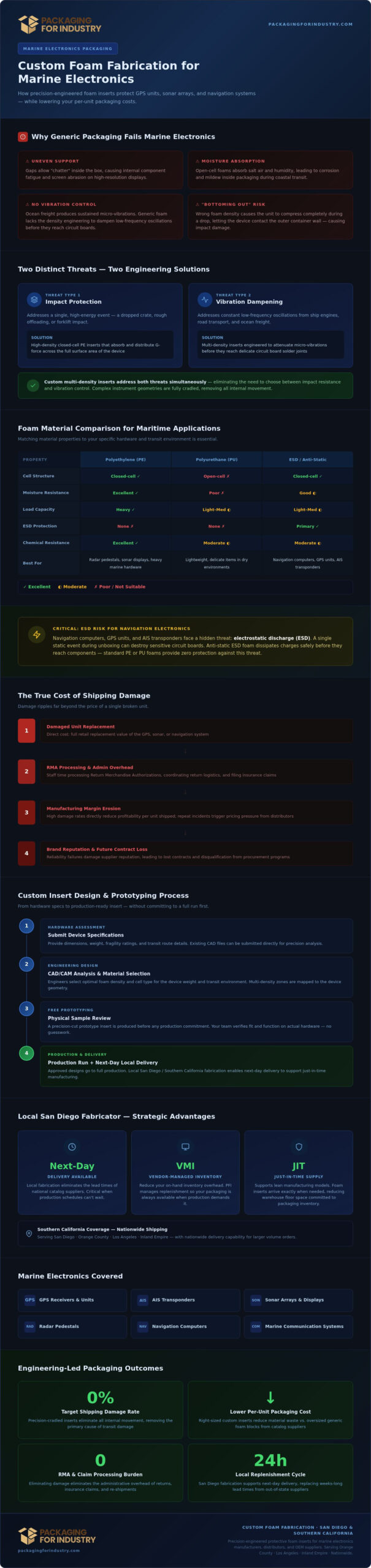
Unlike generic consumer goods, marine electronics face unique transit risks. These include the sustained micro-vibrations of ocean freight, the erratic handling of couriers, and the corrosive nature of salt-air moisture exposure. Standard off-the-shelf foam blocks fail because they provide uneven support. They often leave gaps that allow “chatter” within the box, leading to internal component fatigue or surface abrasion on high-resolution screens. Precision engineering ensures that every curve and connector of the device is cradled, eliminating movement entirely.
The Cost of Shipping Damage in the Marine Industry
Shipping damage creates a ripple effect of financial loss that extends far beyond the price of the damaged unit. Manufacturers must account for the logistics of Return Merchandise Authorizations (RMAs), the administrative overhead of processing insurance claims, and the potential loss of future contracts. High damage rates erode manufacturing margins and damage the brand’s reputation for reliability. Using custom foam reduces the total cost of ownership for marine distributors by ensuring products arrive ready for immediate installation. Reliable protection is the most effective way to eliminate the professional stress of logistical failures and maintain a stable supply chain.
Vibration Dampening vs. Impact Protection
It’s vital to distinguish between impact protection and vibration dampening. Impact protection focuses on a single, high-energy event like a dropped crate. Vibration dampening addresses the constant, low-frequency oscillations from ship engines or road transport. Marine electronics require specific foam densities engineered to absorb these micro-vibrations before they reach sensitive circuit boards. Utilizing custom design packaging allows for the creation of multi-density inserts that address both threats simultaneously. This engineering-led approach ensures that complex instrument geometries remain secure and functional regardless of the rigors of the shipping environment.
Selecting the Right Foam Materials for Maritime Gear
Material selection is where engineering meets economic efficiency. In the maritime sector, the choice between Polyethylene (PE) and Polyurethane (PU) isn’t just about cushioning; it’s about environmental resilience. While PU foam is excellent for lightweight, delicate items, its open-cell structure can absorb moisture and salt air, potentially leading to corrosion or mildew inside the package. Conversely, closed-cell foams provide a moisture barrier that’s essential for Southern California’s coastal logistics. Working with a dedicated foam fabricator for marine electronics San Diego ensures your materials are matched to both the weight of your gear and the humidity of the transit route. Choosing the right density prevents “bottoming out,” where the gear hits the outer container during a drop.
Polyethylene Foam: The Industrial Standard
Polyethylene (PE) serves as the industrial benchmark for heavy marine hardware. Its high-load capacity and rigidity make it ideal for supporting substantial units like radar pedestals or mounted sonar displays. Because PE is a closed-cell material, it remains buoyant and resistant to water absorption. This is a critical factor when shipping through humid port environments or across open water. When integrated into corrugated boxes, PE inserts provide structural integrity that standard foam cannot match. It also resists degradation from common marine fuels, hydraulic fluids, and oils. This chemical resistance ensures the packaging remains functional even in harsh industrial warehouse settings or on active manufacturing floors.
Anti-Static and ESD Foam for Navigation Systems
Navigation computers and sensitive circuit boards face a hidden threat: electrostatic discharge (ESD). A single static event during unboxing or transit can latent-damage a component, causing it to fail months later at sea. Specialized foam packaging treated with anti-static agents, often identified by its pink color, dissipates these charges before they reach the hardware. For long-term durability, cross-linked polyethylene offers a superior, non-abrasive surface that’s perfect for reusable equipment cases. This material doesn’t shed particles, keeping optical sensors and high-resolution screens clean during repeated deployments. It’s a pragmatic choice for manufacturers who prioritize both protection and professional presentation. If you’re unsure which density best fits your specific hardware, you can consult with a technical specialist to review material performance data and ensure your gear is fully protected.
The Design and Prototyping Process for Custom Inserts
Engineering a protective solution requires a methodical approach that balances material science with structural design. As a specialized foam fabricator for marine electronics San Diego, PFI follows a rigorous five-step process to ensure every unit is secured against the specific hazards of maritime logistics. This process moves from digital mapping to physical validation, ensuring that the final product meets both engineering specifications and budgetary requirements. By focusing on the intersection of geometry and physics, we eliminate the guesswork that often leads to shipping damage.
- Step 1: CAD/CAM Analysis – We begin by mapping the exact dimensions of the marine unit. This digital blueprinting identifies fragile external components, such as protruding knobs or glass displays, that require specific clearance or reinforcement.
- Step 2: Material Selection – We match foam density to the weight and fragility of the gear. This step ensures the load is distributed evenly to prevent compression failure during long-duration transit.
- Step 3: Prototyping – We create a physical sample for fit testing. This allows your team to verify that the device seats correctly within the insert without excessive pressure on sensitive ports.
- Step 4: Testing – Validating shock absorption through drop testing or vibration simulation ensures the design performs under real-world conditions. This data-driven approach confirms the packaging meets your specific G-force requirements.
- Step 5: Production – Once validated, we move to high-speed die-cutting or CNC routing for the final production run, maintaining tight tolerances across every unit.
Free Prototyping: Ensuring a Perfect Fit
PFI offers free prototyping to San Diego manufacturers to guarantee product fit before full-scale production begins. This service eliminates the financial risk of ordering incorrect packaging and allows for rapid design adjustments. It’s essential to test the foam insert within its final shipping container to verify that the entire system works in unison. Our local Southern California design team significantly reduces lead times. This proximity allows you to move from a design concept to a physical sample in days, supporting faster product launches and more agile manufacturing cycles.
Custom Foam-Lined Crates for Large Marine Hardware
When hardware dimensions or weight exceed the capabilities of standard containers, it’s necessary to move from corrugated boxes to custom foam lined crates. This is particularly relevant for large-scale radar arrays and engine monitoring systems destined for international export. These specialized crates provide the structural rigidity required for heavy lifting while the internal foam lining isolates the gear from exterior shocks. All our wood packaging complies with ISPM-15 standards. This compliance ensures your international maritime shipments clear customs without delays, providing peace of mind for your global logistics operations.
Benefits of a Local San Diego Foam Fabricator
Proximity in manufacturing isn’t just about convenience; it’s a strategic advantage that directly impacts your bottom line. When you partner with a local foam fabricator for marine electronics San Diego, you eliminate the excessive freight costs associated with shipping bulky foam materials from national catalog suppliers. Local next-day delivery across San Diego County ensures that your production line never stalls due to packaging delays. Bulky foam takes up space. This proximity supports “Just-In-Time” (JIT) manufacturing, allowing you to repurpose valuable warehouse space for production rather than storing empty boxes and foam inserts.
Face-to-face design consultations provide a level of precision that remote communication can’t replicate. For complex marine electronic assemblies with intricate geometries, having an engineer on-site to measure and test fitments prevents costly design revisions. Additionally, local sourcing significantly reduces the environmental impact of your supply chain by cutting down on long-haul transportation emissions. It’s a solution that balances engineering needs with fiscal responsibility.
Vendor Managed Inventory (VMI) for San Diego Manufacturers
Managing packaging inventory is a common operational stressor for marine electronics firms. Our VMI programs are designed to prevent shortages of custom foam by shifting the burden of inventory tracking to our team. By stocking your specific foam inserts at our facility, you free up floor space in your San Diego warehouse for high-value components. This model also improves cash flow, as you only pay for the packaging materials as they’re used. It’s a pragmatic solution for businesses looking to optimize their logistical flow without increasing overhead.
Serving the San Diego Marine Cluster
We’re deeply committed to the local maritime and defense contracting community, providing specialized support to businesses in Kearny Mesa, Harbor Island, and around the San Diego Bay. Establishing a relationship with a local foam fabricator for marine electronics San Diego is particularly vital for urgent marine repairs, often referred to as “AOG” style situations. When a critical navigation system needs immediate refurbishment and shipment, waiting days for a custom prototype from out-of-state isn’t an option. Our local presence ensures rapid response times for these high-stakes requirements, maintaining the reliability of San Diego’s marine infrastructure.
Request Your Custom Marine Electronics Foam Quote
PFI stands as the premier foam fabricator for marine electronics San Diego because we understand the high stakes of maritime logistics. Our approach combines technical material science with a deep focus on your operational bottom line. By utilizing custom-engineered inserts, you don’t just protect your hardware; you eliminate the hidden costs of shipping damage and logistical inefficiency. We invite you to leverage our local expertise to secure your supply chain and enhance your brand’s reputation for reliability. Our engineering team is ready to evaluate your current packaging and demonstrate how a precision-fit solution can lower your total cost of ownership.
What to Include in Your Quote Request
To provide an accurate engineering assessment and cost analysis, we require specific data points regarding your hardware and logistical goals. Providing detailed information during the initial consultation allows our team to select the optimal foam density and design structure for your needs. Please include:
- Technical Specifications: Precise product dimensions, weight, and the estimated fragility level of internal components.
- Environmental Requirements: Any need for specialized ESD (anti-static) foam or moisture barrier liners for salt-air protection.
- Logistical Volume: Your estimated monthly or annual usage, which helps us determine the feasibility of a VMI program to optimize your warehouse space.
Our evaluation process considers the entire journey of your product. Whether you’re shipping sonar arrays internationally or distributing GPS units locally, the data you provide ensures the final design meets every stress test. This methodical approach identifies potential failure points before they become costly shipping errors.
Partnering with Packaging For Industry (PFI)
Choosing PFI means gaining a comprehensive manufacturing packaging partner rather than just a material supplier. Our ability to integrate custom foam with corrugated boxes, crates, and stretch film creates a unified protection system for your entire product line. This holistic oversight ensures accountability from the initial CAD design to the final delivery at your San Diego facility. We provide the professional, industrial-grade reliability that Southern California manufacturers require to remain competitive in a global market.
Establishing a local supply chain with a specialized foam fabricator for marine electronics San Diego gives you direct access to engineering support and rapid prototyping that national catalog vendors can’t match. We focus on the intersection of engineering and economics. We prioritize your bottom line.
Securing Your Marine Supply Chain
Protecting sophisticated marine instruments requires more than generic packaging. It’s about a strategic partnership that prioritizes both technical protection and operational efficiency. By utilizing a specialized foam fabricator for marine electronics San Diego, you gain access to precision CAD design and free prototyping that ensures a perfect fit. This local proximity allows for next-day delivery across Southern California, supporting your just-in-time manufacturing goals and reducing warehouse overhead.
Specialized materials like ESD and moisture-resistant foam are essential for maintaining the integrity of navigation systems in harsh maritime environments. These engineering choices directly impact your brand reputation by eliminating shipping damage and reducing replacement costs. Establishing a reliable local supply chain isn’t just a logistical upgrade; it’s a commitment to professional-grade reliability. We’re here to help you optimize your logistical flow and provide the peace of mind that comes with comprehensive protection. Your high-value gear deserves a solution that’s as precisely engineered as the hardware itself.
We look forward to helping you streamline your operations and secure your bottom line with a tailored packaging strategy.
Frequently Asked Questions
What is the best foam for shipping sensitive marine electronics?
Polyethylene (PE) is generally the best choice for shipping sensitive marine electronics due to its closed-cell structure and high-load capacity. It provides superior vibration dampening for heavy hardware like radar pedestals. While Polyurethane (PU) offers softer cushioning for very light components, it’s open-cell and can absorb moisture. A specialized foam fabricator for marine electronics San Diego will typically recommend PE to ensure durability and moisture resistance during maritime transit.
How much does custom foam fabrication cost for marine gear?
The cost of custom foam fabrication depends on material density, the complexity of the design, and total production volume. While custom solutions require a dedicated engineering phase, they often lower per-unit packaging costs by reducing material waste and eliminating shipping damage. We focus on optimizing the design to balance protection with fiscal responsibility. Establishing a local supply chain also removes the high freight surcharges often found with national catalog suppliers.
Can you fabricate anti-static foam for GPS and radar systems?
Yes, we specialize in fabricating anti-static (ESD) foam specifically for GPS units, navigation computers, and radar systems. These sensitive electronics are vulnerable to electrostatic discharge, which can cause latent component failure. Our pink anti-static foam dissipates electrical charges before they reach your hardware. This specialized protection is a critical requirement for manufacturers who need to maintain high reliability standards in the defense and commercial maritime sectors.
Do you offer local delivery for foam packaging in San Diego?
We provide local Southern California delivery, including all industrial zones throughout San Diego County. This local service is a core part of our commitment to helping manufacturers maintain lean inventory levels. By sourcing from a local foam fabricator for marine electronics San Diego, you can utilize next-day delivery options and avoid the logistical delays associated with out-of-state vendors. This proximity is essential for supporting urgent repair schedules or rapid production increases.
How long does the prototyping process take for custom foam inserts?
The prototyping process is streamlined to support fast-moving manufacturing cycles, typically producing a physical sample within a few business days. We offer free prototyping to ensure a perfect fit before you commit to a full production run. This phase allows your team to test the insert within your actual shipping containers. Our local design team uses CAD/CAM analysis to move quickly from a digital blueprint to a physical, testable foam prototype.
Can custom foam be used inside existing shipping crates?
Custom foam inserts are frequently designed to fit within existing shipping crates or corrugated boxes. We can engineer foam-lined crates for large-scale radar arrays or engine monitoring systems that require structural rigidity. This approach ensures that even heavy, oversized equipment remains isolated from exterior shocks. Whether you’re using standard containers or custom-built wood crates, we provide the precision-cut cushioning needed to secure the internal load effectively.
Is closed-cell foam necessary for marine environments?
Closed-cell foam is highly recommended for marine environments because it doesn’t absorb water or salt air. Open-cell foams can act like a sponge, trapping humidity that eventually leads to corrosion or mildew on sensitive electronic components. Closed-cell materials like Polyethylene provide an inherent moisture barrier. This characteristic is vital for protecting gear stored in humid port warehouses or shipped across open water where environmental control is often limited.
How do I request a quote for custom foam in San Diego?
You can request a quote by submitting your product dimensions, weight, and fragility requirements through our online portal. It’s helpful to include your estimated monthly usage so we can evaluate your eligibility for a Vendor Managed Inventory (VMI) program. Once we receive your specifications, our engineering team will review the data and contact you to discuss material options and prototyping. This consultative process ensures your packaging solution is both protective and cost-effective.