
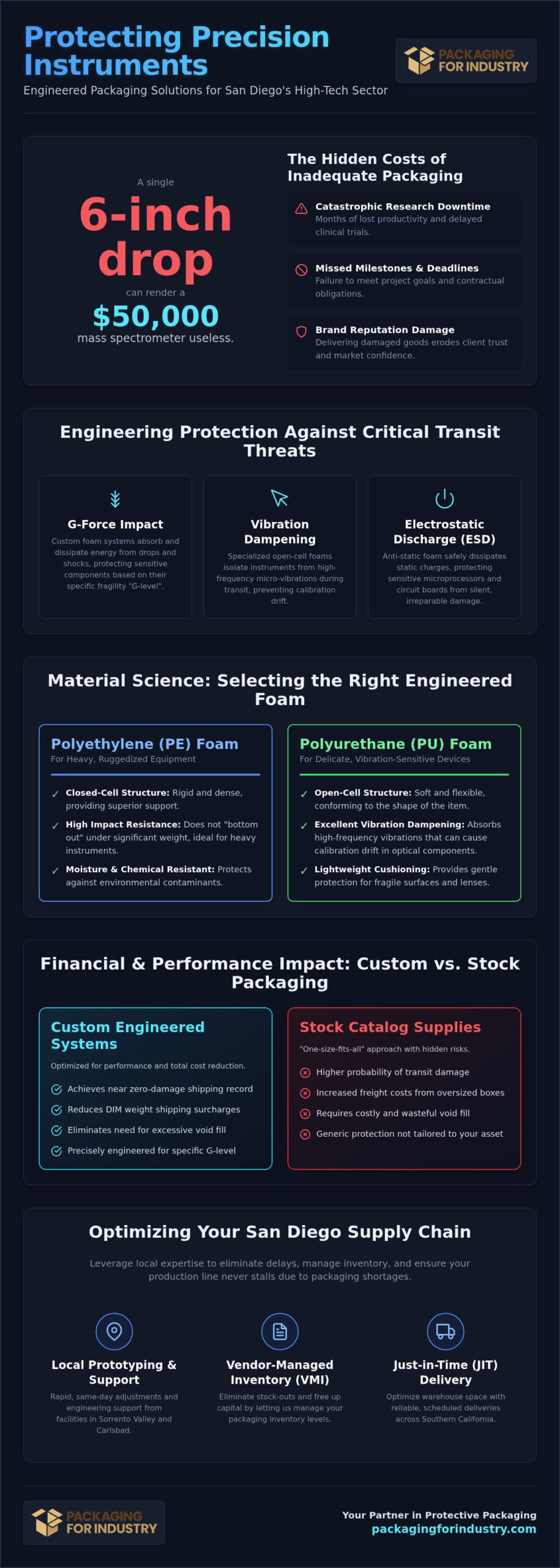
The most expensive component of a $50,000 mass spectrometer isn’t the internal sensor; it’s the six-inch drop during transit that renders the entire unit useless. For laboratory managers and operations directors, the hidden costs of shipping damage go far beyond the repair bill, often resulting in months of research downtime and missed milestones. You need protective packaging for scientific measurement devices San Diego providers can engineer to exact specifications to ensure every shipment arrives in perfect calibration.
We understand that managing the financial impact of the 139 dimensional weight divisor and strict ASTM D4169-23e1 standards is a constant challenge for local life sciences firms. This buyer’s guide explains how to secure your precision instruments using engineered foam and custom crates while reducing your total cost of ownership compared to generic catalog suppliers. You’ll learn how local San Diego logistics and vendor-managed inventory (VMI) programs can eliminate lead-time delays and ensure your production line never stalls due to packaging shortages. By the end of this article, you’ll have a clear roadmap for achieving a zero-damage shipping record through smarter procurement and localized support.
Key Takeaways
- Identify the engineering requirements for protective packaging for scientific measurement devices San Diego labs use to mitigate G-force impact and prevent transit damage.
- Understand the technical differences between PE and PU foam to select the right material for impact protection, vibration dampening, and ESD compliance.
- Evaluate the financial advantages of custom-engineered crates over stock catalog supplies to reduce shipping surcharges and eliminate the need for excessive void fill.
- Learn how local vendor-managed inventory (VMI) and just-in-time delivery can eliminate packaging shortages and optimize warehouse space in San Diego’s biotech hubs.
- Review the essential compliance standards for scientific logistics, including ESD protection, cleanroom requirements, and mil-spec packaging for aerospace and defense applications.
The Stakes of Protective Packaging for Scientific Measurement Devices in San Diego
For the biotech and life sciences firms clustered in Sorrento Valley and Torrey Pines, the shipping container is an extension of the laboratory. Protective packaging for scientific measurement devices San Diego manufacturers rely on isn’t just a box; it’s a precisely engineered system designed to mitigate G-force impacts that occur during multi-modal transit. When a mass spectrometer, chromatography system, or high-powered laser leaves the warehouse, it faces a gauntlet of vibration, drops, and compression. A single failure doesn’t just result in a repair bill. It causes catastrophic research downtime, delays clinical trials, and can cost a firm hundreds of thousands of dollars in lost productivity and recalibration fees.
Fragility Factors in Scientific Instrumentation
Every precision instrument has a specific “G-level” sensitivity, which defines the maximum deceleration the device can withstand without sustaining internal damage. Engineers must design custom design packaging that accounts for these thresholds using advanced materials. Standard Package testing standards evaluate how well a crate or box manages shock, but for scientific gear, vibration protection is equally critical. Constant micro-vibrations during air or truck transit can lead to calibration drift, rendering sensors inaccurate upon arrival. Beyond physical impact, many optical sensors and lasers require protection from environmental variables like moisture and electrostatic discharge (ESD), which can fry sensitive circuitry before the box is even opened.
San Diego’s High-Tech Logistics Landscape
Operating within the “Biotech Beach” corridor requires a packaging partner that understands the specific logistical pressures of Southern California. From the distribution hubs in Carlsbad to the specialized R&D facilities in Sorrento Valley, local expertise is the primary hedge against supply chain volatility. PFI provides the specialized protective packaging for scientific measurement devices San Diego companies need to maintain tight production schedules. By leveraging local manufacturing and foam packaging expertise, we reduce the long lead times often associated with custom-engineered solutions. This proximity allows for rapid prototyping and same-day adjustments, ensuring that innovation doesn’t stall due to a lack of reliable shipping materials. Our focus on the intersection of engineering and economics helps local firms lower their total cost of ownership while maintaining a zero-damage shipping record across global supply chains.
Engineering the Solution: Custom Foam and Crating Systems
Engineering effective protective packaging for scientific measurement devices San Diego firms utilize requires a deep understanding of material science. It’s not just about filling a box; it’s about managing the energy transfer between the external environment and the sensitive internal components of the device. We primarily work with two types of foam: Polyethylene (PE) and Polyurethane (PU). PE is a closed-cell material that’s ideal for heavy, ruggedized measurement tools because its rigid structure won’t bottom out under significant weight. PU is an open-cell foam that provides a soft, cushioned environment for extremely delicate optical components that require high-frequency vibration dampening.
For instruments containing sensitive electronic circuit boards, we integrate anti-static (ESD) foam. This specialized material prevents the buildup of static electricity, which can silently destroy microprocessors during transit even if the physical box remains intact. When high-value devices move through international supply chains, we often recommend custom wood crates. These are built to withstand the rigors of ocean freight and comply with federal packaging requirements for structural integrity and safety. By combining heavy-duty corrugated boxes with custom-engineered foam end caps, we create specialized protective packaging for scientific measurement devices San Diego companies rely on to maintain their brand reputation.
Selecting the Right Foam Density
Choosing the correct density is the difference between a safe arrival and a costly insurance claim. We analyze the weight and surface area of your device to determine the optimal foam load. Polyethylene (PE) is best for heavy-duty industrial sensors and mechanical measurement tools. Polyurethane (PU) is essential for light-weight, high-precision optics that require maximum shock absorption. We also provide ESD foam for any device with exposed PCBs or sensitive microelectronics to prevent electrostatic damage during the unboxing process.
The Role of CAD Design and Prototyping
Precision instruments require a precision fit. We utilize CAD/CAM technology to create custom design packaging that mirrors the exact geometry of your device. This eliminates internal movement, which is the leading cause of transit damage for multi-component kits. To ensure the solution works before you commit to a full production run, we offer free prototyping. This allows you to test the fit and performance of the packaging in your own facility. If you’re ready to optimize your shipping reliability and compare packaging pricing, our engineering team is available to review your specifications today.
Buying Guide: Custom vs. Stock Packaging for Lab Equipment
Procurement teams in San Diego’s biotech corridors often face a choice between the immediate availability of catalog-grade supplies and the long-term reliability of engineered solutions. While a standard RSC box from a large catalog might seem cost-effective at the point of purchase, it often fails to provide the specific protective packaging for scientific measurement devices San Diego firms require for high-value exports. Stock boxes are designed for general commodities; they lack the structural integrity to support heavy-duty sensors or the precision fit needed for delicate optics. This mismatch leads to “hidden costs” that quickly erode any initial savings on materials.
A true Total Cost of Ownership (TCO) analysis accounts for more than just the unit price of a corrugated box. When you use oversized stock packaging, you’re forced to pay for excessive void fill and higher shipping rates. As of August 2025, major carriers like FedEx and UPS require all fractional measurements to be rounded up to the next whole inch before calculating dimensional weight. Using a 139 divisor, an extra inch in each direction can significantly increase your freight bill. Custom-sized packaging eliminates this “air tax” by matching the box dimensions exactly to the instrument and its foam inserts, ensuring you only pay for the space your product actually occupies.
Framework for Choosing Your Packaging Method
Determining whether to invest in custom engineering or stick with stock supplies depends on three primary criteria. First, consider the value of the instrument versus the cost of the packaging; a $20,000 spectrometer justifies a custom-engineered crate to prevent a total loss. Second, evaluate your shipment frequency. Recurring production lines benefit from the speed and consistency of custom foam inserts, whereas a one-off prototype might only need heavy-duty double-wall corrugated with standard cushioning. Finally, assess the transit mode. Parcel shipping involves significantly more G-force impacts than palletized freight, requiring more robust internal protection to remain compliant with NIST labeling regulations and safety standards.
Why Industrial Buyers are Moving Away from Large Catalogs
Industrial operations are increasingly shifting toward local suppliers to achieve meaningful packaging cost savings through better engineering. Partnering with a local San Diego provider allows for specialized solutions like corner and edge protection that catalog companies simply don’t offer in custom sizes. Instead of “making it fit” with generic bubble wrap, you can utilize precision-cut foam that secures every component in a multi-part kit. This transition doesn’t just reduce damage rates; it streamlines your warehouse operations by reducing the amount of SKU variety you need to stock for different device models. By focusing on the intersection of engineering and economics, we help you eliminate the waste inherent in one-size-fits-all packaging strategies.
Compliance and Protection Standards for Scientific Logistics
Scientific logistics in San Diego’s aerospace and defense sectors demand more than generic cushioning. You need a system that meets rigorous Mil-Spec and ISTA testing standards to guarantee instrument safety during high-velocity transit. Compliance isn’t optional; it’s a financial hedge against rejected shipments and failed inspections. For global distribution, all wood pallets and crates must meet ISPM-15 heat-treatment standards to bypass international customs without quarantine delays. We ensure every crate is stamped and documented to prevent costly logistical bottlenecks at the border.
ISTA testing protocols provide a standardized way to simulate the vibrations, drops, and atmospheric changes a package will face. Following these recognized performance standards allows us to validate the engineering behind our protective packaging for scientific measurement devices San Diego firms rely on for global distribution. It moves the procurement process from guesswork to data-driven assurance. When your device is subject to the new ASTM D4169-23e1 compression calculations, having a validated packaging design is the only way to ensure your freight insurance remains valid.
Anti-Static and Moisture Barrier Protection
Electronic measurement components are susceptible to invisible threats like electrostatic discharge and oxidation. We utilize static shielding bags and moisture barrier packaging to create a controlled micro-environment for your gear. When combined with specialized foam packaging, these materials prevent circuit degradation during long-term storage or sea freight transit. Desiccant packs are added to absorb residual humidity, ensuring that optical sensors remain clear and electronic boards stay dry regardless of external weather conditions. This multi-layered approach is essential for semiconductor tools and optical devices that must remain in a factory-new state upon arrival.
Heavy-Duty Corrugated and Reinforcement
Standard cardboard won’t suffice for heavy laboratory instruments or industrial sensors. We specify double-wall or triple-wall corrugated boxes to provide the necessary stacking strength and puncture resistance for items exceeding 50 pounds. To prevent the box from collapsing under its own weight, we integrate corner and edge protection into palletized loads. This reinforcement distributes the vertical load evenly, which is critical for maintaining the integrity of the bottom layer during long-haul trucking. Using high-performance stretch film further stabilizes the load, reducing the risk of shifting that leads to internal calibration drift. Providing the right protective packaging for scientific measurement devices San Diego manufacturers export means understanding the intersection of physics and policy.
Optimizing Your San Diego Supply Chain with PFI
Operational efficiency in San Diego’s high-tech corridors depends on more than just the quality of the box. It requires a logistical partner that understands the specific pressures of Sorrento Valley and Torrey Pines, where warehouse floor space is at a premium and production schedules are non-negotiable. PFI provides the protective packaging for scientific measurement devices San Diego manufacturers need to maintain a lean supply chain. By leveraging our local manufacturing and distribution capabilities, we offer local next-day delivery across San Diego County, ensuring your shipping department never stalls due to a lack of critical supplies. This proximity allows us to act as a seamless extension of your warehouse, providing just-in-time (JIT) delivery that frees up valuable square footage for R&D and production rather than bulk packaging storage.
Managing specialized inventory for precision instruments involves complex SKU requirements, from custom-cut foam to heavy-duty corrugated. We simplify this process by offering comprehensive oversight of your packaging stock levels. Our goal is to lower packaging costs by eliminating the emergency freight charges and production delays associated with stockouts. Whether you are shipping sensitive sensors from Carlsbad or medical diagnostics from Mira Mesa, our localized support ensures your protective packaging for scientific measurement devices San Diego logistics remain predictable and cost-effective.
Leveraging VMI for Recurring Production
For firms with recurring production lines, manual ordering is an inefficient use of procurement resources. Our vendor managed inventory (VMI) program transfers the responsibility of stock maintenance to our team. We conduct regular inventory reviews at your facility to monitor usage patterns and automatically replenish supplies before they hit critical levels. This proactive approach reduces the administrative burden on your purchasing department and ensures that custom sizes are always available when a production batch is ready for shipment. By stabilizing your supply, we help you maintain a consistent shipping schedule and avoid the volatility of generic catalog lead times.
Custom Kitting for Scientific Tool Sets
Precision measurement devices often ship as part of a multi-component system, including cables, sensors, and secondary calibration tools. We provide specialized packaging kitting and assembly services to streamline your final fulfillment process. Instead of your warehouse team spending hours picking and packing individual foam components and boxes, we deliver pre-assembled kits that are ready for immediate use. These custom foam assemblies are engineered to secure every part of the kit in a single, organized container, which reduces the risk of missing components and improves the end-user unboxing experience. This level of organization is essential for maintaining professional standards in the scientific and medical device sectors.
If you’re ready to optimize your local logistics and compare packaging pricing for a more efficient operation, contact our San Diego team to request a packaging quote today.
Securing Your Competitive Edge in San Diego’s Biotech Corridor
Securing high-value precision instruments requires a shift from catalog-grade supplies to engineered systems. By integrating aerospace-grade foam engineering and custom-sized corrugated boxes, you eliminate the hidden costs of transit damage and dimensional weight surcharges. It’s about protecting both the device and your operational bottom line through smarter procurement and technical precision.
Localized support is the final piece of the puzzle for firms in Sorrento Valley and Torrey Pines. With local next-day delivery across San Diego County and free CAD prototyping to ensure a perfect fit, you can maintain a zero-damage shipping record while freeing up valuable warehouse space. Partnering with a local specialist ensures your protective packaging for scientific measurement devices San Diego strategy remains compliant with the latest ISTA and ASTM standards.
We’re ready to help you streamline your procurement and protect your most sensitive innovations. Let’s build a more resilient and cost-effective supply chain together.
Frequently Asked Questions
What is the best foam for shipping sensitive scientific instruments?
The best foam depends on your instrument’s fragility and weight. Polyurethane (PU) foam is ideal for lightweight, highly delicate sensors that require superior vibration dampening. For heavier units, Polyethylene (PE) foam provides the necessary structural support to prevent bottoming out. When selecting protective packaging for scientific measurement devices San Diego labs often require a hybrid approach using custom-engineered inserts to manage specific G-force thresholds effectively.
Do you provide custom crates for international export from San Diego?
We manufacture custom wood crates specifically for international and domestic transit. Every crate used for export is ISPM-15 heat-treated to ensure compliance with global customs regulations. This prevents your high-value instruments from being quarantined at the border. Our engineering team designs these crates to withstand the rigors of ocean freight while maintaining the internal calibration of your scientific gear through integrated foam cushioning.
How can I reduce shipping damage for heavy laboratory equipment?
Reducing damage for heavy equipment requires high-performance materials like triple-wall corrugated boxes and engineered foam end caps. We use a problem-solution framework to identify specific impact points on your device. By adding corner and edge protection to palletized loads, you distribute vertical weight evenly and prevent box collapse. This methodical approach ensures your heavy-duty measurement tools survive the high-impact environment of multi-modal shipping.
What is the difference between PE and PU foam for protective packaging?
Polyethylene (PE) is a closed-cell foam that offers high durability and moisture resistance, making it suitable for rugged industrial tools. Polyurethane (PU) is an open-cell, softer material that excels at protecting lightweight, sensitive optics from micro-vibrations. Choosing between them requires a technical analysis to determine which material provides the best protection for your specific budget and device sensitivity. Both materials are available in various densities.
Do you offer anti-static (ESD) packaging for electronic measurement devices?
Yes, we provide a full range of ESD-safe materials including anti-static foam and static-shielding bags. These are essential for protective packaging for scientific measurement devices San Diego electronics manufacturers ship. Standard foam can generate thousands of volts of static electricity during transit, which can fry sensitive microprocessors. Our ESD solutions dissipate this charge safely, ensuring your electronic sensors arrive in perfect working condition upon final delivery.
Can PFI help reduce our dimensional weight surcharges?
We help lower packaging costs by optimizing box dimensions to fit your product exactly. Since carriers like FedEx and UPS round up fractional measurements and use a 139 divisor for dimensional weight, even an extra inch of void space significantly increases costs. Custom-sized boxes eliminate this “air tax,” allowing you to pay only for the volume your instrument actually requires rather than generic catalog sizes that waste space.
Is there a minimum order quantity for custom foam inserts?
We focus on industrial partnerships and bulk procurement needs rather than one-off residential purchases. Our custom foam inserts and corrugated solutions are designed for manufacturers and distributors who require predictable supply chains. You can request a packaging quote to compare packaging pricing for your specific production volumes. We offer free prototyping for these recurring orders to ensure the fit is perfect before full production begins.
Do you offer next-day delivery in San Diego for stock items?
We offer local next-day delivery in San Diego County for stock items to support your just-in-time (JIT) inventory goals. This service is available for all San Diego zip codes, helping you free up warehouse space by reducing the amount of packaging you need to store on-site. By acting as a local extension of your logistics team, we ensure your production line never stalls due to material shortages.