
The annual global cost of corrosion has surged to over $3 trillion, a figure that represents a staggering 3.4% of global GDP. For manufacturers shipping high-value components across the ocean, this isn’t just a macroeconomic data point; it’s the daily reality of rejected shipments and damaged reputations. Implementing effective non-corrosive packaging for overseas shipping is the only way to shield your products from “container rain” and the relentless humidity of maritime transit. We understand the frustration of navigating complex international standards while trying to lower packaging costs and maintain a reliable supply chain.
You don’t have to settle for high rejection rates or the hidden expenses of over-packaging. This guide teaches you how to engineer an integrated anti-corrosion system that eliminates rust damage and reduces your total export costs. We’ll explore the latest barrier materials, discuss compliance with updated standards like the IMDG Code Amendment 42-24, and explain how custom kitting processes lead to zero-defect arrivals. Whether you’re a Southern California manufacturer or a nationwide distributor, these professional strategies will help you achieve predictable results and total peace of mind.
Key Takeaways
- Identify why standard methods fail by understanding “container rain” and the electrochemical process of oxidation in humid maritime environments.
- Compare the advantages of active Vapor Corrosion Inhibitors (VCI) against passive Moisture Barrier Bags to determine the most cost-effective protection for your specific metal components.
- Learn to engineer a high-performance system of non-corrosive packaging for overseas shipping by integrating surface preparation with custom-engineered foam and primary barrier layers.
- Discover how Vendor Managed Inventory (VMI) and just-in-time delivery prevent critical stockouts of anti-corrosion supplies, ensuring your export line remains operational.
- Streamline your kitting process and reduce total export costs by utilizing custom-sized crates and heavy-duty corrugated boxes designed for international shipping compliance.
The Hidden Risks of International Logistics: Why Corrosion Happens
Corrosion is the electrochemical oxidation of metals. In an industrial shipping context, it’s a destructive process that occurs when metal surfaces react with environmental factors like moisture and oxygen. This isn’t just a cosmetic issue. It’s a structural failure that can render precision-machined parts useless upon arrival. Protecting these assets requires a sophisticated approach to non-corrosive packaging for overseas shipping that goes beyond simple plastic wraps.
One of the most persistent threats is “container rain.” This phenomenon happens when a sealed shipping container undergoes drastic temperature fluctuations during ocean transit. During the day, the air inside the container warms and holds significant moisture. As temperatures drop at night, the air reaches its dew point, and moisture condenses on the container ceiling. This water eventually drips onto the cargo, creating a repeated cycle of moisture exposure that standard packaging often fails to stop.
The risk is compounded by the “salt spray” factor. Coastal warehouses and deck-loading expose cargo to high concentrations of chloride ions. These ions act as catalysts, significantly accelerating the oxidation process. The financial consequences for manufacturers are severe. Beyond the direct cost of the damaged product, businesses face high rejection rates, expensive rework, and a damaged brand reputation. When a shipment is rejected, the “hidden costs” of return logistics and emergency production runs can quickly eclipse the original value of the goods.
The Role of Humidity and Temperature in Ocean Freight
Humidity levels inside ocean freight containers frequently exceed 90%. When a vessel crosses the equator, the extreme heat increases the air’s moisture-carrying capacity. This creates dangerous “micro-climates” even within a single pallet. While the exterior of a load might appear dry, the center can remain warm and humid, trapping moisture against the metal. Effective non-corrosive packaging for overseas shipping must account for these internal atmospheric shifts to prevent corrosion from the inside out.
Identifying High-Value Vulnerabilities
For industries like aerospace and medical device manufacturing, there’s zero tolerance for oxidation. Precision surfaces are susceptible to “flash rust,” a rapid form of corrosion that can occur within hours of exposure. Even invisible microscopic pits can lead to catastrophic structural failure under stress. Using advanced technologies like a Vapor Corrosion Inhibitor (VCI) is essential for these high-stakes applications. These inhibitors provide a molecular layer of protection that neutralizes the metal surface, ensuring components arrive in pristine, ready-to-use condition.
Primary Non-Corrosive Packaging Technologies
Selecting the right non-corrosive packaging for overseas shipping requires understanding how different materials interact with the environment. You can’t rely on a single solution for a 30-day ocean voyage. Instead, professional shippers use a combination of active inhibitors and passive barriers. Vapor Corrosion Inhibitors (VCI) work by releasing a protective vapor that deposits an invisible molecular layer on metal surfaces. This layer prevents moisture and oxygen from reaching the metal, effectively halting the oxidation process before it starts. For larger crates, volatile emitters provide a sustained source of these inhibitors to protect complex machinery with hard-to-reach internal components.
While VCI is an “active” technology, desiccants and adsorbents provide a vital supporting role. These materials pull moisture directly out of the air inside the package. When used alongside high-quality anti-rust products, desiccants ensure the internal relative humidity remains below the critical 40% threshold where rust typically begins to form. This dual-action approach is the standard for high-value industrial exports.
VCI Film vs. VCI Paper: When to Use Each
VCI film is the standard for wrapping large machinery or securing palletized loads with specialized stretch film. It’s durable and provides a moderate moisture barrier alongside chemical protection. VCI paper is better suited for interleaving between small parts or protecting internal bores where film can’t easily reach. You must follow the “line-of-sight” rule: VCI molecules must have a clear path to the metal surface. Most engineering guidelines suggest keeping the VCI material within 12 inches of the product for maximum efficacy.
The Importance of Moisture Barrier Bags
Mil-Spec moisture barrier bags (MBB) are essential for high-sensitivity electronics and aerospace components. These bags utilize layers of aluminum foil and polyethylene to achieve a near-zero Moisture Vapor Transmission Rate (MVTR). Unlike standard poly bags, MBBs are designed to be heat-sealed, creating a true hermetic environment. This seal prevents “container rain” and saltwater aerosols from penetrating the primary packaging. If you’re unsure which material fits your specific application, you can request a packaging quote to compare options tailored to your specific shipping route and budget.
Comparing Barrier Protection vs. Vapor Corrosion Inhibitors
Choosing the right non-corrosive packaging for overseas shipping often comes down to the distinction between active and passive protection. Passive barriers, such as foil-lined bags, work by creating a physical wall that moisture cannot penetrate. Active VCI systems release chemicals that bond to the metal on a molecular level. While a physical barrier is effective, it’s vulnerable to punctures during transit. If a bag is torn during loading, the protection is compromised. VCI offers a “self-healing” advantage; the vapor continues to circulate within the enclosure, protecting the part even if the outer seal isn’t perfectly airtight.
Shippers must also analyze transit duration and material compatibility. A 14-day air freight shipment experiences fewer temperature cycles than a 45-day ocean voyage. For short durations, a standard poly bag with a high-quality desiccant may be sufficient to manage moisture. However, for long-haul sea freight, the risk of “container rain” makes active protection nearly mandatory. You must also match the chemistry to the metal. Ferrous metals like steel require different inhibitors than non-ferrous metals like copper or aluminum. Using the wrong VCI formula can cause staining or adverse reactions on sensitive precision surfaces.
Decision Framework for Industrial Buyers
Industrial buyers should use a risk-based framework to balance cost and safety. Start by assessing the replacement value of the component against the packaging price. A high-value aerospace turbine justifies a redundant protection strategy, while bulk fasteners might only require basic VCI paper. Consider the destination port’s climate. Tropical hubs like Singapore or Panama City present much higher humidity risks than arid regions. Customs inspections are another critical factor. If agents open a vacuum-sealed barrier bag to inspect a serial number, the passive protection is lost. In these cases, VCI emitters are superior because they re-establish a protective atmosphere once the crate is re-closed.
Hybrid Approaches for Extreme Environments
For the most demanding export routes, hybrid systems provide the highest reliability. This involves placing VCI emitters inside a heat-sealed moisture barrier bag. We often integrate custom foam packaging into these setups to maintain airflow around the metal parts, ensuring the VCI vapor reaches every surface. To verify the system’s integrity, include humidity indicator cards. These simple visual tools allow the end receiver to confirm that the internal environment remained dry throughout the journey. This level of oversight eliminates guesswork and ensures that your quality control standards are met upon arrival.
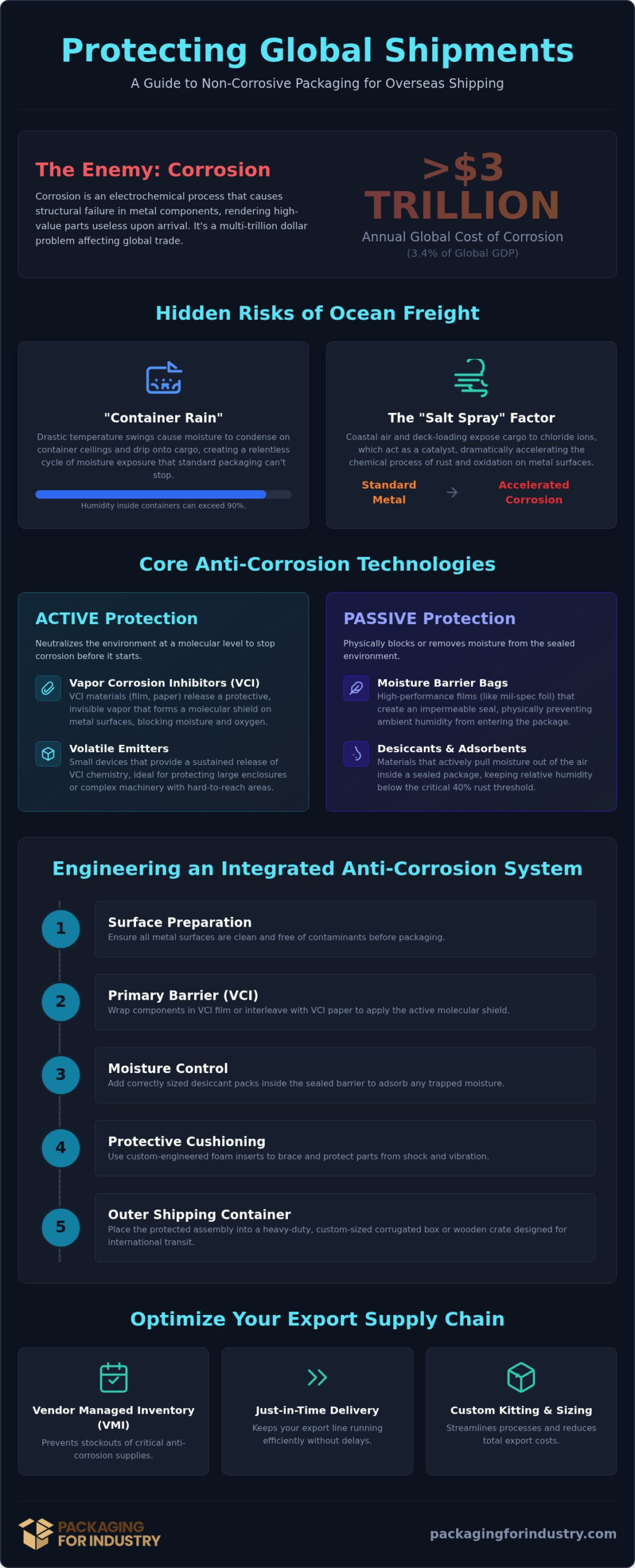
Engineering an Integrated Anti-Corrosion Packaging System
Building an effective system for non-corrosive packaging for overseas shipping requires a layered engineering approach. It’s not enough to rely on a single material; you’ve got to ensure the entire assembly works together to neutralize environmental threats. If one component fails, the whole system is compromised. This methodical process ensures your products withstand the rigors of long-haul maritime transit without the risk of oxidation or structural damage.
- Step 1: Surface Preparation: You must ensure parts are clean and oil-free. Residue from manufacturing or even salts from a worker’s fingerprints can cause “under-film” rust that VCI can’t stop.
- Step 2: Primary Layer: Apply your VCI film or barrier protection directly to the component. This creates the immediate micro-environment needed to halt electrochemical reactions.
- Step 3: Structural Support: Use custom shipping crates for heavy machinery or double-wall RSC boxes for smaller high-value components. These provide the necessary puncture resistance and stack strength for containerized freight.
- Step 4: Load Stabilization: Secure the load with high-performance industrial stretch film and corner boards. This prevents the cargo from shifting, which is the primary cause of torn barrier bags.
- Step 5: Final Sealing: Use weather-resistant tapes and liners to ensure the outer container is shielded from direct saltwater spray and external humidity.
Eliminating Internal Contaminants
Internal contaminants often come from the packaging materials themselves. Standard wood pallets and corrugated liners can release acidic vapors that promote rust in enclosed spaces. We mitigate this by using corner boards to create a buffer between the product and the outer crate. These corner boards also prevent sharp metal edges from puncturing your mil-spec packaging, which would otherwise destroy the hermetic seal and allow “container rain” to enter the package.
Custom Kitting for Export Efficiency
Utilizing professional packaging kitting services is a pragmatic way to reduce assembly errors on your packing line. By standardizing your kitting process, you ensure every shipment receives the exact level of protection required by your engineering specs. We design custom foam inserts that provide shock absorption while maintaining the airflow needed for VCI molecules to reach all surfaces. This integrated approach streamlines your warehouse logistics and ensures your products arrive in pristine, ready-to-use condition.
Optimizing Your Export Supply Chain with PFI Solutions
Integrating high-performance non-corrosive packaging for overseas shipping into your daily operations shouldn’t create logistical friction. Manufacturers often face erratic lead times for specialized barrier materials, which can stall production and delay critical exports. Our Vendor Managed Inventory (VMI) programs eliminate this risk by maintaining stock of your critical anti-corrosion supplies. This level of oversight helps you lower packaging costs by preventing expensive emergency freight and reducing on-site inventory carrying costs. We manage the replenishment cycle so your team can focus on production rather than supply shortages.
The PFI advantage is our ability to deliver fully integrated protection. We combine heavy-duty custom corrugated boxes with engineered foam and active inhibitors to create a single, efficient kitting solution. Because we have custom sizes available for even the most complex industrial components, you avoid the waste of oversized packaging. We invite you to compare packaging pricing between our custom-engineered kits and the high failure rates of generic alternatives. For Southern California manufacturers in Orange County, Los Angeles, San Diego, and the Inland Empire, we provide local next-day delivery to keep your export schedule on track.
Reducing Total Cost of Ownership (TCO)
The true cost of export packaging includes more than just the price of a bag; it includes the “rust tax” of product rejections and freight claims. Engineered solutions reduce these hidden expenses while improving your cash flow through just-in-time delivery of bulky export crates. Precision-fit designs require less material and lower your overall freight volume, providing a tangible economic benefit over one-size-fits-all options. By shifting the focus to TCO, you gain a clearer picture of how high-quality materials actually protect your bottom line during long-term maritime storage.
Aerospace and Defense Compliance
Meeting Mil-Spec requirements is a core competency at PFI. We offer full CAD/CAM support and free prototyping to ensure your components fit perfectly and remain compliant with overseas defense contracts. Every solution is “Export Ready,” using ISPM-15 heat-treated pallets to prevent customs delays and regulatory fines at international ports. Our engineering team understands the zero-tolerance nature of aerospace logistics. When you are ready to streamline your logistics and improve arrival reliability, you can request a packaging quote for a tailored anti-corrosion strategy.
Secure Your Global Shipments with Engineered Protection
Transitioning from reactive rust prevention to a proactive, integrated system is the most effective way to eliminate rejection rates and protect your bottom line. By understanding the mechanics of container rain and selecting the right mix of active and passive technologies, you create a zero-tolerance environment for oxidation. Implementing high-performance non-corrosive packaging for overseas shipping doesn’t just safeguard your components; it streamlines your entire export operation and reduces total ownership costs.
Packaging For Industry (PFI) provides the technical expertise and logistical support needed for these complex requirements. We offer free prototyping for custom designs and provide next-day delivery across Southern California, including Orange County and Los Angeles. Our team specializes in the unique demands of aerospace and industrial manufacturing, ensuring your products arrive in pristine condition every time. It’s time to replace logistical uncertainty with a steady, dependable partnership.
We look forward to helping you optimize your logistics and eliminate the professional stress of shipping damage. Your international success starts with a more reliable and cost-effective supply chain.
Frequently Asked Questions
How long does VCI protection last during overseas shipping?
VCI protection typically lasts between two and five years when the packaging remains sealed and undamaged. For a standard 30 to 45 day ocean transit, this provides a significant safety margin. The longevity depends on the quality of the seal and the thickness of the film or paper used. If a container is opened for customs, the protective vapor will dissipate, but a high quality emitter will re-establish the atmosphere once re-sealed.
Do I need to clean my metal parts before using non-corrosive packaging?
Yes, thorough surface preparation is essential for the success of non-corrosive packaging for overseas shipping. Contaminants like machining oils, fingerprints, and dust trap moisture against the metal surface. Even the best inhibitors can’t neutralize acids found in skin oils. We recommend using a residue-free industrial cleaner and ensuring the part is completely dry before sealing it inside a VCI bag or moisture barrier to prevent oxidation from starting underneath the film.
What is the difference between a moisture barrier bag and a standard poly bag?
The primary difference lies in the Moisture Vapor Transmission Rate (MVTR). Standard poly bags are porous on a microscopic level and allow moisture to seep through over time. Moisture barrier bags contain a layer of aluminum foil or specialized resins that create a near-zero transmission rate. This provides a hermetic seal that’s necessary for protecting sensitive electronics and aerospace components from the high humidity and saltwater aerosols found in maritime environments.
Can I use VCI packaging for electronics and sensitive sensors?
Yes, you can use VCI packaging for electronics, provided you select a formula designed for multi-metal protection. These inhibitors don’t interfere with electrical conductivity or optical sensors. For high-value circuit boards, we often combine VCI with anti-static properties to prevent both corrosion and electrostatic discharge. It’s a pragmatic solution for international logistics where components face both environmental risks and physical handling stress during long-haul transit.
How many desiccant packs do I need for a standard shipping container?
The number of desiccant units required depends on the volume of the enclosure and the duration of the shipment. A general industrial guideline is to use 32 units of desiccant for every 100 cubic feet of air space within a sealed container. However, factors like the hygroscopic nature of your wood crates or corrugated dunnage can increase this requirement. We recommend a custom review to determine the exact quantity needed for your specific export route.
Is VCI packaging safe for workers and the environment?
Modern VCI materials are fundamentally safe for both workers and the environment. Most high-quality inhibitors are nitrite-free and don’t contain hazardous chemicals that require special handling or respirators. Because the protection is delivered via a molecular layer, there’s no need for messy grease or solvent-based coatings. This improves warehouse safety and simplifies the unpacking process for your international customers, as parts arrive clean and ready for immediate assembly.
Why did my parts rust even though I used VCI bags?
Rust usually occurs due to improper surface preparation or a breach in the packaging seal. If parts aren’t cleaned of fingerprints and oils before packing, corrosion can form underneath the VCI layer. Additionally, if the bag is punctured or the VCI material is placed more than 12 inches away from the metal surface, the protective vapor can’t reach the target area effectively. Ensuring a tight seal is vital for non-corrosive packaging for overseas shipping success.
Does PFI provide custom-sized non-corrosive crates for heavy machinery?
PFI specializes in custom-engineered crates and heavy-duty corrugated boxes designed for large-scale industrial equipment. We offer custom sizes available to fit any machine footprint, ensuring a secure fit that prevents shifting during ocean transit. Our team can integrate VCI emitters and custom foam padding into these crates to provide a total protection system. Southern California manufacturers can also benefit from our local next-day delivery for urgent export requirements.