
A surgical kit is only as reliable as the protection surrounding its components. If a high-value instrument shifts or sustains damage during transit, the clinical outcome is at risk before the procedure even begins. You likely understand that disorganized layouts and inconsistent foam quality don’t just frustrate surgical teams; they slow down prep times and increase operational costs. Securing precision-engineered die cut foam trays for surgical kits San Diego is the most effective way to eliminate these variables and ensure your products arrive in theater ready for immediate use.
This guide provides a pragmatic roadmap for specifying and sourcing custom inserts that enhance both instrument safety and brand value. You’ll learn how to select the right materials to prevent damage and how to optimize your packaging engineering to lower total costs. We’ll also examine how local Southern California manufacturing and vendor-managed inventory can reduce your lead times, helping you avoid the high shipping fees and delays associated with out-of-state suppliers. By the end of this article, you’ll have the technical and logistical knowledge needed to build a more efficient, reliable medical supply chain.
Key Takeaways
- Identify the specific material properties, such as moisture resistance and chemical compatibility, that make closed-cell foam essential for sterile environments.
- Learn how to utilize free prototyping to validate instrument fit and layout precision before committing to full production runs.
- Discover how integrating foam inserts with custom corrugated boxes can reduce kit dimensions and lower overall logistical costs.
- Understand the operational advantages of sourcing die cut foam trays for surgical kits San Diego, including local next-day delivery and VMI support.
- Explore engineering techniques that protect high-value tools while streamlining clinical prep times in the operating room.
The Critical Role of Die Cut Foam Trays in Surgical Kit Design
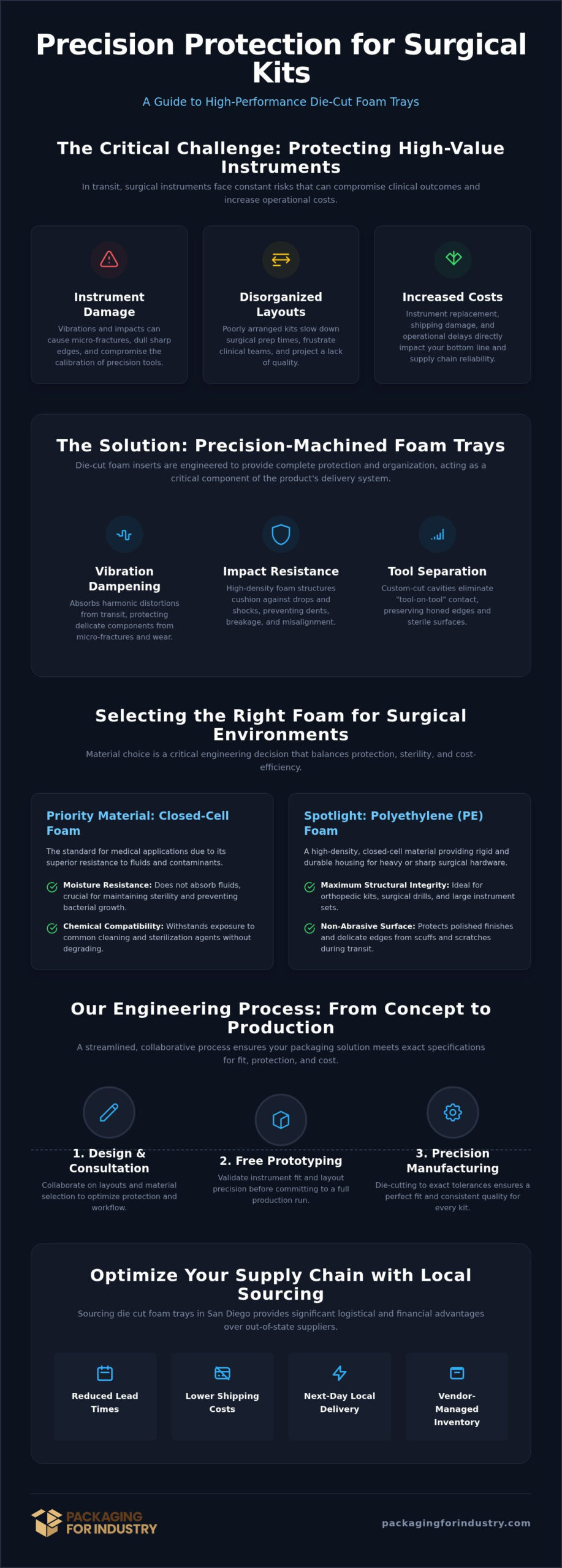
Die-cut foam trays are far more than simple cushioning; they’re precision-machined inserts tailored to the exact geometry of specific surgical tools. In the medical device industry, packaging must do more than just prevent breakage. It acts as a critical component of the product’s delivery system. Unlike standard electronics packaging that might allow for slight movement, surgical kits require significantly higher tolerances. Even a millimeter of shift can compromise a sterile barrier or dull the honed edge of a specialized cutting tool. When manufacturers source die cut foam trays for surgical kits San Diego medical device firms gain a logistical advantage through precision fit and local accountability.
Professional presentation is a major factor in how surgeons perceive the quality of your brand. A surgeon’s first interaction with your product often happens in a high-pressure clinical environment. A kit that’s disorganized or difficult to navigate projects a lack of precision. Conversely, a perfectly seated instrument set conveys a sense of reliability and engineering excellence. Beyond aesthetics, these trays perform three primary protective functions: vibration dampening, impact resistance, and tool separation. These features work together to ensure that your high-value assets arrive in the operating room in the same condition they left the manufacturing floor.
Preventing Damage to High-Precision Instruments
High-precision instruments like scalpels, forceps, and specialized implants feature delicate tips and edges that are highly susceptible to damage. Transit vibrations are a constant threat throughout the logistics cycle, potentially causing micro-fractures in metal or ceramic components. Custom cavities in protective foam packaging eliminate the risk of “tool-on-tool” contact. By seating each instrument in its own dedicated space, you ensure that vibrating surfaces never touch. This level of protection is essential for maintaining the calibration of sensitive diagnostic tools and ensuring that every blade remains surgery-ready upon arrival.
Surgical Workflow and Kit Organization
Surgical technicians and nurses operate in environments where efficiency is mandatory. An intuitive layout allows for rapid, sequential tool access, which can streamline the entire prep process. Manufacturers can use multi-layer inserts or color-coded foam to guide technicians through the stages of a procedure. This organized approach also simplifies the post-operative process. When every instrument has a dedicated, visible slot, technicians can perform inventory counts instantly. This visibility reduces the risk of lost tools and improves hospital compliance with safety protocols. To see how these layouts can fit your specific needs, you can request a packaging quote for a custom-designed solution.
Selecting the Right Foam Materials for Surgical Environments
Selecting the correct foam material is a critical engineering decision that balances instrument protection with logistical efficiency. For manufacturers specifying die cut foam trays for surgical kits San Diego, medical firms generally prioritize closed-cell structures for their superior moisture resistance. Unlike open-cell alternatives, closed-cell foams don’t absorb fluids, making them easier to manage in clinical settings where humidity or chemical exposure may occur. Density is another key metric; higher density foams provide better support for heavy tools, while lower density options offer superior vibration dampening for lighter components. If your kit contains electronic sensors or power modules, we also provide anti-static (ESD) foam variants to prevent discharge that could compromise the device’s functionality.
Polyethylene (PE) Foam for Heavy and Sharp Tools
Polyethylene (PE) foam is a high-density, closed-cell material that provides a rigid and durable housing for heavy surgical hardware. It’s the industry standard for orthopedic kits, surgical drills, and large instrument sets that require maximum structural integrity. Cross-linked PE foam is especially beneficial for high-value metal tools because its surface is non-abrasive, ensuring that polished finishes and honed edges remain pristine. This material is also highly resistant to chemicals, which is essential for reusable kits that undergo repeated handling. Its durability ensures that the custom-cut cavities maintain their tight tolerances over time, preventing instruments from becoming loose and sustaining damage through tool-on-tool contact.
Polyurethane (PU) Foam for Delicate Component Cushioning
Polyurethane (PU) foam provides a softer, more compliant cushioning solution for delicate or lightweight medical components. This open-cell material is ideal for protecting fragile glass vials, sensitive diagnostic sensors, or intricate catheter sets that could be damaged by the rigidity of PE foam. Convoluted PU foam is a popular choice for kit lids, as its “egg crate” profile applies gentle, uniform pressure to keep items seated without the need for complex custom cutouts in the top layer. Because PU is generally more affordable than high-density PE, it’s often the most economical choice for single-use or disposable surgical kits. To determine which material best suits your budget and protection requirements, you can compare packaging pricing for different foam densities and styles.
The Engineering Process: From Prototype to Production
Precision begins with the digital blueprint. We translate your instrument CAD files into exact foam geometries to ensure every cavity matches the tool’s dimensions perfectly. This technical translation is where the development of die cut foam trays for surgical kits San Diego medical firms rely on starts. At PFI, we provide a free prototyping service to validate these designs. This allows your team to test the fit and layout with physical instruments before you commit to a full production run. By identifying potential issues during the sampling phase, you avoid the high costs of re-tooling and production delays later in the cycle.
The manufacturing method we select depends on your specific volume and complexity requirements. For low-volume orders or highly intricate prototypes, we often utilize CNC routing. This process is ideal for rapid design iterations because it doesn’t require expensive dies. When your product scales, we transition to high-speed die-cutting. This shift ensures you get the most competitive packaging cost savings while maintaining the tight tolerances required for medical devices. Our CAD/CAM support stays integrated throughout this entire transition, allowing for seamless updates as your surgical tools evolve.
CAD/CAM Integration and Fit Testing
Our engineering team uses CAD/CAM software to design features that improve clinical usability. This includes the addition of “finger pulls” or recessed areas that allow surgical technicians to remove instruments safely and quickly. We work with you to determine the ideal “friction fit” for your tools; they must stay secure during transit but release without resistance during a procedure. Because the entire design is digital, we ensure 100% repeatability across thousands of units. Every tray in your ten-thousandth shipment will be identical to the approved prototype, which is essential for maintaining strict quality control standards.
Scaling to High-Volume Die Cutting
When moving to high-volume production, we utilize steel rule dies to create consistent, clean-cut edges. These dies are engineered for longevity and precision, ensuring that the professional appearance of your surgical trays remains consistent throughout the production life. We optimize the nested layout of the cavities on the foam sheet to maximize material yield and reduce waste. This efficiency is a primary driver in helping our clients lower packaging costs for recurring orders. Whether you’re a local San Diego startup or a large-scale manufacturer, our facility has the capacity to handle your batch sizes with local next-day delivery options to keep your supply chain moving.
Optimizing Your Supply Chain with Integrated Packaging Solutions
Sourcing die cut foam trays for surgical kits San Diego from the same partner that manufactures your custom corrugated boxes creates a seamless protective system. When the foam and the box are designed concurrently, we can minimize the overall footprint of the kit. This integrated engineering approach directly addresses “dimensional weight” surcharges, helping you lower packaging costs across your entire distribution network. For kits destined for international markets, we seat these precision inserts within heavy-duty double-wall boxes to ensure they withstand the rigors of long-distance air or ocean freight.
Labor is often the most significant hidden expense in medical device assembly. By utilizing our packaging kitting services, you can receive pre-assembled kits that are ready for instrument insertion. This allows your team to focus on high-value production rather than folding boxes or seating foam, which significantly reduces your internal operational overhead and streamlines your workflow.
Vendor Managed Inventory (VMI) for Medical Manufacturers
Maintaining a consistent supply of die cut foam trays for surgical kits San Diego requires careful coordination to avoid production halts. Our VMI programs eliminate the risk of stockouts by monitoring your usage levels and replenishing stock automatically. This is particularly valuable in the San Diego region, where industrial warehouse space is at a premium. By using PFI as your logistics hub, you free up expensive floor space for manufacturing. Additionally, VMI improves your cash flow; you pay for the packaging as it’s deployed rather than sitting on a massive, upfront investment of stagnant inventory.
Reducing Damage-Related Costs and Returns
A single damaged instrument does more than just incur a replacement fee. It compromises your reputation with hospitals and surgeons. We conduct detailed packaging reviews to identify vulnerabilities in your current shipping configurations. Engineered foam eliminates “hidden costs” like freight claims, expedited replacement shipping, and the administrative time spent processing returns. By investing in precision protection, you ensure that the fiscal responsibility of your supply chain matches the high standards of your medical engineering.
Why San Diego Medical Device Firms Choose PFI for Foam Trays
PFI has established deep roots in the Southern California industrial sector, positioning us as a steady partner for the region’s most demanding manufacturers. For firms producing medical devices along the Sorrento Valley and Carlsbad corridor, proximity isn’t just a convenience; it’s a competitive necessity. When you source die cut foam trays for surgical kits San Diego local delivery ensures your production lines never stall due to logistics delays from out-of-state suppliers. Choosing to manufacture die cut foam trays for surgical kits San Diego with a local partner like PFI ensures that your specialized equipment is protected by experts who understand the local logistical environment. We serve as a direct, cost-effective alternative to large catalog suppliers, providing the same high-tier engineering quality without the inflated overhead or rigid ordering structures.
Many firms default to national catalog vendors out of habit, yet they often face inconsistent foam quality and high shipping costs for bulky items. PFI offers a more resourceful approach. We combine custom engineering with fiscal responsibility, ensuring your bottom line is as protected as your instruments. Our ability to offer local next-day delivery for San Diego’s “Medical Mile” means you can maintain leaner inventory levels without the fear of stockouts. This responsiveness allows you to adapt to sudden shifts in surgical demand without the burden of excessive safety stock.
Local Support for the San Diego Biotech Corridor
Our service area extends across the primary hubs of SoCal innovation, including Irvine, Carlsbad, and the Sorrento Valley. Having a local representative means we can perform on-site packaging reviews to identify inefficiencies in your current warehouse operations. This hands-on approach is essential for the custom design packaging required by biotech firms. We also support the region’s aerospace and defense contractors with mil-spec foam inserts, ensuring that every component meets rigorous government and industry standards for protection and durability. This local oversight creates a narrative of total accountability from the initial design phase to final delivery.
Request a Custom Foam Tray Quote
Securing a precision-engineered solution starts with an accurate assessment of your needs. When you’re ready to move forward, preparing your instrument blueprints or physical samples allows our team to provide a fast, accurate quote. We understand that fit is everything in the medical field. That’s why we offer a free prototype for your review. This sample allows your technicians to validate the “friction fit” and layout before we begin high-volume die-cutting. By localizing your supply chain with PFI, you reduce lead times and improve overall kit reliability. Request a packaging quote today to begin your custom foam tray design.
Secure Your Medical Supply Chain with Precision Packaging
Selecting the right protective inserts is a technical decision that impacts both instrument safety and operational efficiency. By prioritizing closed-cell materials and integrated design, you ensure that high-value tools remain secure throughout the logistics cycle. Our engineering process moves seamlessly from digital blueprints to physical samples, allowing you to validate every cavity before full production begins. This methodical approach reduces hidden costs like damage claims and expedited shipping fees.
Partnering with a local expert for die cut foam trays for surgical kits San Diego provides the added benefit of next-day delivery and on-site support. PFI brings deep expertise in medical and aerospace standards, offering free CAD prototyping to guarantee a perfect instrument fit. We’re here to help you optimize your packaging strategy while maintaining the high standards your clinical end-users expect.
We look forward to helping you build a more reliable and cost-effective distribution system for your surgical products.
Frequently Asked Questions
What is the best foam material for surgical kit trays?
Closed-cell polyethylene (PE) is generally the best choice for surgical trays. It’s non-absorbent, chemical-resistant, and maintains its structural integrity under the weight of metal instruments. For lighter components or single-use kits, polyurethane (PU) might be used to reduce costs. You should compare packaging pricing for both materials to determine the most cost-effective solution for your specific clinical application and protection requirements.
Can you provide custom foam trays in small quantities for medical startups?
Yes, we support medical startups by offering custom foam trays in small-batch quantities. We utilize CNC routing for low-volume orders, which avoids the upfront cost of custom steel rule dies. This flexibility allows you to test market reception and iterate on your design without a massive financial commitment. As your production scales, we can transition your project to high-volume die-cutting to help you lower packaging costs over the long term.
How do I request a prototype for my surgical instrument kit?
You can request a free prototype by providing us with your instrument CAD files or physical samples. Our engineering team uses this data to design precise cavities that match your tool geometries exactly. This fit-testing phase is essential for validating the layout and protection levels before bulk manufacturing begins. To start the process, simply request a packaging quote and specify that you require a functional sample for instrument validation.
Do you offer anti-static (ESD) foam for surgical kits with electronics?
We provide specialized anti-static (ESD) foam options for surgical kits containing electronic sensors, power modules, or diagnostic components. These materials prevent the buildup of static electricity that could damage sensitive internal circuitry during transit or handling. By integrating ESD protection into your die cut foam trays for surgical kits San Diego, you ensure that your high-tech medical devices remain functional and safe for use in the operating room.
How quickly can I get delivery for my surgical kit packaging in San Diego?
We offer local next-day delivery for customers located within San Diego County and the broader Southern California region. Because our manufacturing facilities are local, we eliminate the long lead times and high freight costs associated with out-of-state suppliers. This proximity is a major advantage for firms in Sorrento Valley and Carlsbad that require just-in-time inventory to keep their medical device production lines moving without interruption.
Can you design both the foam insert and the outer corrugated box together?
We specialize in designing integrated packaging systems where the foam insert and the outer corrugated box are engineered concurrently. This ensures a perfect fit and optimizes the overall kit dimensions to reduce dimensional weight surcharges. We have custom sizes available for heavy-duty double-wall boxes that provide maximum protection for international transit. Sourcing both components from one supplier simplifies your procurement process and ensures total accountability for the kit’s performance.
What information do I need to provide for a custom die-cut foam quote?
To provide an accurate quote, we need the dimensions of your instruments, the desired tray footprint, and your estimated order volume. Providing CAD blueprints or physical samples allows our engineers to assess the complexity of the cavities and recommend the best material density. Once we have these details, we can provide a comprehensive proposal that allows you to compare packaging pricing and evaluate the logistical benefits of our local San Diego manufacturing.
Do you offer stocking programs for recurring surgical kit orders?
We offer Vendor Managed Inventory (VMI) programs for manufacturers with recurring production schedules. Through VMI, we monitor your stock levels and replenish your die cut foam trays for surgical kits San Diego automatically. This program helps you avoid stockouts of critical components while freeing up valuable warehouse space in your facility. It’s a pragmatic solution that improves cash flow by allowing you to pay for packaging only as it’s used.