
Mounting a shock data logger to the exterior of a shipping crate is often the fastest way to collect completely useless data. While it might show that a box was dropped, it fails to capture the actual G-force transferred to your sensitive electronics or medical hardware. If your packaging design for shock data logger placement doesn’t account for the dampening effects of internal cushioning, you’re likely paying high insurance premiums for data that won’t stand up in a claims dispute. We understand that for industrial manufacturers in Southern California and beyond, “good enough” monitoring isn’t an option when high-value assets are at risk.
You already know that data integrity is the only way to prove liability and optimize your supply chain. In this guide, you’ll learn the technical engineering principles behind precise logger placement to ensure every impact is recorded with clinical accuracy. We will explore how to integrate sensors into custom foam inserts, the impact of the updated ISTA 3E-2026 standards on testing, and how to validate your custom packaging designs to eliminate hidden transit damage for good.
Key Takeaways
- Understand why mounting loggers at the product’s center of gravity is the engineering gold standard for capturing accurate internal impact data.
- Learn how technical packaging design for shock data logger placement utilizes custom die-cut foam cavities to secure sensors and maintain data integrity.
- Discover the critical differences between exterior and interior mounting zones and how each choice affects your ability to verify shipping damage claims.
- Align your monitoring protocols with the latest industry standards, including ISTA 3E-2026, to ensure your data is technically sound and defensible.
- Leverage custom-engineered foam and aerospace-grade packaging solutions to protect high-value assets while lowering your overall transit damage costs.
The Engineering Logic Behind Shock Data Logger Placement
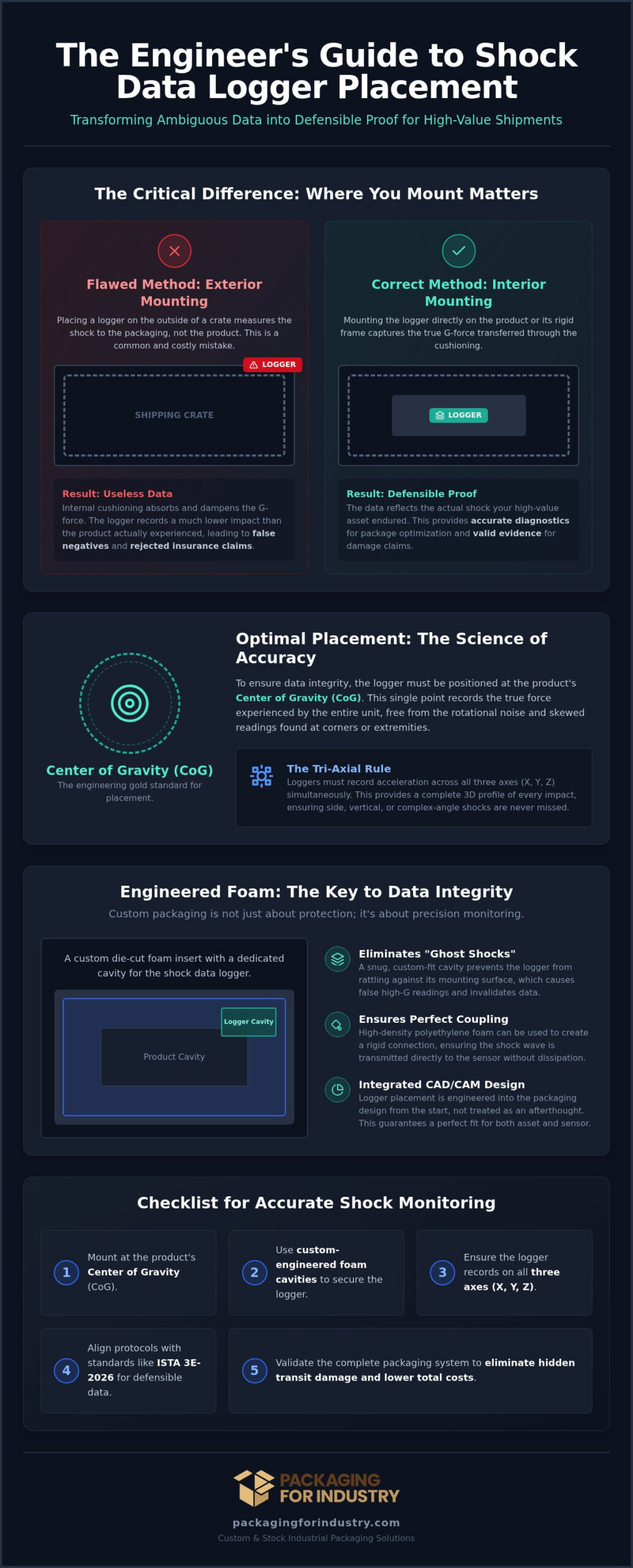
A Shock and vibration data logger is a critical instrument for high-value industrial logistics. It provides an objective, forensic record of every acceleration event your cargo encounters. Many manufacturers treat these devices as afterthoughts, sticking them to any available flat surface. This “near enough” approach is a costly mistake. If the sensor isn’t positioned correctly, it produces false negatives. You might receive a clean data report while the internal components of your machine are actually shattered. Accurate packaging design for shock data logger placement ensures the sensor records the exact force the product feels, not just the impact on the outer corrugated shell.
Understanding G-Force and Impact Transmission
Shock waves don’t move uniformly through a package. When a crate hits a warehouse floor in the Inland Empire, the kinetic energy travels through layers of double-wall corrugated board and protective foam. Each material has a specific density that dampens the shock. If you place a logger on a soft polyurethane foam layer, the foam absorbs the energy before the sensor can measure it. To get accurate readings, the logger must be coupled directly to the product or its rigid mounting frame. This balance between dampening for protection and coupling for recording is a core part of our custom design packaging process. We use high-density polyethylene when rigidity is required for data transmission, ensuring the sensor isn’t “blinded” by the very materials meant to protect the asset.
The Financial Impact of Data Accuracy
Precision in placement isn’t just about physics; it’s about fiscal responsibility and supply chain accountability. For companies shipping aerospace parts or medical devices, a single unrecorded impact can lead to catastrophic field failure. Verified data supports insurance claims and identifies exactly where in the supply chain a failure occurred. This ends the “blame game” between your warehouse team and the carrier. By using PFI’s CAD/CAM design phase to engineer specific cavities for loggers, you validate your packaging before the first shipment leaves Southern California. We offer free prototyping to ensure the fit is perfect for both your sensitive gear and the monitoring hardware. This proactive approach lowers the total cost of ownership by reducing damage claims and verifying that your custom sizes and materials are performing as intended.
Identifying Optimal Placement Zones: Box vs. Product
Deciding where to mount your sensor is as critical as the sensor itself. A common failure in packaging design for shock data logger placement is mounting the device to the most convenient spot rather than the most accurate one. To capture a complete profile of transit hazards, you must follow the “Tri-Axial” rule. This ensures the logger records acceleration across the X, Y, and Z axes simultaneously. Without this 3D perspective, a side-impact might go undetected or appear significantly weaker than it actually was. This data gap can be the difference between a successful insurance claim and a rejected one.
Center of Gravity (CoG) mounting is the gold standard for internal monitoring. When a sensor is placed at the CoG, it records the true force experienced by the entire unit without the rotational noise found at the corners. This alignment is consistent with international testing standards like IEC 60068-2-27, which provides the framework for determining how specimens withstand shock. If you can’t mount at the exact CoG, placing the logger on a rigid structural member of the product is the next best option. This ensures the shock wave doesn’t dissipate through secondary components before reaching the sensor.
Improper mounting leads to “Ghost Shocks.” These are high-G readings caused by the logger rattling against its mounting surface rather than a real impact event. If your sensor isn’t perfectly coupled, the data is invalid. You can request a quote for custom-engineered inserts that eliminate this vibration noise and ensure your data reflects reality.
Mounting on the Product Surface
Attaching loggers directly to industrial machinery requires specialized adhesives. You need a bond strong enough to prevent rattling but gentle enough to avoid stripping sensitive coatings or finishes upon removal. Accessibility is also a major factor. Your destination team must be able to retrieve the logger without disassembling the entire unit. We often design specific access ports in our crates to facilitate this data retrieval without compromising the structural integrity of the shipment.
Mounting on the Primary Packaging
Sometimes, monitoring the container is necessary. When using custom corrugated boxes, exterior mounting tells you how the carrier handled the package. However, there’s a risk of recording “box impact” instead of “product shock.” The corrugated board flexes and absorbs energy, meaning the logger on the box might see 50G while the product inside only feels 10G. For complex aerospace assemblies, we often recommend dual-logger setups. One sensor monitors the outer shell while the other tracks the internal component, providing a clear picture of how well the packaging is performing its dampening duties.
Engineering Custom Foam Inserts for Logger Integration
Stock foam solutions often leave loggers loosely tucked into corners or taped to the underside of a lid. This is a primary cause of data corruption and hardware loss. Advanced packaging design for shock data logger placement requires a dedicated, die-cut housing within the protective foam block. This ensures the sensor stays exactly where the engineers intended, regardless of how many times the crate is rolled or tilted during transit. Without a secure cavity, the logger can migrate within the package, leading to inaccurate readings or “blind spots” during a critical impact event.
Material choice is the most important factor in data transmission. High-density polyethylene (PE) foam is typically the superior choice for coupling a sensor to a product. Its closed-cell structure is rigid enough to ensure that impact energy is transferred directly to the sensor without the “muffling” effect seen in softer polyurethane (PU) foams. When we design for ASTM D4169 performance testing, we ensure the foam density matches both the product’s fragility and the logger’s recording threshold. This technical alignment prevents the foam from absorbing the very data you’re trying to collect.
Operational efficiency also depends on “Line of Sight” engineering. If your logger has a screen or visual status indicators, the protective foam packaging must include a viewing window. This allows warehouse staff in Orange County or at the final destination to check for “red light” shock events without unpacking the asset. Our designs hold the sensor in a fixed orientation, preventing it from rotating away from these viewing ports during rough handling.
Die-Cut Precision and Prototyping
We use CAD/CAM technology to create precision friction-fit cavities. This eliminates the need for secondary adhesives that can fail or leave residue on your monitoring hardware. We offer free prototyping to Southern California manufacturers, allowing you to test the logger’s fit and extraction ease before committing to a full production run. This ensures the monitoring hardware is easily removable and reusable across multiple shipments, helping you lower packaging costs over time.
ESD and Anti-Static Considerations
Electronic data loggers are sensitive instruments that require a controlled environment. When shipping for the electronics or medical device packaging sectors, ESD (Electrostatic Discharge) foam is non-negotiable. Pink anti-static or black conductive polyethylene prevents static buildup that could fry the logger’s internal circuitry or corrupt the recorded data. We match the foam’s electrical properties to the specific requirements of your equipment, ensuring total reliability for every high-value shipment.
Step-by-Step Guide to Mounting Loggers for Accurate Data
Execution is just as vital as engineering. Even the most sophisticated packaging design for shock data logger placement fails if the hardware isn’t installed with precision. A sensor that’s slightly loose or misaligned will produce “noisy” data that’s difficult to interpret during a damage claim. To ensure your monitoring protocol is technically sound, your warehouse team should follow a standardized mounting process every time a high-value asset is prepped for shipment from your Irvine or Anaheim facility.
- Step 1: Identify the primary impact axis. Determine the most likely direction of shock based on the shipping orientation and the product’s fragility.
- Step 2: Clear the mounting surface. Remove all dust, oils, or moisture from the attachment point. Contaminants are the leading cause of adhesive failure during transit.
- Step 3: Secure the logger. Place the device firmly within the engineered foam cavity. There should be zero play or wiggle room once the logger is seated.
- Step 4: Align the axes. Ensure the logger’s internal X, Y, and Z axes perfectly match the package orientation arrows.
- Step 5: Perform a simulation. Conduct a “drop test” with a prototype box to verify the logger stays coupled to the product under stress.
Orientation and Axis Alignment
Aligning the logger’s internal coordinate system with the package’s external orientation is a technical requirement, not a suggestion. If the logger’s “Up” arrow doesn’t match the crate’s orientation, you’ll skew your G-force data by up to 30%. This discrepancy makes it impossible to tell if an impact was a vertical drop or a side-swipe in the back of a truck. We recommend labeling the exterior of the carton to match the internal logger placement. This helps handlers avoid placing heavy equipment directly over the sensor, which can cause false pressure readings or physical damage to the monitoring hardware.
Securing the Logger Within the Crate
The choice between mechanical fastening and industrial adhesives depends on the shipment’s duration and environment. For custom shipping crates, we often use a combination of precision friction-fit foam and secondary security straps. You must ensure the logger doesn’t become a projectile inside the package. If a sensor breaks loose, it won’t just stop recording; it can physically impact and destroy the very product it’s supposed to protect. Before the final seal is applied, perform a “shake test.” If you can feel or hear the logger moving, it isn’t secure enough for a long-haul journey.
Optimizing High-Value Logistics with PFI’s Custom Solutions
PFI operates as a proactive problem solver for manufacturers who can’t afford a single failure in their supply chain. We don’t simply provide materials; we engineer a comprehensive system of protection. Our specialized packaging design for shock data logger placement ensures that your monitoring hardware is a high performing asset rather than a logistical hurdle. By integrating sensor housing into the initial design phase, we help you eliminate the professional stress of unverified shipping damage and high insurance premiums. We focus on the intersection of engineering and economics, ensuring every custom solution is as cost-effective as it is durable.
For specialized sectors, we integrate data logger housing directly into aerospace packaging workflows. These high-value assets require more than just a stock box. They need precision-cut foam and heavy-duty corrugated structures that maintain structural integrity under extreme conditions. To support your recurring shipping needs, our vendor-managed inventory (VMI) program provides a seamless supply of custom-engineered crates and inserts. This approach allows you to maintain lean operations while ensuring that every shipment is protected by validated, data-backed packaging designs. You can request a packaging quote to see how our engineering-first methodology reduces your total transit damage claims.
Southern California’s Partner in Industrial Protection
We provide deep local expertise for the manufacturing hubs of Anaheim, Irvine, and Los Angeles. Our proximity to these centers allows us to offer local next-day delivery for custom-designed boxes and foam inserts. We don’t just ship products; we offer on-site packaging reviews to identify specific cost-saving and damage-reduction opportunities. This hands-on approach is why Southern California distributors trust us to handle their most sensitive gear. Whether you need ESD-safe foam for electronics or mil-spec crates for defense contracts, our team ensures your logistical flow remains uninterrupted and efficient.
From Prototype to Full-Scale Production
Transitioning from a single test crate to a nationwide rollout requires a steady and dependable partner. PFI manages this entire journey, starting with free prototyping to ensure a perfect fit for both your product and its monitoring hardware. Once the design is validated, we utilize just-in-time (JIT) delivery to keep your production line moving without cluttering your warehouse with excess inventory. We provide the quiet confidence that comes with precision engineering and total accountability. From the first CAD drawing to the final delivery, we guarantee a reliable supply of packaging that performs exactly as intended.
Securing Your Supply Chain with Data-Driven Engineering
Accurate impact monitoring is only as reliable as the physical mounting of your hardware. By prioritizing precise packaging design for shock data logger placement, you transform raw data into a defensible record of carrier accountability. Center of Gravity mounting and custom die-cut foam are essential for eliminating “ghost shocks” and capturing true G-force events. These technical details ensure your insurance claims are backed by clinical evidence rather than speculation.
PFI brings specialized experience in aerospace and medical device packaging to every project we handle. We offer free prototyping for all custom designs to ensure your sensors and products fit perfectly before full-scale production begins. For manufacturers across Orange County, Los Angeles, and the Inland Empire, our local next-day delivery keeps your logistical flow moving without interruption. We’re committed to lowering your packaging costs while improving the reliability of your most sensitive shipments.
We’re ready to help you eliminate the professional stress of transit damage through superior engineering and dependable service.
Frequently Asked Questions
Where is the best place to put a shock data logger?
The center of gravity (CoG) of the product is the most effective location for mounting a shock data logger. Placing the sensor here ensures that the recorded data reflects the true force experienced by the entire asset. If the CoG is physically inaccessible, the sensor should be mounted to a rigid, non-flexible structural component. This prevents the logger from recording secondary vibrations that don’t represent the actual impact force encountered during transit.
Should I mount the logger on the product or the box?
Mounting the logger directly on the product provides the most accurate data regarding the product’s experience. Mounting on the exterior corrugated box only records the impact the package shell received. While box mounting is easier for retrieval, it often leads to false negatives. For high-value aerospace or medical shipments, we recommend a dual-logger configuration. This setup monitors both the external handling and the internal shock dampening performance of your custom foam.
How many loggers do I need for a single large crate?
A single logger is typically adequate for standard-sized shipments if it’s placed correctly. For oversized industrial machinery or long-span medical hardware, we suggest using two loggers at opposite ends of the unit. This configuration helps identify uneven impacts or rotational “tip” events that a single central sensor might miss. Multiple sensors provide a more comprehensive profile of the hazards encountered throughout the Southern California distribution network or during international transit.
Does the foam density affect data logger readings?
Foam density plays a critical role in how impact energy is recorded. High-density polyethylene is the preferred material for packaging design for shock data logger placement because its rigid structure transfers energy efficiently. Softer foams can dampen the shock wave before it reaches the sensor, resulting in under-reported G-force readings. We use CAD/CAM support to match the foam density to your product’s weight and the logger’s sensitivity thresholds.
Can I reuse the foam inserts for multiple shipments?
You can reuse custom foam inserts if they are made from durable, closed-cell materials like polyethylene. These materials don’t degrade or crush after a single impact, unlike lower-cost expanded polystyrene. Reusable foam cavities are a cost-effective solution for recurring shipping needs. We design our inserts for easy hardware removal, allowing you to quickly swap loggers between shipments while maintaining a consistent and reliable data-logging protocol for all high-value assets.
What is the most common mistake in shock logger placement?
The most frequent error is failing to secure the logger firmly to the mounting surface. If there is any “play” or wiggle room, the sensor will rattle during transit and record “ghost shocks.” These are high-G readings that represent the logger hitting the side of its cavity rather than the product hitting the floor. Proper coupling is essential for data integrity. Always verify the fit with a “shake test” before sealing the crate.
How do I ensure the logger stays secure during a 3-foot drop?
Ensuring security during a significant drop requires a precision friction-fit cavity within the protective foam. We engineer these cavities to the exact dimensions of your monitoring hardware. For heavy-duty applications or military-spec packaging, we may also incorporate secondary mechanical fasteners or high-bond industrial adhesives. This multi-layered approach ensures the sensor remains coupled to the product even during severe handling events or accidental free-fall drops of three feet or more.
Does PFI provide loggers with their custom packaging?
PFI specializes in the custom engineering and supply of protective packaging rather than the electronic hardware itself. We provide the technical expertise to integrate your chosen sensor into a high-performance shipping system. Our packaging design for shock data logger placement includes free prototyping to ensure a perfect fit for brands like ShockWatch or SpotBot. This allows you to validate the packaging fit and data accuracy before you commit to full-scale production.