
What if the foam around an electronic component matters as much as the outer box? Cross-Linked Polyethylene Foam for Electronics uses polymer chains bonded during manufacturing, creating a more uniform material than standard polyethylene foam. That structure can provide consistent cushioning and help protect sensitive parts during handling and shipping.
Choosing foam involves more than selecting a thickness. The cross-linking method, density, and hardness all affect how the material responds to impact and fits the product. For purchasing teams, matching these details to the component helps define a practical packaging specification.
This guide explains how XLPE differs from standard polyethylene foam, how physical and chemical cross-linking shape its properties, and what density, hardness, and safety considerations mean for electronics packaging. It also covers how to assess custom sizes for a project, compare packaging prices, and prepare a quote request that reflects product and order requirements, including bulk pricing.
Key Takeaways
- Understand how cross-linking changes foam structure and what that means for cushioning, water resistance, and compression response.
- Match foam density and hardness to the product’s weight, shape, and protection needs rather than choosing by thickness alone.
- See how closed-cell foam can support protective packaging for electronics, sensitive components, medical devices, and industrial parts.
- Compare physical and chemical cross-linking to identify which material qualities best fit your packaging requirements.
- Explore how PFI’s foam packaging, inventory management, and packaging support can help streamline supply for industrial operations.
What’s the difference between cross-linked polyethylene and standard polyethylene foam?
XLPE’s bonded polymer structure affects how foam responds to impact, moisture, chemicals, and compression.
Chemical and Compression Resistance
Chemical cross-linking creates a more consistent cell structure than standard polyethylene foam. XLPE resists many chemicals, but compatibility depends on the fluid and formulation. Its compression and rebound are more consistent, which can support fitted electronics cavities. Some product listings identify FMVSS 302 and ISO 11925-2 fire-resistance certifications. Those certifications don’t apply automatically to every grade.
Closed-Cell Insulation and Water Resistance
Closed cells limit water absorption and support thermal insulation. One listed specification sets absorption at no more than 8% after 24 hours at 23°C ±2°C. That figure doesn’t mean every grade suits every exposure. For electronics shipped through damp environments, match material performance to handling conditions. Edge protection can also address exposed package edges.
Density and Surface Resistivity
Density affects firmness and cushioning, so match it to the component and packaging design. Listed XLPE options range from 2LB to 6LB. Surface resistivity indicates how readily material dissipates charge; antistatic foam isn’t automatically conductive. US buyers can source antistatic XLPE through industrial foam converters and packaging suppliers. Conductive grades require distinct electrical-performance specifications.
Outgassing and Chemical Compatibility Risks
Outgassing and chemical compatibility matter when foam sits close to sensitive electronics. The level of risk depends on the foam formulation, nearby materials, and exposure conditions. Residues or emitted compounds may affect sensitive surfaces, coatings, or contacts. Match the grade to the component’s material restrictions and intended storage conditions. XLPE is used to protect electronics, but that alone doesn’t establish compatibility with every device.
Is cross-linked polyethylene foam non-toxic and safe for packaging?
XLPE foam is used in protective packaging, but “non-toxic” isn’t a universal grade designation. Material safety depends on the formulation and intended contact conditions. For electronics, assess technical documentation against device material restrictions, nearby coatings, and storage conditions. Foam selected for cushioning alone may not address emissions or chemical compatibility. Packaging use doesn’t establish suitability for food contact, skin contact, or direct medical contact.
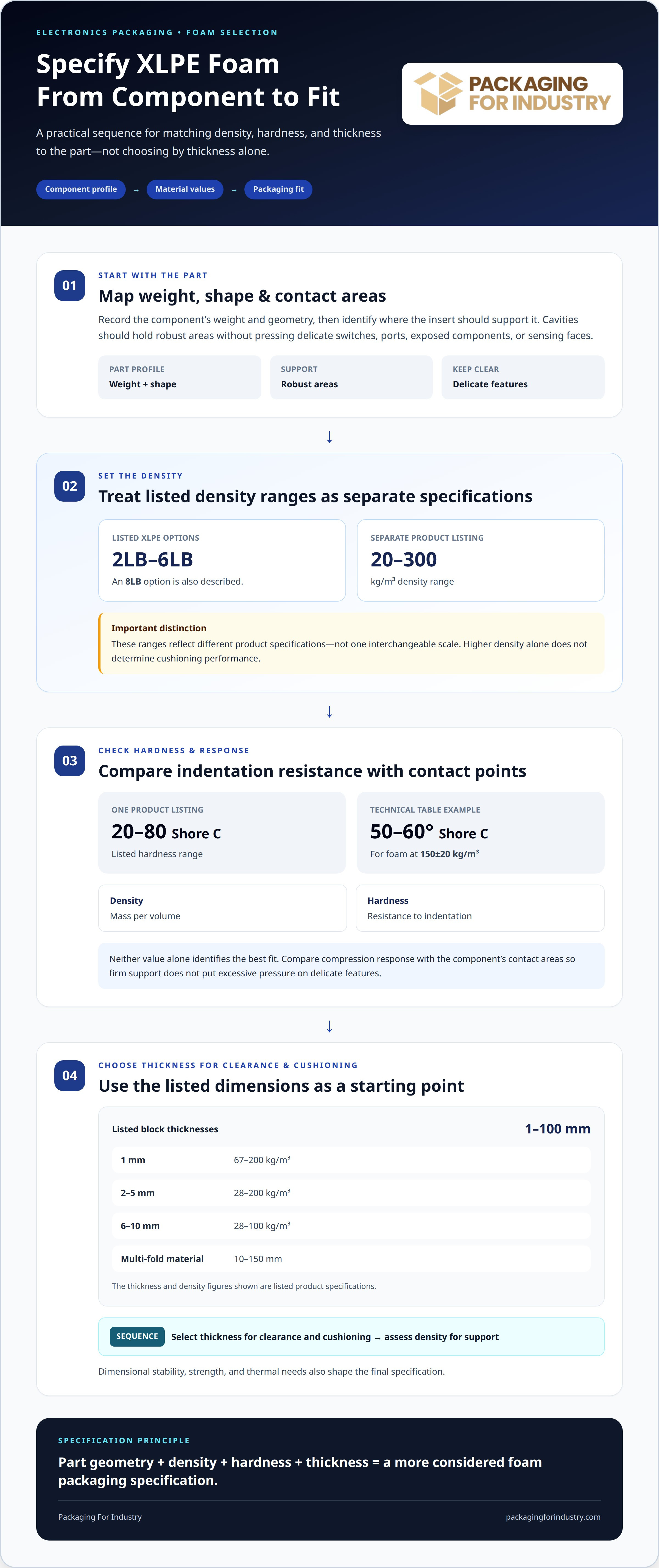
Cross-Linked Polyethylene Foam for Electronics can cushion sensitive components during shipment, but the grade must suit the device and its surroundings. A fitted insert can secure a circuit board, connector, or instrument housing and help limit movement. Packaging geometry matters, too. Cavities should support robust areas without pressing delicate switches, ports, or exposed components. This is especially important for assemblies shipped with attached cables.
Medical-device and industrial applications use XLPE for protective inserts and shock absorption. It can also package industrial parts with tight tolerances, where movement may affect alignment or surface condition. Choosing Cross-Linked Polyethylene Foam for Electronics means distinguishing transit cushioning from material requirements for the device itself. For example, an insert can hold a precision sensor by its housing while leaving its sensing face clear. Use in medical-device packaging doesn’t make foam sterile or suitable for every device.
Foam densities and hardness
Density and hardness help determine how foam supports a product. Consider both alongside the part’s weight, shape, and cushioning requirements.
Density Specifications and Options
Listed XLPE options include 2LB to 6LB, with an 8LB option also described. A separate product listing gives a density range of 20 kg/m³ to 300 kg/m³. These ranges reflect different product specifications, not a single interchangeable scale. Higher density alone doesn’t determine cushioning performance; the component’s geometry and the packaging design also matter. For example, an insert supporting a compact, heavy component may need different firmness than padding for a broad, lightweight panel.
Hardness Specifications
One product listing gives a Shore C hardness range of 20 Shore C to 80 Shore C. A technical table specifies 50-60° Shore C for foam with a density of 150±20 kg/m³. Hardness describes resistance to indentation, while density measures mass per volume. Neither value alone indicates the best fit. Compare the foam’s compression response with the component’s contact areas, so firm support doesn’t place excessive pressure on delicate features.
Thickness and Density Ranges
Listed block thicknesses range from 1 mm to 100 mm. Physically cross-linked foam is available at 1 mm thickness in densities from 67 to 200 kg/m³; 2-5 mm options span 28 to 200 kg/m³. At 6-10 mm, listed densities range from 28 to 100 kg/m³. Multi-fold material ranges from 10 to 150 mm. Select thickness for clearance and cushioning, then assess density for support. Dimensional stability, strength, and thermal needs also shape the final specification. “Excellent” isn’t a measurable grade; use stated values instead.
XLPE foam composition and closed-cell structure
XLPE’s linked polymer chains shape its cell structure, consistency, and durability. IXPE uses a distinct cross-linking process.
Foam Composition
XLPE foam starts with polyethylene polymer chains bonded during manufacturing. Cross-linking joins those chains into a network, changing how the material holds its shape and responds to force. The resulting structure is more uniform than that of non-cross-linked polyethylene foam. IXPE, or irradiated cross-linked polyethylene, uses electron-beam processing to create its cross-linked structure. This process distinguishes IXPE from chemically cross-linked foam.
Closed-Cell Formation
In closed-cell foam, individual cells form enclosed pockets rather than open pathways. This structure limits water absorption and helps provide thermal insulation. It also supports cushioning by allowing the foam to compress under impact. IXPE foam is used in protective packaging for electronics and medical devices. Its shock-absorbing properties also make it suitable for sports equipment, where cushioning helps manage impact during use.
Cross-Linked Structure and Durability
Cross-linked polymer chains help XLPE maintain dimensional stability and resilience during handling. Its uniform cell structure supports consistent compression and rebound, which is useful for inserts that repeatedly hold components in position. Physically cross-linked polyethylene foam is produced using extrusion technology and electron-beam processing. Chemical and physical methods produce different material structures, so the manufacturing route matters when selecting foam for a packaging design. Evaluate the finished material’s performance against the product’s handling needs.
Physical and chemically cross-linked foam qualities
Physical and chemical cross-linking describe different manufacturing routes for polyethylene foam. Physically cross-linked foam uses extrusion technology and electron-beam processing. Chemical cross-linking bonds polymer chains during manufacturing, creating a cross-linked structure. Both methods produce XLPE, but the process and finished grade determine the properties relevant to packaging.
IXPE is a physically cross-linked polyethylene foam made through irradiation. It is lightweight, with a smooth surface and clean-cut edges. Those features can help when packaging designs need fitted, neat internal surfaces. IXPE can also provide thermal insulation, while the cross-linked structure supports dimensional stability. The material’s listed operating temperature range is -40°C to +120°C, a factor for packages exposed to temperature changes.
Compare the finished foam’s intended performance, rather than selecting by process name alone. For an electronics insert, dimensional stability helps maintain the component’s position; smooth surfaces can reduce rough contact with finished parts. Thermal insulation may matter when the package faces temperature variation. A physically cross-linked grade and a chemically cross-linked grade should be assessed against the same design needs, including fit, cushioning, and handling conditions. Protective foam packaging is shaped around those application requirements, not just a manufacturing label. The practical takeaway: specify the required properties first, then select the cross-linking route and grade that meet them.
Foam packaging products and services
Packaging For Industry (PFI) helps manufacturers match foam packaging to product and workflow requirements. Its Foam Packaging offering serves electronics and industrial components that need protection. Packaging needs depend on the item’s shape, shipping method, and packing process. Sharing these details helps define a design that fits the part and the way employees handle it at the packing station.
For products that need a fitted arrangement, custom packaging design can account for component outlines, contact points, and available space. A clear layout can help operators place each item consistently and keep accessories organized. PFI’s Packaging Kitting and Assembly Services can also prepare packaging components for repeat workflows, helping teams handle recurring packing tasks in a planned sequence.
Stretch Film secures palletized shipments after products are packed. It helps hold a load together as it moves through warehouse handling and distribution. Stretch film packaging supplies complement internal protective materials by stabilizing the unitized load rather than cushioning individual components.
PFI’s Vendor Managed Inventory (VMI) for Packaging supports coordinated inventory planning around recurring packaging use. Its Just-In-Time (JIT) Inventory Management for Packaging aligns replenishment with planned operational demand. These options can suit operations where packaging consumption follows production schedules or storage capacity is limited. They connect material requirements with purchasing and replenishment workflows.
For electronics operations, assess packaging decisions alongside the packing sequence, pallet configuration, and expected replenishment pattern. This broader view helps purchasing and operations teams align product protection, handling, and packaging supply with routine production and shipping needs.
Industries served
Electronics manufacturers need packaging that protects circuit boards, sensors, connectors, and finished equipment during handling and shipment. Foam Packaging can cushion sensitive components, while Stretch Film helps secure palletized loads for warehouse movement. Packaging design must account for the product’s shape, fragile contact points, and packing process. A control unit, for example, may need internal support that prevents movement without pressing on delicate switches or ports.
Aerospace and medical companies also move precision parts and equipment where surface condition and fit matter. Foam can separate components and help limit contact during transit. Industrial manufacturers handling parts with tight tolerances need packaging aligned with the part’s geometry and shipping route. For production operations, packaging for manufacturers should fit the way products move from assembly to storage and dispatch.
Food companies, construction suppliers, distributors, and fulfillment centers have different packaging priorities. A warehouse may need stable pallet loads and predictable access to materials, while a construction supplier may ship bulky or irregular components. Stretch Film helps contain loads, and foam packaging cushions products inside the package. Matching materials to each operation helps avoid excess handling and reduce opportunities for shipping damage.
Supply planning matters across these industries, especially when packaging demand follows production schedules. PFI’s Vendor Managed Inventory for Packaging supports coordinated replenishment, while its Just-In-Time Inventory Management for Packaging aligns supply with planned needs. These approaches can suit electronics plants, medical-device operations, aerospace production, and distribution centers with limited storage. The right packaging system considers both product protection and the routine work of the people packing, storing, and shipping it.
Benefits of protective foam packaging
Protective foam creates a buffer between a product and its shipping container. Cross-linked polyethylene foam for electronics can be shaped to support a component and limit movement in transit. A fitted insert can hold a circuit board, sensor, or control module in position, reducing contact with the box walls. The design should account for the product’s shape, vulnerable features, and how operators load and remove it. This fit can help reduce shipping damage without relying on loose fill alone.
Foam can also separate multiple parts within one package. For example, dividers can keep connectors or machined components from striking each other during shipment. Cushioning works best as part of a complete package, with the outer container and handling process considered alongside the insert. A component that shifts inside an oversized cavity may still face impact, even if the foam cushions it well. A carefully planned layout also supports orderly packing and repeatable handling.
Cross-Linked Polyethylene Foam for Electronics packaging should be specified around the product and its packing process. Manufacturers need suitable materials available alongside production, while warehouses need packaging that supports consistent routines. Aligning foam specifications with the component can help limit unnecessary material changes and disruptions. Review contact areas, shipping orientation, and package arrangement together. This gives purchasing and operations teams a practical basis for selecting cushioning materials, planning replenishment, and supporting reliable supply across recurring orders.
Why choose Packaging For Industry (PFI)
Packaging For Industry (PFI) helps electronics and industrial teams match protective foam packaging to production and shipping needs. Turn to PFI when components need cushioning suited to their shape, current packaging creates packing difficulties, or material replenishment disrupts operations. Foam Packaging addresses product protection needs, while Stretch Film helps stabilize palletized loads after packing.
A useful packaging review considers the product, packing method, and shipping route together. Component dimensions, weight, fragile areas, and existing damage concerns help define the packaging challenge. For example, a delicate connector may need clearance from pressure points, while a production line may need repeatable placement in each package. These details guide practical packaging decisions without treating every part as interchangeable.
Supply planning matters, too. PFI’s Vendor Managed Inventory (VMI) for Packaging supports coordination between packaging demand and inventory planning. Its Just-In-Time (JIT) Inventory Management for Packaging aligns replenishment with planned operational needs. These approaches can suit manufacturers managing limited storage or recurring shipments, where packaging availability affects the packing schedule. PFI connects packaging supply with the day-to-day requirements of manufacturing and warehouse teams.
PFI can help when a business needs foam packaging, stretch film, or a more coordinated approach to packaging inventory. The next step is to discuss the product being packed, the current shipping process, and the supply issue to solve. That conversation can help identify which packaging requirements to address first.
To request a custom foam packaging quote, contact PFI with the product, dimensions, order quantity, and delivery requirements.
Frequently Asked Questions
What is XLPE foam?
XLPE foam is a polyethylene cushioning material used in industrial packaging. Buyers typically assess it as part of an insert or protective assembly, rather than as a stand-alone guarantee of safe transit. For a device with a removable battery, for example, the package design should prevent the battery and device from shifting into each other. Specify the complete package use, not only the foam name.
What is cross-linked polyethylene foam and how is it made?
Cross-linked polyethylene foam is made by bonding polyethylene polymer chains during manufacturing. Chemical processes create the bonds through a manufacturing reaction, while IXPE uses irradiation, including electron-beam processing. After selecting a material, a packaging designer can convert the foam into components sized for the product and package. The process name identifies how the foam is produced; it doesn’t by itself define the fit or performance of a finished insert.
What are the key properties of XLPE foam for electronics packaging?
For an electronics package, useful properties depend on the device and shipping conditions. Buyers can evaluate cushioning, compression response, insulation, and resistance to moisture or chemicals against the intended application. For example, a sensor shipped with a metal mounting bracket may need separation to prevent abrasion. Consider a foam specification alongside the insert layout, outer carton, and handling process, since material properties alone don’t describe the complete package.
How does XLPE foam protect electronics from static electricity and ESD?
XLPE protects against static only when the selected grade has the required static-control properties. Antistatic foam helps limit charge buildup; conductive foam provides a conductive path. These functions are distinct, so a semiconductor component’s packaging specification should state which is needed. Consider the component’s handling and contact points, then coordinate the foam with any ESD bags or other packaging materials in the pack-out. Don’t assume ordinary cushioning foam provides ESD protection.
What XLPE foam densities, thicknesses, and grades are available for electronics?
Listings include 2LB to 6LB options, a separate density range of 20 kg/m³ to 300 kg/m³, and block thicknesses from 1 mm to 100 mm. These figures describe different listings, not one combined product range. For purchasing, compare values within the same product specification and units. Also record the required insert dimensions, static-control needs, and component contact areas, so the selected grade aligns with the design.
How does XLPE foam compare with EVA, polyurethane, and non-cross-linked polyethylene foam?
These materials differ in polymer composition and manufacturing, so their names alone don’t establish which is best. Compare grades against the same packaging requirements: insert geometry, component support, compression behavior, surface contact, and static-control needs. EVA and polyurethane are separate material families, while non-cross-linked polyethylene lacks the linked structure. For a procurement comparison, request comparable technical specifications and assess each candidate in the intended package design.
What standards and certifications apply to XLPE foam used in electronics packaging?
Some XLPE listings identify FMVSS 302 and ISO 11925-2 fire-resistance certifications. Treat these as product-specific statements, not evidence that every foam grade or finished package carries them. They also don’t establish ESD performance or chemical compatibility. For procurement, keep the material’s certification documentation with the specification and distinguish it from requirements applying to the packed device or complete shipping package.
How do packaging providers design and fabricate custom XLPE foam inserts for electronic devices?
A custom insert project uses device dimensions, accessory details, fragile areas, and the outer package’s interior space as design inputs. Packaging For Industry provides CAD/CAM support, foam design, prototypes, and samples. The design process can map cavities and access points, then use a sample to assess fit and packing sequence before full rollout. Clear drawings and product samples help resolve placement questions early and support repeatable assembly on the packing line.