
With the civilian industrial drone market projected to reach $18.44 billion in 2026, the financial stakes for protecting high-value flight electronics have never been higher. You’ve likely invested heavily in sophisticated gimbals and sensors, only to face the frustration of equipment arriving at a field site with transit-induced calibration errors. It’s a common operational bottleneck that leads to expensive delays and repair costs. Securing custom foam inserts for drone cases Southern California manufacturers can trust isn’t just a luxury; it’s a logistical necessity for maintaining a competitive edge as the industry moves toward standardized Beyond Visual Line of Sight (BVLOS) operations.
This guide explains how to engineer high-performance foam inserts that shield sensitive sensors while streamlining your regional supply chain. We’ll explore the latest 2026 IATA battery regulations and MIL-STD-810H testing requirements to ensure your fleet remains compliant and field-ready. From choosing between anti-static (ESD) materials to leveraging local next-day delivery in Orange County and Los Angeles, this overview provides the technical framework needed to optimize your industrial drone protection. You’ll gain the insights required to eliminate disorganized equipment and long lead times from distant catalog suppliers.
Key Takeaways
- Identify the limitations of generic foam and learn to select specialized PE, PU, and ESD materials for long-term equipment protection.
- Optimize your logistics by sourcing custom foam inserts for drone cases Southern California facilities produce to minimize lead times and logistical overhead.
- Leverage CAD/CAM engineering and precision cutting techniques to ensure a perfect fit for complex sensor arrays and sensitive gimbals.
- Improve supply chain reliability through local inventory programs and integrated packaging solutions that combine foam with heavy-duty corrugated boxes or crates.
The Critical Role of Custom Foam Inserts for Industrial Drone Fleets
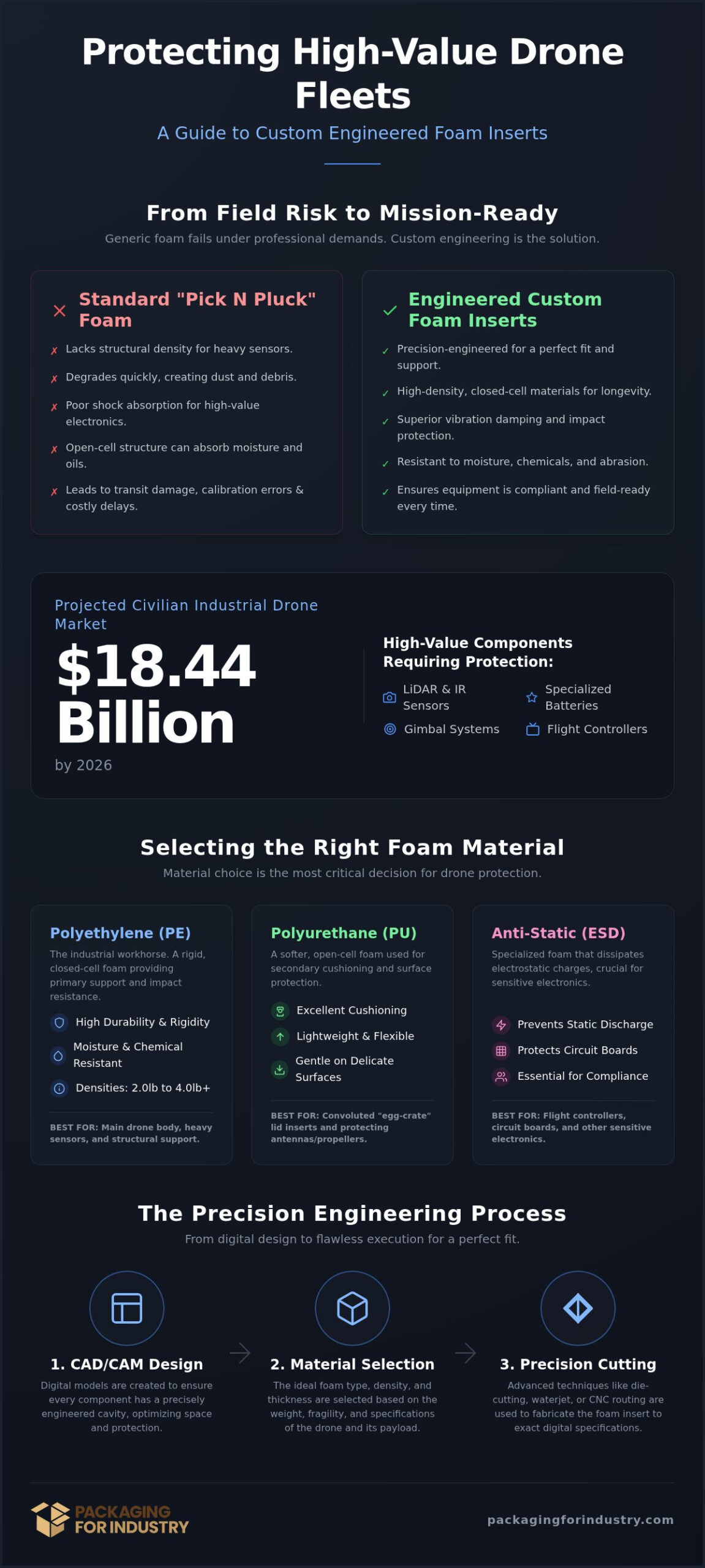
The industrial drone market is moving away from generic, off-the-shelf storage solutions. While “Pick N Pluck” foam is common in consumer markets, it fails to meet the rigorous demands of professional field operations. These pre-perforated options lack the structural density required to support heavy payload sensors; they often degrade after repeated use, leaving expensive equipment susceptible to impact. For companies operating in the aerospace and defense sectors, investing in custom foam inserts for drone cases Southern California helps secure high-value assets against the harsh realities of industrial logistics. It’s a pragmatic choice for any operation that values equipment longevity.
Professional organization directly influences field efficiency. When every component has a precision-engineered cavity, technicians can perform rapid inventory checks before and after missions. This reduces the risk of leaving critical sensors or specialized batteries behind. Beyond protection, these inserts serve as a vital marketing tool for drone manufacturers. A well-organized, branded case projects stability and technical competence during sales demonstrations and client handovers. By preventing even a single instance of transit damage, custom foam significantly lowers the Total Cost of Ownership (TCO) for a drone fleet.
Protecting Sensitive UAV Components
Industrial drones carry payloads that often exceed the cost of the aircraft itself. High-resolution cameras and LiDAR sensors are particularly vulnerable to high-frequency vibrations during transport. Custom foam provides the necessary damping to isolate these components. It also prevents battery movement, which is critical for avoiding terminal wear and friction-related heat. Understanding Package cushioning principles is essential for designing these environments. The cushioning factor is defined as the ratio of the peak stress to the energy absorbed per unit volume during an impact.
Industrial vs. Consumer Drone Packaging
B2B drone fleets require materials that withstand years of deployment rather than occasional hobbyist use. Retail foam often uses open-cell structures that absorb moisture and oils, which can damage sensitive flight electronics over time. Industrial solutions utilize closed-cell polyethylene or specialized ESD foam to ensure long-term durability. These protective foam packaging solutions are designed for high-cycle use in demanding environments. For Southern California manufacturers, custom design packaging also simplifies the assembly line process. Kitting components into pre-cut foam inserts allows for faster final assembly and more reliable quality control before shipping to global distributors.
Selecting the Right Foam Materials: PE, PU, and ESD Options
Material selection is the most critical decision in the engineering of drone protection. Selecting the wrong density or cell structure can lead to equipment migration during transit or, worse, static damage to sensitive flight controllers. For companies sourcing custom foam inserts for drone cases Southern California, the choice typically begins with Polyethylene (PE). This closed-cell foam is the industrial workhorse. It’s rigid enough to support the weight of heavy industrial UAVs without collapsing over time. It’s also moisture-resistant, which is vital for field teams operating in the humid coastal environments of San Diego or Orange County.
While PE provides the base support, Polyurethane (PU) foam often serves as the secondary cushioning layer. This open-cell material is much softer and is frequently used for convoluted “egg-crate” lid inserts. It provides a gentle downward pressure that keeps the drone seated in its PE base without applying excessive force to delicate propellers or antennas. For manufacturers looking to upgrade their presentation, Cross-linked Polyethylene (XLPE) offers a premium, non-abrasive surface that’s ideal for high-gloss drone chassis. It provides a clean, professional aesthetic that doesn’t sacrifice the durability required for long-term field use.
Material Density and Shock Absorption
Density is measured in pounds per cubic foot and must correlate directly with the drone’s weight. A heavy LiDAR-equipped drone requires a higher density PE foam, typically 2.0lb or 4.0lb, to prevent the equipment from “bottoming out” during a drop. Conversely, a lightweight inspection drone might need a lower density to ensure the foam actually compresses and absorbs shock rather than acting as a hard surface. Balancing this rigidity with impact absorption is the key to reducing shipping damage. Southern California field environments, from the heat of the Inland Empire to coastal salt air, demand materials that won’t degrade or become brittle after repeated sun exposure.
Specialized Protection for Electronics
Static electricity is a silent killer of drone sensors and circuit boards. Anti-static (ESD) foam is essential for any case housing unshielded flight controllers or spare electronic components. This specialized custom foam packaging is treated to dissipate static charges, preventing them from reaching sensitive terminals. Many professional custom foam inserts for drone cases Southern California designs utilize a multi-layer approach. By laminating ESD foam onto a rigid PE base, engineers create a cavity that is both structurally sound and electrically safe. Manufacturers can compare packaging pricing for these specialized material combinations to ensure their fleet is protected against both physical and electrical hazards.
Engineering Precision: Designing Custom Inserts for Drone Cases
Engineering precision serves as the bridge between material selection and field performance. For industrial UAVs with complex geometries, standard foam templates are insufficient. The design process begins with CAD/CAM software, where 3D models of your drone and its peripherals are used to create an exact digital footprint. This ensures that every component, from the delicate landing gear to the proprietary sensor housing, fits with zero tolerance for movement. When you source custom foam inserts for drone cases Southern California, you’re investing in a technical workflow that prioritizes part retention and logistical flow over simple padding.
Choosing the right cutting method depends heavily on your production volume and the complexity of the drone’s design. Laser cutting offers unparalleled precision for intricate shapes and is the preferred method for low-volume aerospace prototypes or specialized sensor kits. It requires no physical tooling, making it highly adaptable for iterative designs. For larger manufacturing runs, die cutting provides a more cost-effective solution for bulk quantities. Both methods ensure that kitting is optimized. A well-designed layout organizes the drone, controllers, secondary batteries, and chargers into a single, intuitive interface. This organization isn’t just for aesthetics; it’s a functional requirement that prevents field delays and ensures mission readiness.
Prototyping is a non-negotiable step before a full fleet rollout. A physical sample allows your operations team to verify the “hand” of the foam and the ease of equipment extraction. It’s the only way to confirm that the cushioning density performs as expected under real-world handling conditions.
Proprietary Design Support
Aerospace startups and defense contractors in the Anaheim hub require a partner that understands the sensitivity of new technology. Protecting trade secrets is paramount during the development phase. Local design partnerships allow for secure, face-to-face collaboration that offshore suppliers can’t match. Utilizing custom design packaging ensures that your proprietary gear is shielded by engineering that’s as advanced as the drone itself. This localized oversight reduces the risk of design leaks and ensures that the final product meets your exact specifications.
Integration with Hard Cases
Most industrial drone fleets rely on ruggedized outer shells from manufacturers like Pelican, SKB, or Nanuk. Engineering custom foam inserts for drone cases Southern California involves matching the internal foam geometry to the specific interior dimensions of these industry-standard cases. For larger military-grade drones that exceed standard case sizes, custom foam-lined wood crates provide a heavy-duty alternative. These aerospace packaging solutions are designed to withstand the rigors of global deployment while maintaining the integrity of the internal cushioning system.
Sourcing Drone Case Inserts in Southern California
Southern California is the primary hub for the North American industrial drone market, which is projected to grow to $18.44 billion in 2026. For manufacturers in this region, sourcing custom foam inserts for drone cases Southern California facilities produce provides a massive logistical edge. Relying on national catalog suppliers often introduces unnecessary lead times and high shipping surcharges. A local partnership ensures that your packaging supply chain moves at the same speed as your production line. It’s about maintaining operational agility in a market that’s rapidly expanding due to the FAA’s 2026 BVLOS regulatory framework.
Our Anaheim headquarters is strategically positioned to serve key technology clusters across Orange County, Los Angeles, San Diego, and the Inland Empire. Being local means we can offer next-day delivery for established accounts, which is a critical capability when field teams need to deploy quickly. In-person design consultations allow you to bring your proprietary hardware directly to our engineers. This hands-on approach eliminates the trial-and-error often associated with remote prototyping. It ensures your CAD models translate perfectly into physical protection before you commit to a full production run.
Regional Logistics Benefits
Proximity to our manufacturing hub reduces the carbon footprint associated with your packaging materials. It also allows you to avoid the logistical delays that plague cross-country shipments. We provide localized service to active drone manufacturers in Irvine and Huntington Beach, offering a level of responsiveness that national distributors can’t match. By keeping your supply chain regional, you gain better oversight and faster resolution for any design adjustments.
Just-In-Time Supply for SoCal Manufacturers
Scaling a drone startup in Silicon Beach or the OC tech corridor requires efficient use of capital and warehouse space. Many manufacturers don’t have the luxury of storing months’ worth of packaging inventory. By leveraging just-in-time inventory management, you can sync foam insert deliveries with your weekly production schedules. This reduces the need for extensive warehouse space and improves your bottom-line efficiency. We also offer local stocking programs to support rapid scaling, ensuring that as your order volume increases, your packaging supply remains reliable and cost-effective.
Why Packaging For Industry (PFI) is the Preferred Partner
Selecting a packaging partner involves balancing technical capability with logistical reliability. At Packaging For Industry (PFI), we provide custom foam inserts for drone cases Southern California manufacturers use to secure their most sensitive assets. Unlike large catalog suppliers that offer generic sizes, we focus on custom-tailored solutions that help lower packaging costs by reducing material waste and transit damage. Our engineering team analyzes your specific payload requirements to ensure compliance with mil-spec and aerospace standards. This expertise is essential for defense-related drone projects that must adhere to MIL-STD-810H environmental testing protocols.
A significant advantage of partnering with PFI is our Vendor Managed Inventory (VMI) program. In high-volume production environments, running out of specialized foam inserts can halt your entire assembly line. We manage the stock levels for you, ensuring that custom sizes are always available for just-in-time delivery from our Anaheim headquarters. This proactive approach eliminates professional stress and allows your operations team to focus on manufacturing rather than inventory tracking. We act as a steady partner, valuing long-term reliability over one-size-fits-all convenience.
Beyond the Foam: Integrated Packaging
Industrial drones often require more than just an internal insert. We offer comprehensive solutions that combine foam packaging with heavy-duty corrugated boxes or wood crates for international shipping. Our packaging kitting services further streamline your fulfillment process. We can assemble complete field kits that include the drone, controllers, and peripherals, ready for immediate deployment. For large-scale fixed-wing UAVs, we design and build custom-lined crates that provide the structural integrity required for heavy industrial transport. This end-to-end oversight ensures total accountability for your equipment’s safety.
Requesting a Quote and Prototyping
To request a packaging quote, prepare your drone’s 3D models or physical dimensions alongside your desired case specifications. Our team provides free prototyping and CAD/CAM support to ensure the first physical sample meets your technical expectations. We’re committed to providing industrial-grade protection that withstands the rigors of field use while helping you compare packaging pricing against less efficient catalog alternatives. Our local presence in Orange County ensures fast turnaround times and reliable oversight from the initial design phase to final delivery. We don’t just sell products; we provide an entire system of logistical optimization.
Securing Your Drone Fleet for the 2026 Industrial Landscape
Protecting high-value UAV assets requires a shift from generic padding to engineered solutions. By selecting specialized materials like PE and ESD foam, you’re not just cushioning equipment; you’re safeguarding critical sensors and flight electronics against vibration and static discharge. Sourcing custom foam inserts for drone cases Southern California facilities produce allows your operation to benefit from local next-day delivery and specialized aerospace engineering expertise. This regional proximity ensures that your supply chain remains agile as industrial drone regulations evolve.
Our team provides free prototyping for qualified industrial projects to ensure every cavity meets your exact specifications. Whether you’re scaling a startup in Orange County or managing a defense-related fleet in Los Angeles, we provide the stability and precision required for professional field operations. It’s time to eliminate transit damage and lower your total cost of ownership with a partner that understands the intersection of engineering and economics.
We look forward to helping you optimize your drone logistics and future-proof your fleet’s protection.
Frequently Asked Questions
What is the best foam material for protecting expensive drone sensors?
Polyethylene (PE) is the most effective material for securing high-value drone sensors because its closed-cell structure provides rigid support that doesn’t collapse under weight. For delicate gimbals, we often combine a PE base with a soft Polyurethane (PU) lid insert to provide gentle compression. This multi-material approach ensures that sensors remain stationary during transit while absorbing high-frequency vibrations that could lead to calibration errors or mechanical failure in the field.
Can you design custom foam inserts for cases we already own?
We specialize in engineering custom foam inserts for drone cases Southern California operators already have in their inventory. Whether you use industry-standard Pelican, SKB, or Nanuk shells, our design team uses CAD software to match the interior dimensions perfectly. This allows you to upgrade your protection without the expense of purchasing new outer cases. We simply need the model number or physical dimensions to begin the precision design process for your existing fleet.
What are the typical lead times for custom foam inserts in Southern California?
Typical lead times for local production are significantly shorter than national catalog suppliers because we manufacture everything at our Anaheim facility. Specific timelines depend on the complexity of the design and order volume, but local sourcing eliminates the cross-country shipping delays that often plague industrial projects. We prioritize efficiency to help manufacturers meet their production deadlines. You can request a packaging quote to get a specific timeline for your current drone project.
Do you offer anti-static (ESD) foam for drone electronics?
We provide specialized anti-static (ESD) foam to protect sensitive drone electronics from electrostatic discharge. This material is critical for housing unshielded flight controllers, GPS modules, and spare circuit boards. Static electricity can cause latent damage that isn’t immediately apparent but leads to system failure during flight. By integrating ESD foam into your case layout, you ensure that every electronic component remains safe from both physical impact and electrical hazards.
What is the minimum order quantity for custom drone case inserts?
Our services are designed for industrial manufacturers and drone fleet operators who require bulk quantities of custom foam inserts for drone cases Southern California. We don’t typically serve one-time consumer purchases. Our workflow is optimized for professional-grade kitting and assembly. This focus allows us to maintain high quality and competitive pricing for businesses that need a reliable supply. We encourage professionals to compare packaging pricing for their specific fleet requirements.
Do you provide free prototypes for industrial drone packaging projects?
We offer free prototyping and CAD/CAM support for qualified industrial drone packaging projects. This allows your team to verify the fit and function of the foam before committing to a full production run. Prototyping is a vital step in the engineering process. It confirms that the chosen foam density and cavity layout provide the necessary protection for your specific hardware. It’s an essential part of our commitment to reliability, precision, and customer satisfaction.
Can you manufacture foam inserts that meet mil-spec standards for defense drones?
We have extensive experience manufacturing foam inserts that meet rigorous mil-spec and aerospace standards. Our team understands the requirements of MIL-STD-810H and can select materials that withstand extreme temperatures, humidity, and shock. This expertise is particularly valuable for defense contractors in Southern California who need to ensure their UAV equipment remains operational in the most demanding environments. We focus on providing durable, high-performance solutions for the specialized needs of the defense sector.
How does local delivery in Orange County and LA help reduce my packaging costs?
Local delivery in Orange County and Los Angeles helps lower packaging costs by eliminating high freight charges and reducing the risk of transit damage to the packaging itself. Our local presence allows for next-day delivery on established accounts and supports Vendor Managed Inventory (VMI) programs. By reducing the distance your packaging travels, you improve your supply chain reliability and reduce the need for expensive on-site warehouse space for bulky foam inventory.