
Could your current shipping crates be costing you more in carrier penalties than the actual parts they protect? With UPS and FedEx implementing new surcharge triggers in January 2026 for packages exceeding 10,368 cubic inches, the margin for error in automotive logistics has disappeared. Manufacturers across the region are currently struggling with these rising freight costs and the strict new SB 54 packaging regulations that went into effect on May 1, 2026. Finding the right protective packaging for automotive parts Southern California requires a balance between rugged durability and precise dimensional engineering.
You already know that a single scratch on a Class A surface can turn a profitable shipment into a total loss. We understand the pressure to maintain zero-damage rates while managing inconsistent supply from national catalog distributors. This guide explores how custom-engineered solutions, from heavy-duty double-wall corrugated to precision die-cut foam, can lower your dimensional weight surcharges and secure your supply chain. We’ll examine how localized vendor-managed inventory and next-day delivery in Anaheim, Los Angeles, and the Inland Empire can transform your operations from a cost center into a competitive advantage.
Key Takeaways
- Identify the specific materials required to protect sensitive Class A surfaces and heavy components from vibration and impact damage.
- Discover how custom-engineered protective packaging for automotive parts Southern California can eliminate costly dimensional weight surcharges by rightsizing your shipments.
- Leverage free prototyping and CAD design services to create integrated corrugated and foam solutions tailored for complex, odd-shaped parts.
- Reduce operational downtime and storage overhead by utilizing local Vendor Managed Inventory (VMI) programs and next-day delivery across the region.
- Focus on reducing total landed costs by optimizing packaging for labor efficiency and maximum pallet density.
Protective Packaging Challenges in the Automotive Supply Chain
Southern California’s automotive industry generates billions in annual revenue, but the logistics of moving parts through the congested corridors of Los Angeles and the Inland Empire are fraught with risk. High-value components often face a grueling transit environment where vibration, humidity, and rough handling are constant threats. Effective Packaging must do more than just contain a product; it has to act as a precision-engineered shield. Standard catalog boxes frequently fail because they aren’t designed for the high-stakes requirements of heavy or oddly shaped automotive components like exhausts, radiators, or headlights.
The “Class A” surface challenge is perhaps the most demanding aspect of this sector. These finished, painted, or chrome-plated parts require non-abrasive contact points to prevent micro-scratches that occur during vibration in transit. If a part arrives with even a minor surface abrasion, it’s often rejected by the assembly plant. This damage isn’t just a lost item; it causes assembly line stoppages, triggers expensive warranty returns, and erodes the trust you’ve built with your customers. Reliable protective packaging for automotive parts Southern California is the only way to safeguard your reputation and your bottom line.
Identifying Vulnerable Automotive Components
Different parts demand distinct protective strategies. We focus on the unique vulnerabilities of each component class:
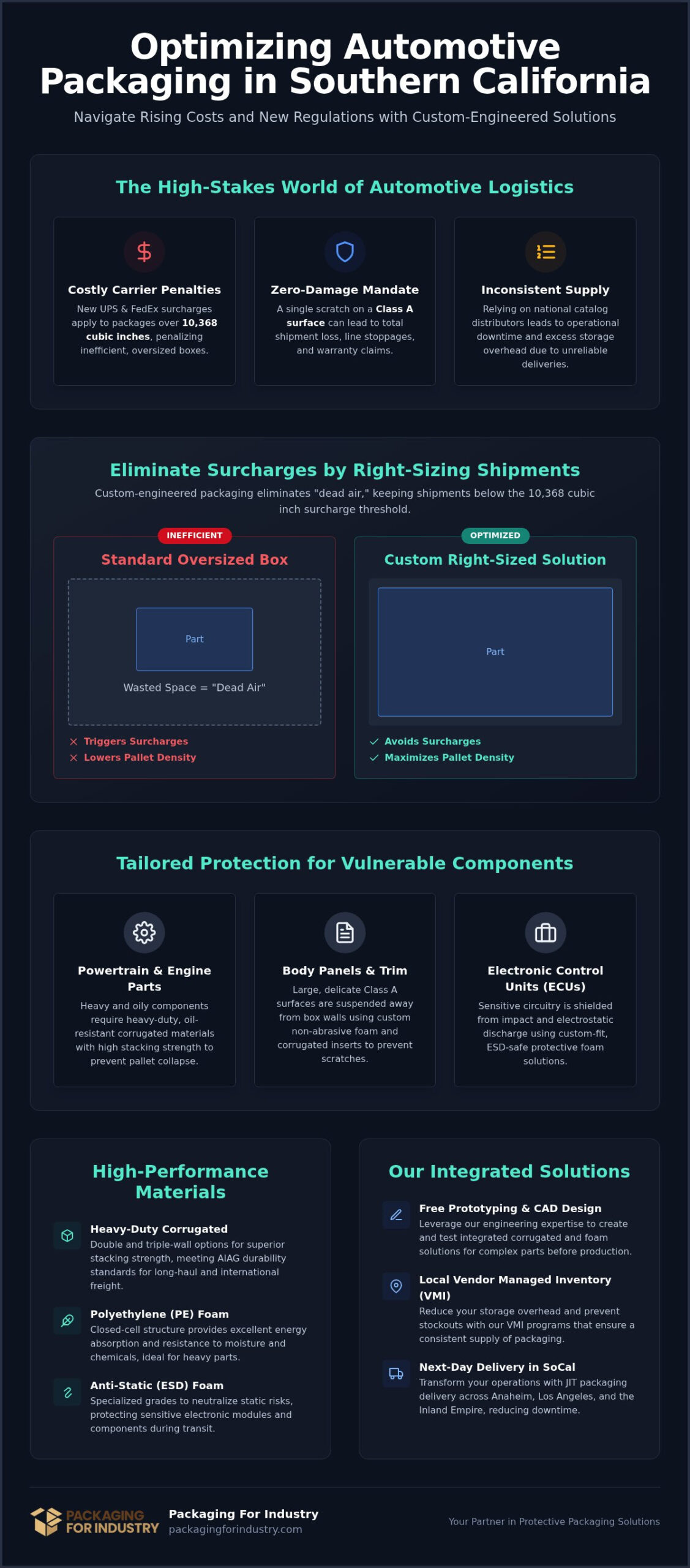
- Powertrain and Engine Parts: These components are exceptionally heavy and often carry residual oils. You need heavy-duty corrugated materials that resist oil degradation and provide enough stacking strength to prevent pallet collapses.
- Body Panels and Trim: Large exterior parts are prone to bending and surface damage. They require custom inserts that suspend the part away from the box walls.
- Electronic Control Units (ECUs): Sensitive circuitry is vulnerable to both physical impact and electrostatic discharge. We utilize ESD-safe protective foam to neutralize static risks while providing superior cushioning.
The Impact of UPS and FedEx Dimensional Surcharges
In January 2026, major carriers implemented new surcharge triggers that directly impact the automotive aftermarket. An “Additional Handling Surcharge” now applies to packages exceeding 10,368 cubic inches. Shipping oversized boxes filled with “dead air” is no longer just inefficient; it’s a significant financial penalty. By utilizing custom corrugated boxes, you can right-size your shipments to avoid these expensive dimensional weight penalties. Optimized designs improve pallet density, allowing you to move more product in fewer shipments while ensuring the highest level of protective packaging for automotive parts Southern California.
High-Performance Materials for Automotive Part Protection
Selecting the right materials for protective packaging for automotive parts Southern California depends heavily on your logistics cycle. While short-haul deliveries across Orange County or San Diego might require less rigid outer shells, international shipments or long-haul freight demand the superior stacking strength of triple-wall corrugated. Adhering to standards set by the Automotive Industry Action Group (AIAG) ensures that your materials meet the rigorous durability requirements of major OEMs. Using high-performance substrates allows you to maintain structural integrity even when pallets are stacked three-high in a warehouse.
Custom Foam Packaging and Inserts
Foam isn’t just filler; it’s a precision engineering tool. For heavy, high-value components, polyethylene (PE) is the industry standard due to its closed-cell structure and excellent energy absorption. It resists moisture and chemicals, making it ideal for engine parts that might have residual fluids. In contrast, polyurethane (PU) offers a softer cushion for lighter, highly sensitive items. By using custom-designed foam packaging, manufacturers can create kitting trays that organize multiple components into a single, secure unit. This reduces labor time on assembly lines and ensures no part is left behind. We also provide anti-static foam grades to protect electronic control modules from static discharge during transit through the dry Southern California climate.
Heavy-Duty Corrugated and Structural Support
Standard boxes often buckle under the weight of automotive assemblies. To prevent pallet failure, we specify double-wall or triple-wall corrugated board. These materials provide the vertical compression strength necessary for high-density warehouse stacking. While a standard Regular Slotted Container (RSC) works for many applications, die-cut boxes offer a more tailored fit for complex geometries. We often integrate internal partitions and dividers to eliminate part-to-part contact, which is essential for protecting Class A finishes. For specialized applications, weather-resistant or mil-spec corrugated grades provide an extra layer of security against humidity variations. If you’re looking to optimize your material usage, you can compare packaging pricing for custom-sized solutions that reduce waste.
True protection comes from an integrated system. By combining the structural integrity of heavy-duty corrugated with the shock-absorbing properties of custom foam inserts, you create a comprehensive barrier against transit damage. This holistic approach to protective packaging for automotive parts Southern California ensures that your logistics costs remain predictable and your damage rates stay at zero.
Engineering Custom Solutions for Heavy and Complex Parts
Automotive engineering doesn’t end at the production line; it extends to the logistical systems that deliver parts to their destination. Oddly shaped components like transmission assemblies or engine blocks require more than just a standard box. Our engineering process begins with detailed CAD design, ensuring every contour is accounted for before we move to free prototyping. This phase is critical because it validates the fit and protection levels before you commit to full-scale production. Validating designs early prevents the costly “trial and error” approach that leads to damaged inventory and delayed shipments.
While some competitors suggest molded pulp for motors, that material often lacks the structural integrity needed for components weighing 500 lbs or more. We focus on rigid, load-bearing solutions that prevent shifting and internal movement. In a recent project involving heavy industrial transmission components, we replaced failing generic packaging with custom-engineered skids that eliminated 100% of transit-related casting fractures. This level of precision is why manufacturers seek specialized protective packaging for automotive parts Southern California. By addressing the specific geometry of the part, we eliminate “dead air” and ensure the component remains stationary throughout the transit cycle.
Custom Wood Crates and Export Packaging
For oversized powertrain assemblies destined for international markets, custom shipping crates provide the ultimate structural defense. These crates are engineered to withstand the rigors of sea freight, including multi-axis vibration and extreme stacking pressure. We ensure full ISPM-15 compliance for all wood packaging, preventing costly customs delays at international ports. Beyond the wood exterior, we often integrate foam lining to provide maximum shock absorption. This ensures compliance with logistical standards and the Fair Packaging and Labeling Act, which requires clear identification and secure containment of goods in the supply chain. If you’re shipping globally from Anaheim or Los Angeles, these engineered crates are your best defense against the unpredictable nature of ocean transit.
Corner and Edge Protection Strategies
Heavy automotive loads exert massive pressure on their packaging. Using corner and edge protection is a pragmatic way to prevent steel or plastic strapping from cutting into your corrugated containers. These edge boards distribute strap tension across the entire height of the load, significantly reducing carton crush rates. To finish the load, we apply high-performance stretch film with high puncture resistance. This combination stabilizes the pallet, preventing the “leaning tower” effect during transit through Southern California’s frequent stop-and-go traffic. When you optimize these secondary materials, you’re investing in the total reliability of your protective packaging for automotive parts Southern California.
Reducing Total Landed Costs in SoCal Automotive Manufacturing
Many procurement managers make the mistake of focusing solely on the unit price per box. However, the true economic impact of your packaging includes damage rates, labor efficiency, and freight surcharges. National catalog distributors often sell generic sizes that result in excessive “dead air,” which triggers the dimensional weight penalties discussed earlier. By sourcing protective packaging for automotive parts Southern California from a local expert, you can design a rightsized solution that fits your part exactly. This precision reduces the volume of every shipment, directly lowering your freight spend. Local sourcing also eliminates the hidden cost of shipping bulky, empty packaging materials from distant out-of-state warehouses.
Vendor Managed Inventory (VMI) for Tier 1 Suppliers
Production interruptions are a major threat to Tier 1 suppliers who must meet strict OEM delivery windows. Our VMI services provide a buffer against supply chain volatility. We store your custom corrugated and foam components at our Anaheim headquarters, allowing you to reclaim valuable warehouse space for production equipment rather than stacks of empty boxes. We offer scheduled inventory reviews, including weekly, biweekly, or monthly options, to ensure your stock levels are always aligned with your current production forecast. This proactive management eliminates the need for expensive emergency rush orders that eat into your margins.
Packaging Kitting and Assembly Efficiency
Labor costs in Southern California are among the highest in the nation. You can’t afford to have assembly line workers spend their time folding boxes or manually inserting complex foam structures. Our kitting services provide pre-assembled packaging sets that arrive ready for the part. This approach is particularly effective for aftermarket repair kits, where multiple small components must be organized and protected within a single container. By implementing a just-in-time delivery model, we help you maintain a lean operation in Los Angeles, Orange County, or the Inland Empire. This streamlines your packing process, increases throughput, and ensures that your protective packaging for automotive parts Southern California is as efficient as the parts it contains.
Shifting your focus to total landed costs allows you to identify savings that aren’t visible on a standard invoice. When your packaging is engineered for both protection and logistics, you improve your bottom line while securing your customer relationships.
Why Southern California Manufacturers Choose PFI
PFI operates with a deep understanding of the regional industrial landscape. While many manufacturers rely on national catalog distributors for convenience, these large-scale suppliers often lack the specialized engineering required for high-stakes automotive components. Choosing a local partner for protective packaging for automotive parts Southern California means you have direct access to our engineering team in Anaheim. We don’t just ship boxes; we design integrated protection systems that combine heavy-duty corrugated with precision-cut foam. Our proximity allows for rapid prototyping, often delivering physical samples for fit-testing in a fraction of the time required by out-of-state vendors. This speed is essential when launching new product lines or addressing sudden damage issues in the field.
Local Service Areas and Logistics Support
Our logistics network is built to serve the unique needs of the region’s manufacturing hubs. We provide dedicated support and next-day delivery to facilities in Irvine, Santa Fe Springs, and Anaheim. By maintaining our own fleet of delivery vehicles, we ensure a dependable supply chain that isn’t subject to the delays of third-party carriers. For manufacturers with multi-state operations, we also offer nationwide shipping capabilities, providing a consistent packaging standard across all your locations. This local presence combined with national reach makes us a steady partner for evolving automotive production lines. We understand the traffic patterns of the 57, 91, and 5 freeways, allowing us to time our deliveries for maximum warehouse efficiency.
Requesting an Automotive Packaging Quote
Our process is fundamentally consultative. We don’t just take an order; we identify opportunities to lower your total landed costs. When you’re ready to improve your logistics efficiency, providing us with your specific requirements is the first step. We need to know the dimensions, weight, and surface sensitivity of your parts, along with your typical shipping volume. Whether you need custom RSC boxes, heavy-duty triple-wall corrugated, or complex kitting trays, our team will analyze your specs to find the most cost-effective solution. This approach ensures that your protective packaging for automotive parts Southern California is optimized for both safety and fiscal responsibility. We prioritize tangible outcomes like zero-damage shipments and reduced dimensional weight surcharges.
We’re ready to help you lower your total landed costs and build a more resilient logistics operation. Let’s start designing a solution that protects your parts and your bottom line today.
Frequently Asked Questions
What are the best packaging materials for Class A automotive surfaces?
Non-abrasive materials like polyethylene foam or soft polyurethane inserts are the most effective choice. These materials prevent micro-scratches that occur during transit vibration. We often combine these foam inserts with custom corrugated dividers to ensure no part-to-part contact occurs. Protecting finished surfaces is critical for reducing rejection rates at the assembly plant and maintaining your brand’s reputation for quality. For professional support in achieving these high-standard finishes, you can explore Industrial Painting with the BIS Group.
How can I reduce shipping damage for heavy engine parts?
You can reduce damage by using heavy-duty double-wall or triple-wall corrugated boxes and custom-built wood skids to manage extreme weight. These materials provide the necessary stacking strength for high-density warehousing in the Inland Empire. We also recommend using corner and edge protection to distribute strap tension effectively. This prevents carton crush during the frequent stop-and-go transit typical of Southern California logistics.
Do you provide custom foam inserts for automotive tool kitting?
Yes, we provide precision die-cut foam packaging for automotive tool kitting and part organization. We use high-density polyethylene foam to create durable trays that improve assembly line efficiency. These custom inserts secure each component in place, preventing internal movement. This ensures that your technicians have every required part organized and immediately available, which reduces labor time and prevents missing components.
Can PFI help reduce my UPS/FedEx dimensional weight surcharges?
We help you lower packaging costs by right-sizing your containers to avoid the 2026 dimensional weight and cubic volume surcharges. By eliminating “dead air” with custom-engineered boxes, you can stay below the 10,368 cubic inch threshold that triggers additional handling fees. This optimization ensures your protective packaging for automotive parts Southern California is both secure and fiscally responsible for every shipment.
Is next-day delivery available for automotive packaging in Orange County?
We provide local next-day delivery for stock items from our Anaheim headquarters to manufacturers throughout Orange County. Our own fleet serves industrial hubs in Irvine, Brea, and Costa Mesa on a daily basis. This proximity allows you to maintain a lean inventory while ensuring you never run out of critical protective packaging for automotive parts Southern California during peak production cycles.
Do you offer VMI programs for high-volume automotive suppliers?
We offer comprehensive Vendor Managed Inventory (VMI) programs tailored for high-volume automotive suppliers and Tier 1 manufacturers. We stock your custom packaging at our Anaheim facility and perform scheduled inventory reviews to prevent production stops. This service frees up your warehouse floor space for production and ensures a steady supply of just-in-time packaging for your specialized automotive components.
What information do I need to provide for a custom packaging quote?
To provide an accurate quote, we need the part dimensions, weight, and surface sensitivity details. It’s also helpful to include your expected monthly usage volume and the primary transit method. You can request a packaging quote through our website. Our engineering team will then analyze your specifications to design a solution that optimizes both part protection and your total landed costs.
Are your wood crates compliant with international export regulations?
All our custom shipping crates are fully ISPM-15 compliant for international automotive exports. We use heat-treated lumber and provide the required certification stamps to prevent customs delays at global ports. This ensures your heavy powertrain assemblies or oversized components reach international markets without the risk of regulatory rejection or expensive pest-related quarantine issues during the ocean freight process.