
Operations and warehouse managers understand the high cost of product damage. When a pallet is wrapped in standard stretch film, it creates an airtight seal that can trap heat, moisture, and gases—a process known as pallet suffocation. This leads to condensation, which weakens corrugated boxes, ruins labels, and promotes mold growth. For other industrial products, it can trap heat from freshly molded parts or prevent critical off-gassing, leading to instability or damage. While often associated with agricultural produce, the solution to these complex thermal and atmospheric challenges lies in an engineered material: cross ventilated stretch film.
Unlike standard wraps, cross ventilated stretch film is a high-performance packaging solution designed with strategically placed apertures that allow air to circulate freely. This guide moves beyond the common applications in produce and explores the technical mechanics, industrial use cases, and selection criteria that make vented film an indispensable tool for aerospace, medical, chemical, and food processing industries. We will analyze how this film maintains superior load containment while solving costly problems related to condensation, off-gassing, and thermal management. For businesses looking to reduce product damage and improve operational efficiency, understanding the engineering behind ventilated film is the first step toward significant cost savings.
What is Cross Ventilated Stretch Film and Why Does It Matter?
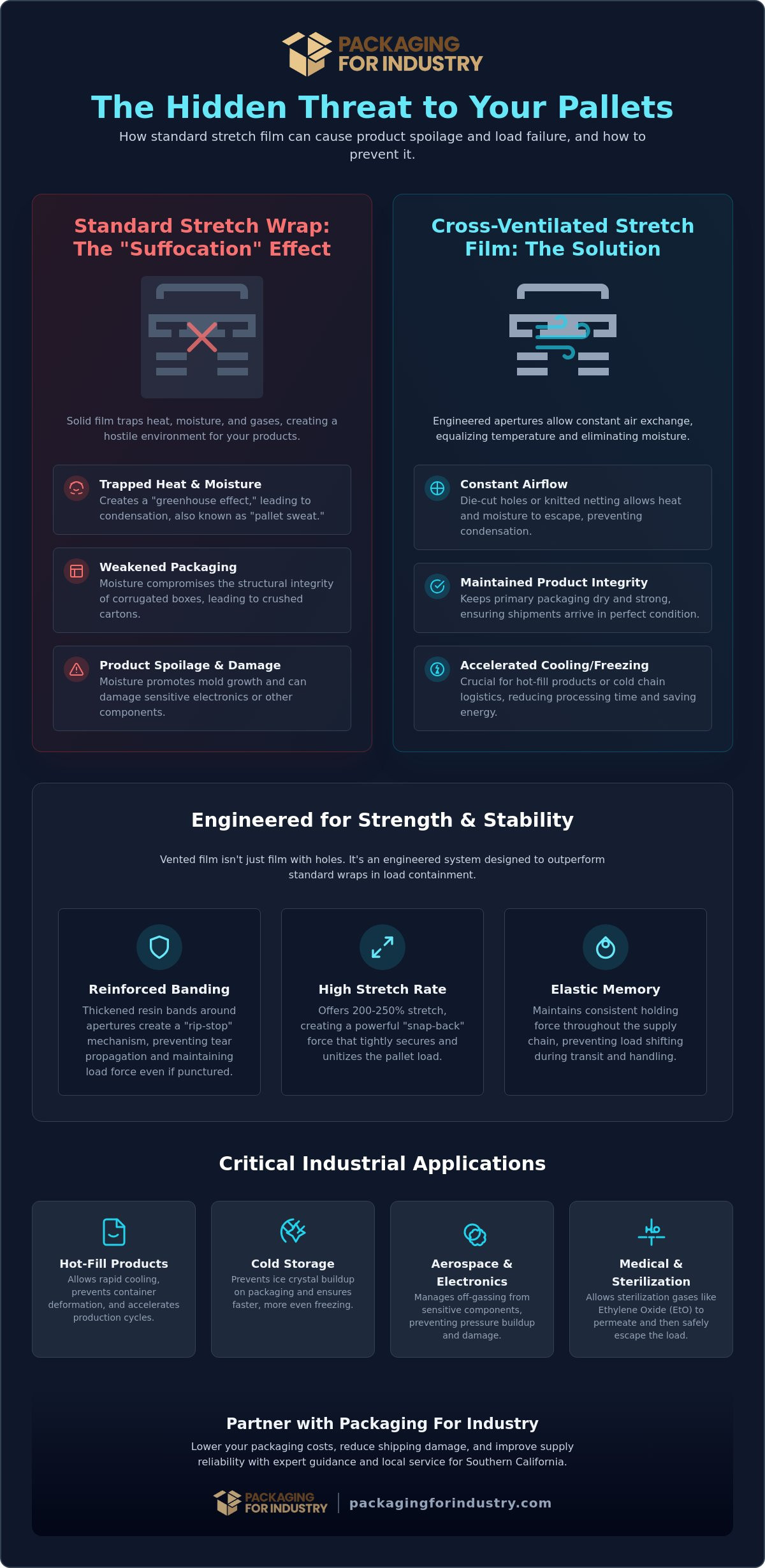
Cross ventilated stretch film is a high-performance pallet wrap engineered with die-cut holes or a knitted mesh structure. These apertures are designed to allow air, moisture, and heat to pass through the wrap, preventing the “suffocation” that occurs with solid, non-permeable films. This breathability is critical for palletized goods that are sensitive to atmospheric conditions during transit and storage.
- The ‘Suffocation’ Problem: Standard stretch film creates a sealed environment around a pallet. This traps residual heat from production processes (like hot-filled cans or freshly molded plastics), ambient humidity, and gases released by the products themselves (off-gassing). The result is condensation, product degradation, and load instability.
- Die-Cut vs. Knitted Netting: Die-cut film features precisely cut holes, often reinforced with thicker resin bands for strength, making it ideal for heavy, uniform loads. Knitted netting offers maximum airflow and flexibility, often used for irregularly shaped products or those requiring the fastest possible cooling.
- Thermal Dynamics vs. Standard Film: While standard stretch film acts as an insulator, cross ventilated stretch film facilitates convection. It allows air to circulate, enabling loads to cool faster, freeze more efficiently, and remain at a stable temperature, directly reducing the risk of moisture-related damage.
The Physics of Pallet Ventilation
The effectiveness of cross ventilated stretch film is rooted in basic physics. By preventing a sealed environment, it disrupts the conditions that lead to product damage. Operations managers dealing with high-value or sensitive goods can leverage this technology to protect their inventory and bottom line.
- Preventing the ‘Greenhouse Effect’: A pallet wrapped in solid film acts like a miniature greenhouse. Heat trapped inside cannot escape, and internal temperatures can rise, causing products to sweat. Ventilated film breaks this cycle by allowing for continuous air exchange with the external environment, equalizing temperature and humidity.
- Accelerating Cooling and Freezing: For products that are hot-filled or need to be flash-frozen, airflow is essential. Ventilated wrap allows cold air in cold storage facilities to directly contact the product boxes, drastically reducing the time and energy required to reach target temperatures.
- Eliminating Condensation and Box Failure: Condensation is the primary cause of “box crush,” where moisture weakens the structural integrity of corrugated boxes. This leads to collapsed pallets, damaged goods, and unsafe warehouse conditions. Ventilated film ensures moisture vapor can escape before it condenses into liquid, keeping boxes dry and strong.
Vented Film vs. Traditional Stretch Wrap
Choosing between vented and traditional film requires an analysis of the product, its environment, and the desired outcome. While standard film is suitable for inert, stable loads, vented film is a specialized solution for specific, and often costly, industrial challenges.
- Breathability vs. Surface Area Contact: Traditional film offers maximum surface contact, which provides excellent protection against dust, dirt, and external moisture. Vented film sacrifices some surface coverage for critical breathability. The choice depends on whether the primary threat to the product is internal (condensation, heat) or external (contaminants).
- When to Choose Vented Film: Opt for cross ventilated stretch film when palletizing products that are warm, moist, emit gases, or require rapid temperature changes. This includes hot-fill food and beverages, freshly manufactured plastic parts, sterilized medical devices, and chemicals that off-gas.
- Impact on Packaging Cost Savings: The upfront cost of vented film may be higher than standard wrap, but its ROI is realized by drastically reducing product loss. A single rejected pallet due to mold or collapsed boxes can cost far more than the incremental expense of using the correct film. This makes vented film a key component in any serious packaging cost savings strategy.
Technical Mechanics: Load Stability and Reinforcement
The most common objection from procurement officers and warehouse leads is whether a film with holes can be strong enough to secure heavy or unstable industrial loads. The answer lies in its advanced engineering, which combines strategic reinforcement with high-performance resin technology to deliver exceptional load containment without compromising on airflow.
- Addressing the Strength Objection: Cross ventilated stretch film is not simply standard film with holes punched in it. It is engineered from the ground up with reinforced edges and banding that concentrate holding force where it’s needed most, providing stability comparable to, and sometimes exceeding, conventional wraps.
- Reinforced Edge Technology: The top and bottom edges of the film roll are often left solid or are significantly thicker. This creates strong “bands” that act like ropes, securing the top and bottom of the pallet to prevent load shifting, while the ventilated center section allows for airflow.
- High Stretch Rates (200-250%): Modern ventilated films, meeting 2026 industry performance standards, offer stretch rates between 200% and 250%. This means one foot of film can be stretched to three feet or more on a pallet wrapper. This high yield maximizes material efficiency and applies consistent, high tension across the load.
- Memory Retention: The film’s elastic memory causes it to constantly “snap back” after being applied. This ensures that even as a load settles during transit, the film continues to tighten, maintaining a secure and stable pallet.
Reinforced Banding and Tear Resistance
The structural integrity of die-cut ventilated film comes from the way the apertures and reinforced zones work together. This system is designed to contain force and resist the rigors of industrial handling and shipping.
- Preventing Tear Propagation: Each die-cut hole is bordered by thickened resin bands. If a puncture does occur, these bands act as a barrier, stopping the tear from propagating across the pallet—a common failure point in standard, non-reinforced films.
- Puncture Resistance in Manufacturing: In busy manufacturing environments, pallets are constantly at risk of being snagged by forklifts, racking, or other equipment. The reinforced structure of ventilated film provides superior puncture resistance compared to standard films of a similar gauge.
- Force-to-Load Ratios: Testing confirms that high-quality ventilated films exhibit excellent force-to-load ratios. This measurement indicates how much force the film applies to the load to keep it contained. Thanks to reinforced banding, ventilated films can achieve the high containment force required for heavy industrial goods.
Stretch Ratios and Material Efficiency
For procurement managers, the total cost of ownership is more important than the cost per roll. High-stretch ventilated film delivers significant material efficiency, leading to a strong return on investment.
- Calculating ROI: While a roll of vented film might cost more than a low-cost alternative, its ability to stretch 250% means fewer wraps are needed per pallet and more pallets can be wrapped per roll. When combined with the savings from eliminated product damage, the ROI becomes clear.
- How Pre-Stretch Technology Works: Pre-stretch is the process of elongating film before application to maximize yield and tension. On an automated pallet wrapper, a set of rollers running at different speeds stretches the film. The apertures in ventilated film are designed to maintain their shape during this process, ensuring consistent airflow and strength after application.
Industrial Applications: Beyond Agriculture
While ventilated film is a staple for shipping produce, its problem-solving capabilities extend to some of the most demanding industrial sectors. For manufacturers in aerospace, medical devices, and chemicals, cross ventilated stretch film is not an option—it’s a requirement for product integrity and safety.
- Aerospace: Managing the off-gassing of composite materials, sealants, and adhesives that can compromise component integrity if trapped.
- Medical Devices: Allowing ethylene oxide (EtO) gas to circulate during sterilization and then safely escape afterward, ensuring a sterile and residue-free product.
- Chemicals and Plastics: Preventing heat buildup in freshly molded plastic parts or drums of chemicals that are filled warm, which can cause warping or container failure.
- Food and Beverage: Facilitating rapid cooling for hot-fill applications (e.g., sauces, jams, canned goods) to prevent condensation that can cause label slippage, rust on metal lids, and bacterial growth.
Off-Gassing and Chemical Stability
For many advanced materials, what you can’t see can cause the most damage. Trapped gases can create pressure, react with products, and lead to catastrophic packaging failure.
- Ventilation for Aerospace Components: High-value aerospace parts, particularly composites and items with applied coatings or adhesives, often release volatile organic compounds (VOCs). Ventilated film allows these VOCs to safely dissipate, preventing pressure buildup and chemical degradation of sensitive surfaces.
- Preventing VOC Buildup: In a sealed pallet, VOC concentration can reach levels that are hazardous or that can compromise the product. Cross ventilated film provides the necessary airflow to keep concentrations at safe levels, protecting both the product and personnel.
- Case Study: ‘Box Crush’ in Chemical Shipping: A manufacturer of bagged chemical powders experienced pallet collapses in humid conditions. The bags would release trace amounts of gas and moisture, which became trapped by standard film. This moisture weakened the corrugated slip sheets between layers, causing the load to shift and fail. Switching to cross ventilated stretch film allowed the gas and moisture to escape, keeping the slip sheets dry and the pallets stable.
Thermal Management in Cold Chain Logistics
In cold chain logistics, time is money. The faster a product can be brought to its target temperature, the lower the energy costs and the higher the throughput.
- Accelerating ‘Flash Freeze’ Cycles: Products requiring flash freezing must have maximum exposure to cold air. Ventilated film allows frigid air to penetrate the pallet from all sides, reducing freezing times by up to 30% compared to solid wrap.
- Preventing Interior Frost and Ice: When warm products are moved into a cold environment and wrapped with standard film, condensation freezes on the inside of the wrap, obscuring barcodes and potentially damaging packaging. Vented film allows moist air to escape before it can freeze.
- Optimizing Energy Usage: By reducing the time products need to spend in blast freezers or cold storage to reach temperature, facilities can lower their energy consumption significantly. This makes ventilated film a key tool for improving operational efficiency and sustainability in any warehouse or distribution center.
Selection Guide: Choosing the Right Vented Film
Selecting the appropriate cross ventilated stretch film requires a clear understanding of your load characteristics, application methods, and performance requirements. Making the right choice ensures optimal load containment and prevents costly failures.
- Evaluating Load Weight: Vented films are available in different gauges and reinforcement patterns. Lighter loads may use a standard vented film, while heavy-duty loads of machinery or building materials require a film with more robust reinforced banding.
- Hand vs. Machine Application: For low-volume operations, hand-applied vented film is available. However, for consistency, efficiency, and to achieve the high stretch rates needed for material savings, machine application on an automated pallet wrapper is strongly recommended.
- Gauge Selection: The thickness of the film (gauge) often correlates with the size and spacing of the apertures. A packaging specialist can help determine the correct gauge to provide the necessary airflow without compromising load stability.
- Compatibility with Existing Pallet Wrappers: Most modern ventilated films are designed to run on standard pallet wrapping equipment with minimal adjustments to tension and pre-stretch settings.
Machine vs. Hand Vented Film
The application method has a significant impact on the performance and cost-effectiveness of your pallet wrapping operation.
- Ergonomics and Consistency: Manual wrapping with any type of film is physically demanding and prone to inconsistent application. Machine wrapping ensures every pallet is wrapped with the same tension and number of revolutions, providing predictable and reliable load containment.
- Setting Correct Machine Tension: It is crucial to set the tension on an automated wrapper correctly. Too little tension will result in a loose, unstable load. Too much tension can distort the die-cut holes, reducing airflow, or even break the film. PFI specialists can help calibrate your equipment for optimal performance.
- Maintenance for Die-Cut Films: The die-cutting process can sometimes leave small plastic particles. Regularly cleaning the rollers on your pallet wrapper is a simple maintenance step that prevents buildup and ensures smooth operation.
Environmental and Regulatory Compliance
Modern packaging materials must meet standards for safety and sustainability. Cross ventilated stretch film is designed to comply with key industry regulations.
- Recyclability: Most ventilated stretch films are made from low-density polyethylene (LDPE), which is a #4 plastic. LDPE is the primary resin used for industrial stretch film due to its balance of clarity and strength. It is fully recyclable in standard commercial plastic recycling streams.
- FDA Requirements: For food, beverage, and medical applications, it is essential to use film made from FDA-compliant resins. PFI can provide ventilated films that meet requirements for both direct and indirect food contact, ensuring the safety and compliance of your products.
Why Source Vented Film from Packaging For Industry?
Choosing the right supplier is as important as choosing the right film. Packaging For Industry (PFI) combines product expertise with a deep understanding of the logistical and operational challenges faced by industrial businesses in Southern California and nationwide. We provide not just a product, but a complete packaging solution designed to reduce your costs and protect your assets.
- Local Expertise: We have decades of experience serving the unique needs of Southern California’s industrial hubs, from the aerospace manufacturers in Los Angeles to the distribution centers in Anaheim and the medical device companies in San Diego.
- Supply Chain Reliability: Our Vendor Managed Inventory (VMI) program ensures you never run out of critical packaging supplies. We monitor your usage and manage your inventory, preventing costly stockouts and production delays. This program can even be configured with automated usage tracking to meet 2026 supply chain standards.
- Total System Approach: We don’t just sell film. Our engineers can design a complete packaging system, combining vented film with custom corrugated boxes, foam inserts, and edge protectors to provide total product protection.
- Cost-Reduction Analysis: We prove the value of switching to vented film. Our team will conduct a thorough analysis of your current wrapping process, identify areas of product loss and inefficiency, and demonstrate the tangible ROI you can expect.
Local Delivery and Supply Chain Reliability
For businesses operating in the fast-paced Southern California market, a responsive and reliable local supplier is a competitive advantage.
- Next-Day Delivery: We offer next-day delivery for businesses throughout Orange County, Los Angeles County, and the Inland Empire, ensuring you get the supplies you need, when you need them.
- Reduced Lead Times: Sourcing from a local partner eliminates the long lead times and shipping uncertainties associated with national catalog suppliers, keeping your operation running smoothly.
- On-Site Troubleshooting: If you’re facing a load stability issue, our experts can be on-site quickly to diagnose the problem and help you adjust your materials or machine settings for a fast resolution.
Comprehensive Packaging Reviews
Our goal is to be more than a supplier; we are your packaging partner, dedicated to optimizing your entire process.
- Process Audits: PFI engineers will audit your current palletizing process, from material selection to machine settings, to identify hidden costs and opportunities for improvement.
- Prototyping and Testing: We can provide samples of cross ventilated stretch film and help you test them on your specific products and equipment to validate performance before you commit to a full order.
- Request a Quote: Stop letting condensation and heat damage erode your profits. Contact our team today for a professional consultation and discover how the right ventilated film can protect your products and lower your total packaging costs.
Request a Custom Vented Film Quote Today
Frequently Asked Questions About Cross Ventilated Stretch Film
- Is cross ventilated stretch film as strong as regular stretch wrap?
- Yes, when the correct type is chosen for the application. High-performance ventilated films are engineered with reinforced bands and use advanced resins that provide load containment force equal to or greater than many standard films. The key is matching the film’s specifications to the load’s weight and stability requirements.
- Does vented film work on standard pallet wrapping machines?
- Absolutely. Cross ventilated stretch film is designed to run on most standard automated and semi-automated pallet wrapping equipment. Minor adjustments to the pre-stretch and tension settings may be required to achieve optimal performance, a process our technical specialists can assist with.
- Which industries benefit most from using ventilated pallet wrap?
- Beyond agriculture, key industries include food and beverage (for hot-fill products and frozen goods), aerospace (for off-gassing composites), medical devices (for sterilization), and plastics/chemicals (for cooling freshly manufactured parts).
- Can ventilated stretch film be recycled in standard plastic streams?
- Yes. The vast majority of ventilated films are made from LDPE (Low-Density Polyethylene), a #4 plastic that is widely recycled in commercial and industrial recycling programs. It can be bundled with other clean stretch films for collection.
- How much money can I save by switching to vented film?
- Savings are realized primarily through the elimination of product damage from condensation, heat, or off-gassing. Additional savings come from material efficiency due to high stretch rates and reduced energy costs in cold storage applications. A PFI packaging audit can provide a specific ROI calculation for your operation.
- What is the difference between die-cut vented film and knitted netting?
- Die-cut film is a solid sheet with holes cut into it, typically offering superior strength and puncture resistance for heavy, uniform loads. Knitted netting is a mesh-like material that provides maximum airflow and flexibility, ideal for irregularly shaped loads or products needing the absolute fastest cooling.
- Does vented film prevent condensation in cold storage?
- Yes, it is one of its primary functions. By allowing moist, warm air to escape from the pallet as it enters a cold environment, it prevents that moisture from getting trapped and condensing or freezing on the inside of the wrap and on your products.
- How do I determine the correct gauge for my ventilated load?
- The correct gauge depends on load weight, height, stability, and shipping conditions. The best approach is to consult with a packaging specialist who can analyze your specific load and recommend the most cost-effective film that provides the necessary containment force and airflow. Contact PFI for a professional recommendation.