
Your current damage rate is likely a direct result of relying on off-the-shelf supplies that weren’t designed for your specific product’s G-force tolerances. For industrial buyers, the best packaging for fragile items isn’t just a thicker box; it’s an engineered system that balances material science with fiscal responsibility. Every broken component represents more than just a replacement cost. It’s a logistical failure that erodes customer trust and wastes valuable warehouse space with bulky, inefficient void fill.
We understand that protecting high-value goods requires a pragmatic approach to logistics. You need a solution that eliminates professional stress and stabilizes your bottom line. In this guide, you’ll discover how to eliminate transit damage and reduce dimensional weight surcharges through custom-fitted industrial solutions. We’ll explore specialized foam inserts, double-wall corrugated options, and the strategic use of Vendor Managed Inventory (VMI) to ensure your supply chain remains both lean and resilient. Whether you’re shipping across the country or looking for a reliable local supplier in Los Angeles or Orange County, this framework provides the path to a zero-damage shipping cycle.
Key Takeaways
- Identify the hidden costs of shipping damage and learn why engineered industrial solutions outperform standard retail supplies.
- Discover why material synergy between corrugated outer containers and custom foam inserts is the best packaging for fragile items in high-value sectors.
- Avoid the financial pitfalls of oversized stock boxes by switching to custom-fitted designs that reduce dimensional weight surcharges.
- Establish a repeatable 5-step packaging protocol for your warehouse team to ensure consistent protection and zero-damage shipping cycles.
- Utilize free CAD prototyping and local next-day delivery in Southern California to optimize your packaging lead times and supply reliability.
The High Cost of Inadequate Fragile Protection in Industrial Logistics
The financial impact of transit damage extends far beyond the invoice value of a broken component. When a high-value assembly arrives damaged at a client’s facility in Orange County or Los Angeles, the immediate cost is only the beginning of a cascading operational failure. You must account for the labor required to process returns, the freight costs for shipping replacements, and the potential for line-down penalties at your customer’s site. These hidden expenses erode margins and damage professional reputations in competitive sectors like aerospace and medical manufacturing.
Standard retail supplies often fail because they lack the structural integrity required for the rigors of industrial freight. While a generic bubble wrap might suffice for a consumer parcel, it rarely provides the repeatable performance needed for bulk industrial shipping. Selecting the best packaging for fragile items requires a shift from simple packing to comprehensive engineered protection. This transition focuses on material synergy, where the outer corrugated box and internal cushioning work together to neutralize shock and vibration throughout the entire supply chain.
Common Fragility Challenges in Aerospace and Electronics
In high-tech sectors, protection is a matter of precision engineering. Aerospace components often face extreme G-force impacts during long-haul freight, requiring specific foam densities to ensure deceleration doesn’t exceed the part’s structural limits. For electronics, the challenge is two-fold. You must provide physical protection while managing Electrostatic Discharge (ESD) for sensitive semiconductors. Effective package cushioning materials are selected based on these specific technical requirements to prevent both mechanical and electrical failure. Similarly, medical device manufacturers must ensure that their packaging maintains sterile integrity even after multiple drops or heavy stacking pressure.
The ROI of Professional Packaging Reviews
Investing in a professional packaging review is a pragmatic strategy for lowering packaging costs without sacrificing safety. A custom review identifies weak points in your current shipping cycle, such as excessive void fill or inadequate corner protection. By optimizing the fit of your internal components, you can often reduce dimensional weight (DIM) surcharges. Many industrial buyers find that switching from generic supplies to custom-fitted inserts allows them to use smaller outer boxes, significantly cutting freight expenses. We’ve seen manufacturers successfully reduce their damage rates from 5% to less than 0.1% by implementing these data-driven changes. This level of reliability provides peace of mind and ensures that your logistics operations remain a competitive advantage rather than a financial drain.
Material Science: Choosing the Best Packaging for Fragile Items
Material selection serves as the foundation of industrial logistics. Relying on a single protective layer is rarely sufficient for high-value components. True security comes from material synergy, where the outer container, internal cushioning, and load stabilization work as a unified system. This approach ensures that energy from an impact is absorbed and dissipated before it reaches the product. While the FedEx packing guide provides a baseline for individual parcel shipping, industrial bulk loads require higher material specifications to withstand the pressures of stacking and long-haul transport.
Determining the best packaging for fragile items often starts with the outer shell. Double-wall corrugated boxes provide the necessary puncture resistance and stacking strength for most industrial applications. For extremely heavy or sensitive equipment, triple-wall corrugated offers a level of durability that rivals timber crates while remaining more cost-effective and lighter. These materials prevent the structural failure that leads to crushed contents during transit. If you are unsure which material combination fits your specific product, you can request a packaging quote to get an expert assessment of your requirements.
Load stabilization is the final, critical component of the material science equation. Even the best box cannot protect a product if the entire pallet shifts during a sudden stop. High-performance stretch film maintains the integrity of the load by providing consistent containment force. We also integrate corner and edge protection to prevent “strapping bite” and reinforce the vertical strength of the pallet. This combination of materials ensures that fragile goods remain immobile and protected from the first mile to the last.
Foam Packaging Comparison: PE vs. PU vs. Anti-Static
Polyethylene (PE) foam is a closed-cell material designed for heavy, high-impact protection. It is resilient and resists moisture, making it ideal for aerospace parts or industrial machinery. In contrast, Polyurethane (PU) foam is an open-cell material that provides soft, delicate cushioning for lighter items that require a gentle touch. For electronics and semiconductors, specifying anti-static (ESD) foam is essential. This pink-tinted foam prevents the buildup of static electricity that can destroy sensitive circuits without any visible physical damage.
Corrugated Options for Fragile Goods
Standard Regular Slotted Containers (RSC) are efficient for many applications, but custom corrugated boxes offer a precision fit that eliminates internal movement. Die-cut designs can be engineered to include integrated folds and locking tabs, reducing the need for excessive tape. For shipments containing multiple small components, we utilize heavy-duty corrugated partitions. These dividers eliminate part-to-part contact, ensuring that finished surfaces remain scratch-free throughout the shipping cycle.
Custom vs. Stock: Which Strategy Lowers Your Total Cost?
Many procurement managers fall into the “Stock Box Trap” by assuming that lower unit prices for generic containers translate to lower total costs. In reality, oversized stock boxes create a cascade of unnecessary expenses. They require excessive void fill to prevent movement and trigger high dimensional weight (DIM) surcharges from carriers. When you’re shipping high-value components, the best packaging for fragile items is a custom-engineered solution that minimizes empty space while maximizing structural integrity. This precision reduces the overall shipping footprint, directly lowering your freight spend on every pallet sent.
Custom solutions also simplify the kitting and assembly process. Instead of warehouse staff spending time wrapping items in multiple layers of bubble wrap, they can simply place the product into a pre-fitted insert. This efficiency is critical for high-volume production lines where every second of pack time impacts the bottom line. Before a full production rollout, we utilize free prototyping to ensure a perfect fit. This step eliminates the risk of costly design flaws and ensures your protection system is optimized for both safety and speed. By engineering the package to the product, you eliminate the guesswork that leads to transit damage.
The Financial Case for Custom Foam Inserts
Labor savings represent a significant portion of the ROI for custom solutions. By using pre-shaped foam, you reduce the variability of hand-packing and ensure consistent protection for every unit. This approach eliminates “over-packing” with precision-cut polyethylene, ensuring you only use the material necessary for the job. You can view our range of protective foam packaging to see how custom inserts streamline operations while providing superior shock absorption for sensitive equipment.
Evaluating Lead Times and Local Supply Chains
Relying on national catalogs often leads to extended lead times and high shipping costs for the packaging itself. Local Southern California suppliers in Orange County, Los Angeles, and San Diego provide a logistical advantage with faster turnaround and reduced transit times. Implementing Vendor Managed Inventory (VMI) further improves supply reliability by having us monitor and replenish your stock automatically. This just-in-time delivery model reduces warehouse clutter and frees up valuable floor space for your core manufacturing operations. Local next-day delivery ensures that your production line never stops due to a packaging shortage.
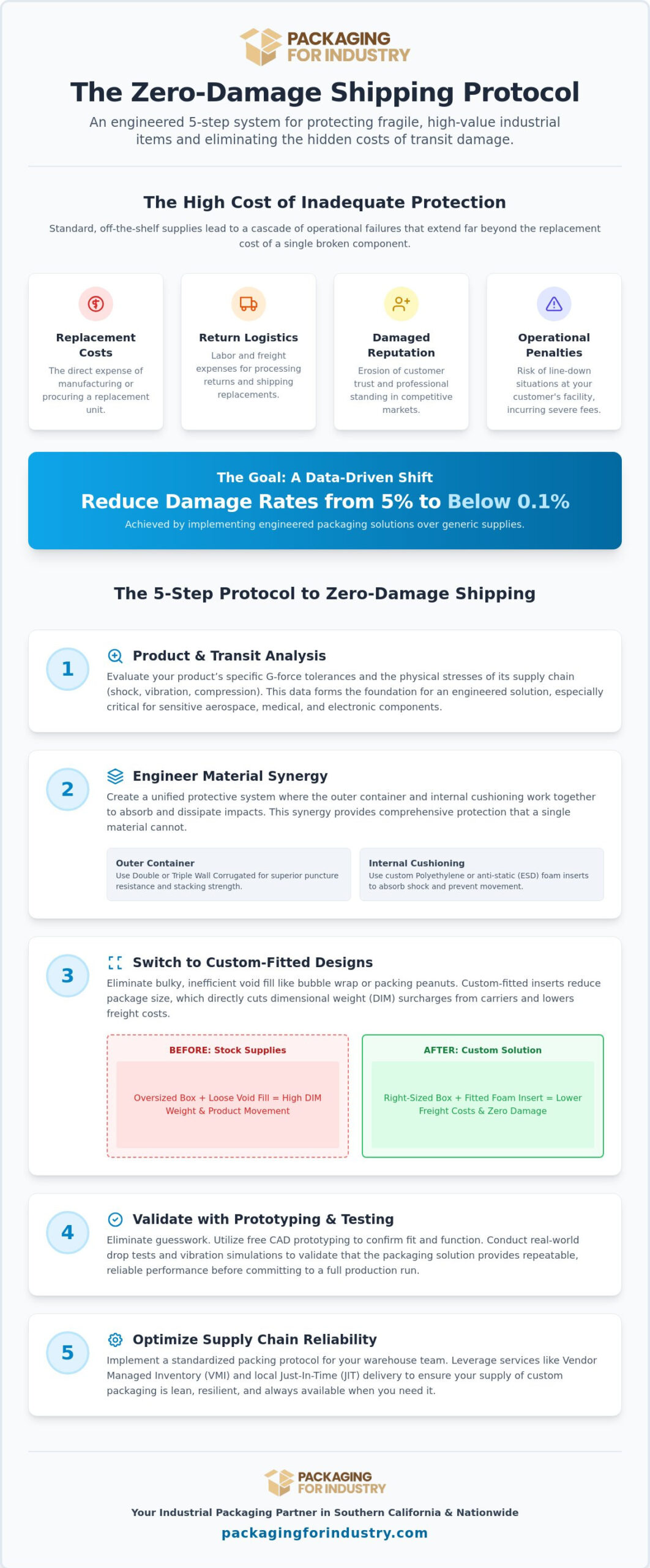
A 5-Step Protocol for Packaging Fragile Industrial Items
Consistency in the warehouse is the only way to guarantee that your engineering efforts aren’t undermined during the pack-out process. A repeatable Standard Operating Procedure (SOP) ensures that every unit receives the same level of protection, regardless of which shift is on the floor. For high-volume manufacturers, the best packaging for fragile items is a process, not just a product. Following a structured protocol eliminates the human error that often leads to inconsistent protection and recurring transit damage.
This protocol begins with a technical Fragility Assessment to identify the product’s ‘G-factor.’ This numerical value represents the maximum acceleration the item can withstand without mechanical failure. Once this is established, we apply Primary Cushioning by matching foam density to the product’s weight and fragility. Step three involves Box Selection, where we match the board strength of the corrugated container to the load requirements. We then focus on Load Stabilization to eliminate internal movement, followed by External Reinforcement using edge protectors and industrial-grade tape to secure the outer shell.
The Role of CAD/CAM in Fragile Design
Our engineering team utilizes CAD software to predict impact points and stress distribution before a physical sample is even cut. This digital environment allows for iterative testing, including simulated drop tests and vibration analysis. By refining the design in a virtual space, we reduce lead times and ensure the final prototype is optimized for real-world transit conditions. If you need a precision-engineered solution for a new product launch, you can learn more about our custom design packaging services to get started.
Stabilizing the Pallet for Fragile Freight
Protection doesn’t end at the box level. We use high-performance stretch film to lock individual containers to the pallet, creating a unified load that resists sliding and tipping during transport. For ultra-heavy fragile equipment that exceeds the capacity of standard corrugated, we recommend custom timber crates. These are especially critical for global logistics, as detailed in our guide on engineering custom crates for international transit. This level of external shielding provides the final layer of security for high-value industrial assets.
To optimize your current warehouse protocol and reduce shipping damage, request a packaging quote for a comprehensive audit of your shipping cycle.
Why PFI is the Preferred Industrial Packaging Partner in Southern California
Choosing a partner for high-value logistics requires an engineering consultant rather than a simple vendor. If you’ve been searching for a reliable packaging supplier near me in Southern California, Packaging For Industry (PFI) brings over 30 years of specialized experience to the Anaheim area and surrounding regions. We operate as a comprehensive custom box manufacturer, managing corrugated containers, protective foam inserts, and heavy-duty crates under one roof. This integrated model ensures that the best packaging for fragile items is delivered without the coordination gaps found when using multiple vendors. Our team acts as a steady and dependable partner, focusing on the intersection of engineering and economics to protect your bottom line.
Our local footprint enables next-day delivery across Orange, Los Angeles, San Diego, and Riverside counties. This proximity is about more than just speed; it allows for a high-touch consultative journey that traditional catalog vendors can’t replicate. We provide free prototyping and CAD design to ensure your protection system is tailored to your unique product geometry. By testing a physical sample in your own facility, you verify protection levels before committing to a full production run. We don’t just supply materials; we provide a complete system of logistical optimization designed to eliminate professional stress and stabilize your operations through methodical oversight and total accountability.
Cost-Reduction Packaging Analysis
Many manufacturers overpay by relying on expensive catalog pricing that doesn’t account for their specific volume or technical needs. We perform a deep analysis to identify packaging cost savings through material optimization and freight reduction. Our VMI programs go a step further by eliminating stock shortages and freeing up your warehouse floor space for core production. Instead of tying up capital in bulky generic supplies, you receive exactly what you need, exactly when you need it. This just-in-time approach stabilizes your supply chain and ensures you’re prepared for fluctuations in demand.
Nationwide Support with a Local Touch
While we’re a premier Southern California partner, our reach extends across the United States from our strategic hub. We provide specialized support for the Aerospace, Medical, and Automotive sectors, where compliance and precision are non-negotiable. Whether you’re shipping sensitive semiconductors or heavy aircraft components, we ensure your goods arrive in factory condition. We maintain a strong focus on the end-to-end experience, from the initial design phase to final delivery. To see how we can stabilize your supply chain and reduce damage rates, request a custom packaging quote today.
Stabilize Your Bottom Line with Engineered Protection
Eliminating transit damage requires moving beyond generic supplies and adopting an engineered approach to logistics. The best packaging for fragile items integrates material science with custom-fit design to neutralize shock and vibration throughout the entire shipping cycle. By shifting from oversized stock containers to precision-fitted foam and corrugated solutions, you don’t just protect your products; you also reduce dimensional weight surcharges and labor costs. This proactive strategy turns your packaging from a recurring expense into a measurable competitive advantage.
PFI provides the technical expertise needed to secure your high-value components and stabilize your supply chain. Our expert damage reduction analysis identifies vulnerabilities in your current process, while our free prototyping ensures a perfect fit before production begins. For manufacturers in Orange County, Los Angeles, and San Diego, our local next-day delivery and VMI programs provide the reliability your operations demand. It’s time to stop overpaying for damaged goods and start shipping with total confidence. Request a Custom Fragile Packaging Quote Today to optimize your supply chain and protect your professional reputation.
Frequently Asked Questions
What is the best packaging material for heavy but fragile industrial parts?
Polyethylene (PE) foam paired with heavy-duty corrugated board is the most effective solution for high-mass fragile goods. PE foam is a closed-cell material that doesn’t lose its shape under heavy loads, ensuring the product remains suspended and protected from G-force impacts. This combination provides the structural rigidity needed for stacking in a warehouse while maintaining the cushioning required to prevent mechanical failure during long-haul freight transport.
How do custom foam inserts compare to bubble wrap for damage prevention?
Custom foam inserts offer far superior protection because they’re engineered to the specific geometry of your product. While bubble wrap can shift or deflate under pressure, custom-cut polyethylene or polyurethane provides repeatable shock absorption that won’t fail during transit. This precision fit eliminates the “human factor” in the warehouse, ensuring every unit is packed with the same level of security to reduce shipping damage consistently.
Can custom packaging actually lower my total shipping costs?
Custom packaging lowers total landed costs by optimizing freight density and significantly reducing product replacement rates. When you request bulk packaging pricing from a direct manufacturer like PFI, you eliminate the middleman markups often found in national catalogs. This efficiency, combined with right-sized containers that minimize dimensional weight surcharges, ensures that your high-volume shipping cycles remain both safe and fiscally responsible over the long term.
What is the difference between polyethylene and polyurethane foam for fragile items?
The primary difference lies in cell structure and load-bearing capacity. Polyethylene (PE) is a firm, closed-cell foam ideal for heavy assemblies that need rigid support and vibration dampening. Polyurethane (PU) is an open-cell, soft foam designed to cushion lighter, more delicate items that require a gentle touch. Selecting the wrong density can lead to “bottoming out,” where the foam fully compresses and allows the impact energy to reach the product.
How do I determine if I need double-wall or triple-wall corrugated boxes?
Your choice depends on the total weight of the shipment and the anticipated stacking height during transit. Double-wall corrugated is sufficient for most industrial applications up to 80-100 lbs. However, triple-wall board is necessary for ultra-heavy equipment or shipments destined for international transit where containers face extreme crushing forces. Triple-wall offers timber-like durability without the excessive weight or cost of traditional wooden crates.
Does PFI provide free samples or prototypes for fragile item protection?
PFI provides free CAD prototyping to ensure your custom solution fits perfectly before you authorize a full production run. This engineering-first approach allows your team to perform fit-tests and drop-tests with a physical sample in your own facility. By verifying the design early, you eliminate the risk of purchasing thousands of units that don’t meet your protection standards, ultimately helping to lower packaging costs and improve reliability.
What are the specific packaging requirements for fragile aerospace components?
Aerospace components require high-precision protection that often includes anti-static (ESD) properties and military-spec compliance. The best packaging for fragile items in this sector must account for both physical impact and environmental factors like moisture or electrostatic discharge. We utilize specialized foam densities and custom-engineered corrugated structures to ensure these mission-critical assets arrive in factory condition, ready for immediate installation or assembly.
How can I reduce dimensional weight surcharges while still protecting fragile goods?
Reducing dimensional weight (DIM) surcharges requires a “right-sizing” strategy that eliminates unnecessary air within the shipping container. By using custom-fitted inserts, you can often move your product into a smaller outer box without sacrificing safety. This reduces the billable volume of the parcel, which is a major factor in carrier pricing. Our engineering team focuses on maximizing protection within the smallest possible footprint to keep your freight expenses as low as possible.