
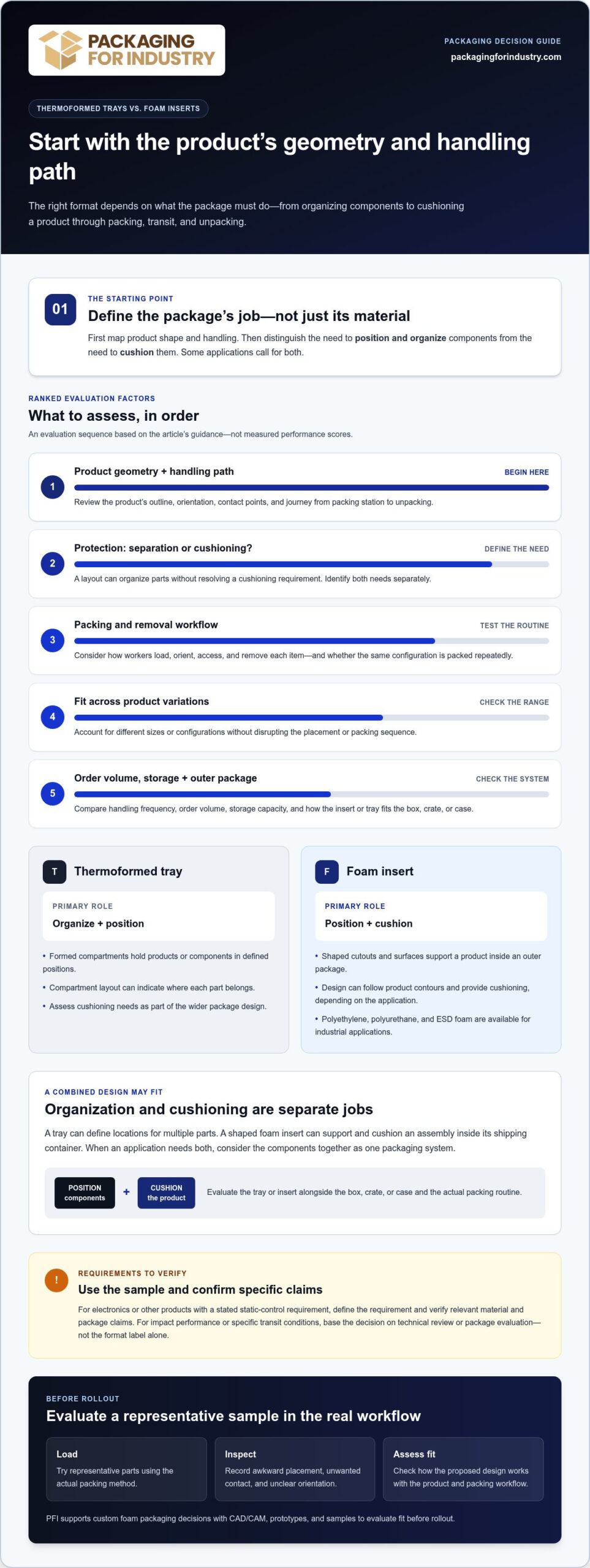
The packaging that secures a part neatly may not be the option that best protects it through shipping. A thermoformed trays vs foam inserts comparison should start with the product’s geometry and handling cycle, not the material name.
Both formats can help keep components positioned, but the right choice depends on what happens during packing, transit, and unpacking. Consider fit across product variations, pack-line steps, storage needs, and repeat shipments. A mismatch can add handling work or leave products vulnerable to movement and contact.
Use this comparison to assess protection, fit, handling, and operational trade-offs. It explains when rigid trays can support organization, when shaped foam can help position and cushion a product, and when combining packaging components may suit the application. Packaging For Industry (PFI) provides custom foam packaging design support, CAD/CAM, prototypes, and samples to evaluate fit before rollout. Foam can also be considered alongside corrugated boxes or crates as part of a complete shipping system.
Key Takeaways
- A thermoformed trays vs foam inserts comparison should account for product geometry, protection needs, and how packaging moves through your operation.
- Separate the need to position and organize components from the need to cushion them. Some products may benefit from both functions.
- Compare the packing method, handling frequency, order volume, and storage capacity before selecting a format.
- Use prototypes or samples to assess whether a custom foam design fits the product and packing workflow before rollout.
- Consider inserts alongside corrugated boxes or crates to evaluate protection as part of the complete shipping system.
Thermoformed Trays vs. Foam Inserts: What Is the Difference?
Thermoformed trays have formed compartments that organize products or components. Foam inserts are shaped cushioning placed inside a box, crate, or case to position a product. In this thermoformed trays vs foam inserts comparison, the formats serve different packaging functions, and neither has universal performance advantages. The right fit depends on product shape, protection requirements, handling steps, and the complete shipping system.
For manufacturers shipping components, assemblies, or products packed repeatedly, the choice affects how each item is placed, secured, and removed. A tray can define separate locations for multiple parts, while an insert can be shaped around a product’s contours. Some applications call for organized positioning, some for cushioning, and others for both. The packaging should work with the outer container and the actual packing routine.
How thermoformed trays are used in product packaging
A thermoformed tray uses formed compartments to hold products or components in defined positions. The thermoforming process shapes material into a tray. In a repeat-packing operation, the cavity layout can indicate where each part belongs and how workers access it. Compartment dimensions and arrangement affect placement, removal, and packing consistency. A tray’s role is organization and positioning; assess any cushioning needs as part of the wider package design.
How foam inserts protect and position products
A foam insert is designed to fit around or support a product inside its outer package. Its cutouts and surfaces can position components and provide cushioning, depending on the product and design. PFI supplies polyethylene, polyurethane, and ESD foam packaging for industrial applications. Custom foam inserts can be designed as part of a protective foam packaging system, with fit assessed against the product and packing workflow.
For example, machined components that need to stay arranged between packing and unpacking may benefit from separate tray compartments. If an assembly also needs cushioning inside its shipping container, a shaped foam insert may address that requirement. One format does not automatically replace the other. A packaging system may use one, or combine positioning and cushioning components.
Start by listing what the package must do at each stage: hold parts in sequence, separate items, support a particular shape, or cushion the product during shipment. Then consider how workers load and remove it, whether the same configuration is packed repeatedly, and how the tray or insert fits the box, crate, or case. These details help packaging and distribution teams compare formats based on the package’s job, rather than assumptions about material or form.
How Design and Protection Needs Shape the Comparison
Design starts with the job the package must perform. A component that needs a consistent orientation and a designated compartment presents a different challenge from a fragile assembly that needs cushioning within its outer container. In a thermoformed trays vs foam inserts comparison, assess the part’s geometry and full handling path. The format or material alone does not determine protection.
Map the journey from packing station to unpacking: how the item is placed, whether it shifts between steps, how it is carried or shipped, and how it is removed. If impact performance or suitability for a specific transit condition matters, base the decision on technical review or evaluation of the proposed package, not on the format label.
Product geometry, compartments, and fit
Review the product’s outline, orientation, contact points, and relationship to nearby components. A tray’s compartments can establish separate locations, while a custom insert can be shaped to accommodate contours or support a particular placement. If a product family includes different sizes or configurations, account for those variations in the design without disrupting the packing sequence.
Use a sample to assess fit before rolling out a design across a recurring packing operation. Have packers load and remove representative parts, then record awkward placement, unwanted contact, and unclear orientation. PFI’s CAD/CAM support and prototypes or samples can help evaluate a proposed custom foam design against the product and workflow.
Cushioning, product separation, and ESD considerations
Keep two questions distinct: does the package need to separate and organize components, and does it also need to cushion them? A layout can address organization without resolving a cushioning requirement. If both needs apply, consider a combined design, such as a shaped insert inside an outer box or crate. The design should reflect the item and its handling conditions.
For electronics or other products with a stated static-control requirement, ESD foam may be part of the packaging discussion. Its presence alone does not establish that a design meets a particular standard. Define the requirement and verify relevant material and package claims before relying on them.
Comparisons also need context. PET thermoform vs Styrofoam food trays addresses a specific food-tray and material comparison. Its conclusions should not be treated as universal guidance for industrial components or assemblies. For custom foam packaging, evaluate the insert as part of the complete package, including the outer container and packing steps.
- Record orientation, separation, and contact points.
- Identify cushioning or static-control needs separately.
- Evaluate a representative sample using the actual packing method.
Once those requirements are clear, a custom foam packaging quote can be based on the product, package, and workflow being evaluated.
Thermoformed Trays vs. Foam Inserts: Compare Workflow and Trade-Offs
Packaging affects more than transit protection. It also shapes the work involved in packing, inspection, picking, and replenishment. This thermoformed trays vs foam inserts comparison is most useful when it reflects the actual process: how a part enters the package, how it is accessed, and how the complete package fits the shipping operation. Neither format guarantees a particular result on its own.
Use the table to identify questions for a representative pack-out. Then evaluate the proposed format with the product and outer container together.
| Consideration | Thermoformed tray | Foam insert |
|---|---|---|
| Product fit | Compartment layout can define locations for products or components. | Cutouts or shaped areas can be designed around a product’s geometry. |
| Organization | May suit operations that need separated, repeatable positions. | Can position a product or components within an outer package. |
| Cushioning needs | Evaluate separately; organization alone doesn’t establish cushioning performance. | Design may address positioning and cushioning, subject to package evaluation. |
| Handling | Check access to each compartment and the sequence of loading or removal. | Check how workers seat, inspect, and lift the product from its shaped location. |
| Storage | Assess the storage footprint of the tray and its replenishment method. | Assess insert storage alongside boxes, crates, and packing supplies. |
| Design | Review compartment layout against product mix and packing steps. | Review shape, orientation, material choice, and outer-container fit. |
Packing speed, product access, and repeatability
Observe the pack-out from start to finish. Workers may need to orient each part, separate components, inspect the contents, and repack them in a defined sequence. A format that makes placement clear may support consistency, but access and removal still need a hands-on check. Test representative products and have packers follow the intended process before adopting a recurring format. Note where they pause, turn a part, or need clarification, as these details can reveal a layout or instruction issue.
Storage, shipping configuration, and integrated packaging
Evaluate the tray or insert inside the actual box or crate, not in isolation. The outer container, packed configuration, and replenishment method all affect the operation. A tray may suit an organized pack-out; a foam insert may suit a design that calls for shaped support. For products that need a combined crate-and-foam approach, PFI can integrate foam with wooden crates.
Compare storage footprint using your warehouse layout and replenishment pattern. Don’t assume one format takes less space or costs less without evaluating the complete design and order needs. Match the packaging structure to the product and workflow, then review access, consistency, protection requirements, and fit inside the shipping container. A custom packaging quote can support evaluation of a foam-based package for your application.
How to Choose the Right Format for Your Product and Operation
Use a structured evaluation rather than selecting a format by material name. The thermoformed trays vs foam inserts comparison should account for the product, shipping conditions, and work required to pack and replenish it. Document the requirements first, then assess sample configurations using the intended outer container and a representative pack-out.
- Document the product. Record dimensions, weight, orientation, sensitive surfaces, and how components relate to one another. Note areas that need separation, support, or protection, along with any stated static-control requirement.
- Define fragility and transit conditions. Describe the product’s handling path, from the production area through shipping and delivery. Include known carrier or freight constraints and damage history, but don’t assume packaging caused prior damage without reviewing the circumstances.
- Map the packing method. List the steps workers follow to load, inspect, close, unpack, and repack the product. Consider whether consistent orientation, clear component separation, or quick access affects production or fulfillment.
- Assess handling frequency and order volume. A package used for recurring shipments has different workflow demands from one used for occasional orders. Consider how often workers handle the package and whether the product mix changes between orders.
- Check storage and replenishment. Evaluate where packaging components will be stored, how they will be replenished, and whether the format fits available warehouse space. Base the assessment on your facility and purchasing pattern, not assumed footprint or cost advantages.
- Compare sample configurations. Test candidate formats with representative products, packers, and the outer container. Observe placement, removal, inspection, and repacking. Record fit issues and workflow differences before selecting a format for ongoing production.
A practical evaluation checklist for packaging buyers
Keep the product record and workflow map together so packaging, production, shipping, and purchasing teams can review the same requirements. Include photos or drawings where useful, identify the areas that need attention, and note known shipping or freight constraints. Record who will pack and inspect the product, how variants will be identified, and what needs to be replenished. This gives a packaging review a clear basis for comparing practical options.
When to consider a custom packaging review
Consider design support if standard packaging does not position products consistently or leaves key areas without the needed support. PFI provides packaging reviews, CAD/CAM support, prototypes, and samples to assess a proposed design before broader use. Through custom packaging design services, the package can be evaluated against product geometry and the packing workflow.
Bring product details, shipping conditions, order patterns, and storage requirements together to make the review useful. Request a packaging quote for your product and workflow
How PFI Supports Custom Foam Packaging Decisions
Custom foam decisions work best when engineering, production, quality, and shipping teams agree on what the package needs to support. Their priorities can differ: packers need a clear, repeatable process, inspectors need access to relevant product areas, and shipping teams need a configuration that fits the planned shipment. Bringing these requirements together keeps packaging decisions connected to day-to-day operations.
From product requirements to a prototype
For aerospace, electronics, and medical device manufacturers, product details and handling procedures shape the packaging review. An aerospace component may have specific contact areas to account for; an electronic assembly may need connectors kept accessible during inspection. Document these needs alongside packing steps and known transit concerns. Feedback from the people who pack, inspect, and receive the product can then help refine the design.
PFI’s packaging reviews help buyers assess whether a proposed configuration aligns with operational requirements. Focus review feedback on practical questions: Can the product be loaded in the intended orientation? Can staff identify the correct placement? Does the package fit the established inspection and shipping process? The answers guide design decisions without assuming one format suits every application.
Foam inserts within a broader packaging system
For production operations, packaging should fit the way materials move from the line to shipping. PFI’s packaging solutions for manufacturers can be considered in the context of product handling, packing responsibilities, and supply planning. For businesses with recurring packaging needs, vendor managed inventory and just-in-time packaging programs can help coordinate replenishment with usage patterns.
Share the application, the teams involved, and the requirements that matter most to your operation. That gives the packaging discussion a practical starting point, whether the priority is product access, consistent pack-out, or coordinating supplies with production demand. PFI serves businesses in Orange County, Los Angeles, San Diego, and Riverside, as well as other Southern California locations.
Turn Your Packaging Requirements Into a Testable Design
Before changing a packaging format, give purchasing, operations, and quality teams a shared basis for the decision. A short evaluation plan can identify what matters most, such as acceptable product positioning, access for inspection, and packing steps workers can follow consistently. This makes a thermoformed trays vs foam inserts comparison easier to apply to your operation instead of relying on broad assumptions about either format.
Agree on how your team will assess a proposed configuration and who will review it. Recording feedback in one place helps decision-makers weigh product handling alongside workflow demands and supply planning. It also gives the next packaging discussion a clear purpose: resolve a specific fit or process need, rather than simply replace one format with another.
With shared criteria in place, your team can select a packaging approach that supports dependable operations. To compare custom foam options with your current setup, request a packaging quote from PFI.
Frequently Asked Questions
Are thermoformed trays or foam inserts better for fragile products?
Neither is automatically the better choice. First identify how the product could be damaged. A finish-sensitive part may need separation from neighboring items, while a component vulnerable at a connector or projecting feature may need that area addressed in the design. Describe likely failure modes and evaluate the proposed configuration for the specific product. The format name alone cannot establish how well a package will perform.
Can foam inserts be designed for products with unusual shapes?
Yes. To support a design discussion for an irregular product, provide a current drawing or CAD file when available and identify critical surfaces, projections, and areas that must remain clear. Note any variation in dimensions between production runs as well. This information helps distinguish essential contact and clearance areas from details that do not affect packaging, keeping the design brief focused on the part’s functional requirements.
How do I compare thermoformed trays and foam inserts for production packing?
Compare how each option fits the work on your line. Track misloads, time spent correcting orientation, SKU changeovers, and inspection steps that require repositioning the product. Review the observations with production and quality teams, especially if several versions of a component share a packing area. This can reveal whether a format supports clear identification and smooth handoffs across the operation.
Do foam inserts need to be combined with a box or crate?
An insert is an internal packaging component, so the shipment also needs an appropriate outer container. If your operation already uses a box or crate, evaluate its interior dimensions and closure with the insert in place. Confirm that the assembled package suits the planned shipping configuration and the way staff will handle it. The right outer container depends on the product and shipment, not on the foam alone.
When should a manufacturer request a custom packaging quote?
Request a quote when preparing a purchasing plan for a new product, reviewing a packaging budget, or comparing a proposed design with your current supply arrangement. Include the expected order pattern and purchasing constraints that affect how the packaging will be sourced. For a useful comparison, apply the same requirements to each option, including the outer package and any related components being evaluated.
Can one packaging design work for multiple products?
It can, if the products are compatible with the same package layout and support requirements. Account for part-number differences and how workers will distinguish variants at the packing station. If a shared design could make similar components easy to confuse, consider how packing instructions and product identification will control that risk. Do not assume a design suitable for one variant will fit every item in a product family.
What information should I provide for a foam packaging quote?
Along with part information, include the current packaging configuration if one exists, such as the box’s interior dimensions and any components packed with the product. Share estimated order quantities, release frequency, and whether demand changes across the year. Drawings or photos can clarify details that are difficult to describe in text. Request a foam packaging quote from PFI with these details to start a review of the actual product and supply requirement.