
What if your packaging supply could stay dependable without filling the warehouse with extra stock? Production and shipping teams know the tradeoff: recurring materials run short, or excess boxes, foam, and stretch film take up valuable space. The right vendor managed inventory packaging companies help address both by aligning replenishment with how your operation actually uses packaging.
Packaging For Industry supports businesses in Los Angeles and Orange County with managed stocking, planned replenishment, and inventory reviews scheduled weekly, biweekly, or monthly. A program can take usage history, supplier lead times, available storage, and production or shipping schedules into account, helping reduce routine purchasing work and avoid preventable shortages. This article explains how packaging VMI works, what to assess when comparing a program, and how a local packaging supplier can support recurring needs for corrugated products, foam, stretch film, and other materials. You’ll also learn how to evaluate stocking levels and replenishment rules for a more reliable supply process without putting unnecessary pressure on warehouse space or working capital.
Key Takeaways
- Compare vendor managed inventory packaging companies by how they tailor replenishment rules to item usage, lead times, storage, and operational needs.
- Use a clear review-to-replenishment process to help limit shortages, excess stock, and repeat-order administration.
- Prioritize recurring packaging items for VMI based on how consistently they’re used and the operational impact of running short.
- Ask suppliers how they gather, share, review, and update inventory information when demand or schedules change.
- Consider coordinating corrugated products, foam, stretch film, and other packaging through one supplier to simplify recurring supply management.
How Packaging VMI Helps Prevent Stockouts and Excess Inventory
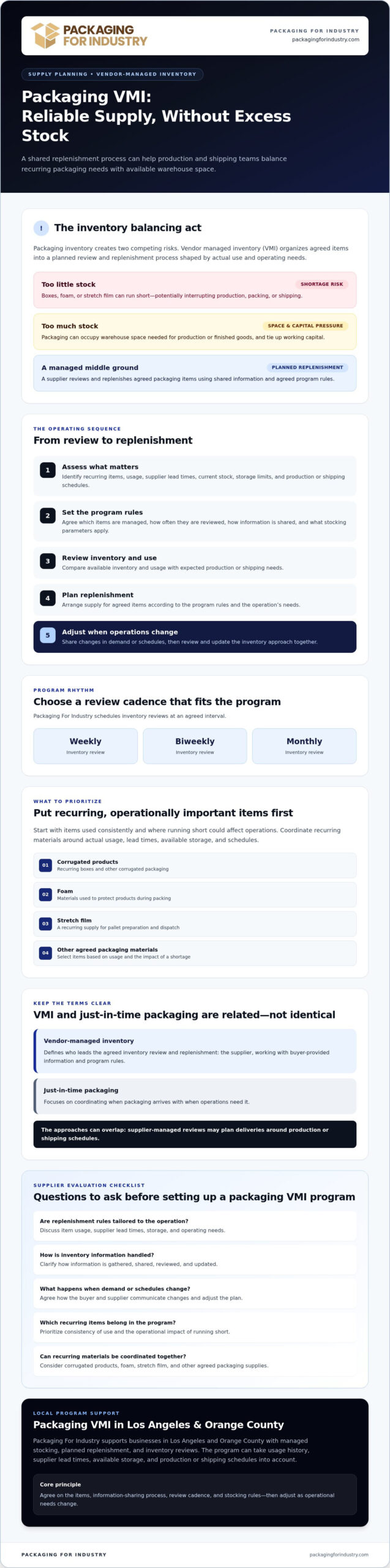
Packaging inventory creates two competing risks: too little stock can interrupt production or shipping, while too much can crowd the warehouse and tie up working capital. Packaging VMI gives a supplier responsibility for reviewing and replenishing agreed packaging items according to usage and lead times. It changes repeat ordering from a series of reactive purchases into a planned process.
As a neutral overview explains, Vendor-managed inventory (VMI) places primary inventory management responsibility with the supplier, within an agreed arrangement. For packaging, that means the supplier monitors specified materials and plans replenishment, while the buyer remains involved in oversight, program decisions, and sharing changes in demand or operations.
Packaging VMI is not simply ordering more in bulk; it is a managed replenishment plan for agreed items, shaped by actual usage, lead times, storage, and operating schedules. Bulk orders can affect the quantity purchased, but they don’t by themselves establish a review and replenishment process. Businesses comparing vendor managed inventory packaging companies should ask how a program will respond when usage changes, not just how much stock it can supply.
What packaging inventory problems can VMI address?
A shortage of corrugated boxes can hold up an order. Running low on foam may disrupt packing for products that need protection, while limited stretch film or other supplies can slow pallet preparation and dispatch. Emergency orders can add purchasing work and make it harder to plan around normal lead times.
The opposite problem also has a cost. Packaging purchased ahead of need can occupy space needed for production or finished goods. Materials tied to a product or specification that changes may become difficult to use. Meanwhile, staff who repeatedly check stock, chase usage information, and place routine orders have less time for higher-priority work. VMI can help bring these competing pressures into a planned review process, without removing the buyer’s role in monitoring the program.
How is VMI different from just-in-time packaging?
VMI describes who manages the agreed inventory review and replenishment: the supplier takes the lead, working with the buyer’s information and program rules. Just-in-time packaging focuses on coordinating when packaging arrives with when operations need it. The approaches can overlap, but they are not interchangeable. A program may use supplier-managed reviews while planning deliveries around production or shipping schedules.
Packaging For Industry considers usage history, lead times, available storage, and operating schedules when planning VMI. Reviews can be weekly, biweekly, or monthly, depending on the program. Learn more about packaging vendor managed inventory and the agreed items and review process that can support recurring supply.
How Packaging Vendor Managed Inventory Works from Review to Replenishment
A workable VMI process starts with a shared view of what packaging is used, what can affect supply, and how much room is available to store it. The supplier and customer then agree on the items to manage and how to review them. VMI moves packaging from initial assessment to agreed stocking rules, scheduled review, planned replenishment, and adjustment as operating needs change.
This transparent sequence matters more than a particular tracking tool. An overview from Inbound Logistics on how packaging vendor managed inventory works describes VMI as a coordinated approach to replenishment and fulfillment. In practice, the buyer and supplier should establish who shares inventory information, who reviews it, and how changes are handled.
- Assess: Identify recurring packaging items, usage, lead times, current stock, storage limits, and operating schedules.
- Set rules: Agree on managed items, review cadence, communication, and any stocking parameters.
- Review: Check available inventory and usage against expected production or shipping needs.
- Replenish: Plan supply for agreed items according to the program rules and relevant lead times.
- Adjust: Revisit the plan when demand, schedules, or packaging requirements change.
What happens during the initial packaging inventory assessment?
Start with an item list and usage history, then add current stock, supplier lead times, and practical storage limits. Note which materials are standard repeat-use items and which require custom production. Purchasing can explain order history and lead-time concerns; warehouse staff can confirm what fits and where; production or shipping teams can identify which shortages would disrupt daily work. These details help focus the program on operational priorities.
How are stocking levels and replenishment reviews agreed?
The customer and supplier decide which items belong in the program and how often to review them. If the program includes minimum and maximum stock levels, both parties should establish those parameters together, using usage, lead times, storage, and schedules as inputs. They should also agree how to flag unusual demand and correct inventory information. Levels are program rules, not universal figures that fit every operation.
Packaging For Industry considers usage history, lead times, storage, and production or shipping schedules when planning managed stocking. Reviews can be scheduled weekly, biweekly, or monthly. Businesses comparing vendor managed inventory packaging companies should confirm how the agreed review process works and who communicates changes, rather than assuming replenishment is automatic. See PFI’s vendor managed inventory program for service details.
To assess how recurring packaging needs could fit a defined review and replenishment process, share your packaging requirements with PFI.
Which Packaging Supplies Should a Company Put in a VMI Program?
Start with packaging items your operation uses repeatedly, then prioritize them by consumption patterns, lead times, storage pressure, and the impact of a shortage. This gives the VMI discussion a practical starting point instead of treating every supply as equally important. Ask potential suppliers how they would assess each item and whether the proposed review process can support your actual production and shipping needs.
PFI supplies packaging for manufacturers, aerospace and aviation companies, electronics and medical device businesses, food and beverage producers, industrial distributors, and warehouse and distribution operations. Their needs differ: a warehouse may use stretch film steadily across outbound shipments, while a manufacturer may rely on particular corrugated boxes or foam to keep a production or packing process moving. Consider the role each item plays in your own workflow.
| Item type | Usage pattern to review | Lead time and storage pressure | Potential shortage consequence |
|---|---|---|---|
| Corrugated boxes | Repeat-use sizes tied to orders or production | Check replenishment timing and space for stored stock | Packing or shipments may be delayed |
| Stretch film and tape | Regular use across packing and palletizing | Compare consumption with storage capacity | Shipping preparation may slow |
| Foam and protective materials | Use tied to specific products or handling needs | Confirm supply timing and custom planning needs | Protective packing may be interrupted |
| Labels | Repeat use by product, order, or workflow | Review replenishment timing and item variations | Identification or shipping steps may be held up |
| Tubes and pallets | Recurring use based on product and shipping activity | Consider replenishment timing and storage space | Relevant packing or handling steps may be affected |
| Corner and edge protection | Used with selected products or shipments | Review storage and replenishment lead time | Protective packing steps may be affected |
Are stock packaging supplies good VMI candidates?
Stock items are practical candidates when teams use them repeatedly and can observe their consumption. Consider supplies used across production, warehouse, shipping, or fulfillment workflows. Frequent reordering or tight storage can signal a reason to assess managed replenishment. For recurring corrugated boxes, compare actual usage and replenishment timing before deciding which items to include.
How should custom packaging be managed in VMI?
Custom boxes, foam inserts, and crates need planning around design and production lead times because an off-the-shelf substitute may not suit the product. Coordinate stocking with product revisions and operating schedules, and discuss how to handle inventory if specifications change. PFI’s custom packaging design services may be relevant when inventory planning also involves packaging design.
Begin with repeat-use items that are trackable and operationally important. Once the review process works for that group, assess whether additional packaging should be included.
How to Evaluate a Packaging VMI Supplier and Set Program Controls
A VMI supplier should offer more than packaging products. The program needs clear review routines, communication, and responsibility for acting on inventory information. As you compare vendor managed inventory packaging companies, look for a supplier that can manage the packaging categories you use, plan for custom items, and explain how the process works when demand changes.
Use this checklist to guide supplier discussions:
- Product range: Can the supplier support the packaging items you want included, such as corrugated boxes, foam, stretch film, or other recurring materials?
- Custom-item planning: How will the program account for custom packaging requirements, production lead times, and design or product revisions?
- Review cadence: What review frequency fits your usage and operating schedules? PFI’s VMI reviews can be scheduled weekly, biweekly, or monthly.
- Inventory information: How will current stock and usage be gathered, shared, reviewed, and corrected if records differ?
- Communication and exceptions: Who should be contacted about a demand change, potential shortage, revised packaging, or inventory that may no longer be needed?
Clarify the division of work before launch. For example, specify who confirms physical counts, who approves changes to managed items or stocking parameters, and how the supplier plans replenishment after a review. A supplier may lead the agreed inventory review, but your purchasing, warehouse, and operations teams still need to share relevant changes and oversee program performance.
What should a packaging VMI agreement define?
Document the items in scope, review frequency, any agreed stocking parameters, and communication channels. Add a process for changing demand, packaging revisions, shortages, and concerns about obsolete stock. Make responsibilities clear for both sides. Don’t assume that a particular tracking tool, service level, or replenishment guarantee is included unless it’s explicitly agreed.
How can buyers assess local and multi-location support?
Confirm that the supplier can support the locations and packaging categories covered by your plan. PFI serves Southern California, but buyers should verify applicable local delivery coverage and program details for their specific operation. For multiple sites or national needs, confirm scope directly; support depends on the program requirements and location.
Clear controls help purchasing and operations teams spot exceptions and keep the replenishment plan aligned with real demand. They also give both parties a practical basis for reviewing whether the program is working as intended.
Why Choose PFI for Vendor Managed Inventory Packaging?
A useful VMI program should fit the way your business buys, stores, and uses packaging. Packaging For Industry works with recurring packaging needs by planning managed stocking and scheduled inventory reviews around usage, lead times, storage, and production or shipping schedules. The goal is a clearer replenishment process that can help reduce avoidable shortages and unnecessary on-site inventory, without assuming every operation needs the same setup.
PFI can coordinate recurring corrugated products, foam, stretch film, and other packaging materials through one supplier. That can simplify oversight when an operation uses both stock supplies and custom packaging. A standard box may need routine replenishment, while custom packaging requires planning around its production lead time and any design changes. Keeping those requirements visible in one program can make purchasing and supply planning easier to coordinate.
What makes PFI relevant for recurring industrial packaging needs?
Packaging For Industry serves Southern California businesses with manufacturing, warehouse, and shipping requirements. VMI reviews can be scheduled weekly, biweekly, or monthly, based on the program. PFI’s materials also note local next-day delivery throughout Southern California; confirm whether delivery timing and program terms apply to your location and specific packaging needs. Certain multi-location or national programs may be supported, subject to scope and requirements.
For buyers comparing vendor managed inventory packaging companies, PFI’s combination of recurring stock supply and custom packaging planning can be relevant when both types of items affect the same production or fulfillment schedule. Review PFI’s packaging VMI service to understand the program offering.
What information should buyers prepare before requesting a quote?
Bring a practical picture of current needs. Prepare descriptions of recurring packaging items, approximate usage history, known lead times, storage constraints, and the locations involved. Note production or shipping schedules, recent supply interruptions, and any custom packaging requirements or revisions. This gives PFI a starting point to discuss which items may fit managed inventory and what review cadence could suit the operation.
PFI can review your requirements without assuming that every item belongs in VMI. A focused discussion can help distinguish predictable repeat-use supplies from items that need separate planning, and identify what details still need confirmation before setting program rules.
Build a More Dependable Packaging Replenishment Plan
A well-designed VMI program connects replenishment to actual usage, lead times, storage limits, and operating schedules. Start with recurring items that are important to production or shipping, then agree on how inventory will be reviewed and how the plan will adapt when demand or packaging requirements change. These are useful points to compare when evaluating vendor managed inventory packaging companies.
Packaging For Industry supports recurring industrial packaging needs with custom and stock packaging, including corrugated products, foam, and stretch film. VMI reviews can be scheduled weekly, biweekly, or monthly. PFI’s materials also state that local next-day delivery is available throughout Southern California; confirm applicable delivery coverage and program details for your operation.
Prepare your item list, usage history, known lead times, storage constraints, and operating schedules to help shape a practical discussion. A clear starting point can make it easier to assess which supplies belong in a managed replenishment plan.
With the right program rules and supplier communication, your team can work toward steadier packaging availability and a more manageable inventory process.
Frequently Asked Questions
What is vendor managed inventory for packaging?
Vendor managed inventory for packaging is an arrangement where a supplier reviews agreed packaging items and plans replenishment with the customer. The plan can account for usage, lead times, available storage, and operating schedules. The customer and supplier define which items are included, how often they’ll be reviewed, and who handles approvals or exceptions. The buyer still provides operational oversight and communicates changes that could affect demand.
How does packaging VMI work?
A packaging VMI program typically begins by reviewing the items a business uses, usage history, lead times, current inventory, and operating schedules. The supplier and customer then agree on the items to manage, review frequency, responsibilities, and any stocking parameters. The supplier reviews inventory and plans replenishment under those rules. If demand or packaging requirements change, both parties communicate and adjust the plan as agreed.
Which packaging supplies can be included in a VMI program?
The program can include recurring items the supplier can support and the business wants managed. Common examples include corrugated boxes, stretch film, tape, foam, labels, tubes, pallets, crates, and corner or edge protection. Selection should reflect actual use, lead times, storage limits, and the impact of a shortage. Custom boxes, foam, or crates may also be considered, but their production timing and specifications need review.
Is vendor managed inventory a good fit for a small warehouse?
It may be worth assessing if recurring packaging consumes valuable storage space or frequent reordering takes time away from warehouse work. Fit depends on how consistently items are used, their lead times, the location, and the supplier’s ability to support the program. Review current stock, purchasing frequency, and operating schedules with a potential supplier to decide whether managed replenishment is practical for your facility.
Can a packaging VMI program include custom boxes or foam?
Yes, custom items can be considered when they’re recurring operational requirements and the supplier can support them. Discuss their specifications, known production lead times, usage history, and possible design or product revisions during program planning. A custom box or foam insert may require earlier coordination than a standard stock item. The supplier and customer should determine suitable stocking and replenishment rules for each custom item.
How often should packaging inventory be reviewed in a VMI program?
Review frequency should reflect item usage, lead times, storage capacity, and production or shipping schedules. Packaging For Industry’s VMI program information allows weekly, biweekly, or monthly reviews. The supplier and customer should agree on a cadence that suits the items being managed, then revisit it if demand or packaging requirements change. The review schedule is part of the program, not a one-size-fits-all setting.
How much does packaging VMI cost?
Packaging VMI pricing depends on the items, quantities, program scope, and operational requirements, so request a quote based on your situation rather than relying on a generic estimate. Ask the supplier to explain what the proposed program covers and which responsibilities remain with your team. You can also compare the proposal with your current purchasing workload, storage needs, emergency ordering, and supply risks when assessing fit.
How do I choose a vendor managed inventory packaging company?
Compare vendor managed inventory packaging companies by product range, custom-item planning, review process, communication, location coverage, and clearly assigned responsibilities. Ask how usage and lead-time information will be gathered, reviewed, and corrected when demand changes. Packaging For Industry serves businesses in Orange County, Los Angeles, San Diego, and Riverside. Confirm that the supplier can support your specific locations, packaging categories, and program requirements before making a decision.