
Your choice of adhesive is a logistical strategy that dictates your total cost of ownership, not just a minor line-item expense. If your team is forced to double-tape boxes to prevent popping or pilferage, you aren’t just wasting material; you’re paying a premium in labor and risking shipment integrity. Procurement managers looking for packaging tape wholesale Anaheim often face the challenge of finding a product that remains consistent across varying temperatures and heavy-duty corrugated surfaces.
We understand that a single failure in the field can negate any savings found on a cheap roll of tape. This guide will help you optimize your shipping integrity and reduce per-unit costs by selecting the right industrial adhesive technology for your specific operations. You’ll learn how to match tape chemistry to your substrates, navigate California’s evolving SB 54 packaging regulations, and streamline your supply chain through reliable wholesale channels that prioritize zero transit failures. By focusing on engineering and economics, you can transform a simple consumable into a tool for logistical precision.
Key Takeaways
- Understand why tape failure is a systemic issue and how specific adhesive properties maintain the structural integrity of your corrugated boxes.
- Compare the technical performance of acrylic versus hot melt adhesives to ensure your seal holds during long-term storage or high-speed transit.
- Learn to calculate the true cost per linear foot to identify the most efficient packaging tape wholesale Anaheim options for your specific volume and application.
- Discover how to select specialized adhesives that resist freezing in cold storage or maintain bonding strength in high-dust warehouse environments.
- Streamline your procurement with local next-day delivery and engineering-driven solutions designed to eliminate material waste and transit damage.
Beyond the Roll: The Role of Wholesale Tape in Supply Chain Integrity
Many logistics managers view tape as an afterthought, but it is actually the final link in your supply chain’s physical security. When an adhesive fails, it isn’t just a minor inconvenience. It represents a total failure of the entire packaging system. A compromised seal exposes your product to pilferage, environmental moisture, and structural collapse during transit. If you are sourcing packaging tape wholesale Anaheim, you need to look beyond the price per roll and evaluate how that tape interacts with your specific corrugated box inventory.
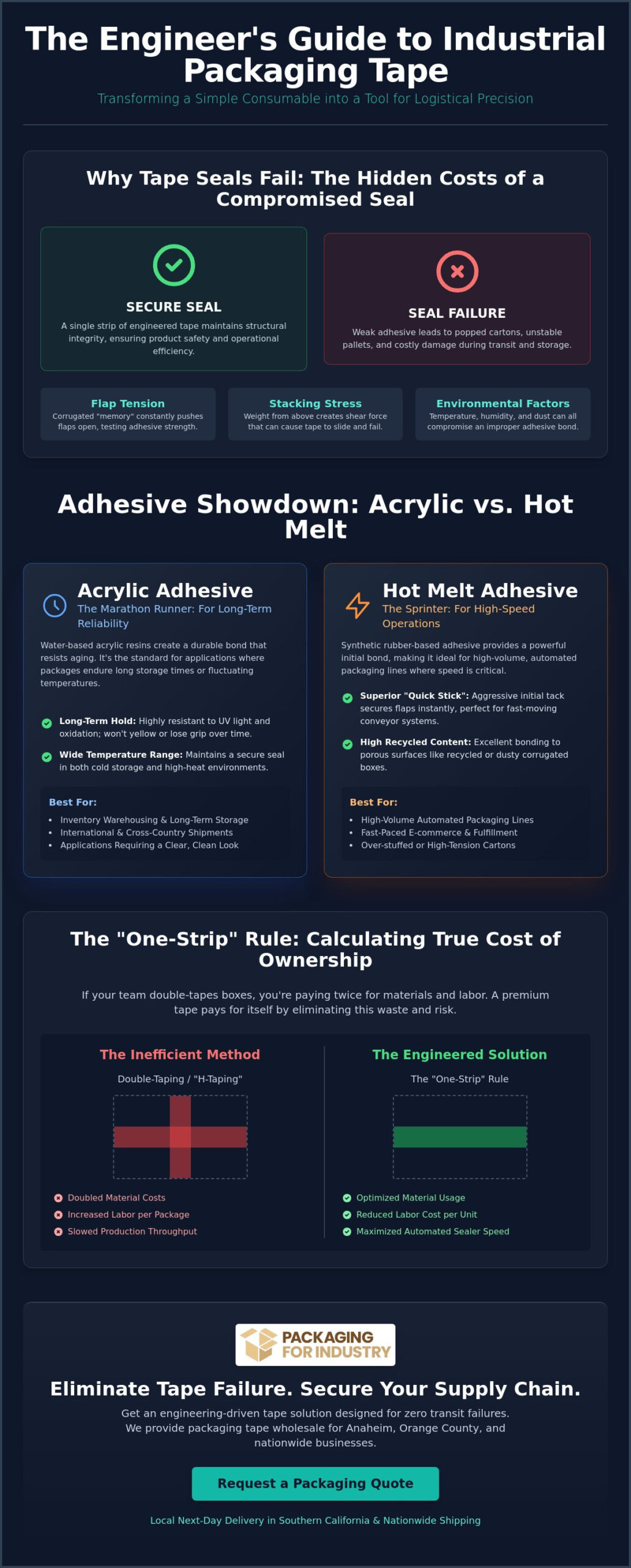
The primary technical challenge is flap tension. High-quality corrugated materials have “memory” and naturally resist being folded shut. A weak adhesive will eventually succumb to this constant upward pressure, leading to “popped” cartons in the warehouse or on the truck. This issue is compounded when boxes are stacked high. The weight of the pallet above puts lateral stress on the seal. Without sufficient shear strength, the tape slides, the box loses its square shape, and the entire stack becomes unstable. This leads to damaged inventory and costly returns that could have been avoided with a technically superior seal.
The Anatomy of an Industrial Seal
Industrial tapes are typically categorized as pressure-sensitive tape (PSA tape), which relies on a combination of a carrier material and a specialized adhesive layer. Polypropylene is the most common carrier due to its high tensile strength and cost-effectiveness. In fact, polypropylene backing is expected to hold more than a third of the adhesive tapes market share by 2026. However, PVC and reinforced paper remain essential for specialized applications where silence or recyclability is a priority.
The thickness of the adhesive, measured in microns, dictates how well the tape “wets out” or flows into the fibers of the box. A thicker adhesive layer is often necessary for recycled corrugated surfaces, which are more porous and difficult to bond with. Beyond thickness, you must consider shear strength. This is the tape’s ability to resist being pulled apart by vertical forces. In high-stacking scenarios, shear strength is what keeps your pallets from leaning or collapsing during long-haul trucking. It ensures the box maintains its structural integrity under pressure.
Reducing Labor Through Adhesive Reliability
Operational efficiency is found in the small details. We advocate for the “one-strip” rule: a single piece of premium tape should be sufficient to secure any standard carton. If your warehouse staff feels the need to double-tape or “H-tape” every box, your labor costs are effectively doubling. This extra time spent at the packing station slows down your entire throughput and creates unnecessary material waste.
Reliable packaging tape wholesale Anaheim solutions ensure that your automated sealing machines can run at maximum speed without frequent jams or misapplied strips. Inconsistent tape quality leads to machine downtime and manual rework. By investing in a tape with a consistent release and high initial tack, you streamline your procurement and your production floor simultaneously. You aren’t just buying a roll of tape; you’re buying the assurance that your packages will arrive intact without excessive labor or material overhead.
Engineering the Seal: Comparing Industrial Adhesive Technologies
Selecting the right adhesive is a technical decision that impacts your operational speed and long-term storage viability. While many buyers looking for packaging tape wholesale Anaheim focus on the price per roll, the chemistry of the tape dictates how well it will bond to specific fibers. Acrylic adhesives, for instance, are expected to hold a 42.0% share of the adhesive tapes market in 2026 due to their versatility. These water-based resins excel in long-term storage environments because they are highly resistant to UV light and oxidation. They won’t yellow or lose their grip over time, making them the standard choice for inventory that might sit in a warehouse for months.
Conversely, hot melt adhesives utilize synthetic rubber to provide a superior “quick stick” or initial tack. This is critical for high-volume shipping operations where boxes move quickly through automated lines. Hot melt is particularly effective on boxes with high recycled content, as the adhesive flows more easily into the shorter, more irregular fibers of recycled corrugated board. For operations dealing with extreme temperature fluctuations, such as cold storage or uninsulated desert warehouses, solvent-based adhesives remain the most reliable option. These adhesives maintain their bond in conditions where others would simply become brittle and flake off.
Hot Melt vs. Acrylic: Which Wins for Your Warehouse?
The choice between these two often comes down to the environment of your packing station. Hot melt tapes are known for their high tensile strength but can be noisy during application, which is a consideration for worker comfort in tight spaces. Acrylic tapes offer a much quieter release and better clarity for branding. When adhering to corrugated boxes, hot melt provides an almost instant bond, whereas acrylic requires a few seconds of “dwell time” to reach maximum adhesion. Following European adhesive tape standards and ASTM testing ensures that whichever chemistry you choose, the performance metrics remain consistent across your bulk orders. When sourcing packaging tape wholesale Anaheim, understanding these technical differences prevents the “buy-cheap, pay-twice” cycle.
The Security Advantage of Water-Activated Tape
For heavy-duty applications or high-value shipments, water-activated tape (WAT) is the gold standard. Unlike pressure-sensitive tapes, WAT features a starch-based adhesive that penetrates the box fibers to create a permanent, tamper-evident bond. You cannot remove this tape without visibly damaging the carton, which significantly reduces the risk of pilferage.
WAT is the preferred solution for shipments exceeding 50lbs because the reinforced fiberglass yarns provide exceptional burst strength. It also aligns with sustainability goals, as the paper backing is easily recyclable. If you are unsure which technology fits your current volume, you can compare packaging pricing for these different technologies to see which provides the best balance of security and cost-effectiveness. This engineering-first approach ensures your logistics remain secure from the warehouse floor to the final destination.
The Economics of Wholesale Procurement: Reducing Total Cost of Ownership
Industrial buyers often fall into the trap of comparing tape solely by the price per roll. This metric is deceptive. To understand your true operational expense, you must calculate the cost per linear foot and factor in the volume of tape required to achieve a secure seal. Using a lower-grade tape that requires multiple layers to meet USPS packaging and sealing standards actually increases your total spend. When you source packaging tape wholesale Anaheim, the goal is to find a high-performance material that achieves a permanent bond with a single strip. This approach directly contributes to significant packaging cost savings by reducing both material consumption and the time spent at the packing station.
Reducing waste is the most immediate way to improve your bottom line. Inconsistent tape thickness or poor tensile strength leads to “tabbing” or premature snapping, which forces workers to discard partially used rolls. By selecting a tape with a consistent release and high shear strength, you eliminate these micro-inefficiencies. Bulk purchasing also protects your operations from market volatility. Securing a reliable supply of packaging tape wholesale Anaheim ensures that your lead times remain stable even during seasonal surges or global supply chain disruptions. It’s about building a procurement strategy that values long-term stability over short-term price fluctuations.
Bulk Ordering Strategies for National Distribution
Efficiency starts with volume. Pallet-level pricing offers a much lower cost basis than case-level procurement, but the benefits extend beyond the unit price. Consolidating your tape orders with other essentials like stretch film or edge protectors reduces inbound freight costs. We also recommend standardizing your roll lengths. While 110-yard rolls are standard for handheld dispensers, switching to 1,000-yard machine rolls for automated lines reduces changeover downtime. This keeps your throughput high and your labor costs controlled. It’s a simple shift that yields measurable results in high-volume environments.
Vendor Managed Inventory (VMI) for Adhesive Supplies
Managing adhesive stock requires more precision than other consumables because adhesives have a finite shelf life. Implementing a Vendor Managed Inventory program removes the burden of tracking these expiration dates from your team. We monitor your usage patterns and replenish stock on a Just-In-Time (JIT) basis. This prevents “stock-out” emergencies and ensures that your tape is always at peak performance. By optimizing your warehouse footprint and ensuring adhesive freshness, VMI transforms your procurement from a reactive task into a streamlined, economic advantage for your facility.
Application-Specific Selection: Matching Tape to Industrial Environments
A standard roll of tape that performs well in a climate-controlled office will often fail in a cold storage facility or a dusty distribution center. For businesses sourcing packaging tape wholesale Anaheim, it’s vital to match the adhesive technology to the ambient conditions of your facility. Cold-temperature adhesives are specifically engineered to remain flexible and tacky at sub-zero levels. In contrast, standard hot melt adhesives can become brittle and lose their grip in refrigerated environments. Similarly, in high-dust manufacturing settings, you need a tape with an aggressive initial tack that can penetrate surface debris to reach the corrugated fibers. Without this specific engineering, your seal is compromised before the package even leaves the dock.
Specialized sectors like electronics and aerospace require even more precise material selection. Static-sensitive components demand anti-static (ESD) tapes to prevent discharge during the packing or unpacking process. High-tensile requirements for heavy industrial parts often necessitate the use of reinforced filament tapes. These products utilize fiberglass yarns to provide extreme burst strength, ensuring that heavy loads remain secure throughout the rigors of long-haul logistics. Choosing the wrong tape for these applications doesn’t just risk a “popped” box; it risks damaging high-value, sensitive inventory.
Specialized Solutions for Manufacturing and Aerospace
Industrial components often require a higher level of protection than standard consumer goods. When meeting strict aerospace packaging standards, the focus shifts to vertical shear strength and residue-free removal. We provide reinforced filaments for oversized industrial parts that require extra stabilization. For parts with high-finish surfaces, we offer specialized adhesives that leave zero residue upon removal. This ensures that components are ready for immediate assembly or inspection without the need for additional cleaning, saving valuable labor time in the production cycle.
The E-commerce and Retail Fulfillment Standard
The e-commerce sector must balance transit security with the customer’s unboxing experience. Tape is the first physical touchpoint a customer has with your brand. While security is paramount, ease of opening is a key factor in customer satisfaction. High-volume fulfillment centers often find that switching from manual handheld dispensers to automated water-activated tape machines improves both consistency and security. This transition allows for faster throughput while ensuring every box is sealed to the same professional standard. If your current tape is failing in specific environmental conditions or slowing down your fulfillment line, request a packaging quote to find a technical solution tailored to your facility’s unique demands.
Optimizing Logistics with Professional Wholesale Tape Solutions
Logistics optimization requires more than just a reliable product; it requires a partner who understands the intersection of engineering and economics. At Packaging For Industry (PFI), we move beyond the role of a traditional supplier by providing engineering-driven solutions that address the specific stressors of your supply chain. For companies searching for packaging tape wholesale Anaheim, our proximity allows for a level of responsiveness that national catalog companies cannot match. We don’t just deliver rolls. We provide the technical oversight necessary to ensure your seals hold under the most rigorous conditions.
Our logistical footprint is designed for speed and reliability. We offer local next-day delivery across Southern California, including Orange County, Los Angeles, and San Diego. This allows our clients to maintain leaner inventory levels without the risk of stock-outs. For multi-site industrial clients, our nationwide shipping capabilities ensure that your standardized packaging protocols are maintained across every facility. By integrating high-performance tape into a broader custom design packaging strategy, you create a unified system where every component, from the corrugated box to the internal foam, works in concert to protect your bottom line.
The PFI Advantage: Expertise Beyond the Supply
Our specialists perform detailed audits to identify the lowest-cost, highest-performance tape for your specific application. When evaluating packaging tape wholesale Anaheim, we test different micron thicknesses and adhesive chemistries against your current substrates. This often reveals that a slightly more advanced adhesive can eliminate the need for double-taping, effectively cutting your labor and material costs in half. We provide access to both stock and custom sizes designed to fit specialized automated sealing machinery. To see how our volume-based pricing can impact your operations, you can request a packaging quote that reflects your specific throughput and performance requirements.
Streamlining Your Procurement Workflow
Efficiency is maximized when you consolidate your supply chain. PFI serves as a one-stop shop where you can procure tape alongside heavy-duty corrugated boxes, protective foam packaging, and high-performance stretch film. This consolidation reduces administrative overhead and inbound freight costs. If you encounter adhesive failures or “popped” cartons, our team provides the technical support needed to troubleshoot the root cause, whether it’s environmental or mechanical. We invite you to move from a transactional relationship to a strategic partnership that prioritizes long-term reliability and operational excellence. By focusing on the total cost of ownership, we help you build a more resilient and cost-effective logistical framework.
Securing Your Supply Chain with Data-Driven Adhesive Selection
Optimizing your logistics requires a transition from viewing tape as a simple consumable to treating it as a critical engineering component. By aligning your adhesive technology with your specific corrugated materials and environmental stressors, you eliminate the hidden costs of excess labor and transit damage. Whether you are managing high-volume fulfillment or specialized aerospace components, the right seal is essential for maintaining operational stability and fiscal responsibility.
As your premier source for packaging tape wholesale Anaheim, PFI provides the technical expertise needed to streamline your procurement. We offer local next-day delivery throughout Southern California and robust national shipping for our industrial clients across the country. Beyond standard supplies, our team provides custom engineering and prototyping services to solve your most complex packaging challenges. Each solution is designed to lower your total cost of ownership while protecting your brand’s reputation during every mile of transit.
Don’t let tape failure compromise your shipping integrity. Request a wholesale packaging tape quote from PFI today to begin optimizing your packaging workflow. We look forward to helping you build a more resilient and efficient logistics operation.
Frequently Asked Questions
What is the difference between Hot Melt and Acrylic packaging tape?
Hot melt tape offers superior initial tack and is the preferred choice for fast-paced shipping lines and boxes with high recycled content. Acrylic tape provides better long-term aging stability and UV resistance, making it ideal for inventory stored in unconditioned warehouses for months. While hot melt creates a quick, aggressive bond, acrylic maintains its integrity without yellowing or drying out over time.
How much weight can standard 2-inch wholesale packaging tape hold?
The weight capacity depends on the mil thickness of the tape. A standard 2.0 mil tape is typically sufficient for cartons weighing up to 30 pounds. For industrial applications involving 60-pound loads or higher, we recommend moving to a 3.0 mil heavy-duty tape. This ensures the seal has enough tensile strength to resist bursting under the internal pressure of the contents during transit.
Is water-activated tape more expensive than plastic pressure-sensitive tape?
Water-activated tape (WAT) has a higher upfront cost per roll, but it often lowers your total cost of ownership. Because WAT creates a permanent, fiber-deep bond, your team only needs a single strip to secure a carton. Plastic tapes frequently require double-taping or “H-taping” to achieve similar security, which leads to higher material waste and increased labor costs that negate the lower roll price.
What micron thickness is recommended for heavy-duty industrial shipping?
We recommend a thickness of at least 3.0 mil, which is approximately 75 microns, for heavy-duty industrial shipping. This thickness provides the necessary burst strength and vertical shear resistance required for high-stacking and long-haul trucking. When sourcing packaging tape wholesale Anaheim, verify the micron rating to ensure the tape can handle the specific weight and flap tension of your corrugated boxes.
Can I use standard packaging tape for cold storage or refrigerated shipments?
How do I calculate the total cost of tape per linear foot for bulk orders?
To find the base cost, divide the price per roll by the total length of the roll in feet. However, a true operational calculation must factor in the “one-strip” rule. If a cheaper tape requires two strips to hold a box shut, your actual cost is double the linear foot price. We help clients compare packaging pricing by looking at the total material used per shipment rather than just the price per roll.
What are the benefits of using machine-length tape rolls over hand rolls?
Machine-length rolls, which are typically 1,000 yards long, dramatically increase warehouse throughput by reducing changeover downtime. Hand rolls are limited to 110 yards for ergonomic reasons, but machine rolls allow automated sealing equipment to run continuously for much longer periods. This consistency in application and reduction in manual labor is a primary driver for businesses looking for packaging tape wholesale Anaheim to optimize their fulfillment lines.
Does packaging tape have an expiration date or shelf life?
Most industrial tapes have a functional shelf life of approximately 12 months when stored in a cool, dry environment away from direct sunlight. After one year, the adhesive can begin to oxidize, leading to poor tack or leaving a gummy residue on the box. We prevent performance issues by utilizing Just-In-Time (JIT) delivery and Vendor Managed Inventory to ensure our clients always have fresh, high-performance adhesive stock.