
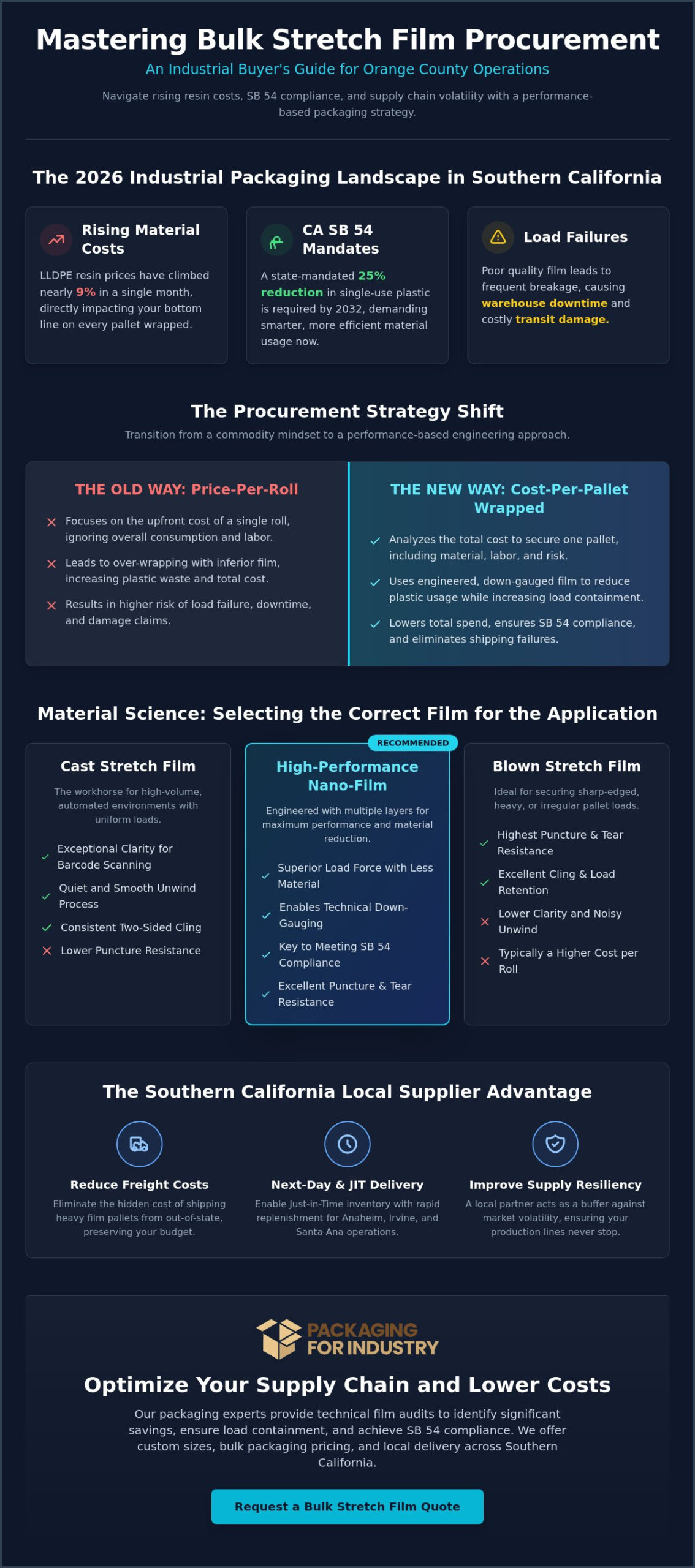
With LLDPE resin prices climbing nearly 9% in May 2026 alone, the traditional approach to sourcing bulk stretch film Orange County is now a liability for your bottom line. You’re likely feeling the pressure of rising material costs while navigating the strict plastic reduction mandates of SB 54. It’s a difficult balance to maintain, especially when frequent film breakage leads to warehouse downtime and expensive transit damage. Efficiency is no longer optional. You don’t just need another vendor; you need a procurement strategy that treats packaging as a precise engineering requirement.
This guide will show you how to master high-volume procurement to achieve a lower cost-per-pallet wrapped and ensure total load safety. We’ll examine how technical down-gauging and localized supply chain strategies can stabilize your loads and your budget. By focusing on the intersection of engineering and economics, you can eliminate shipping failures while meeting California’s 25% plastic reduction target by 2032. You’ll learn how to transition from a price-per-roll mindset to a performance-based strategy that secures your Southern California supply chain against volatility and waste.
Key Takeaways
- Learn to distinguish between blown, cast, and high-performance nano-films to ensure your load containment matches your specific industrial product profile.
- Discover how sourcing bulk stretch film Orange County from local suppliers reduces lead times and mitigates the impact of rising resin costs on your bottom line.
- Evaluate the ROI of transitioning to automated machine wrapping systems to eliminate warehouse downtime and reduce labor-intensive manual processes.
- Identify strategies for SB 54 compliance by utilizing technical film audits and down-gauging to reduce plastic waste without compromising load safety.
- Optimize procurement by bundling stretch film with corrugated boxes and leveraging local inventory programs for a more resilient Southern California supply chain.
Sourcing Bulk Stretch Film in Orange County: The 2026 Landscape
Procuring industrial-grade packaging materials in Southern California requires a shift from a retail mindset to a strategic logistics approach. For high-volume manufacturers, “bulk” doesn’t refer to a few cases of four rolls; it describes pallet-level or truckload procurement designed to feed high-speed automated systems. In a region where industrial space is limited and expensive, managing your inventory of bulk stretch film Orange County is as much about space optimization as it is about price. The primary objective of high-performance Stretch wrap is load containment. While simple dust protection might suffice for short-term storage, industrial buyers must prioritize the structural integrity of the pallet to prevent shifting during high-velocity transit through the Southern California logistics corridor.
Understanding the Impact of California SB 54
California Senate Bill 54 (SB 54) has fundamentally changed the procurement criteria for plastic packaging. The law mandates a 25% reduction in single-use plastic by 2032, and as of 2026, the industry is seeing the first major wave of compliance benchmarks. Orange County manufacturers face unique pressures to document their plastic usage and demonstrate reduction efforts. Transitioning to high-performance stretch film is the most effective way to meet these state environmental goals. These engineered films allow for significant “down-gauging”—using a thinner material that offers superior puncture resistance and load force. By reducing the total weight of plastic used per pallet, you satisfy regulatory requirements while simultaneously lowering your environmental footprint.
The Economics of Local Southern California Supply
The proximity of your supplier directly affects your operational agility. High-volume warehouses in Anaheim, Irvine, and Santa Ana operate on thin margins where downtime is the ultimate cost-driver. Sourcing locally provides several distinct advantages:
- Reduced Freight Costs: Stretch film is heavy. Shipping pallets of film from out-of-state vendors adds a “hidden cost” of freight that often negates any marginal savings on the roll price.
- Next-Day Delivery: Localized distribution allows for rapid replenishment, which is critical when production spikes occur unexpectedly.
- JIT Inventory Support: Proximity enables a just-in-time (JIT) strategy. Instead of tying up capital and floor space in months of film stock, you can maintain leaner inventory levels and rely on a local partner for frequent, reliable deliveries.
In the current market, where LLDPE resin prices rose nearly 9% in May 2026, a local supply chain acts as a buffer against volatility. It ensures that your Southern California operations remain resilient, compliant, and focused on the bottom line rather than managing the logistics of their own packaging supplies.
Material Science: Blown vs. Cast vs. High-Performance Nano-Films
Resin quality determines the success or failure of your pallet stabilization strategy. When sourcing bulk stretch film Orange County, industrial buyers must look beyond the price-per-roll and evaluate the molecular engineering of the material. High-quality resins provide the necessary “memory” to keep a load tight throughout its journey. Lower-grade films often suffer from consistent breakage, which forces operators to stop automated lines and reset equipment. An RIT study on stretch film properties highlights how understanding these physical attributes is critical to reducing trial-and-error in your procurement process. Better materials lead to better outcomes.
Cast Stretch Film: Clarity and Quiet Application
Cast film is the workhorse of high-volume, automated warehouse environments. It’s manufactured using a continuous process where molten resin is extruded through a flat die and cooled on rollers. This method results in a film with exceptional optical clarity. It’s the ideal choice for operations that rely on barcode scanning for inventory identification. Cast film also features two-sided cling, which is essential for securing irregular pallet loads that might shift during transit. Because it unwinds quietly, it’s often preferred in large-scale facilities to maintain a manageable decibel level for warehouse personnel.
Blown Stretch Film: Maximum Strength for Heavy Loads
While cast film dominates the general market, blown stretch film remains the standard for heavy manufacturing and construction applications. The manufacturing process involves blowing a large bubble of molten resin, which creates a film with superior tear resistance and puncture strength. If you’re shipping sharp-edged metal components or heavy masonry, blown film provides the holding force required to prevent load failure. The trade-off is a significantly higher noise level during application and reduced clarity. However, for outdoor storage or long-haul transit across harsh environments, the durability of blown film is unmatched.
The High-Performance Revolution: Down-Gauging for Savings
In 2026, multi-layer nano-film technology represents the cutting edge of material science. These films consist of dozens of ultra-thin layers that provide incredible strength while using less material. This technology allows for extreme down-gauging, where a 39-gauge high-performance film can match or exceed the load containment of a traditional 80-gauge film. Nano-layer construction prevents “zippering,” a common failure where a small puncture causes the entire wrap to tear. Down-gauging is the primary method for reducing your cost-per-pallet wrapped without sacrificing stability. If you’re ready to modernize your operations, you can request a packaging quote to see how these high-performance materials fit your specific load profiles.
Calculating ROI: Hand Stretch Film vs. Automated Machine Systems
Deciding between manual labor and automation is a critical pivot point for any growing operation. When you procure bulk stretch film Orange County, you’re investing in more than just plastic; you’re investing in the stability of your supply chain. For many businesses, the “cost-per-roll” is a deceptive metric. A more accurate calculation focuses on the total cost-per-pallet, which includes labor hours, material waste, and the potential cost of transit damage due to inconsistent wrapping. Most industrial operations find that transitioning from manual to machine wrapping becomes financially necessary once they reach a threshold of 10 to 15 pallets per day. At this volume, the labor savings and material efficiency typically offset the capital expenditure of automated equipment.
Hand Stretch Film: Flexibility for Lower Volumes
Manual wrapping provides the flexibility needed for low-volume facilities or irregular shipping schedules. However, it’s the most labor-intensive and inconsistent method of stabilization. To maintain efficiency, you should select roll widths and weights that minimize operator fatigue. Using pre-stretched hand film serves as an effective bridge for many companies. Because it’s already elongated, it requires less physical effort from the warehouse team and provides more consistent tension than standard film. This reduces the risk of workplace injuries while improving the reliability of your load containment before you’re ready for full automation.
Machine Stretch Film: Precision for High-Throughput Hubs
For high-volume manufacturers and distributors, machine stretch film is the standard for precision. The primary advantage lies in the pre-stretch carriage, which can elongate the film by 200% to 300% before it even touches the pallet. This mechanical advantage means you’re getting significantly more yield out of every roll compared to hand application. In fact, optimized machine systems can reduce total plastic consumption per pallet by up to 50%. This isn’t just about saving money; it’s about meeting the strict plastic reduction goals mandated by SB 54. Consistent machine tension ensures that every pallet is wrapped with the same force, virtually eliminating the human error that leads to product shifting and damage during long-haul transit.
Procurement Strategies for High-Volume Manufacturers and Distributors
Procuring bulk stretch film Orange County requires a move away from transactional purchasing toward a strategic partnership model. It’s about more than just plastic; it’s about the reliability of your entire output. When evaluating suppliers, you must prioritize resin consistency and lead time reliability. If a vendor’s resin quality fluctuates between batches, your automated wrapping settings will require constant recalibration; this leads to downtime and inconsistent load containment. A professional film audit is the first step in stabilizing your procurement costs. This process involves measuring containment force at the top, middle, and bottom of the load, weighing the film used per pallet, and calculating the exact cost-per-pallet wrapped. This data identifies where over-wrapping occurs and where thinner, higher-performance films can be implemented.
Efficiency also improves when you consolidate your supply chain. Bundling your stretch film with corrugated boxes reduces administrative overhead and simplifies inbound logistics. You can also eliminate waste by specifying custom film sizes. If your product profile doesn’t require a standard 20-inch roll, using custom widths prevents the excess plastic waste that often accumulates at the top of a load. These small adjustments in procurement strategy lead to significant long-term savings and a more resilient operation.
Vendor Managed Inventory (VMI) and JIT Delivery
Stockouts are an unacceptable risk for high-volume distributors. Implementing Vendor Managed Inventory allows your supplier to monitor and replenish your film levels automatically. This strategy shifts the burden of inventory management to the partner, freeing up your warehouse floor space for revenue-generating production. In the crowded Southern California market, Just-In-Time management ensures that heavy pallets of film arrive exactly when needed, minimizing the capital tied up in sitting stock.
Specialized Applications: Aerospace, Medical, and Electronics
Specialized sectors require engineered additives to protect high-value components. For instance, outdoor storage for large components requires UVI (Ultra-Violet Inhibitor) additives to prevent the film from degrading under the California sun. Electronics manufacturers often specify anti-static (ESD) films to protect sensitive circuitry from electrostatic discharge during handling. PFI understands these technical nuances, providing tailored aerospace packaging solutions that meet rigorous industry standards. To optimize your current procurement strategy for bulk stretch film Orange County, you can compare packaging pricing and schedule a professional audit of your facility’s film usage.
Optimizing Your Supply Chain with PFI’s Bulk Stretch Film Solutions
Packaging For Industry (PFI) acts as a strategic partner for businesses sourcing bulk stretch film Orange County. We provide both stock and custom film solutions designed to withstand the rigors of industrial logistics. Our approach begins with a technical assessment. We offer free prototyping and comprehensive film audits to ensure you’re using the correct gauge for your specific load profile. This precision eliminates the waste associated with guessing at film thickness. By matching the material to the machine settings, you achieve significant packaging cost savings while simultaneously improving load stability.
Speed is a critical factor in Southern California’s manufacturing hubs. We maintain a robust local inventory to provide reliable next-day delivery across Orange County, Los Angeles, and Riverside. This proximity allows you to operate with leaner inventory levels, knowing that high-quality stretch film is available within 24 hours. Our expertise ensures that your supply chain remains fluid, even during peak production cycles. We don’t just deliver a product; we provide a system of protection that secures your goods from the warehouse floor to the final destination.
Why PFI is the Preferred Orange County Supplier
Headquartered in Anaheim, PFI is deeply committed to the success of regional manufacturers and distributors. We take on the persona of a “fixer” for your warehouse operations. If you’re experiencing frequent film breakage or inconsistent containment force, we diagnose the root cause. This might involve resin quality checks, machine calibration, or adjusting the material selection for irregular loads. We also guide our clients through the complexities of California’s environmental laws. As SB 54 requirements become more stringent, we help you transition to high-performance nano-films that reduce plastic consumption without compromising the safety of your aerospace or electronics shipments.
Request a Packaging Quote and Start Saving
Securing a reliable supply of bulk stretch film Orange County is a straightforward process. You can request a packaging quote through our streamlined online portal. Once we understand your annual volume and load requirements, we establish a customized bulk pricing tier that reflects your scale of operation. We don’t believe in a one-size-fits-all approach. Instead, we invite you to contact us to schedule a facility walk-through. Our team will visit your warehouse, analyze your current wrapping process, and provide a clear, data-driven path toward optimizing your packaging spend and load security.
Modernizing Your Pallet Stabilization Strategy
Industrial load stabilization is a technical requirement that balances material science with economic efficiency. By adopting high-performance nano-films and down-gauging strategies, you can meet California’s strict SB 54 requirements while reducing your total cost-per-pallet. Transitioning from manual wrapping to automated machine systems further secures your output; this ensures consistent containment force and eliminates the human error that leads to transit damage. Each layer of your procurement strategy should focus on maximizing yield and minimizing waste.
Sourcing your bulk stretch film Orange County from a local, engineering-minded partner provides the agility needed to manage 2026’s volatile resin market. PFI offers specialized support for aerospace and heavy manufacturing, backed by local next-day delivery and free technical audits. We’re ready to help you optimize your gauge selection and implement a just-in-time inventory strategy that keeps your warehouse running at peak capacity. We’ll work directly with your team to identify failure points and implement solutions that protect your bottom line.
Take the first step toward a more resilient supply chain today. You can Request a Bulk Stretch Film Quote from PFI to receive expert engineering support and custom prototyping tailored to your specific load profiles. We look forward to solving your most complex stabilization challenges.
Frequently Asked Questions
How does SB 54 affect my bulk stretch film orders in Orange County?
SB 54 mandates a 25% reduction in single-use plastic by 2032, which directly impacts how regional manufacturers procure pallet-wrapping materials. To comply with these benchmarks, operations must transition toward high-performance films that enable significant down-gauging. Sourcing bulk stretch film Orange County through a partner that understands these regulations ensures you’re utilizing thinner, stronger materials that meet state reduction targets without compromising the structural integrity of your loads.
What is the difference between cast and blown stretch film for pallet wrapping?
Cast film is manufactured using a cooling roller process that results in high optical clarity and quiet application; it’s the standard for automated hubs where barcode scanning is essential. Blown film is created by blowing a resin bubble, which produces a material with superior puncture resistance and higher holding force. While blown film is louder during unwind, it’s the preferred choice for sharp-edged industrial components or loads stored in outdoor environments.
When should my warehouse switch from hand stretch film to a machine wrapper?
Your warehouse should consider switching to an automated machine wrapper once your volume reaches 10 to 15 pallets per day. At this level, the labor costs associated with manual wrapping and the material waste from inconsistent tension become a financial liability. Automation provides a level of precision and pre-stretch yield that manual application can’t match, leading to a more stable load and a lower total cost-per-pallet wrapped.
How can down-gauging reduce my total packaging costs?
Down-gauging reduces your packaging costs by replacing traditional, thick films with engineered high-performance materials that offer equivalent strength at a lower weight. For instance, transitioning from an 80-gauge film to a 39-gauge nano-film significantly reduces the total amount of plastic used per pallet. This strategy lowers your material spend and helps your facility meet environmental compliance goals by reducing the total weight of plastic entering the waste stream.
Does PFI offer local next-day delivery for stretch film in Southern California?
Yes, PFI provides local next-day delivery for bulk stretch film Orange County and across the Southern California region from our Anaheim headquarters. We maintain a deep inventory of both stock and custom film sizes to ensure regional manufacturers don’t face stockouts or production delays. This localized supply chain allows you to maintain leaner warehouse inventory levels and rely on just-in-time replenishment for your high-volume operations.
What is the best stretch film gauge for heavy industrial equipment?
Heavy industrial equipment typically requires a high-performance 80-gauge or 90-gauge blown film to handle the weight and potential sharp edges of the load. If you’re shipping irregular machinery, a thicker gauge or a multi-layer nano-film prevents zippering and catastrophic film failure during transit. We recommend a professional film audit to weigh your current wrap and determine the exact gauge required to stabilize your specific equipment profile.
Can I get custom printed stretch film for branding and security?
Custom printed stretch film is an effective solution for businesses that require tamper-evident security or enhanced brand visibility. By printing logos or handling instructions directly on the film, you make unauthorized access immediately detectable and improve inventory identification in the field. This is a common requirement for high-value electronics and aerospace components where security and professional presentation are critical to the end-to-end shipping experience.
What are the benefits of Vendor Managed Inventory (VMI) for shipping supplies?
Vendor Managed Inventory (VMI) removes the operational stress of tracking packaging stock and manually placing orders. PFI monitors your film and corrugated inventory levels, replenishing supplies automatically to prevent downtime. This service frees up warehouse floor space and improves your cash flow by ensuring you only hold the stock you need. It’s a pragmatic solution for high-throughput hubs that need to focus on production rather than supply logistics.