
Relying on generic catalog packaging for precision components isn’t just a risk; it’s a direct tax on your bottom line. You already know that every cracked medical device or scuffed aerospace part represents lost revenue and a damaged reputation. Partnering with a specialized polyethylene foam fabricator Orange County allows you to move past the limitations of one-size-fits-all inserts. Most operations managers are tired of the high damage rates and long lead times associated with national suppliers who lack local engineering support.
This guide explains how to eliminate those logistical headaches by choosing a local partner who understands the Southern California industrial landscape. With Orange County industrial rents sitting at $1.45 PSF NNN as of Q2 2026, you can’t afford to waste warehouse space on bulky, inefficient packaging. You’ll learn how custom-engineered foam solutions achieve zero-damage shipping cycles while reducing your footprint through Vendor Managed Inventory (VMI) programs. We’ll examine the specific benefits of local fabrication, from free prototyping to just-in-time delivery strategies that keep your supply chain lean and reliable.
Key Takeaways
- Learn to select the correct polyethylene foam density and material type to meet the rigorous protection standards of the aerospace and medical sectors.
- Identify the most efficient production method for your specific volume, ranging from high-speed die-cutting to precision CNC routing from a polyethylene foam fabricator Orange County.
- Reduce lead times and freight expenses by utilizing local Anaheim-based fabrication and Vendor Managed Inventory (VMI) to support just-in-time manufacturing cycles.
- Streamline your procurement process by integrating the design of custom foam inserts with heavy-duty corrugated boxes for a complete, engineered protection system.
Why Orange County Manufacturers Prioritize Custom Polyethylene Foam
Expanded polyethylene (EPE) foam is a closed-cell, durable material engineered specifically for high-performance industrial cushioning. Unlike open-cell foams that absorb moisture and lose structural integrity under pressure, PE foam provides a rigid, moisture-resistant barrier that’s essential for long-term protection. Partnering with a specialized polyethylene foam fabricator Orange County ensures your packaging isn’t just a container; it’s a precision-engineered component of your quality control process. For local manufacturers, this move from generic void fill to custom inserts is often the difference between a successful delivery and a costly insurance claim.
High-value manufacturing in Southern California requires more than off-the-shelf solutions. If you’re shipping a $50,000 aerospace assembly or a delicate surgical laser, bubble wrap and loose-fill peanuts are liabilities. Custom-fabricated foam inserts are designed to the exact geometry of the part, eliminating internal movement and absorbing shock loads that would otherwise cause catastrophic failure. This “engineered protection” approach treats the packaging as a safeguard for your fiscal health, not just a shipping expense.
The Role of PE Foam in Industrial Logistics
Transit through the Port of Long Beach and across the national rail network exposes cargo to constant vibration and multi-axis impacts. With Southern California ports handling 4.1 million loaded import containers in the first five months of 2026 alone, the sheer volume of logistics activity creates a high-stress environment for freight. Protective foam packaging acts as a shock absorber, dampening these frequencies before they reach your product. It’s not just about preventing total breakage. PE foam also provides critical surface protection for sensitive finishes, preventing the micro-abrasions and scuffs that lead to customer rejections. For local manufacturers, the quality of the packaging directly reflects their brand reputation.
Meeting Orange County’s Industry Standards
The regulatory and technical demands of local industries leave no room for error. A professional polyethylene foam fabricator Orange County must understand the specific requirements of several key sectors:
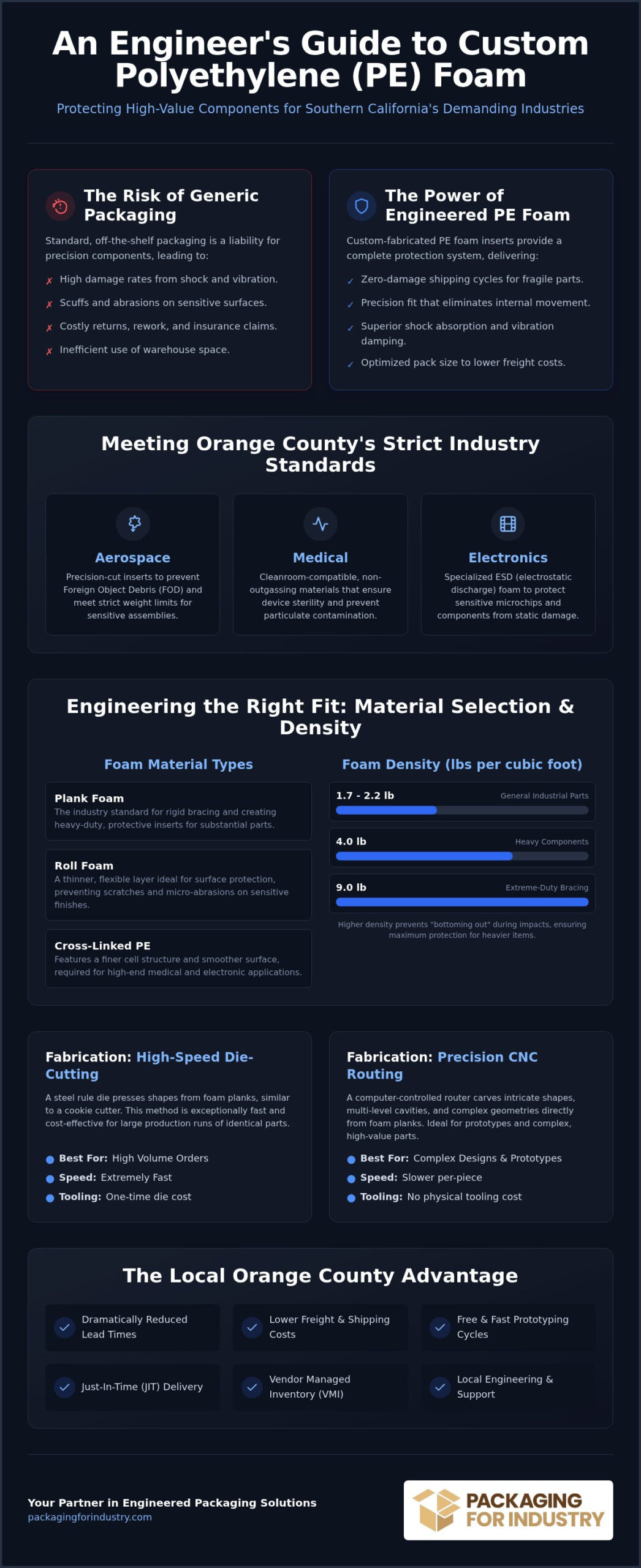
- Aerospace: Requires precision-cut inserts that meet strict weight requirements and prevent Foreign Object Debris (FOD) from entering sensitive assemblies.
- Medical: Needs cleanroom-compatible materials that don’t outgas or shed particles, ensuring device sterility and safety.
- Semiconductors: Demands ESD (electrostatic discharge) foam to protect sensitive electronics from static buildup during handling and transit.
We move beyond the “one size fits all” mentality by providing engineered protection that accounts for G-force thresholds and material compatibility. This targeted approach reduces shipping damage and lowers your total cost of ownership by eliminating the hidden expenses of returns, rework, and replacements.
Engineering Custom PE Foam Inserts: Material Selection and Density
Selecting the right material grade is the foundational step in optimizing your industrial supply chain. Polyethylene (PE) foam comes in several formats, each serving a specific logistical purpose. Plank foam is the industry standard for rigid bracing and heavy-duty inserts, while roll foam provides a thinner, more flexible layer for surface protection. For high-precision applications, cross-linked PE offers a finer cell structure and a smoother finish, often required for medical or high-end electronics. As an experienced polyethylene foam fabricator Orange County, we focus on matching the specific polymer properties of polyethylene to your part’s weight and fragility.
Density is the most critical metric in foam engineering, typically measured in pounds per cubic foot. A 1.7 lb or 2.2 lb density is common for most industrial parts, providing a balance between cushioning and durability. If your components are exceptionally heavy, you might require a 4 lb or 9 lb density to prevent “bottoming out” during a drop. There’s a direct economic trade-off here: thicker foam offers more protection but increases the overall box size. This is where engineering expertise becomes vital. We design inserts to minimize the footprint of your foam packaging, helping you avoid aggressive dimensional weight (DIM) surcharges from carriers like UPS and FedEx.
Polyethylene vs. Polyurethane: Which is Right for You?
The choice between PE and polyurethane (PU) depends on the weight and sensitivity of your product. PE is a firm, closed-cell foam that excels at supporting heavy loads and resisting moisture. PU is a soft, open-cell material better suited for lightweight, delicate items like glassware or small sensors. In many cases, a hybrid assembly is the most cost-effective solution. We often use a rigid PE base for structural support combined with a soft PU top layer to gently secure the part. If you aren’t sure which material fits your application, you can request a custom packaging quote to get an expert recommendation.
Specialized Foam Materials: ESD and Anti-Static
For the electronics and semiconductor firms throughout Orange County, static electricity is a constant threat. We provide pink anti-static foam, which contains additives to prevent the buildup of static charges during transit. For long-term storage or highly sensitive military and medical components, black ESD-safe PE foam provides permanent dissipative properties. Our team applies this material expertise to specialized aerospace packaging, ensuring that every insert meets the rigorous safety and performance standards required by the industry.
Choosing the Right Fabrication Method for Your Packaging Needs
Efficiency in production depends on matching the fabrication process to your order volume and part complexity. As a premier polyethylene foam fabricator Orange County, we don’t just offer one method; we align the technology with your budget and timeline. Choosing the wrong method can lead to unnecessary tooling costs or inflated per-unit prices that strain your procurement budget. For high-volume industrial runs, we typically utilize die-cutting, while lower-volume specialized parts benefit from digital cutting methods.
For thick foam planks, water-jet cutting is the superior choice. This method uses a high-pressure stream of water to slice through material without the heat distortion often found in traditional hot-wire or laser methods. This ensures the structural integrity of the foam remains intact for heavy-duty applications. Additionally, we provide foam-to-foam and foam-to-corrugated laminating. By bonding the foam directly into the box, we create integrated kits that simplify your assembly line and reduce the risk of lost components. This integrated approach is a staple for local firms looking to streamline their kitting operations.
Die-Cutting for High-Volume Production
Steel rule die-cutting is the engine of large-scale manufacturing packaging. While this method requires an upfront investment in tooling, the per-unit cost drops significantly as volume increases. It’s the most efficient way to ensure repeatability and precision across thousands of units. For procurement managers, the goal is to reach the break-even point where the speed of the press outweighs the initial die cost. This method is ideal for standardized parts where the design is finalized and unlikely to change.
CNC Routing and Water-Jet for Prototypes and Small Runs
If you’re in the R&D phase or only need a few dozen inserts, digital fabrication is the standard. CNC routing and water-jet cutting require no physical tooling, allowing for rapid design iterations without extra fees. This flexibility is a core part of our custom design packaging services. You can move from a CAD drawing to a physical prototype in days rather than weeks. It’s the perfect solution for specialized aerospace components or medical device launches where quantities are low but precision is non-negotiable.
Procurement Decision Matrix
To help guide your selection, consider these general volume thresholds for fabrication methods:
- Prototypes and Samples (1-10 units): Water-jet or CNC Routing for rapid iteration with zero tooling cost.
- Short Runs (11-250 units): CNC Routing or Water-jet to maintain low overhead while ensuring precision.
- Bulk Production (251+ units): Die-cutting to achieve the lowest possible per-unit cost through high-speed automation.
By selecting the method that fits your specific lifecycle stage, you can optimize your spend and ensure your polyethylene foam fabricator Orange County delivers the best possible ROI on every order.
Local Sourcing in Orange County: Reducing Lead Times and Freight
Sourcing your protective materials locally provides a strategic advantage that national catalog suppliers cannot match. Shipping custom foam is inherently inefficient because you’re essentially paying to transport air. When you order from a distant supplier, LTL (Less-Than-Truckload) freight charges for bulky foam planks often rival the cost of the material itself. Working with a local polyethylene foam fabricator Orange County eliminates these logistical markups. Our Anaheim headquarters serves as a central hub, allowing us to provide next-day delivery to industrial centers in Irvine, Santa Ana, and Huntington Beach. Beyond the shipping savings, local sourcing facilitates in-person design consultations. For complex aerospace or medical components, physical interaction with a packaging engineer ensures that every tolerance is met before production begins. This hands-on approach prevents the costly redesign cycles common with remote vendors.
Vendor Managed Inventory (VMI) for Foam Packaging
Managing a consistent supply of custom inserts is a challenge when warehouse space is at a premium. Market data shows that Orange County industrial vacancy rates reached 6.0% in Q2 2026, with average rents holding at $1.45 PSF NNN. Every square foot of your facility should be dedicated to production, not storing stacks of empty packaging. Our VMI programs solve this by housing your custom foam inserts at our facility. We track your usage rates and provide just-in-time inventory deliveries that align with your production schedule. This model eliminates the risk of stockouts and allows you to reclaim valuable floor space for manufacturing.
Reducing the Carbon Footprint of Your Supply Chain
Environmental responsibility is a growing priority for Southern California manufacturers. By choosing a polyethylene foam fabricator Orange County, you significantly reduce the carbon footprint of your logistics operations. Sourcing locally minimizes the total transport miles required to get materials to your assembly line, directly lowering the Scope 3 emissions associated with your supply chain. Polyethylene itself is a recyclable thermoplastic. We work with our clients to implement closed-loop systems where scrap material is collected and reprocessed. Positioning PFI as your Orange County packaging supplier of choice ensures that your operational efficiency aligns with modern sustainability standards.
Request a custom packaging quote for local delivery
Partnering with PFI for Custom Foam Fabrication and Design
Effective protection requires a holistic view of the shipping container. Most vendors treat foam as a standalone commodity, but we approach it as one half of a complete protective system. As a leading polyethylene foam fabricator Orange County, we engineer your foam inserts and corrugated boxes simultaneously. This integrated design process ensures that the internal cushioning and the external shell work in tandem to absorb shock. When these components are designed in isolation, you often end up with loose tolerances that lead to product migration and damage. By synchronizing the dimensions, we create a secure environment that maintains its integrity throughout the most rigorous transit cycles.
Our primary objective is to help you lower packaging costs without compromising on safety. We achieve this through material optimization, using exactly the amount of foam required to meet your G-force thresholds. This precision reduces waste and keeps your shipping weights as low as possible. We don’t just supply material; we act as a technical extension of your operations team, identifying opportunities to streamline your assembly and reduce your total cost of ownership.
From Prototype to Production: Our Process
We’ve refined our workflow to move your project from concept to delivery with maximum efficiency. The process starts with a thorough consultation where we measure your physical parts or review your CAD files to determine the optimal foam density and thickness. Once the design is established, we provide Free Prototyping. This step is vital for physical fit testing, allowing you to verify the protection levels before committing to a full production run. After you approve the prototype, we move into full-scale fabrication. To further optimize your labor costs, we offer packaging kitting. We can deliver your foam already inserted into boxes or assembled into kits, allowing your team to focus on production rather than packaging assembly.
Request Your Custom Foam Quote Today
Orange County manufacturers need a partner that combines technical expertise with local accountability. Whether you’re shipping sensitive medical instruments from Irvine or heavy aerospace components from Huntington Beach, we provide the regional support necessary to keep your supply chain moving. Our quote process is direct and transparent, covering everything from bulk material orders to intricate custom-designed inserts. You can rely on our Anaheim-based team for rapid responses and professional guidance on material selection and fabrication methods. Don’t let generic packaging compromise your product quality or your profit margins.
Contact us now to Request a Custom Foam Quote and see the difference that professional engineering makes for your industrial supply chain.
Optimize Your Supply Chain with Custom Foam Engineering
Transitioning from generic void fill to precision-engineered inserts is a strategic move for any Southern California manufacturer. By selecting the right material density and fabrication method, you don’t just protect your product; you protect your brand’s reputation and your bottom line. Working with a dedicated polyethylene foam fabricator Orange County allows you to leverage local expertise that understands the rigorous quality standards of the aerospace and medical sectors. You’ve seen how regional sourcing reduces freight costs and how integrated design prevents the common pitfalls of one-size-fits-all packaging.
Our Anaheim-based team provides the design support and logistical reliability needed to eliminate shipping damage and reclaim valuable warehouse space. With free prototyping for custom designs and local next-day delivery throughout the region, we ensure your transition to better packaging is both seamless and fiscally responsible. We’re ready to help you streamline your operations and lower your total packaging costs through smarter material engineering.
Take the first step toward a more reliable and cost-effective shipping cycle today. Our engineers are standing by to help you design the perfect solution for your most complex parts.
Frequently Asked Questions
What is the typical lead time for custom foam inserts in Orange County?
Standard lead times for custom fabrication typically range from 7 to 10 business days following design approval. We often complete initial prototypes within 48 to 72 hours to keep your project moving forward. These timelines are significantly shorter than those of national catalog suppliers, helping you maintain a lean supply chain without the risk of production shutdowns.
Do you offer free prototyping for custom polyethylene foam designs?
Yes, we provide free prototyping for custom designs to ensure your parts fit perfectly before you commit to a full production run. This process allows your team to conduct physical drop tests and fitment checks with actual components. It’s a vital step for high-value sectors that can’t afford the fiscal impact of sizing errors or inadequate cushioning.
Can you fabricate anti-static or ESD foam for electronics?
We specialize in fabricating both pink anti-static foam and black ESD-safe polyethylene for the electronics and semiconductor industries. These materials are engineered with dissipative properties to prevent static discharge from damaging sensitive circuit boards or components. Choosing a specialized polyethylene foam fabricator Orange County ensures your materials meet the exact technical requirements of your specific application.
What is the difference between die-cut and CNC routed foam?
Die-cutting uses a physical steel rule die to punch out shapes at high speeds, which offers the lowest per-unit cost for high-volume orders. CNC routing is a digital fabrication method that requires no physical tooling, making it the most economical choice for prototypes and small production runs. We evaluate your order volume and part complexity to recommend the method that maximizes your ROI.
Do you provide local delivery to cities like Irvine, Anaheim, and Santa Ana?
We provide local next-day delivery to industrial hubs in Irvine, Anaheim, Santa Ana, and Huntington Beach from our Anaheim headquarters. This local service eliminates the high LTL freight costs associated with shipping bulky foam products across long distances. By sourcing locally, you also reduce the risk of your packaging being damaged before it even reaches your facility.
Can you engineer foam inserts to fit my existing corrugated boxes?
Our engineering team can design custom inserts to fit perfectly within your current inventory of corrugated boxes or plastic cases. We use precise measurements of your container’s interior and your product’s geometry to create a secure, zero-movement fit. This integrated approach helps you optimize your existing supplies while significantly reducing the risk of shipping damage.
What information do I need to provide for a custom foam quote?
To provide an accurate quote, we need the dimensions and weight of your part, your estimated order quantity, and any specific material requirements like ESD safety or medical-grade standards. Providing a CAD file or a physical sample allows our engineers to create the most precise design. This data helps us determine the correct foam density and the most efficient fabrication method for your budget.
Is polyethylene foam recyclable for industrial users?
Polyethylene foam is a 100% recyclable thermoplastic that can be reprocessed into new industrial materials. Many of our clients implement closed-loop recycling programs to manage their foam scrap and meet corporate sustainability goals. Recycling your foam waste not only reduces your environmental footprint but can also lower your overall waste management expenses.