
If your heavy pallets shift during transit across Los Angeles, the issue isn’t your driver; it’s a failure in your film’s containment force. You’ve likely dealt with the frustration of film snapping mid-wrap or arriving at a distribution center with leaning cargo. You already know that every damaged pallet represents lost revenue and a massive logistical headache. Finding the best stretch film thickness for heavy loads is about more than just picking the thickest plastic available. It’s a calculated decision that balances material engineering with fiscal responsibility.
We will show you exactly how to select the right gauge to secure your industrial cargo and significantly reduce transit damage. You’ll learn why loads between 2,400 and 3,000 pounds typically require a 100 to 120-gauge film, and when to step up to a 150-gauge for irregular freight. We also cover how to stay compliant with California’s 2026 SB 54 plastic regulations while maintaining high-performance standards. This guide provides a clear roadmap to optimizing your warehouse operations, reducing material waste, and identifying a reliable Southern California supplier to keep your supply chain moving.
Key Takeaways
- Learn how to calculate the best stretch film thickness for heavy loads by matching specific gauges to pallet weights, ensuring stability for cargo exceeding 3,000 lbs.
- Understand the technical shift toward high-performance hybrid films that provide 100-gauge containment force while reducing material volume and per-pallet packaging costs.
- Discover why containment force is a more accurate measure of load security than film thickness alone, allowing for better protection with strategically applied layers.
- Stay compliant with California’s SB 54 regulations by adopting recyclable film solutions that meet 2026 plastic reduction mandates without compromising transit safety.
- Leverage local Southern California expertise and Vendor Managed Inventory to reduce lead times and guarantee a consistent film supply for your Los Angeles or Orange County facility.
The High Stakes of Load Stabilization for Heavy Industrial Goods
Securing a 2,000 pound pallet of industrial components is fundamentally different from wrapping light consumer goods. For heavy industrial freight, the primary requirement is elastic recovery. This refers to the material’s ability to maintain tension and return to its original shape after being stretched during application. Without high elastic recovery, the film loses its grip as the load shifts during transit, leading to pallet failure. Stretch wrap engineered from high-quality linear low-density polyethylene (LLDPE) provides the necessary memory to hold these loads together. Determining the best stretch film thickness for heavy loads is the first step in preventing expensive freight claims and operational downtime.
Many operations make the mistake of viewing film as a commodity. They focus on the price per roll rather than the total cost of ownership. However, the true cost includes product damage, re-stacking labor, and customer dissatisfaction. In manufacturing, improper film selection is a leading cause of transit damage. By shifting focus toward load stabilization, companies can lower their overall packaging expenses while improving supply chain reliability. This approach moves beyond simple containment and looks at the physics of the entire shipping unit.
Defining ‘Heavy’ in Industrial Logistics
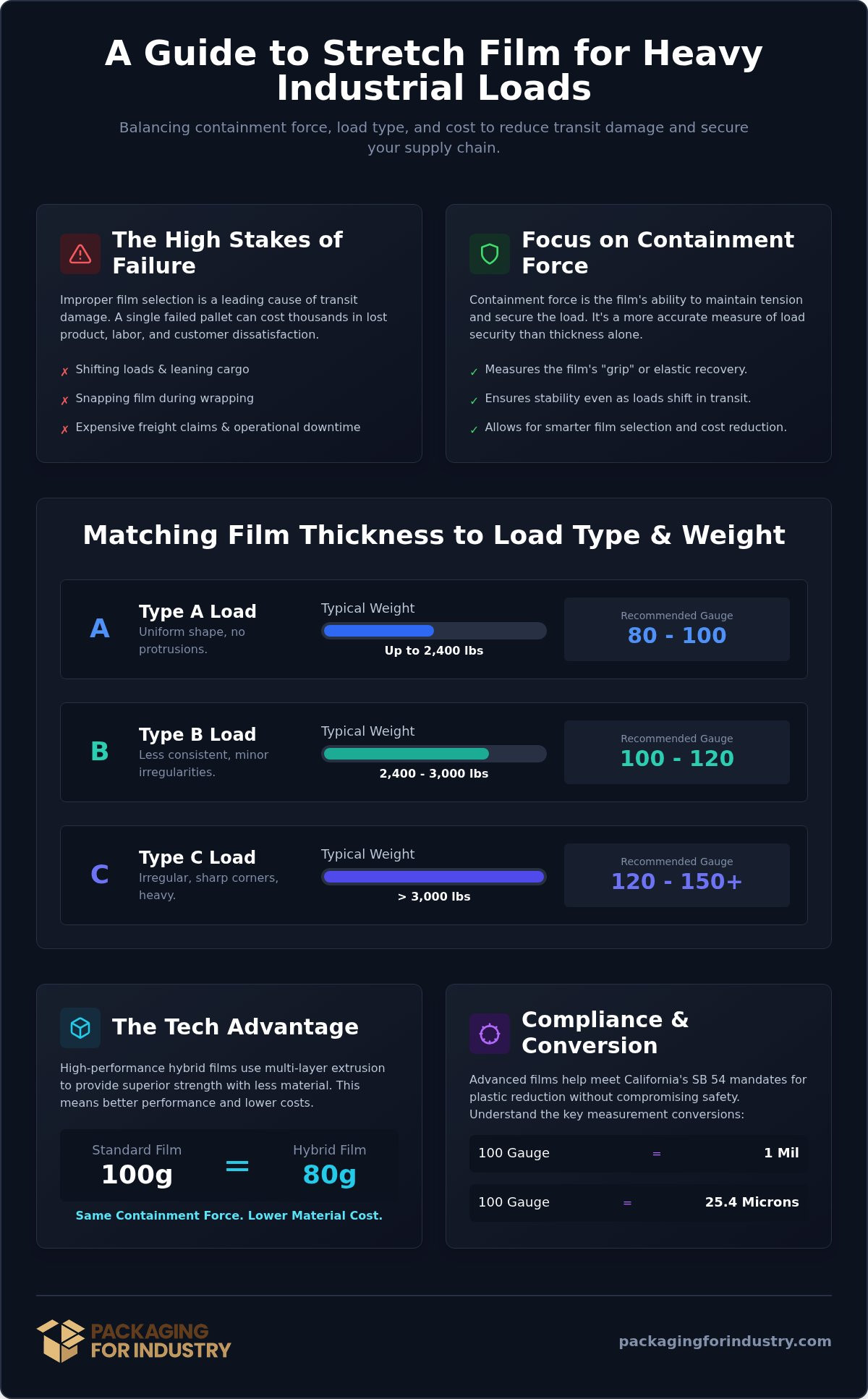
In the logistics world, we classify loads by their profile to determine wrapping requirements. Type A loads are uniform and don’t have protrusions. Type B loads are less consistent, while Type C loads are irregular with sharp corners or uneven weight distribution. Heavy industrial goods, particularly in the aerospace and automotive sectors, often fall into the Type C category. These loads require higher puncture resistance and specialized gauge selection to handle the high stress at the corners of the pallet. If you’re shipping heavy machinery or metal parts, the weight distribution dictates that you need a film with high hold and minimal creep over time.
Financial Impact of Improper Film Selection
A single failed load can cost thousands of dollars when you factor in destroyed inventory and expedited replacement shipping. Compare this to the marginal cost of selecting a premium, high-performance stretch film. For Los Angeles and Orange County manufacturers, reducing damage rates starts with a site-specific packaging review. We focus on damage reduction as a primary cost-saving lever. By calculating the exact containment force needed, we help you select the best stretch film thickness for heavy loads without overspending on unnecessary material. This pragmatic approach ensures your goods arrive intact while keeping your per-pallet costs low.
Stretch Film Thickness: Gauge vs. Micron for Industrial Applications
Understanding the technical specifications of your packaging materials is vital for operational efficiency. In the United States, thickness is traditionally measured in gauge, where 100 gauge equals 1 mil or 0.001 inches. Conversely, international shipping and metric-based systems use microns. One gauge is equivalent to 0.254 microns, meaning a standard 100-gauge industrial film measures exactly 25.4 microns in thickness. While these numbers provide a baseline, the best stretch film thickness for heavy loads in 2026 is often found in high-performance hybrid materials. These advanced films utilize multi-layer extrusion to offer the containment force of a 100-gauge wrap at an 80-gauge thickness. This shift allows manufacturers to meet California’s SB 54 requirements for plastic reduction without sacrificing load security.
Environmental conditions in Southern California play a significant role in film performance. High ambient temperatures in Los Angeles and the Inland Empire can increase film “tack” and alter its stretchability. If your warehouse exceeds 90 degrees, standard films may become too soft, leading to premature stretching and a loss of containment force. Selecting a film with a stable resin blend ensures that your pallets remain secure even during the hottest summer months. If you aren’t sure how your current materials handle the heat, you can request a packaging quote for a site-specific material audit.
Blown vs. Cast Stretch Film for Heavy Loads
The manufacturing process determines how the film reacts under stress. Blown film is cooled slowly, creating a material with superior puncture resistance and a high level of “cling.” It’s the preferred choice for heavy, sharp-edged industrial parts or irregular aerospace components that would easily pierce thinner wraps. Cast film is produced by cooling the resin quickly over rollers. It’s significantly quieter during application and offers better clarity for scanning barcodes. While cast film is more cost-effective for uniform heavy loads, blown film remains the standard for high-stakes, irregular freight that requires maximum durability.
Measuring Performance Beyond Thickness
Thickness is only one part of the equation. You must also consider “Ultimate Stretch,” which defines how far a film can be pulled before it breaks. High-performance films can often reach 200% to 300% stretch on modern warehouse equipment. This maximizes the value of every roll. Additionally, the film must maintain its integrity during transit to prevent the “tail” of the wrap from unraveling. A film with poor cling will fail during long-haul freight, regardless of its gauge. We recommend specific film types based on your machinery’s pre-stretch capabilities to ensure you’re getting the best stretch film thickness for heavy loads at the lowest possible cost per pallet.
Best Stretch Film Thickness for Heavy Loads: A Comparative Guide
Selecting the best stretch film thickness for heavy loads requires a clear understanding of your pallet’s physical profile and weight. While standard warehouse applications often rely on a one-size-fits-all approach, industrial logistics demands higher precision to ensure safety and cost-efficiency. Using a film that is too thin leads to load shifting and breakage. Conversely, over-gauging creates unnecessary plastic waste and inflates your per-pallet packaging costs. A pragmatic approach matches the film’s gauge to the specific demands of the freight.
80 Gauge (20 Micron) is the standard workhorse for medium-heavy loads up to 2,000 pounds. It provides a reliable balance of stretch and containment for uniform pallets. 100 Gauge (25 Micron) becomes essential when loads exceed 2,500 pounds or feature sharp corners that threaten to puncture thinner materials. For the most demanding applications, such as raw metals, bricks, or unboxed industrial components, 120+ Gauge film offers the heavy-duty puncture resistance required to maintain load integrity. However, using a 120-gauge film on a light, uniform pallet is poor fiscal management. It wastes material and takes up valuable warehouse space that could be used for inventory.
Thickness Requirements by Load Weight
To optimize your operations, follow these general industry thresholds for film selection:
- 1,000 to 1,500 lbs: Use 70 to 80-gauge high-performance film to maintain tension without excessive material use.
- 1,500 to 2,200 lbs: Standard 80 to 100-gauge cast or blown film provides the necessary hold for mid-range industrial freight.
- 2,200 lbs and above: Utilize 100 to 150-gauge film or implement multi-layer wrapping strategies to ensure the base of the pallet is fully secured.
Integrating Secondary Stabilization
Heavy loads often require more than just film to stay secure during long-haul transit. We frequently recommend corner and edge protection to prevent film shearing on sharp corners. These protectors distribute the tension of the wrap more evenly, allowing the film to perform at its maximum capacity. For high-density items, using heavy-duty corrugated boxes in tandem with high-gauge film creates a reinforced unit that resists crushing. At PFI, we work with manufacturing clients to engineer integrated solutions that combine these materials, ensuring that even the most difficult loads arrive at their destination without shifting or damage.
Optimizing Film Usage: Containment Force and Cost Reduction
Determining the best stretch film thickness for heavy loads is only the start of the optimization process. While gauge selection is vital, the real metric for shipping success is containment force. This is the total amount of pressure applied to the load by all layers of film combined. In many industrial settings, three layers of 80-gauge high-performance film actually provide better containment and more consistent hold than two layers of 100-gauge film. By overlapping more layers of a slightly thinner, engineered material, you create a more resilient and puncture-resistant skin around the freight. This strategy often results in a more stable pallet that is less prone to shifting during the vibrations of long-haul trucking.
Modern pallet stabilization also relies heavily on the concept of pre-stretch. Most advanced wrapping equipment features a pre-stretch carriage that mechanically elongates the film before it reaches the pallet. High-performance films can often achieve a 200% to 300% pre-stretch ratio. This allows a warehouse to turn one foot of film on the roll into three feet of usable material. This efficiency reduces material consumption and significantly lowers your total cost per pallet. A wrap force tool measures the exact amount of pressure, in pounds, being exerted by the film on the load to ensure it meets safety thresholds.
Hand Wrap vs. Machine Wrap for Heavy Pallets
Hand wrapping heavy pallets presents unique operational challenges. Using a high-quality hand stretch film with the correct thickness is vital for worker safety and ergonomics. If the film is too thin, workers must apply more physical force to achieve the necessary containment, which increases the risk of repetitive motion injuries. However, for high-volume operations, moving to a machine system is the most reliable way to achieve repeatable containment force. Automated systems eliminate the variability of manual labor. This ensures that every shipment, from the first of the day to the last, leaves the facility with the exact same level of protection.
VMI: Ensuring You Never Run Out of High-Performance Wrap
Managing supply levels is as important as material selection. Through Vendor Managed Inventory (VMI), we help you avoid production stops caused by film shortages. We analyze your usage patterns to identify opportunities to switch from expensive, small-batch catalog pricing to wholesale bulk rates. For manufacturing hubs in Anaheim and Orange County, this local support ensures you have the right gauge on hand at all times. This proactive approach to inventory management reduces administrative burden and guarantees that your supply chain remains reliable. We focus on the logistical flow so you can focus on production.
Why Choose PFI for Your Industrial Stretch Film Needs?
PFI operates as an industrial consultant rather than a simple product vendor. We understand that selecting the best stretch film thickness for heavy loads isn’t a decision made from a catalog. It requires a deep understanding of your specific transit conditions and pallet profiles. Our team provides customized thickness recommendations based on actual load testing to ensure your freight stays secure from the warehouse floor to the final destination. We don’t just sell rolls; we engineer containment solutions that protect your bottom line.
As a local Southern California supplier, we serve Los Angeles, Orange, and Riverside Counties with next-day delivery on stock items. This proximity allows us to respond quickly to supply chain disruptions and prevent costly stockouts. The PFI Advantage lies in our ability to design a total protection system for our clients. By combining high-performance film with custom foam packaging, we address both external stabilization and internal cushioning. This holistic approach makes us a pragmatic, cost-saving alternative to large catalog suppliers who lack the technical expertise to optimize your specific packaging line.
Specialized Industry Expertise
We maintain a rigorous focus on sectors where packaging failure isn’t an option. Our team helps manufacturers meet strict aerospace packaging standards by providing certified materials and engineered wrapping protocols. For automotive Tier 1 suppliers, we specialize in stabilizing heavy, high-density components that are prone to shifting during long-haul freight. We often design custom crates that work in harmony with high-gauge stretch wrap to provide a secondary layer of structural integrity for international transit.
Request Your Packaging Audit
Our process begins with an on-site packaging audit. We perform these reviews to identify areas where your operation may be over-packaging and wasting money, or under-protecting and risking damage. By analyzing your equipment and load profiles, we determine the best stretch film thickness for heavy loads in your specific facility. This data-driven review helps you lower packaging costs and improve supply chain reliability without sacrificing safety. We provide the technical proof you need to make informed purchasing decisions.
Requesting a bulk stretch film quote is a straightforward process designed for busy procurement managers. We’re committed to keeping Southern California’s production lines moving with reliable service and expert technical support. Our goal is to provide the peace of mind that comes from knowing your cargo is protected by a system engineered for performance and fiscal responsibility.
Secure Your Supply Chain with Engineered Load Containment
Protecting heavy industrial freight requires a shift from commodity buying to technical optimization. You’ve seen how the right gauge selection, combined with high containment force and strategic pre-stretch, can significantly reduce shipping damage. Finding the best stretch film thickness for heavy loads ensures your pallets survive the rigors of transit while keeping material waste to a minimum. This methodical approach is essential for maintaining the high standards required in the aerospace and automotive sectors.
Packaging For Industry provides the local expertise and logistical support needed to streamline your warehouse operations. With local next-day delivery in Los Angeles and Orange County, alongside specialized VMI programs, we eliminate the risk of packaging shortages. Our team is ready to perform on-site audits to verify your containment force and lower your per-pallet costs. We focus on the engineering so you can focus on your production goals.
We look forward to partnering with you to improve your supply chain reliability and operational efficiency.
Frequently Asked Questions
What is the best stretch film gauge for a 2,500-pound pallet?
For a 2,500-pound pallet, 100 gauge is the industry standard. This thickness provides the necessary containment force to prevent shifting during transit. While 80-gauge film is common for lighter pallets, the increased weight of a 2,500-pound load requires the higher holding power of 100 gauge. Selecting the best stretch film thickness for heavy loads ensures your cargo remains stable and arrives at its destination without expensive product damage.
Is blown stretch film better than cast film for heavy industrial loads?
Blown stretch film is typically superior for heavy industrial loads due to its high puncture resistance and excellent cling. It’s specifically engineered to handle loads with sharp corners or irregular shapes that might pierce standard cast film. While cast film is quieter and more transparent, blown film provides the rugged durability required for heavy machinery or aerospace components. We recommend blown film for any high-stakes industrial application where load integrity is the top priority.
How do I calculate how much stretch film I need per pallet?
Calculating film usage requires looking at your pallet dimensions, weight, and required containment force. On average, a standard 48×40 pallet might require 15 to 20 revolutions of film to achieve proper stabilization. However, modern high-performance films with high pre-stretch ratios allow you to use less material while maintaining the same hold. We perform on-site audits to measure your exact film consumption and identify opportunities to reduce material waste without sacrificing load security.
Can I use 80-gauge film for irregular or sharp-edged heavy loads?
Using 80-gauge film for sharp-edged heavy loads is risky because the material is more likely to shear or puncture. For irregular loads, we typically recommend a minimum of 100 gauge or the use of corner and edge protection to distribute tension. If you’re shipping heavy Type C loads, a thicker film or a high-performance hybrid is necessary to maintain containment. Relying on standard 80-gauge film for difficult freight often leads to transit damage.
How does temperature in Southern California warehouses affect stretch film performance?
High temperatures in Southern California warehouses can increase the tack of stretch film, which may cause it to stretch prematurely. This can lead to a loss of containment force and creep during transit, especially in Los Angeles or the Inland Empire. It’s important to store your film in a cool area and select a resin blend designed to remain stable in high-heat conditions. We help local manufacturers select materials that perform consistently year-round.
What is the difference between gauge and micron in stretch film thickness?
Gauge is the standard unit of measurement in the United States, while microns are used internationally and in metric-based systems. To convert between the two, remember that one gauge is equal to 0.254 microns. For example, an 80-gauge film is approximately 20.3 microns thick. Understanding this conversion is vital for procurement managers who deal with international shipping or suppliers who use metric specifications for their high-performance stretch wrap.
Do I need a machine to use high-performance 100-gauge stretch wrap?
You don’t need a machine to use 100-gauge stretch wrap because it’s available in hand-roll formats. However, high-performance films are often designed for machine application to take advantage of mechanical pre-stretch. These machines can stretch the film up to 300%, which maximizes the material’s containment force and lowers your cost per pallet. While hand wrapping is suitable for low-volume operations, upgrading to a machine ensures repeatable results and improved worker safety.
How can a VMI program help lower my stretch film costs?
A VMI program lowers costs by allowing you to access wholesale bulk rates rather than paying high catalog prices. We monitor your usage patterns and replenish your stock automatically, which eliminates the risk of production stops due to film shortages. This proactive approach ensures you always have the best stretch film thickness for heavy loads on hand. VMI programs also reduce administrative labor and streamline your entire warehouse procurement process.