
A single labeling error on a MIL-STD-129R barcode can stall a multimillion-dollar defense contract faster than a major supply chain breakdown. If you’re operating within the San Diego defense and aerospace corridor, you understand that packaging isn’t just a container; it’s a critical compliance document. Securing reliable military specification packaging San Diego manufacturers can depend on is the only way to avoid the frustration of rejected shipments and high damage rates for sensitive electronics. Packaging For Industry (PFI) provides the technical oversight required to ensure every shipment meets the Department of Defense’s rigorous demands.
We recognize the pressure of meeting strict MIL-STD-2073 preservation methods while managing inconsistent lead times from national catalog suppliers. This guide provides a clear path to achieving 100% compliance and zero transit damage for your high-value assets. You’ll learn how to leverage local Southern California logistics to reduce turnaround times. We also explore integrated solutions that combine V3C/W5C boxes, custom ESD foam, and heavy-duty crates into one seamless protection system designed for the rigors of military logistics.
Key Takeaways
- Navigate the complexities of MIL-STD-2073-1E to ensure total contract compliance and eliminate the risk of costly shipment rejections.
- Learn how to select high-performance materials, including weather-resistant V3C corrugated and specialized ESD foam inserts, for sensitive defense assets.
- Discover the logistical benefits of sourcing military specification packaging San Diego contractors need to reduce lead times and warehouse storage costs.
- Understand the integrated protection strategy that combines custom crates and precision cushioning to achieve zero transit damage for high-value components.
- Identify how partnering with a local Southern California expert provides a more reliable, cost-effective alternative to large national catalog suppliers.
Understanding Military Specification Packaging in San Diego
Military specification packaging is an engineered system of materials and procedures dictated by the Department of Defense. It ensures that critical mission hardware remains operational regardless of how long it sits in a warehouse or how roughly it’s handled during transit. For contractors in the Southern California region, securing compliant military specification packaging San Diego services is a contractual necessity that directly influences the success of a government audit. This isn’t just about putting items in a box; Military specification packaging is a complex integration of chemical preservation, physical cushioning, and structural containerization designed for the most demanding environments on earth.
Failing to meet these standards results in immediate operational friction. When a shipment arrives at a facility like Naval Base San Diego or MCAS Miramar with improper labeling or non-compliant barrier materials, the government issues a Quality Deficiency Report (QDR). These reports trigger payment delays and can jeopardize your status as a preferred vendor. The difference between standard commercial protection and military-grade engineering is the intended lifecycle. While commercial packaging is designed for a single trip, military packaging is engineered for years of protection in extreme environments, ensuring parts are ready for immediate deployment when they’re finally unpacked.
The San Diego Defense Landscape
San Diego serves as a major hub for aerospace and defense electronics, housing both prime contractors and a deep network of specialized subcontractors. These firms require a packaging partner that understands the specific logistical requirements of local military installations. Choosing a local San Diego packaging supplier provides a distinct advantage over national catalog distributors that don’t specialize in defense standards. Local delivery removes the uncertainty of long-haul freight and allows for tighter just-in-time inventory management, keeping your production lines moving without the need for massive on-site material storage.
Why Standard Packaging Fails Military Contracts
Generic industrial packaging often lacks the specialized properties required for defense assets. Common points of failure include moisture ingress in naval environments and electrostatic discharge (ESD) in sensitive aerospace components. Standard materials don’t offer the chemical neutrality or the high-strength burst ratings of V3C or W5C corrugated board. For a San Diego contractor, a single error in compliance can result in a total shipment rejection and the immediate suspension of progress payments for the entire project. We focus on providing the specialized materials and engineering expertise that prevent these costly setbacks.
If you’re ready to secure your supply chain, you can request a packaging quote to ensure your next shipment meets every regulatory requirement.
Decoding MIL-STD-2073 and Essential ASTM Standards
Interpreting a Department of Defense contract requires more than a casual glance at the shipping instructions. The core of these requirements is MIL-STD-2073-1E, Change 4, which serves as the definitive standard for military preservation and packing. This document dictates every detail of how an item is handled before it even enters a box. For contractors managing military specification packaging San Diego projects, failing to decode these alphanumeric strings leads to immediate non-compliance. You’ll typically find codes for the Quantity per Unit Pack (QUP), specific cleaning procedures, and preservative codes that must be followed to the letter to satisfy government inspectors.
Beyond preservation, the physical outer container must meet rigorous structural standards. While corrugated boxes are common, heavy-duty equipment often requires wood crates built to ASTM D6251 or ASTM D6880 specifications. These standards ensure that the panelboard or lumber boxes can withstand the stresses of naval transport and long-term storage in varied climates. If your contract specifies a particular ASTM code, utilizing a generic pallet or crate will result in a rejected shipment at the pier. Understanding these technical nuances is how we help you lower packaging costs by avoiding the rework associated with incorrect material selection.
Common Preservation Methods
The preservation method chosen depends on the item’s sensitivity to the environment. Method 10 is the most basic, providing physical protection for non-critical items that don’t require specialized barriers. However, San Diego’s aerospace sector often deals with sensitive electronics that mandate Method 40 or Method 50. These methods involve watervaporproof, vacuum-sealed barriers that often include desiccant packets to maintain a moisture-free internal environment. Selecting the wrong barrier material can lead to corrosion or component failure before the asset is ever deployed.
Marking and Labeling Compliance
The final hurdle in military logistics is MIL-STD-129R, the standard for marking and labeling. Every unit pack, intermediate container, and exterior shipping box must feature specific barcoding and human-readable text. This includes 2D PDF417 barcodes and, in many cases, RFID tag integration. Passive RFID tags are a common requirement for shipments headed to defense depots, allowing for automated tracking through the supply chain. Managing these complex labeling requirements is a core part of our packaging kitting and assembly services, ensuring your team doesn’t have to worry about the minutiae of barcode placement. If you’re unsure about the labeling requirements in your current contract, you can compare packaging pricing and compliance options with our specialists today.
Integrated Protection: Corrugated, Foam, and Crates
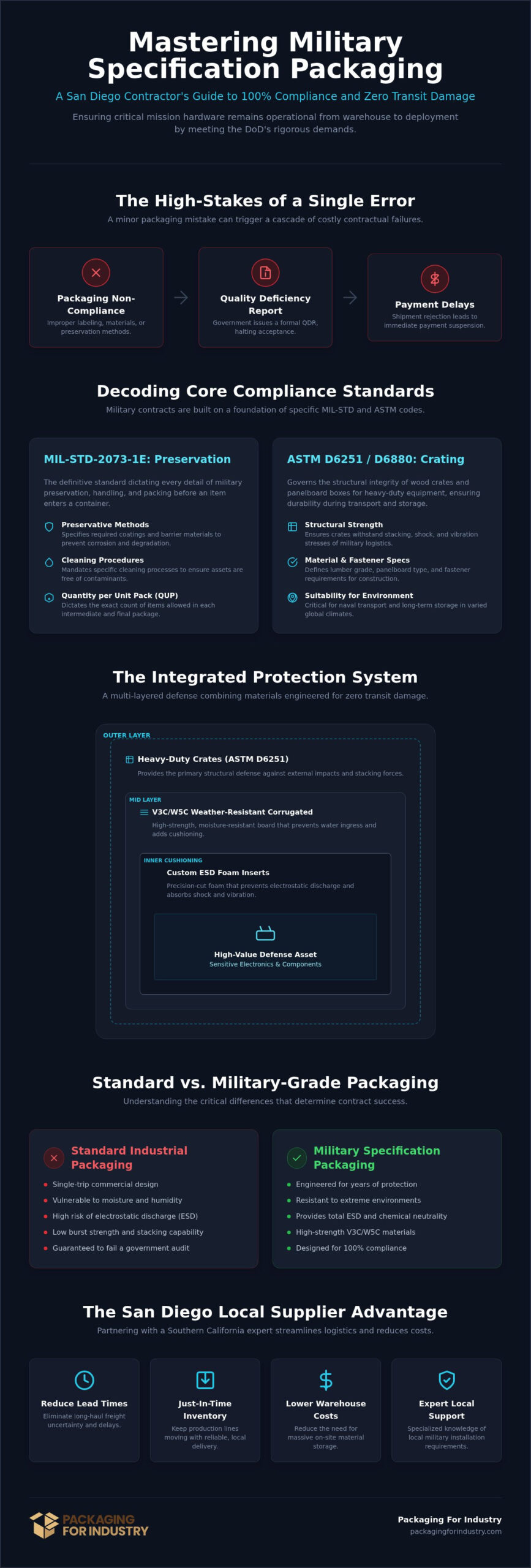
Physical protection for military assets requires a multi-layered approach that goes beyond standard commercial shipping practices. While previous sections focused on the regulatory strings of MIL-STD-2073, the actual implementation of military specification packaging San Diego contractors need involves a precise combination of weather-resistant board, custom-engineered foam, and heavy-duty wood crating. This integrated system ensures that high-value defense components survive the humidity of ocean transit and the physical stresses of multi-modal transport.
Weather-Resistant Corrugated Grades
Standard industrial boxes fail in military logistics because they lack the structural integrity to withstand moisture. We utilize specialized custom corrugated boxes that meet ASTM D5118 standards, specifically in V3C and W5C grades. V3C is a high-strength, weather-resistant board with a typical burst strength of 400 pounds, making it ideal for exterior containers. W5C offers a burst strength of 275 pounds and provides significant water resistance for intermediate packaging. These materials are engineered to maintain their shape even when exposed to high humidity or direct water contact, a common requirement for Naval Base San Diego shipments.
Custom Foam Engineering for Defense
Shock and vibration are the primary causes of damage to sensitive aerospace electronics. Selecting between Polyethylene (PE) and Polyurethane (PU) foam depends on the item’s fragility and weight. PE is a closed-cell foam that provides excellent support for heavier components, while PU is an open-cell material better suited for lighter, more delicate instruments. For San Diego’s electronics sector, we prioritize protective foam packaging that includes Electrostatic Discharge (ESD) protection. Anti-static and conductive foam inserts prevent static buildup that can destroy circuit boards during handling, ensuring your components arrive in perfect working order.
Custom Crating for Heavy Military Assets
Oversized machinery and propulsion systems require the structural support of custom-built wood crates. To meet international military logistics requirements, all wood must be heat-treated and stamped according to ISPM-15 standards to prevent pest infestation. These crates are often foam-lined to provide maximum vibration dampening during long-haul transit. When your project involves global deployment, Engineering custom crates for international transit is a critical step to avoid customs delays at foreign ports. This integrated approach ensures that every layer of the packaging system works together to provide total asset protection.
Optimizing Procurement for San Diego Defense Contractors
Procurement managers in the San Diego defense corridor often face a lead-time crisis that can halt critical assembly lines. When you rely on national catalog suppliers, you’re at the mercy of long-haul freight schedules and potential stockouts of specialized materials. Securing military specification packaging San Diego contractors can access locally ensures that your production remains on schedule. Transitioning to a local supplier allows you to implement just-in-time (JIT) delivery. This is essential for high-volume defense production where floor space is at a premium and shipping deadlines are absolute.
Offloading the storage of bulky weather-resistant corrugated and custom crates to a nearby partner reduces your warehouse footprint. This shift allows you to reallocate valuable square footage toward manufacturing or assembly operations. Evaluating a supplier’s technical capabilities should go beyond their price list. You need to verify their understanding of San Diego’s specific logistical needs, including proximity to Naval Base San Diego and MCAS Miramar. A reliable partner doesn’t just sell boxes; they provide a buffer against the supply chain disruptions that frequently plague national logistics networks.
Vendor Managed Inventory (VMI) for Military Packaging
Shortages of custom MIL-SPEC boxes or ESD foam lead to missed shipping windows and government penalties. Our Vendor Managed Inventory services eliminate this risk by placing the burden of stock management on us. We provide scheduled replenishment based on your actual contract usage, ensuring you never run out of the specific preservation materials required for your defense assets. This proactive approach turns a complex logistical hurdle into a streamlined, automated process that protects your bottom line and your reputation with government inspectors.
Prototyping and Testing
Custom foam inserts for complex geometries require precision engineering before full-scale production begins. We utilize CAD/CAM design to create physical prototypes that ensure perfect fit and function for your high-value components. PFI’s free prototyping reduces the risk of contract rejection by verifying that every custom design meets the exact physical and chemical protection standards required by your government contract. This verification step is vital for aerospace electronics and sensitive sensors that can’t tolerate even minor movement or static buildup during transit. It’s much more cost-effective to identify a fitment issue during the design phase than at the military receiving dock.
Why Partner with PFI for Military Packaging in San Diego?
San Diego’s defense corridor requires more than a simple vendor; it demands a partner that understands the high stakes of Department of Defense contracts. If you’ve been searching for an industrial packaging supplier near me that can handle the technical nuances of MIL-STD-2073, Packaging For Industry (PFI) provides the necessary expertise. We offer a professional, engineering-first approach to military specification packaging San Diego firms can use to eliminate contract delays and compliance errors. By focusing on the specialized materials discussed in previous sections, such as weather-resistant corrugated and custom ESD foam, we provide the technical support that general distributors often overlook.
Our local presence allows us to act as a comprehensive wholesale packaging supplies resource, offering everything from heavy-duty pallets to specialized films. As a reliable stretch wrap supplier, we ensure that even your secondary packaging meets the durability requirements of military logistics. This integrated approach means you have one point of contact for your entire system, allowing you to reduce shipping damage while maintaining a lean inventory. Managing one vendor for boxes, foam, crates, and labels is far more efficient than balancing multiple specialized shops.
The PFI Advantage: Engineering Meets Economics
We focus on reducing your total cost of ownership by addressing both material expenses and shipping damage rates. By engineering the right solution the first time, we help you avoid the massive financial hit of a rejected government shipment. Our team doesn’t just sell products; we design systems that optimize your supply chain reliability. Whether you need to Request a military packaging quote for a new aerospace component or want to compare packaging pricing on high-volume production runs, our engineers are ready to assist. We prioritize functional designs that minimize waste while maximizing the physical security of your assets.
Secure Your Defense Supply Chain
Reliability is the foundation of any successful government contract. PFI ensures a consistent, recurring supply of compliant materials so your production and shipping lines never stop. We understand that in the San Diego defense sector, a packaging shortage is a production failure. As a leading provider of custom boxes in San Diego, we offer the stability needed for multi-year projects. Our local next-day delivery capabilities mean you don’t have to worry about long-haul freight disruptions or stockouts. Contact PFI today for a comprehensive packaging review in San Diego to identify vulnerabilities in your current system and secure your defense supply chain.
Secure Your San Diego Defense Contracts with Compliant Packaging
Achieving total compliance within the defense supply chain requires more than just high-quality materials; it demands a deep understanding of MIL-STD-2073 preservation and MIL-STD-129 marking. By integrating weather-resistant corrugated, custom ESD foam, and heat-treated crates, you eliminate the risk of Quality Deficiency Reports and shipment rejections at the pier. Utilizing local inventory for your military specification packaging San Diego needs also removes the volatility of national freight, allowing your production line to move with confidence.
PFI serves as your proactive partner in Southern California, offering specialized expertise that catalog suppliers can’t match. We provide free prototyping to ensure every custom design fits your assets perfectly before full-scale production. With our focus on both engineering and economics, you can lower packaging costs while maintaining 100% compliance. Our specialists are dedicated to MIL-STD-2073 requirements, ensuring your high-value assets remain protected throughout the entire logistical flow.
Our team is ready to help you optimize your logistics and secure your next government contract with local next-day delivery and proven compliance expertise. We look forward to streamlining your defense supply chain and protecting your critical assets.
Frequently Asked Questions
What is the most common military packaging standard used in San Diego?
MIL-STD-2073-1E, Change 4, is the definitive standard used across the San Diego defense corridor. It establishes the requirements for preservation, cushioning, and packing to ensure equipment survives long-term storage and global transit. Contractors must follow these specific codes to satisfy government inspectors and avoid Quality Deficiency Reports at local naval and marine installations.
How do V3C and W5C boxes differ from standard cardboard boxes?
V3C and W5C are weather-resistant corrugated grades engineered for harsh environments and overseas shipping. Unlike standard commercial cardboard, these materials meet ASTM D5118 specifications for water resistance and structural integrity. V3C boards provide a 400-pound burst strength for exterior containers, while W5C offers 275-pound strength for intermediate packaging, ensuring containers don’t collapse in high-humidity naval settings.
Do I need a local San Diego supplier for MIL-SPEC packaging compliance?
While compliance is based on material standards, a local military specification packaging San Diego supplier provides vital logistical advantages. Local providers understand the specific delivery windows required by Naval Base San Diego and MCAS Miramar. This proximity eliminates long-haul freight delays, reduces your warehouse footprint, and allows for faster prototyping and next-day delivery on critical contract supplies.
What is MIL-STD-2073 and why does my contract require it?
MIL-STD-2073 is the Department of Defense standard for preservation and packing methods. Your contract requires it to guarantee that high-value assets remain functional after years of storage or exposure to extreme climates. It uses alphanumeric codes to dictate everything from cleaning procedures to the type of watervaporproof barrier materials needed to protect sensitive electronics from corrosion and environmental damage.
Can PFI help with custom foam inserts for sensitive aerospace electronics?
Yes, we engineer custom foam inserts specifically for sensitive aerospace instruments and electronics. We offer Polyethylene (PE) and Polyurethane (PU) options, including specialized Electrostatic Discharge (ESD) protective foam. Our CAD/CAM design process ensures that complex geometries are securely cushioned to eliminate vibration and shock, preventing damage to circuit boards and sensors during handling and transit.
How does Vendor Managed Inventory (VMI) benefit government contractors?
Vendor Managed Inventory allows defense contractors to offload the burden of stock management to their supplier. We monitor your usage of MIL-SPEC boxes and foam inserts, replenishing inventory automatically based on your contract needs. This system prevents production-stopping stockouts, reduces your overhead costs, and ensures that compliant packaging materials are always available for your scheduled shipping windows.
Are your wood crates and pallets ISPM-15 compliant for international shipping?
All wood crates and pallets we provide for military logistics are heat-treated and stamped according to ISPM-15 standards. This compliance is mandatory for international shipping to prevent the spread of pests and avoid customs delays at foreign ports. We build these heavy-duty containers to meet various ASTM specifications, ensuring they support oversized defense machinery and propulsion systems during global deployment.
How can I get a quote for bulk military specification packaging in San Diego?
You can request a custom packaging quote directly through our website to compare pricing for bulk quantities. Our specialists review your government contract requirements and provide an estimate that includes materials, compliance labeling, and local delivery. We also offer free prototyping to verify the design of your military specification packaging San Diego solutions before you move into full-scale production.