
A single electrostatic discharge event, often invisible to the naked eye, can compromise an entire shipment of semiconductors and erase your quarterly margins in seconds. For manufacturers in San Diego’s high-tech corridors, the frustration of high product failure rates isn’t just an engineering hurdle; it’s a significant drain on profitability. You’re likely tired of national catalog suppliers who offer long lead times and generic solutions that force you to over-order and waste expensive local warehouse space where rents currently average nearly $22 per square foot. Procuring reliable anti-static foam packaging for electronics San Diego facilities shouldn’t be a logistical bottleneck that slows down your production cycle.
We understand that your goal is a zero-defect shipping process that remains fiscally responsible. This guide provides the technical and economic framework you need to select the right ESD-safe materials and custom-engineered inserts for your specific components. You’ll learn how to leverage local, just-in-time delivery to eliminate stockouts and how tailored packaging designs can significantly reduce your per-unit costs. From meeting ANSI/ESD S541-2026 standards to optimizing your storage footprint, we’re covering everything required to turn your packaging from a simple supply into an engineered insurance policy that protects your bottom line.
Key Takeaways
- Compare the physical properties of Polyethylene and Polyurethane to determine which material offers the best shock absorption and cleanroom compatibility for your components.
- Source anti-static foam packaging for electronics San Diego facilities from a local partner to enable next-day delivery and significantly reduce your warehouse overhead.
- Evaluate the financial benefits of custom-engineered foam inserts, which reduce pack-out labor and virtually eliminate transit damage compared to generic stock options.
- Implement a Vendor Managed Inventory (VMI) program to streamline your supply chain and ensure you never face production delays due to packaging stockouts.
- Consolidate your procurement by integrating ESD bags, foam cushioning, and heavy-duty corrugated boxes into a single, specialized packaging system.
Protecting Sensitive Electronics from ESD Damage in San Diego
Anti-static foam is a specialized material engineered to control the accumulation and dissipation of Electrostatic discharge (ESD). In industrial environments, static electricity is a constant threat to high-value components. Unlike standard cushioning, ESD-safe foam contains chemical additives or conductive carbon that allows electrical charges to bleed off safely rather than building up and jumping to a sensitive device. For San Diego’s dense clusters of electronics manufacturers and biotech firms, using high-spec anti-static foam packaging for electronics San Diego facilities is a mandatory standard to maintain product integrity during both storage and shipping.
The components most at risk include printed circuit boards (PCBs), semiconductors, and sophisticated medical sensors. While a catastrophic failure is easy to spot, the real danger lies in “latent defects.” These occur when a minor ESD event weakens a circuit without immediately breaking it. The product passes your internal quality checks but fails weeks later in the hands of your customer. These field failures result in expensive RMAs, damaged brand reputation, and lost contracts. Investing in precision-engineered protective foam packaging is a direct strategy to eliminate these hidden costs.
The Local Impact: San Diego’s High-Tech Shipping Standards
Operations in the Sorrento Valley and Carlsbad tech corridors face unique logistical challenges. San Diego’s coastal climate can lead to fluctuating humidity levels, which directly impacts the rate of static buildup on packaging surfaces. Dry conditions, common during Santa Ana wind events, accelerate static generation. By partnering with a local supplier, you ensure that your materials are staged and delivered in a controlled environment. Local procurement also allows for rapid prototyping and custom design packaging that accounts for the specific vibration and shock profiles of Southern California’s transit routes. Fast turnaround on custom orders means you can respond to production spikes without maintaining massive, space-consuming inventories.
Dissipative vs. Conductive: The First Procurement Decision
Selecting the right material starts with understanding surface resistivity. Most procurement managers choose between two primary categories based on the 2026 update to the ANSI/ESD S541-2026 standard:
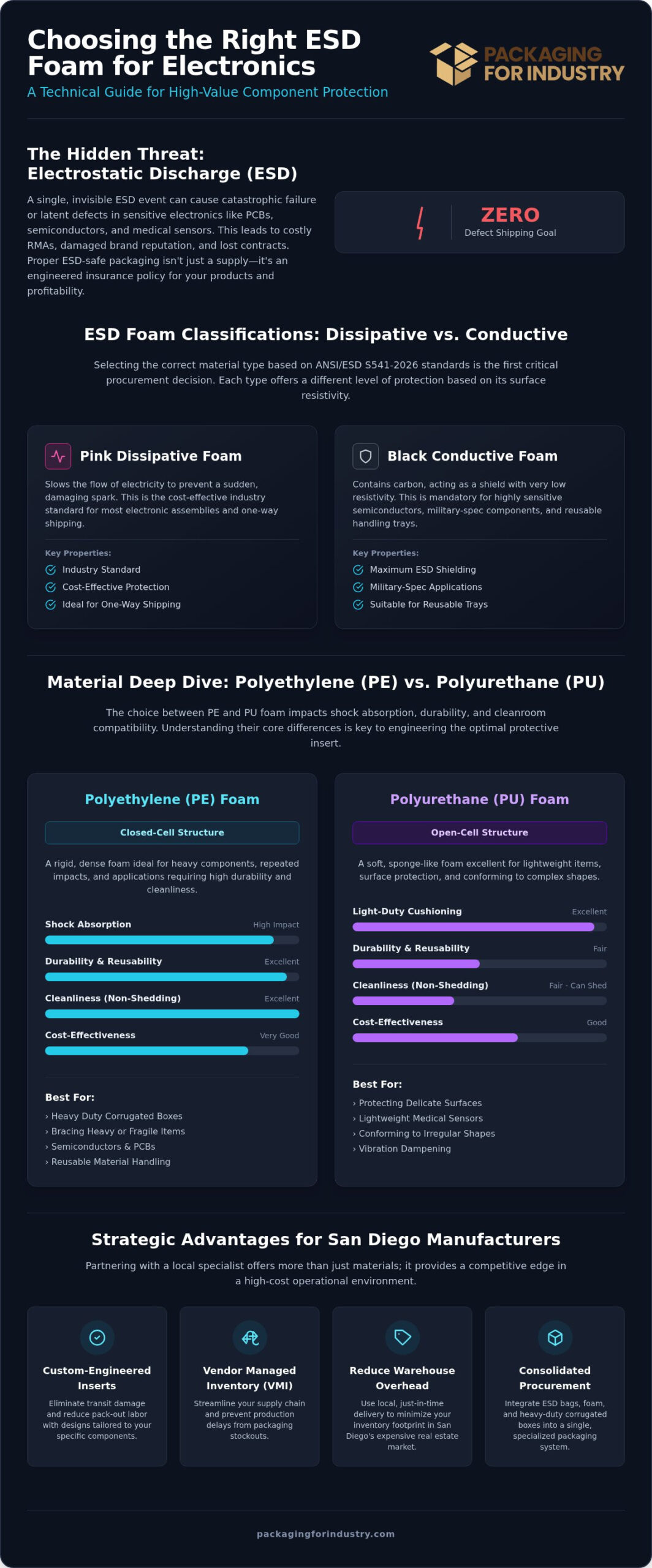
- Pink Dissipative Foam: This is the industry standard for most electronic assemblies. It features a surface resistivity that slows down the flow of electricity, preventing a sudden, damaging spark. It’s cost-effective and ideal for one-way shipping.
- Black Conductive Foam: This material contains carbon and is designed to act as a shield. It has a much lower resistivity, making it mandatory for highly sensitive semiconductors and military-spec components. It is often used for long-term storage or reusable internal handling trays.
Choosing the wrong type can be a costly mistake. If your components are extremely sensitive to voltage spikes, dissipative foam might not offer enough protection. Conversely, over-specifying for conductive foam when dissipative would suffice can lead to unnecessary packaging expenses. A thorough review of your device’s sensitivity levels will determine the most efficient material for your anti-static foam packaging for electronics San Diego needs.
Choosing the Right ESD Foam: Polyethylene vs. Polyurethane
Selecting the correct material for your anti-static foam packaging for electronics San Diego operations requires a balance between engineering requirements and budgetary constraints. The primary decision usually comes down to the cell structure of the foam. This choice affects everything from shock absorption and vibration dampening to the long-term reliability of the ESD protection itself. Procurement managers must evaluate whether a component requires the rigid support of a closed-cell material or the soft cushioning of an open-cell alternative.
One critical operational detail often overlooked is material shedding. Polyurethane can release tiny particles over time, which may compromise sensitive optics or cleanroom environments. Polyethylene is significantly “cleaner” and offers the durability required for multi-use shipping cycles or internal material handling. Additionally, the shelf life of the anti-static properties must be considered. The chemical additives in pink anti-static foam are designed to bloom to the surface, but this effect can degrade over 12 to 24 months. If your facility stores packaging for extended periods, periodic testing of surface resistivity is necessary to ensure compliance with military standards for ESD control.
Polyethylene (PE) Foam for Heavy Components
Polyethylene is a closed-cell foam known for its high load-bearing capacity and rigidity. It’s the industry standard for custom foam inserts designed to protect heavy server blades, aerospace avionics, or industrial power supplies. Because the cells are sealed, PE foam is naturally resistant to moisture, oils, and chemicals. This makes it an ideal choice for the rugged industrial environments found in San Diego’s manufacturing hubs. Its structural integrity allows for precision die-cutting, ensuring that heavy components remain locked in place during the most turbulent transit cycles.
Polyurethane (PU) Foam for Fragile Circuitry
Polyurethane is an open-cell foam that provides superior cushioning for lightweight, highly delicate parts. Its soft, flexible nature allows it to absorb low-level vibrations that could otherwise crack solder joints on fragile circuit boards. For high-volume operations with varied part sizes, convoluted or “egg-crate” PU foam is a highly cost-effective solution. It provides a universal fit that secures items without the need for unique tooling for every SKU. While PU is often used for single-use shipping, its ability to protect sensitive sensors and medical electronics at a lower price point makes it a staple for many San Diego tech firms. To determine which material density best fits your product’s G-force rating, you can request a quote for a technical material comparison.
Custom vs. Stock Anti-Static Foam: Maximizing Protection and ROI
Procuring generic pink foam sheets might seem like a straightforward way to manage a budget, but it often introduces significant operational inefficiencies. For a high-volume facility, the labor required to manually measure, cut, and wrap components in stock foam is a substantial hidden expense. Transitioning to custom-engineered anti-static foam packaging for electronics San Diego allows your operation to move from a manual, variable process to a streamlined drop-in system. Pre-cut inserts are designed to match your specific product geometry, which slashes “pack-out” time. This efficiency gain allows your team to process more shipments per shift without increasing headcount.
Beyond labor savings, custom design eliminates the guesswork involved in protective packaging. We provide free prototyping to ensure every insert offers the precise level of deceleration your component requires. This “perfect fit” approach ensures that products don’t shift during transit, which is a primary cause of surface abrasions and ESD events. When you choose custom design packaging, you’re investing in a repeatable, standardized process that protects both the hardware and your bottom line.
The True Cost of Transit Damage
High-value electronics, such as those produced in San Diego’s biotech and aerospace hubs, often carry price tags in the thousands. A single damaged shipment results in far more than the loss of the physical unit. It triggers a cascade of costs: return shipping, administrative time for insurance claims, and potential production delays for your client. The long-term impact on your brand reputation is even more severe. If a customer receives a dead-on-arrival component, their trust in your quality control is fundamentally compromised. PFI’s custom engineering focuses on reducing G-force impact, ensuring that even the most sensitive internal sensors survive the rigors of the global supply chain.
Eliminating UPS and FedEx Surcharges
Standardizing on oversized boxes because of “one-size-fits-all” foam sheets is a major driver of inflated shipping costs. Carriers like UPS and FedEx utilize dimensional weight (DIM) pricing, where you’re billed based on the box’s volume rather than its actual weight. By engineering tighter, more efficient anti-static foam packaging for electronics San Diego, you can often downsize your outer corrugated boxes. This reduction in volume directly lowers your freight spend. Our focus on packaging cost savings helps procurement managers identify these opportunities to reduce carrier surcharges while actually increasing the level of protection provided to the product.
Selection Criteria for San Diego Procurement Managers
Selecting a supplier for anti-static foam packaging for electronics San Diego facilities involves more than comparing unit prices. For procurement managers in high-growth sectors like aerospace and biotech, the “total cost of ownership” includes lead times, warehouse utilization, and regulatory compliance. A local partner provides a level of responsiveness that national catalog companies simply can’t match. When a production schedule shifts, you don’t have time to wait for a freight shipment from a Midwest distribution center. Local next-day delivery in San Diego County ensures that your assembly line stays moving without the need for excessive safety stock.
A critical criterion is the supplier’s ability to adhere to strict technical standards. If your operation supports San Diego’s massive defense and aerospace presence, your foam must meet specific military specifications such as MIL-STD-CID A-A-59136. Your evaluation checklist should prioritize the following factors:
- Local prototyping capabilities for immediate design feedback.
- Documented compliance with MIL-SPEC and ANSI/ESD standards.
- Scalable production for bulk orders and specialized small runs.
- Proximity to San Diego tech hubs for reduced shipping costs and lead times.
Inventory Management: Preventing Production Stops
With San Diego industrial vacancy rates at 9.3% and average asking rents reaching $21.99 per square foot, warehouse floor space is a premium asset. Implementing Vendor Managed Inventory (VMI) allows you to convert storage areas back into revenue-generating production space. PFI monitors your stock levels and provides just-in-time delivery to your San Diego facility, ensuring you never face a production halt due to a packaging stockout. This model is particularly effective for tech firms scaling rapidly in Sorrento Valley or the Carlsbad tech corridors where space optimization is vital for fiscal responsibility.
Environmental and Regulatory Compliance
California maintains some of the nation’s strictest environmental regulations regarding waste management and foam disposal. Procurement teams must ensure their materials comply with local mandates while meeting the 2026 ANSI/ESD S541 standards. For medical device manufacturers in the region, cleanroom-safe, non-sloughing foams are essential to prevent particulate contamination. Choosing a supplier that understands these regional and industry-specific nuances protects your operation from both technical failures and regulatory fines. A supplier that provides integrated solutions, combining anti-static foam packaging for electronics San Diego with ESD bags and heavy-duty corrugated boxes, ensures that every layer of your system works in harmony to dissipate static charges effectively.
Why San Diego Manufacturers Choose PFI for ESD Packaging
Packaging For Industry (PFI) provides a level of accountability that national catalog distributors simply cannot offer. While many procurement managers default to massive, one-size-fits-all retailers for convenience, they often overlook the hidden freight expenses and the total lack of technical engineering support. We have positioned ourselves as the specialized local alternative for anti-static foam packaging for electronics San Diego firms. By maintaining our primary operations in Southern California, we offer the responsiveness of next-day delivery and the value of on-site consultations that eliminate the communication gaps common with out-of-state suppliers. You are not just buying a SKU; you are partnering with a local team that understands the specific logistical pressures of the San Diego industrial landscape.
One of the most significant advantages we provide is the ability to consolidate your entire ESD protection system into a single stream. We don’t just supply the foam; we engineer integrated solutions that include custom corrugated boxes, anti-static bags, and precision-cut inserts in one coordinated order. This holistic approach reduces administrative labor and ensures that every layer of your packaging system works in harmony to meet the highest protection standards. By streamlining your vendor list, you reduce the complexity of your supply chain while lowering your total operational costs through improved logistical flow and reduced shipping damage.
The PFI Engineering Advantage
Our “Industrial First” mindset means we approach every project as an engineering challenge rather than a simple retail transaction. We understand the high stakes of manufacturing environments where a single failure can halt a production line. Our aerospace packaging expertise allows us to apply the same rigorous standards required for flight-ready avionics to consumer electronics and medical devices. We provide free prototyping for all custom anti-static inserts, allowing your team to verify the fit and performance of the packaging before you commit to a bulk production run. We focus on real-world outcomes, ensuring your components survive the vibration and shock profiles of the global supply chain.
Next Steps: Request Your San Diego Custom Quote
Moving your operation to a more efficient anti-static foam packaging for electronics San Diego model is a straightforward process. It begins with a technical assessment of your current product and shipping methods to identify areas for improvement. From there, we move to design and prototyping, followed by local delivery or the implementation of a tailored VMI program. This 3-step process is designed to be as efficient as the packaging we provide. If you’re ready to lower your total operational costs and eliminate transit damage, it’s time to switch to a local partner that understands your bottom line. Our goal is to provide immediate value through better engineering and superior local logistics.
Optimizing Your San Diego Electronics Supply Chain
Selecting the right anti-static foam packaging for electronics San Diego facilities is a strategic decision that impacts your entire operational flow. By moving away from generic catalog supplies and adopting custom-engineered inserts, you reduce both transit damage and overall shipping costs. Our specialized ESD engineering for the aerospace and electronics sectors ensures that even the most sensitive components meet rigorous industry standards while avoiding the expense of over-packaging.
Efficiency in the San Diego market requires a partner who understands the high cost of local warehouse space and the necessity of just-in-time reliability. Our free prototyping and CAD design services allow you to verify protection levels and fit before bulk production begins. With local next-day delivery available throughout San Diego County, your operation can maintain lean inventory levels and eliminate the stress of potential stockouts.
We’re ready to help you eliminate shipping failures and optimize your packaging budget through precision engineering. It’s time to build a more reliable and cost-effective supply chain for your high-tech operation.
Frequently Asked Questions
What is the difference between anti-static and conductive foam?
Anti-static foam, typically pink, is dissipative and prevents the generation of static electricity while slowing down the flow of any existing charge. Conductive foam, which is black, contains carbon and allows charges to pass through it rapidly to a ground. While dissipative foam is the standard for most shipping needs, conductive foam is required for highly sensitive components that need a Faraday cage effect for protection.
How long does anti-static foam last before it loses its properties?
Pink anti-static foam generally maintains its effectiveness for 12 to 24 months. The material relies on a chemical surfactant that migrates to the surface to provide protection, and this additive eventually dissipates or wears off. We recommend that San Diego procurement managers implement a testing schedule for older inventory to ensure it still meets required surface resistivity standards.
Can you provide custom-cut ESD foam inserts for low-volume orders?
Yes, we provide custom-cut ESD foam solutions for both high-volume production and specialized smaller runs. Our engineering team frequently works with local firms to develop prototypes and short-run inserts for niche medical devices or aerospace components. This approach allows you to scale your packaging precisely as your production volume grows without the need for excessive stock.
Do you offer next-day delivery for electronics packaging in San Diego?
We provide local next-day delivery for most stock and custom anti-static foam packaging for electronics San Diego orders. Our Southern California logistics network is specifically designed to support just-in-time manufacturing cycles. This proximity helps your operation avoid the long lead times and high freight costs typically associated with national catalog suppliers.
Is pink anti-static foam safe for long-term storage of sensitive PCBs?
Pink foam is designed primarily for short-to-medium term shipping and may not be the best choice for storage lasting several years. The chemical surfactants can occasionally leave a faint residue or lose their dissipative effectiveness over long periods. For long-term PCB storage, we recommend using conductive foam or moisture-barrier ESD bags to ensure permanent protection.
How does custom foam packaging help reduce shipping costs?
Custom foam reduces costs by optimizing the dimensional weight (DIM) of your shipments. By engineering a precision-fit insert, you can often utilize a smaller outer corrugated box, which directly lowers carrier surcharges from UPS or FedEx. Additionally, pre-cut inserts eliminate the labor-intensive process of manual wrapping, which reduces your total per-unit pack-out cost.
Do your ESD foam products meet military specifications (Mil-Spec)?
Our ESD foam products are engineered to meet rigorous industrial and military standards. This includes compliance with MIL-STD-CID A-A-59136 for closed-cell polyethylene materials. We ensure that our anti-static foam packaging for electronics San Diego shipments provides the durability and resistivity required for the defense and aerospace sectors common in our region.
Can I get a prototype of my custom foam insert before placing a bulk order?
We offer free prototyping and CAD design for custom foam inserts to ensure a perfect fit before bulk production begins. This process allows your engineering team to verify that the material density provides the exact G-force protection your product needs. It eliminates the risk of fitment issues and ensures the packaging is fully optimized for your specific assembly process.