
A single hairline scratch on a finished surface can instantly transform a high-value asset into a costly return. You understand that “minor” cosmetic flaws are anything but small when they lead to rejected shipments, brand reputation damage, and a spike in operational overhead. It’s a common frustration for manufacturers: the product itself is engineered to perfection, yet it fails the final test of transit. Implementing the right packaging solutions to prevent cosmetic damage on finished products isn’t just about protection; it’s about protecting your profit margins and ensuring zero-defect delivery every time.
In this professional guide, you’ll learn how to eliminate surface abrasions and scuffs through engineered industrial packaging strategies that prioritize both safety and speed. We’ll examine how custom-engineered foam densities and heavy-duty corrugated structures work together to create a zero-friction environment for your goods. We also preview how streamlining your packing process with high-performance materials can lower your total cost of ownership and optimize your logistics. From specialized aerospace components to medical devices, we’ll cover the technical specifications and logistical workflows required to achieve consistent, damage-free shipping across your supply chain.
Key Takeaways
- Identify the hidden financial impact of “minor” surface defects, including the high cost of return logistics and diminished brand equity.
- Discover specific packaging solutions to prevent cosmetic damage on finished products by utilizing non-abrasive “Zero-Friction” contact layers and custom foam inserts.
- Learn how to eliminate movement-based scuffing through optimized stretch film tension and heavy-duty corner protection designed for load stability.
- Establish a reliable damage-prevention audit that uses CAD-designed prototyping to test and verify protection before full-scale rollout.
- Understand industry-specific requirements for aerospace and medical sectors, ensuring compliance with Mil-Spec standards and surface integrity protocols.
The High Cost of Cosmetic Damage in Industrial Shipping
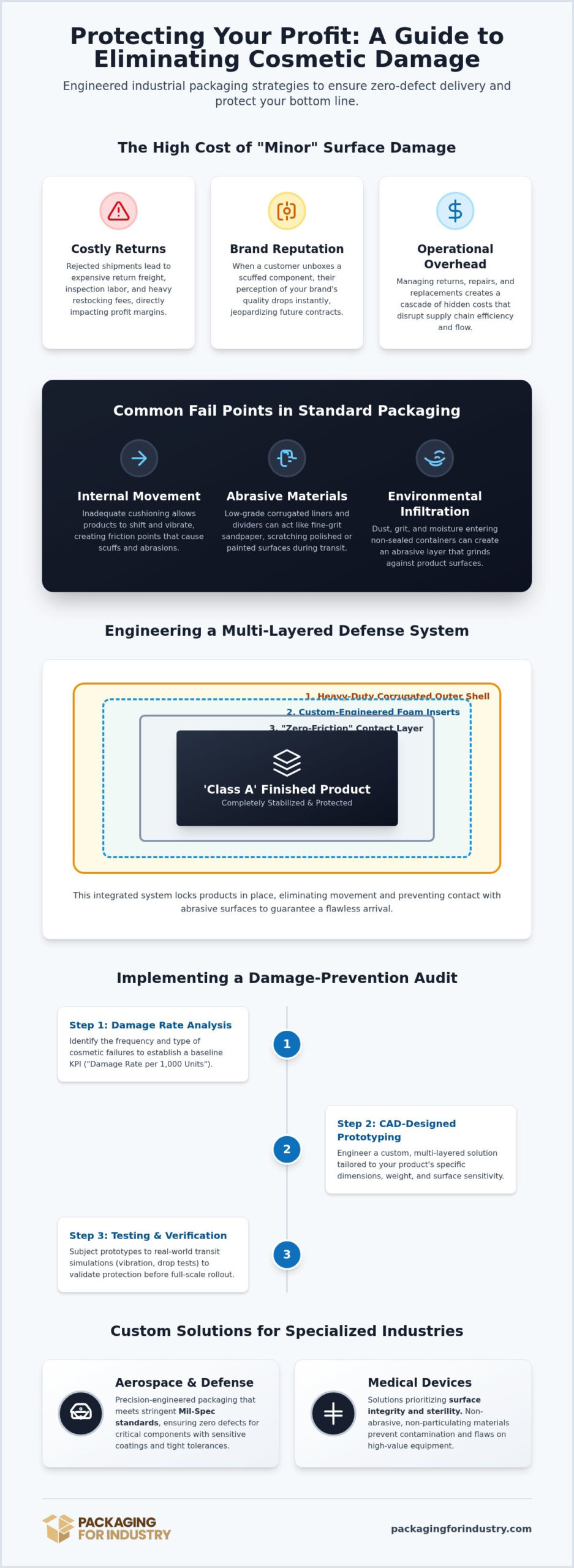
Cosmetic damage refers to surface-level defects like scratches, scuffs, and abrasions that don’t compromise a product’s mechanical function but do destroy its market value. For manufacturers shipping high-polish or “Class A” finishes, these flaws are just as critical as structural breakage. When a customer unboxes a scuffed component, their perception of your brand’s quality drops instantly. This leads to a cascade of hidden costs including return freight, labor for inspections, and heavy restocking fees. Utilizing specialized packaging solutions to prevent cosmetic damage on finished products is a financial necessity for maintaining brand equity and operational flow.
Standard off-the-shelf boxes often lack the surface-specific protection required for sensitive materials. In industries like aerospace, where precision is paramount, or medical device manufacturing, where surface integrity is tied to sterility, even a microscopic abrasion can trigger a rejection. These sectors require engineered protection that stock suppliers simply can’t provide. Protecting the finish is just as vital as protecting the frame.
Calculating the ROI of Enhanced Surface Protection
To justify an investment in higher-quality materials, logistics managers should track the “Damage Rate per 1,000 Units.” By identifying the exact frequency of cosmetic failures, you can clearly see how much you’ll lower packaging costs by reducing returns. High damage rates often jeopardize long-term contract renewals; procurement officers prioritize suppliers who deliver perfect goods consistently. We define “Cosmetic Integrity” as the measurable maintenance of a product’s original surface finish throughout the entire transit cycle, serving as a critical KPI for modern industrial logistics.
Common Fail Points in Standard Shipping Methods
Most cosmetic damage occurs because of internal movement within the container. Vibration-induced scuffing happens when a product rubs against a surface that is too abrasive, such as standard corrugated liners that act like fine-grit sandpaper during long hauls. Identifying these failure points is the first step toward a more efficient supply chain.
- Internal movement: Inadequate cushioning allows the product to shift, creating friction points against the packaging walls.
- Abrasive materials: Harder recycled fibers in low-grade boxes can scratch softer coatings or sensitive plastics.
- Environmental infiltration: Dust or grit entering a non-sealed container creates an abrasive layer that grinds against the product during transit.
Relying on generic materials often leads to these preventable failures. Transitioning to custom-engineered strategies ensures that your products arrive in the same condition they left the factory floor.
Engineering a Multi-Layered Defense for Surface Integrity
Engineered packaging solutions to prevent cosmetic damage on finished products treat the container as a complete protection system rather than just a vessel. This strategy relies on a multi-layered approach that begins with the “Zero-Friction” contact layer. By utilizing non-abrasive materials like polyethylene poly bags or thin-gauge foam wraps, you eliminate the sandpaper effect caused by standard corrugated fibers. This primary layer ensures that even if the product experiences minor vibrations, the material touching the “Class A” finish won’t cause micro-scratches or dulling.
Structural stabilization serves as the second layer of defense. It’s not enough to wrap a product; you must also eliminate its ability to shift. Custom-designed internal components lock the item into a fixed position within the outer shell. When you remove internal movement, you remove the primary catalyst for vibration-induced scuffing. Integrating these layers into a single kitting process ensures that every unit on your production line is packed with the same level of precision and consistency.
Choosing the Right Protective Foam Material
Selecting the correct foam density is a balance between engineering and economics. Polyethylene (PE) foam is a durable, closed-cell material ideal for heavy industrial parts that require rigid support. In contrast, Polyurethane (PU) is an open-cell, softer foam better suited for lightweight items with highly sensitive surfaces. For manufacturers in the semiconductor or electronics sectors, we provide anti-static and ESD foam to protect against both physical abrasions and electrostatic discharge. Precision matters here; die-cut foam inserts offer a superior fit compared to hand-cut void fill, ensuring that every contact point is accounted for. You can explore custom foam packaging options to find the density that matches your specific product weight and finish.
Corrugated Box Selection for Industrial Durability
The outer shell must be strong enough to resist compression, which can force packaging materials against the product surface. While standard RSC boxes work for many applications, die-cut designs offer tighter tolerances that reduce internal air gaps. For heavy-duty industrial shipping, selecting double-wall or triple-wall corrugated is essential to maintain structural integrity under pallet stacking loads. These high-strength walls prevent the box from bowing or collapsing during long-haul transit. Professionals looking to upgrade their outer protection can find custom corrugated boxes for manufacturing that are built for these rigorous environments.
By combining these engineered layers, you create a system that protects your bottom line as much as your product. If you’re ready to optimize your current setup, you can request a packaging quote to see how an integrated design improves your delivery reliability.
Stabilization Strategies: Preventing Movement-Based Scuffing
Even with the most advanced internal layers, a shipment remains vulnerable if the entire pallet load shifts during transit. Movement at the pallet level, often called “pallet drift,” causes secondary vibrations that can bypass interior cushioning. Implementing integrated packaging solutions to prevent cosmetic damage on finished products requires a focus on external stabilization to keep the contents perfectly still. If a product moves even a millimeter, it creates an opportunity for friction between the item and its protective layers.
Custom crates provide the ultimate rigid frame for high-value industrial goods. While corrugated is effective for many applications, heavy machinery or aerospace components often require the structural stability of wood to prevent box compression. Within these containers, we prioritize blocking and bracing over simple void fill. Blocking uses rigid materials to lock the product against the crate walls, while bracing reinforces those blocks to handle the G-forces of sudden stops or rough handling. This engineering ensures the product remains centered and untouched by external forces throughout the journey.
Advanced Corner and Edge Guarding
Vertical load integrity depends on the strength of the corners. Cardboard edge protectors serve a dual purpose; they prevent heavy-duty strapping from “burning” or crushing the edges of your finished boxes and they significantly increase stacking strength. By using industrial corner and edge protection, you can stack pallets higher without risking the “box crush” that forces packaging materials into direct, abrasive contact with your products. This simple addition protects the box’s geometry, which is vital for maintaining the internal air gaps that prevent scuffing.
Pallet Stabilization with Industrial Stretch Film
Stretch film is the primary tool for unitizing a load, but improper application is a leading cause of transit damage. For high-volume operations, machine stretch film provides more consistent containment force than hand-wrapping. The key is finding the correct gauge and tension to ensure the load acts as a single, solid unit. We also offer specialized bulk stretch film for warehouses, including opaque options that protect sensitive finishes from UV exposure and vented films that prevent moisture buildup. Properly unitized loads ensure that your engineered internal protection can do its job without interference from external shifting, ultimately lowering your total cost of ownership through reduced damage claims.
Step-by-Step: Implementing a Damage-Prevention Audit
A successful damage-prevention audit begins with a forensic analysis of your current failure points. Don’t just count the number of returns; examine the specific location and nature of the defects. Is the scuffing happening at the base due to pallet vibration, or are the corners being crushed by improper stacking? Identifying these zones allows you to apply targeted packaging solutions to prevent cosmetic damage on finished products where they are most vulnerable. Shifting from reactive fixes to proactive, engineered design is the only way to eliminate the recurring costs of “minor” surface flaws.
The Role of Prototyping in Custom Design
Generic packaging is a primary driver of inconsistent shipping results. We provide a free prototyping service to Southern California manufacturers to eliminate this guesswork before you commit to a full production run. Using CAD-designed samples, we test the specific foam-to-finish compatibility of your products. This is vital for “Class A” surfaces where chemical migration or “ghosting” from low-quality materials can ruin a finish. Through iterative design, we refine the fit to ensure the protection is robust enough for transit while remaining lean enough for fast assembly on your production line.
Just-in-Time (JIT) and VMI for Packaging Consistency
Logistics managers often face a hidden risk: the emergency substitute. When a warehouse runs out of a specific protective material, staff often use whatever is on hand, such as standard bubble wrap or scrap corrugated. These substitutes are a leading cause of transit damage because they haven’t been tested for surface compatibility. Our Vendor Managed Inventory programs prevent these stockouts by maintaining your critical supplies automatically. This ensures that every shipment uses the exact engineered materials required to maintain surface integrity and brand quality.
Evaluating the unboxing experience is the final step of a comprehensive audit. Packaging that is difficult to remove often leads to “unboxing damage,” where customers accidentally scratch the product with blades or tools while trying to extract it. We design our custom inserts for intuitive, tool-free removal. By reviewing your procurement cycles alongside these design factors, you ensure that your warehouse always has the right tools to protect your finished goods and your bottom line.
Custom Solutions for Specialized Industries in Southern California
Southern California serves as a primary hub for complex manufacturing, from the aerospace clusters in Los Angeles to the medical device corridors in Irvine. Each of these sectors requires specialized packaging solutions to prevent cosmetic damage on finished products that align with their specific regulatory and logistical environments. Generic, one-size-fits-all supplies fail to meet these high-stakes requirements. When surface integrity is tied to safety or sterility, the “standard” box is no longer an option. We provide engineered strategies that ensure your products meet the rigorous demands of your specific industry while you work to lower packaging costs through better reliability.
Aerospace-Grade Protection Standards
Precision is non-negotiable in the defense sector. Machined parts with tight tolerances are vulnerable to even microscopic abrasions during transit. We design aerospace and aviation packaging solutions that utilize high-density foam inserts and heavy-duty crates to meet strict Mil-Spec requirements. These custom-engineered systems pass quality control audits because they provide consistent, repeatable protection. By locking components into a fixed position, we eliminate the metal-on-metal or metal-on-corrugated friction that causes surface scuffing. This level of engineering is essential for maintaining the “Class A” finishes required for high-value aviation components.
E-Commerce and High-Volume Manufacturing
For high-volume producers, the challenge is balancing speed with safety. Our manufacturing packaging solutions focus on optimizing the “dim weight” of your shipments to reduce surcharges without sacrificing the thickness of your protective layers. We often implement packaging kitting, where all necessary components-boxes, foam, and labels-are delivered as a single unit. This reduces labor costs and error rates on the assembly line. When every packer has the exact materials needed for a “Zero-Friction” pack, you eliminate the variability that leads to shipping damage. You can compare packaging pricing for these integrated kits to see the immediate impact on your warehouse efficiency.
Reliability is also a matter of geography. We offer local next-day delivery across Anaheim, Irvine, and Los Angeles, ensuring that Southern California businesses never face the stockouts that lead to “emergency substitute” packaging. Our Vendor Managed Inventory (VMI) programs bridge the gap between supply chain reliability and damage prevention. By keeping your custom-cut foam and heavy-duty corrugated boxes in stock at all times, we ensure your production line never has to compromise on protection. Whether you’re shipping sensitive medical electronics or heavy industrial equipment, having a local partner allows you to maintain a lean, damage-free operation with nationwide shipping capabilities.
Secure Your Surface Integrity and Your Bottom Line
Eliminating scuffs and scratches requires a shift from viewing packaging as a commodity to treating it as an engineered system. By implementing multi-layered packaging solutions to prevent cosmetic damage on finished products, you protect your brand reputation and eliminate the high costs of returns. We’ve explored how “Zero-Friction” contact layers, structural stabilization, and rigorous damage-prevention audits create a reliable path to zero-defect shipping. Success in aerospace, medical, and high-volume manufacturing depends on this level of technical precision and supply chain reliability.
Packaging For Industry supports Southern California manufacturers with specialized expertise and local next-day delivery in Anaheim, Irvine, and Los Angeles. Our team provides free prototyping and CAD design support to ensure your protective strategy fits your product and your assembly line perfectly. Whether you need to lower packaging costs or meet strict Mil-Spec requirements, we provide the industrial-grade materials to solve your complex logistical challenges.
Take the first step toward a more efficient, damage-free future. We’re ready to partner with you to optimize your logistics and provide the professional peace of mind you deserve.
Frequently Asked Questions
What is the best foam for protecting high-polish metal surfaces?
Polyurethane (PU) foam is the superior choice for high-polish metal surfaces due to its soft, non-abrasive open-cell structure. It acts as a gentle contact layer that prevents micro-scratching or “ghosting” on sensitive finishes. For heavier machined parts with polished surfaces, we often recommend a dual-material approach. Using a soft PU layer inside a rigid polyethylene (PE) frame provides both the necessary surface safety and the structural support required for industrial transit.
How can I reduce shipping damage without significantly increasing my packaging costs?
You can lower packaging costs by optimizing your material usage through an engineered audit rather than just buying more bulk supplies. Switching to a “Zero-Friction” strategy often reduces the need for excessive void fill by using precision-fit custom inserts. This reduction in material waste, combined with a significant decrease in costly returns and restocking fees, improves your total cost of ownership without inflating your per-unit packaging spend.
Can custom-sized boxes really prevent cosmetic damage better than standard ones?
Custom-sized boxes prevent cosmetic damage more effectively than standard ones because they eliminate the internal air gaps that allow products to shift. Standard RSC boxes often require excessive filler, which can still allow vibration-induced scuffing. Implementing specific packaging solutions to prevent cosmetic damage on finished products ensures a snug fit. This precision is your primary defense against the friction that ruins high-quality surface finishes during the shipping and handling process.
What is the difference between polyethylene and polyurethane foam for product protection?
Polyethylene (PE) is a high-density, closed-cell foam that provides rigid structural support for heavier industrial items. Polyurethane (PU) is a lower-density, open-cell foam that offers superior cushioning and a softer touch for lightweight or highly sensitive surfaces. Choosing the right material depends on your product’s weight and the fragility of its finish. We often combine both materials in a single design to provide both strength and surface softness for complex parts.
How do corner protectors help prevent damage to finished products?
Corner protectors maintain the vertical integrity of a pallet load and prevent strap-burn. They stop heavy-duty plastic or metal strapping from cutting into the edges of your corrugated boxes during transit. By reinforcing the corners, they also increase stacking strength, which prevents boxes from crushing and forcing abrasive packaging materials against your finished products. This is a vital step for stabilizing bulk shipments in any high-volume warehouse or distribution environment.
Does PFI offer local delivery for packaging supplies in Southern California?
PFI provides local next-day delivery for packaging supplies throughout Southern California, including Anaheim, Irvine, Los Angeles, and the Inland Empire. Our local fleet ensures that your production line stays moving without the long lead times associated with national catalog suppliers. This proximity allows us to be a proactive partner in your supply chain, providing just-in-time delivery for custom boxes, foam inserts, stretch film, and other critical shipping supplies.
What are the benefits of using a Vendor Managed Inventory (VMI) program for packaging?
A Vendor Managed Inventory (VMI) program eliminates the risk of stockouts that lead to the use of “emergency substitute” packaging. When you run out of correct materials, warehouse staff often use whatever is available, which frequently causes surface damage. VMI ensures you always have the exact packaging solutions to prevent cosmetic damage on finished products in stock. This service also reduces your warehouse footprint and administrative overhead while maintaining consistent protection for your brand.
Is custom prototyping necessary for every new packaging design?
Prototyping is essential for any new packaging design to verify fit and material compatibility before a full rollout. We offer free prototyping and CAD design support to ensure your custom foam and corrugated structures perform as expected. This testing phase identifies potential failure points, such as chemical migration or insufficient stabilization, allowing us to refine the design for maximum protection and assembly-line efficiency. It’s the most reliable way to ensure zero-defect delivery.