
Did you know the LTL Producer Price Index rose by 19.6% in the second quarter of 2026? If you’ve noticed your shipping invoices climbing despite steady order volumes, you’re not alone. Carriers like UPS and FedEx are leveraging the 139 dimensional weight divisor more aggressively than ever, effectively charging you for the empty space in every oversized box. Learning how to reduce freight costs with custom packaging is no longer just a minor warehouse improvement; it’s a critical fiscal necessity for modern industrial operations.
It’s understandable to feel frustrated when “air” surcharges and transit damage eat into your quarterly margins. You deserve a logistics strategy that prioritizes efficiency and protection over carrier convenience. This guide will show you how engineered packaging solutions eliminate dimensional weight penalties and significantly reduce the cost of returns. We’ll explore the impact of recent 2026 USPS divisor changes, the fiscal benefits of right-sized corrugated designs, and how localized procurement can stabilize your supply chain against volatile fuel surcharges and capacity tightening.
Key Takeaways
- Understand how carrier DIM weight formulas calculate costs based on package volume rather than just physical weight.
- Learn how to reduce freight costs with custom packaging by conducting a design audit to eliminate “shipped air” and avoid expensive surcharges.
- Discover how precision foam packaging reduces outer box dimensions while providing superior protection against transit damage.
- Optimize pallet density by engineering box sizes that “cube out” standard 48×40 pallets to maximize every shipment’s value.
- Streamline procurement through Vendor Managed Inventory (VMI) to lower the total cost of ownership and improve warehouse cash flow.
Understanding the Core Driver: What is Dimensional Weight (DIM)?
Carriers no longer prioritize the weight on a scale; they prioritize the volume your shipment occupies in their vehicles. This pricing model, known as Dimensional Weight (DIM), allows carriers like UPS, FedEx, and USPS to charge based on the space a package takes up rather than its physical mass. If you are shipping lightweight products in oversized containers, you are effectively paying a premium for empty space. Understanding how to reduce freight costs with custom packaging starts with mastering the math carriers use to bill you.
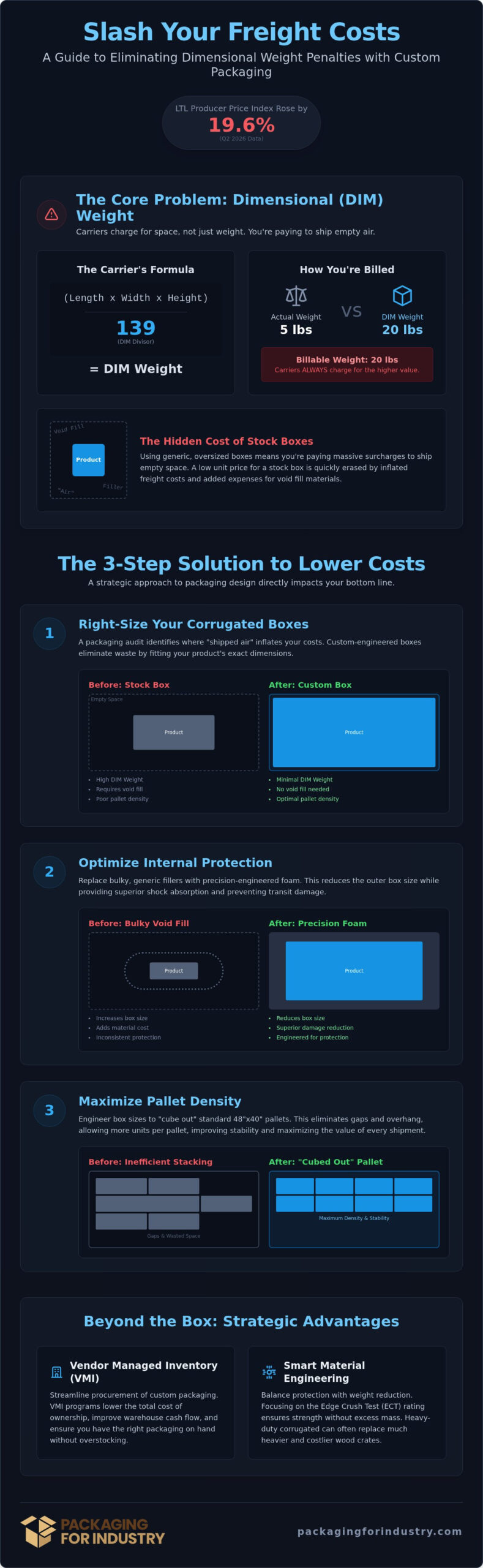
The standard formula for calculating this value is (Length x Width x Height) / 139. As of August 2026, all major carriers round fractional measurements up to the next whole inch before applying this divisor. For example, a box measuring 12.2 inches is treated as 13 inches. When you analyze how to reduce freight costs with custom packaging, you’ll find that even a 10% reduction in box volume can yield thousands in annual savings for high-volume industrial shippers.
How Carriers Calculate Your Shipping Rates
The carrier determines your “billable weight” by comparing the actual physical weight of the package to its calculated DIM weight. They will always bill you for whichever number is higher. This means a five-pound product in a large box might be billed as if it weighs twenty pounds. Beyond the base rate, oversized dimensions often trigger “Additional Handling” or “Oversize” surcharges. These fees are designed to penalize packages that don’t fit easily on automated sorting belts or require manual intervention. Shipping air is a liability that compounds across every leg of your supply chain.
The Hidden Cost of Stock Packaging
Many logistics managers fall into the trap of using “good enough” stock sizes because the individual unit price of the box is low. However, these generic corrugated boxes often require excessive void fill to prevent product movement. This adds material costs and increases the external dimensions of the package. A custom-engineered box eliminates the need for bulky fillers and ensures the smallest possible footprint. The minor savings gained from buying mass-produced catalog boxes are quickly erased by the massive freight surcharges they trigger. DIM weight is the primary obstacle to profitable industrial shipping.
Step 1: Right-Sizing Your Corrugated Boxes
The first stage of a strategic logistics overhaul is a comprehensive packaging audit. You can’t optimize what you haven’t measured. By identifying the exact dimensions of your most frequently shipped components, you can identify where your current containers are failing you. Most industrial shippers rely on a handful of standard catalog sizes that inevitably lead to “shipped air.” When you understand how to reduce freight costs with custom packaging, you recognize that every inch of excess box volume is a direct hit to your bottom line.
Designing custom corrugated boxes allows you to eliminate unnecessary void space. This precision engineering does more than just lower your DIM weight; it improves pallet density. When boxes fit together without gaps or overhang, you can fit more units per pallet and improve load stability. Many manufacturers find that adopting Vendor Managed Inventory principles helps them maintain these custom sizes without the burden of excessive warehouse storage. If you’re ready to see how a custom fit impacts your specific shipping profile, you can request a packaging review to compare your current costs against an optimized design.
RSC vs. Die-Cut: Choosing the Right Style
Style selection is a critical lever for freight efficiency. Regular Slotted Cartons (RSC) are the industrial standard for rectangular products because they’re cost-effective and produce minimal waste. However, die-cut boxes offer a precision fit for complex shapes. These custom designs often include self-locking features that eliminate the need for excessive tape or heavy staples. By reducing the assembly time and the weight of secondary closure materials, you further streamline your outbound logistics process.
Material Engineering for Weight Reduction
Effective packaging balances structural integrity with minimal mass. Instead of simply using thicker materials, we focus on the Edge Crush Test (ECT) rating to ensure your boxes can withstand the rigors of the LTL environment. Heavy-duty double-wall or triple-wall corrugated can often replace much heavier wood crates for domestic transit. This switch significantly reduces the actual weight of the shipment while maintaining high-level protection. For high-value equipment requiring even more robust solutions, you might consider engineering custom crates specifically for international or long-haul transit. Choosing the right board grade ensures you aren’t paying to ship a box that’s heavier than the product inside it.
Step 2: Optimizing Internal Protection to Reduce Bulk
Internal protection is the silent driver of external box dimensions. While many logistics managers focus on the corrugated shell, the choice of cushioning material often dictates the final volume of the shipment. By switching to precision-engineered custom foam packaging, you can reduce the distance between the product and the box wall. This shift is a primary tactic in how to reduce freight costs with custom packaging because it allows for smaller outer dimensions without sacrificing structural safety. When you eliminate the “buffer space” required by inferior materials, you unlock significant freight savings.
Engineered Foam Inserts vs. Generic Void Fill
Generic void fill like bubble wrap or packing peanuts is inherently inefficient for industrial applications. These materials require excessive volume to provide adequate shock absorption, which frequently forces you into larger box categories that trigger DIM weight penalties. Engineered foam inserts or die-cut end caps provide targeted protection exactly where it’s needed. This allows for a much tighter footprint inside the container. PFI’s free prototyping process ensures these foam solutions provide maximum protection in the minimum possible area. For aerospace and medical device manufacturers, we often utilize specialty materials including:
- Anti-Static Foam: Prevents static buildup during handling and transit.
- ESD Foam: Dissipates electrical charges to protect sensitive electronics.
- Cross-linked Polyethylene: Offers high-durability protection for heavy or sharp components.
These specialty materials protect sensitive circuitry while maintaining the same space-saving profile as standard polyethylene foam. Using these high-performance materials means you’re no longer paying to ship bags of air.
Reducing Damage-Related Freight Expenses
Beyond the initial carrier rate, packaging efficiency directly impacts the hidden costs of industrial logistics. When a product fails in transit, you encounter the “Rule of Three.” You pay to ship the original item, you pay the freight to return the damaged unit, and you pay a third time to send the replacement. These redundant shipping expenses can quickly erase the profit from a single sale. Using corner and edge protection helps stabilize heavy loads during the vibrations of LTL transit. These lightweight additions prevent pallet shifting without adding significant volume to the shipment profile. This strategic approach is a vital component of how to reduce freight costs with custom packaging by eliminating the waste of secondary and tertiary shipping. The most expensive shipment is the one that arrives damaged.
Step 3: Maximizing Pallet Density and Load Stability
Once you’ve right-sized your individual boxes, the next efficiency gain happens at the pallet level. Standard 48×40 pallets are the backbone of North American logistics. However, if your containers don’t fit perfectly within these dimensions, you’re paying for unused trailer floor space. Learning how to reduce freight costs with custom packaging involves engineering your box sizes to “cube out” the pallet. This means boxes are sized so they align flush with the pallet edges, leaving no gaps and no overhang. This precision ensures you are utilizing every cubic inch of the pallet footprint you’re paying for.
Overhang is a major cause of freight damage, as the edges of your boxes become the first point of contact during trailer shifting. Conversely, underhang creates “internal air” on the pallet, which carriers often penalize during re-weigh and re-classification audits. If a carrier determines your pallet is taking up more “effective space” than its weight suggests, they will adjust your freight class, leading to unexpected invoice spikes. Custom dimensions ensure your load is dense, stable, and compliant with carrier expectations, which is a fundamental part of how to reduce freight costs with custom packaging.
Cubing Out the Trailer
Vertical space is just as valuable as floor space. By using heavy-duty pallets and corrugated materials with high stacking strength, you can often design packaging that allows for double-stacking in the trailer. This effectively cuts your floor space requirement in half for the same volume of goods. For international transit, custom-engineered crates can be designed with specific load-bearing points to ensure they remain stackable even in the high-vibration environment of an ocean vessel or cargo plane. Maximizing the vertical cube of a trailer is the fastest way to lower your cost per unit shipped.
Stabilization Strategies for LTL Freight
A dense pallet is only effective if it remains intact throughout the journey. High-performance stretch film is essential for maintaining load integrity during the multiple transfers common in LTL (Less-Than-Truckload) shipping. Selecting the correct gauge of film and applying the right tension prevents shifting that leads to crushed corners or collapsed stacks. When you integrate edge boards and top pads, you protect the load from strap damage and improve the overall structural rigidity of the unit. This holistic approach prevents the shifting that often leads to carrier rejection or expensive damage claims.
Strategic Procurement: Lowering Costs with VMI and JIT
Strategic procurement represents the final layer of logistical optimization. While engineering the physical container is essential, the way you acquire those materials determines your total cost of ownership. Implementing a Vendor Managed Inventory (VMI) program allows you to shift the burden of stock management to your supplier. This ensures you always have the necessary custom materials on hand without the risk of over-purchasing. When you analyze how to reduce freight costs with custom packaging, you must also consider the inbound logistics of the packaging itself. Consolidating your corrugated, foam, and stretch film orders with a single local source eliminates the administrative overhead and shipping fees associated with managing multiple vendors.
For manufacturers in Southern California, proximity is a competitive advantage. Utilizing Just-In-Time (JIT) delivery from a local partner reduces the lead times that often plague companies relying on national catalog suppliers. By sourcing from a provider that understands the specific logistics of the Inland Empire and Orange County, you gain a partner capable of next-day delivery and rapid response. This agility is vital when production schedules shift or urgent shipments require immediate custom solutions. You gain the reliability of a local supply chain that acts as an extension of your own warehouse.
Eliminating Warehouse Waste
Warehouse floor space is an expensive asset that shouldn’t be consumed by stacks of empty, slow-moving boxes. A VMI partnership frees up significant square footage by letting your supplier house the inventory until it’s needed for a specific production run. This model reduces the amount of capital tied up in packaging supplies, which directly improves your company’s cash flow. Professional inventory management also prevents the production stops caused by unexpected packaging shortages. You gain the peace of mind that your shipping department will never be the bottleneck in your fulfillment process.
The PFI Advantage for Industrial Buyers
Packaging For Industry (PFI) combines nationwide shipping capabilities with deep local expertise in Anaheim and the surrounding industrial hubs. We don’t just sell supplies; we provide a consultative packaging cost-savings analysis for every repeat order. Our team identifies opportunities to further refine your designs as carrier rates and material costs evolve. This proactive approach ensures your logistics strategy remains lean and resilient against market volatility. We focus on the intersection of engineering and economics to protect your products and your bottom line.
Optimizing Your Logistics Bottom Line
Industrial shipping in 2026 demands a shift from reactive logistics to proactive engineering. By mastering the 139 DIM divisor and right-sizing your corrugated shells, you remove the “shipped air” that inflates carrier invoices. Integrating precision foam inserts and corner protection further stabilizes your loads, preventing the “Rule of Three” costs associated with transit damage and returns. It’s no longer enough to use catalog boxes and hope for the best.
Strategic procurement through VMI and JIT delivery ensures your warehouse remains lean while your production lines stay moving. You’ve seen how to reduce freight costs with custom packaging by addressing every variable from the internal cushion to the final pallet wrap. Packaging For Industry (PFI) provides the technical expertise and local infrastructure to turn these strategies into tangible results.
Our team offers free prototyping and CAD design support to ensure every box is a perfect fit. With local Southern California next-day delivery and deep specialization in Aerospace and Defense standards, we’re ready to serve as your steady logistics partner.
Take control of your shipping spend today. A more efficient supply chain is within reach.
Frequently Asked Questions
How much can custom packaging really save on freight?
Custom packaging can reduce total freight spend by 10% to 20% for most industrial shippers. These savings come from eliminating “shipped air” and avoiding dimensional weight surcharges. While individual results vary based on product density, learning how to reduce freight costs with custom packaging often yields a full return on investment within the first few shipping cycles. You stop paying carriers to transport empty space in oversized containers.
What is the difference between billable weight and actual weight?
Actual weight is the physical mass of the package measured on a scale. Billable weight is the higher value between the actual weight and the calculated dimensional (DIM) weight. Carriers use this metric to ensure they’re compensated for the volume a package occupies in their trucks. If your box is large but light, you’ll be billed for its size rather than its physical heaviness.
Does custom packaging have a higher upfront cost than stock boxes?
Custom boxes often have a higher unit price than generic stock sizes because they require specific tooling and smaller production runs. However, the total cost of ownership is typically much lower. The savings gained from reduced freight surcharges and lower damage rates quickly outweigh the marginal increase in material costs. You’re trading a few cents per box for dollars in freight savings.
Can custom foam inserts actually reduce my box size?
Yes, engineered foam inserts allow you to use significantly smaller outer boxes. Unlike loose void fill which requires a large buffer zone, precision-cut foam holds the product securely in a tighter footprint. This reduction in external volume directly lowers your DIM weight. It also provides superior protection for sensitive aerospace or medical components during high-vibration LTL transit.
What are the most common UPS and FedEx surcharges for industrial shippers?
The most common surcharges include “Additional Handling,” “Oversize,” and “Residential Delivery” fees. As of 2026, carriers apply these penalties to any package that exceeds specific length or girth thresholds. These fees often cost more than the base shipping rate itself. Custom engineering ensures your packages stay within standard size brackets to avoid these expensive, non-negotiable invoice additions.
How does right-sizing packaging affect product damage rates?
Right-sizing dramatically lowers damage rates by preventing internal movement. When a box fits a product perfectly, there is no room for the item to shift or gain momentum during rough handling. This stability reduces the need for heavy internal bracing. Fewer damaged goods means fewer expensive returns and replacements, which further stabilizes your long-term logistics budget.
Is there a minimum order quantity for custom freight-saving boxes?
Minimum order quantities depend on the complexity of the design and the materials used. While stock catalog suppliers prioritize high-volume generic sales, a consultative partner focuses on your specific shipping volume to find a sustainable solution. Understanding how to reduce freight costs with custom packaging requires a tailored approach. We evaluate your annual usage to ensure your inventory levels remain lean through VMI programs.
How do I calculate the DIM weight of my current shipments?
To calculate DIM weight, multiply the length, width, and height of the box to find the total cubic inches. Round each fractional measurement up to the next whole inch first. Divide that total by 139, which is the current standard domestic divisor for UPS and FedEx. The resulting number is the weight the carrier will use for billing if it exceeds the physical weight.