
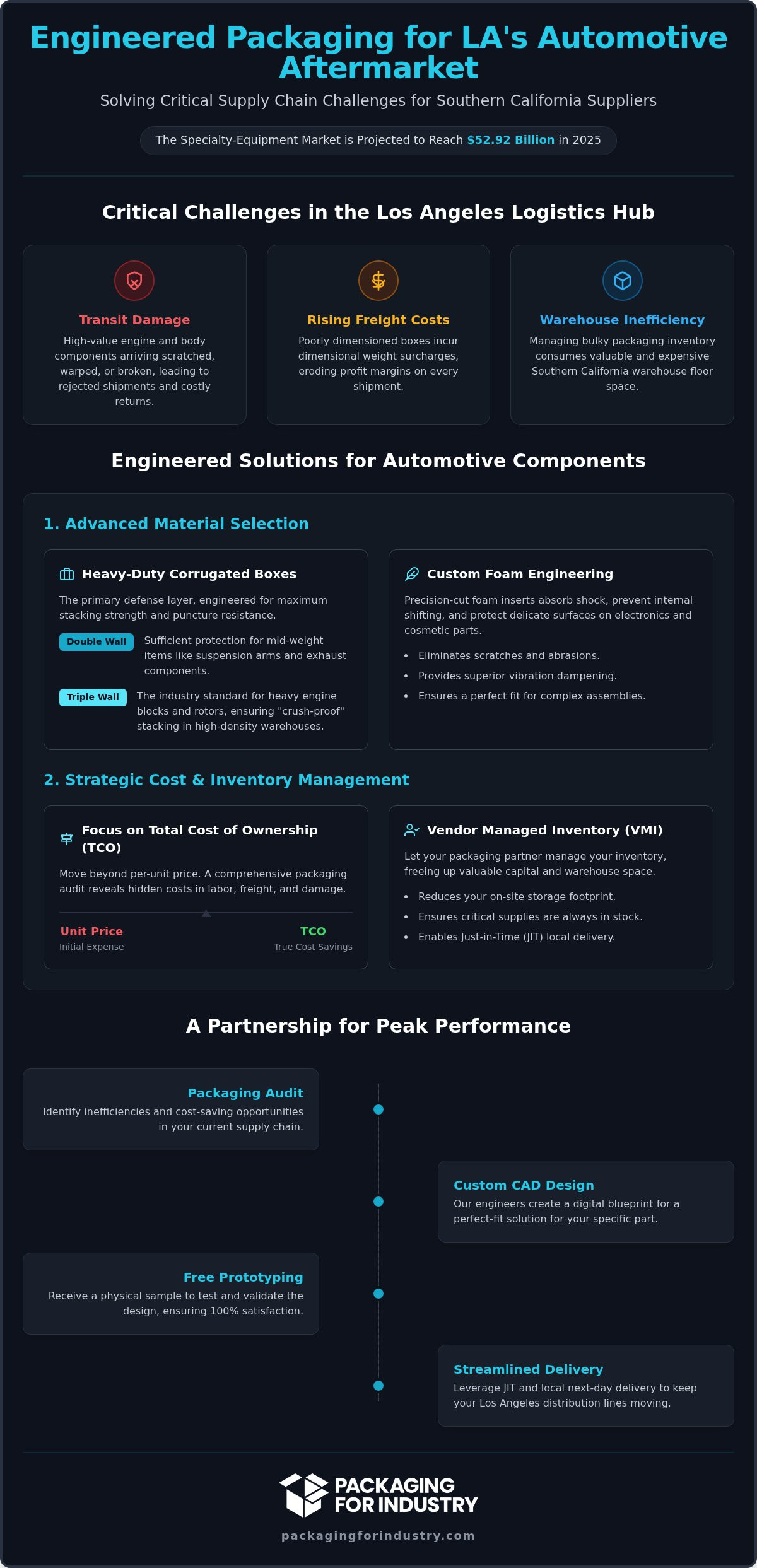
With the specialty-equipment market generating $52.92 billion in sales in 2025, the pressure on Southern California distribution hubs to move high-value components without a single scratch is at an all-time high. For industrial packaging for automotive aftermarket suppliers Los Angeles represents a high-stakes environment where a single poorly dimensioned box doesn’t just risk transit damage; it actively erodes profit margins through rising freight costs. You’re likely dealing with the daily frustration of heavy components arriving damaged or the constant stress of managing bulky packaging inventory in limited warehouse space.
We understand that reliable logistics require more than just supplies; they require an engineering approach to protection. This article outlines how to optimize your automotive supply chain using custom-engineered packaging solutions designed to reduce operational costs and ensure zero-damage shipping for critical parts. We’ll examine the specific impact of California’s 2026 SB 54 packaging fees, the efficiency gains of Vendor Managed Inventory (VMI), and how local next-day delivery to the Gateway Cities keeps your distribution lines moving. Discover how a proactive packaging strategy transforms a necessary expense into a competitive advantage for your Los Angeles operations.
Key Takeaways
- Learn how to select heavy-duty corrugated materials and custom foam inserts to eliminate transit damage for high-value engine and body components.
- Discover how specialized industrial packaging for automotive aftermarket suppliers Los Angeles can reduce dimensional weight surcharges and lower overall freight expenses.
- Implement Vendor Managed Inventory (VMI) to free up valuable floor space in Los Angeles warehouses while ensuring critical supplies are always in stock.
- Identify hidden inefficiencies in your supply chain by conducting a comprehensive packaging audit focused on Total Cost of Ownership rather than just unit price.
- Streamline your product launches with custom CAD designs and free prototyping to ensure a perfect fit for complex automotive assemblies.
Critical Packaging Challenges for Los Angeles Automotive Suppliers
Operating within the Southern California logistics hub requires a specialized approach to protection. Suppliers moving parts from the Port of Los Angeles to distribution centers in Carson or Santa Fe Springs face extreme physical stress on their cargo. Standard shipping supplies often fail because they aren’t engineered for the specific mechanical stresses of the region’s freight corridors. For industrial packaging for automotive aftermarket suppliers Los Angeles companies rely on, the goal is to eliminate the variables that lead to rejected shipments and damaged goods.
The stakes are particularly high when handling high-value components. A single damaged engine block or a set of warped rotors can disrupt an entire assembly line. When parts arrive compromised, the cost isn’t just the replacement value; it includes the logistical nightmare of returns, claims processing, and strained relationships with distributors. Effective packaging acts as a safeguard against these operational setbacks and ensures that your reputation for reliability remains intact.
High-Volume Transit Risks in Southern California
Freight moving through the Inland Empire or the Gateway Cities experiences significant vibration and shock. Long-haul transport involves steady movement, but the constant stop-and-go of Los Angeles traffic adds a different type of physical strain. Environmental factors also complicate storage and transit. High humidity near the ports can weaken standard corrugated boxes, while intense heat in uninsulated warehouses can affect the integrity of certain protective materials. PFI’s custom design packaging addresses these regional risks by utilizing moisture-resistant materials and reinforced structural designs that maintain their shape under pressure.
Compliance and Standards for Aftermarket Parts
The automotive aftermarket requires strict adherence to OEM standards to maintain Tier 1 and Tier 2 supplier status. These standards aren’t suggestions; they’re rigid requirements for durability and labeling. Heavy components like rotors and engine blocks require heavy-duty corrugated materials to prevent box failure during transit. If your packaging doesn’t meet these specific durability benchmarks, you risk losing your status as a preferred supplier. Custom engineering ensures that industrial packaging for automotive aftermarket suppliers Los Angeles firms use meets or exceeds automotive shipping standards by calculating the exact load-bearing requirements and cushioning needs of each specific part. By prioritizing these standards, suppliers can avoid the costly penalties associated with non-compliant shipments while ensuring their products arrive in showroom condition.
Selecting the Right Materials for Automotive Component Protection
Material selection for automotive logistics is an engineering decision that directly impacts your bottom line. Choosing the wrong substrate leads to crushed boxes in the warehouse or scratched surfaces that distributors will reject. Effectively sourcing industrial packaging for automotive aftermarket suppliers Los Angeles relies on requires a technical understanding of how different materials interact with heavy, precision-machined metal parts. Every layer of your packaging must serve a functional purpose, from structural integrity to surface preservation.
Heavy-Duty Corrugated Boxes for Mechanical Parts
Industrial-grade corrugated boxes serve as the primary defensive layer for aftermarket components. While standard RSC (Regular Slotted Container) boxes are efficient for uniform parts, custom die-cut designs are often necessary for odd-shaped components like exhaust manifolds or suspension arms to prevent internal shifting. For heavy metal parts, the choice between double-wall and triple-wall corrugated is critical. Double-wall provides sufficient protection for mid-weight items, but triple-wall is the industry standard for engine blocks and heavy rotors that require maximum puncture resistance and stacking strength. These “crush-proof” specifications allow for high-density warehouse stacking in Los Angeles distribution hubs without risking the integrity of the bottom pallets.
Custom Foam Engineering for Fragile Electronics
As vehicles become more complex, the need to protect sensitive control modules and sensors has increased. Utilizing anti-static foam packaging is essential for preventing electrostatic discharge that can ruin expensive electronics. We offer free prototyping to ensure a perfect part-to-foam fit, which eliminates the “rattle” that causes micro-abrasions during transit. Polyethylene foam provides the rigid support needed for heavier assemblies, while polyurethane is better suited for cushioning lighter, delicate components. Foam density dictates the material’s ability to decelerate a moving object, ensuring that high-value parts don’t experience the G-forces that lead to internal mechanical failure.
Beyond the box and foam, surface protection and pallet stabilization complete the system. Precision-machined surfaces are susceptible to corrosion and scratches, making poly bags and specialized stretch film indispensable. When shipping heavy automotive loads, high-performance stretch film is required to maintain pallet integrity through the sharp turns and sudden stops of Southern California freight corridors. You can request a packaging quote to see how these engineered materials can be integrated into your specific supply chain to lower your total cost of ownership.
Inventory Strategies: VMI and JIT for LA Warehouses
Managing a warehouse in the South Bay or Gateway Cities requires a ruthless focus on floor space utilization. Storing months of bulky corrugated boxes and foam inserts ties up valuable square footage that should be reserved for high-turnover automotive inventory. For industrial packaging for automotive aftermarket suppliers Los Angeles operations must prioritize lean inventory strategies like Vendor Managed Inventory (VMI) to maintain peak efficiency. This approach shifts the burden of stock monitoring and replenishment to us, ensuring you never face a production halt due to a packaging stockout.
Transitioning to a Just-In-Time (JIT) model provides immediate financial relief by improving cash flow. Instead of paying for a massive bulk order that sits in a corner for six months, you pay for packaging as it’s consumed. This proactive problem-solving approach eliminates the “dead space” common in traditional procurement models and allows you to reallocate capital toward growing your core business. It’s about turning your packaging from a storage headache into a streamlined logistical asset.
Maximizing Warehouse Space in Southern California
Industrial real estate in Southern California is among the most expensive in the nation. Suppliers in Torrance and Carson frequently utilize our VMI programs to reclaim significant portions of their packaging storage area. By moving from unpredictable bulk ordering to scheduled replenishment cycles, these facilities can scale their operations without needing to lease additional warehouse space. We monitor your usage levels and trigger deliveries only when your stock reaches a pre-determined threshold, maintaining a seamless flow of supplies without the clutter.
Supply Chain Reliability with Local Support
The speed of the aftermarket industry doesn’t allow for long lead times or shipping delays from out-of-state providers. Having a local partner means you have access to next-day delivery in Santa Fe Springs and other critical industrial hubs. This local proximity is a safeguard against sudden spikes in demand or emergency orders. To further accelerate your operations, we offer packaging kitting services. We deliver pre-assembled sets of boxes, inserts, and labels directly to your assembly line, reducing the time your team spends on manual prep work. This level of logistical integration ensures that industrial packaging for automotive aftermarket suppliers Los Angeles companies depend on is a driver of speed rather than a bottleneck.
Cost Reduction: Beyond the Unit Price of a Box
Purchasing managers often focus exclusively on the per-unit price of a corrugated box. This narrow view ignores the Total Cost of Ownership (TCO), which is the true metric of supply chain efficiency. For industrial packaging for automotive aftermarket suppliers Los Angeles businesses operate, a “cheap” box that leads to a single damaged crankshaft or a rejected shipment of sensors is an expensive liability. True cost reduction comes from analyzing how packaging interacts with freight, labor, and product integrity. It’s about looking at the entire lifecycle of the package from the assembly line to the end customer.
Freight costs are heavily influenced by dimensional weight surcharges. If your boxes are even an inch larger than necessary, you’re paying carriers to ship air. By optimizing box dimensions and utilizing high-performance materials, you can significantly lower your annual shipping spend. We focus on engineering out the waste that standard catalog solutions often overlook.
Freight Optimization and Surcharge Avoidance
Reducing the physical volume of a shipment is the most direct way to combat rising carrier rates. You don’t always need thicker corrugated walls to achieve higher stack strength. Integrating corner and edge protection allows you to use lighter-weight external boxes while maintaining the structural integrity required for palletized loads. This strategy reduces the total weight and volume of the shipment, directly lowering the cost per unit shipped. Additionally, reducing freight claims through better protection eliminates the administrative labor and shipping costs associated with processing returns. Every claim avoided is profit kept on the bottom line.
Custom Engineering vs. Stock Catalog Prices
Stock boxes from a catalog are designed for general use, not for the specific weights and geometries of automotive components. These “one-size-fits-all” options often require excessive void fill, which increases material costs and slows down assembly lines. Custom-engineered designs are built to fit the part precisely, reducing the time your warehouse staff spends on taping and kitting. When boxes are designed for easy assembly, labor costs drop and throughput increases.
A professional packaging cost savings analysis identifies these hidden operational drains. Prototyping a custom solution may seem like an upfront investment, but the long-term ROI is realized through faster pack times and zero-damage delivery. In the competitive Los Angeles market, your packaging shouldn’t just be an expense; it should be a tool for operational excellence.
Partnering with a Los Angeles Industrial Packaging Expert
Choosing a partner for industrial packaging for automotive aftermarket suppliers Los Angeles manufacturers rely on isn’t just about finding a vendor. It’s about establishing a technical partnership that prioritizes operational stability. We follow a methodical four-step onboarding process to ensure your packaging strategy aligns with your financial and logistical goals. Our approach is designed to eliminate the guesswork and provide a predictable, high-performance supply chain.
Step 1 begins with a comprehensive packaging audit. Our specialists visit your facility to identify hidden inefficiencies, such as excessive void fill usage or high damage rates during transit. Step 2 moves into the engineering phase. We collaborate on custom CAD designs and provide free prototypes; this allows you to test the fit and durability of the materials before committing to a full production run. Step 3 focuses on supply chain reliability. We establish a VMI or JIT program tailored to your specific production schedule, ensuring you have the right stock without the warehouse clutter. Finally, Step 4 implements local next-day delivery. This rapid response time keeps your shipping department moving and prevents the bottlenecks that occur when waiting for out-of-state shipments.
The PFI Difference: Local Expertise, National Reach
Automotive suppliers often choose PFI over generic national catalog suppliers because we understand the specific logistical strains of the Southern California market. National providers offer one-size-fits-all solutions that don’t account for the unique vibration profiles of local freight corridors or the high cost of warehouse space in Los Angeles and Orange County. We’re committed to the local manufacturing sector, providing the personalized support that national firms can’t match. You can request a quote today to see how our local presence translates into better protection and lower operational costs for your specific automotive application.
Get Started with a Custom Packaging Review
Your initial assessment with a PFI specialist is focused on tangible outcomes. We look at your current damage reports, freight expenses, and storage limitations to build a customized plan. To make this review as effective as possible, we recommend preparing your usage data and current packaging specifications. This information allows us to create a more accurate VMI proposal that reflects your actual consumption rates. Our goal is to provide a system that pays for itself through increased efficiency and reduced waste. Don’t let outdated packaging hold back your growth in the competitive 2026 market. For industrial packaging for automotive aftermarket suppliers Los Angeles firms trust for reliability and precision, the first step is a professional evaluation of your current system.
Future-Proof Your Automotive Logistics Strategy
High-performance logistics in the Southern California market require more than just stock boxes. By prioritizing custom-engineered protection and advanced inventory management, you can eliminate transit damage and reclaim expensive warehouse floor space. Transitioning to a model that focuses on total cost of ownership ensures your operations remain resilient against the specific freight challenges of the South Bay and Gateway Cities. Don’t let inefficient packaging become a bottleneck for your distribution lines.
For industrial packaging for automotive aftermarket suppliers Los Angeles manufacturers rely on, the path to sustained growth lies in technical precision. Our free prototyping and CAD design services allow you to validate your protection before production begins. Combined with VMI programs for high-volume suppliers and local next-day delivery across LA, we provide a comprehensive system that lowers your total cost of ownership.
We’re ready to help you streamline your logistics and protect your bottom line.
Frequently Asked Questions
What are the specific packaging requirements for automotive aftermarket parts?
Specific requirements for automotive aftermarket parts prioritize OEM compliance and structural integrity to prevent shipment rejection. Packaging must account for high-density stacking and mechanical shock, especially for heavy components like brake rotors. We ensure your supplies meet these standards by using reinforced materials and precise labeling that aligns with Tier 1 and Tier 2 supplier mandates.
How can a Los Angeles-based supplier help reduce my freight costs?
A local partner reduces freight costs by eliminating long-haul fuel surcharges and providing optimized route planning within the Gateway Cities. Because we’re nearby, you can order smaller quantities more frequently, which lowers the total weight per shipment. This proximity also allows us to conduct on-site audits to refine box dimensions and eliminate the cost of shipping unnecessary air.
What is Vendor Managed Inventory (VMI) and how does it benefit automotive suppliers?
Vendor Managed Inventory is a program where we monitor and replenish your packaging stock levels based on your actual consumption. For automotive suppliers, this eliminates the risk of production-stopping stockouts while freeing up warehouse space in high-rent zones. You only pay for materials as they’re used, which significantly improves your operational cash flow and reduces administrative overhead.
Do you provide custom foam inserts for fragile engine components?
We provide custom-engineered foam packaging designed specifically for precision engine components and sensitive electronics. Using CAD technology, we create polyethylene or polyurethane inserts that provide exact fitment and vibration dampening. These inserts are essential for absorbing mechanical shock during transit, ensuring that high-value assemblies arrive without internal damage or surface abrasions.
Is next-day delivery available for warehouses in Torrance and Carson?
Yes, we offer local next-day delivery for warehouses located in Torrance, Carson, and throughout Los Angeles County. Our fleet is optimized for the South Bay industrial corridors, allowing us to respond quickly to sudden spikes in your production schedule. This rapid fulfillment ensures that your shipping department never stalls while waiting for critical corrugated supplies or stretch film.
Can PFI help with Mil-Spec packaging for automotive-defense contracts?
PFI provides specialized military packaging that meets the rigorous standards required for automotive-defense contracts. We understand the complex documentation and material specifications involved in mil-spec orders, including moisture-vapor barriers and reinforced crating. Our team ensures that every shipment complies with federal regulations, protecting your parts against extreme environmental conditions and long-term storage requirements.
How do I avoid UPS and FedEx dimensional weight surcharges?
You can avoid dimensional weight surcharges by utilizing industrial packaging for automotive aftermarket suppliers Los Angeles experts design to minimize external volume. We use high-performance materials and corner boards to maintain strength in smaller boxes, reducing the air inside your shipments. Precise sizing ensures you’re billed for the actual weight of the part rather than the container size.
What is the benefit of using double-wall or triple-wall corrugated boxes?
The choice between double-wall and triple-wall corrugated boxes depends on the weight and puncture risk of your parts. Double-wall is sufficient for most mid-sized mechanical components, providing reliable stacking strength. Triple-wall is the industry standard for extremely heavy items like engine blocks, offering maximum structural integrity and resistance to crushing in high-density warehouse environments.