
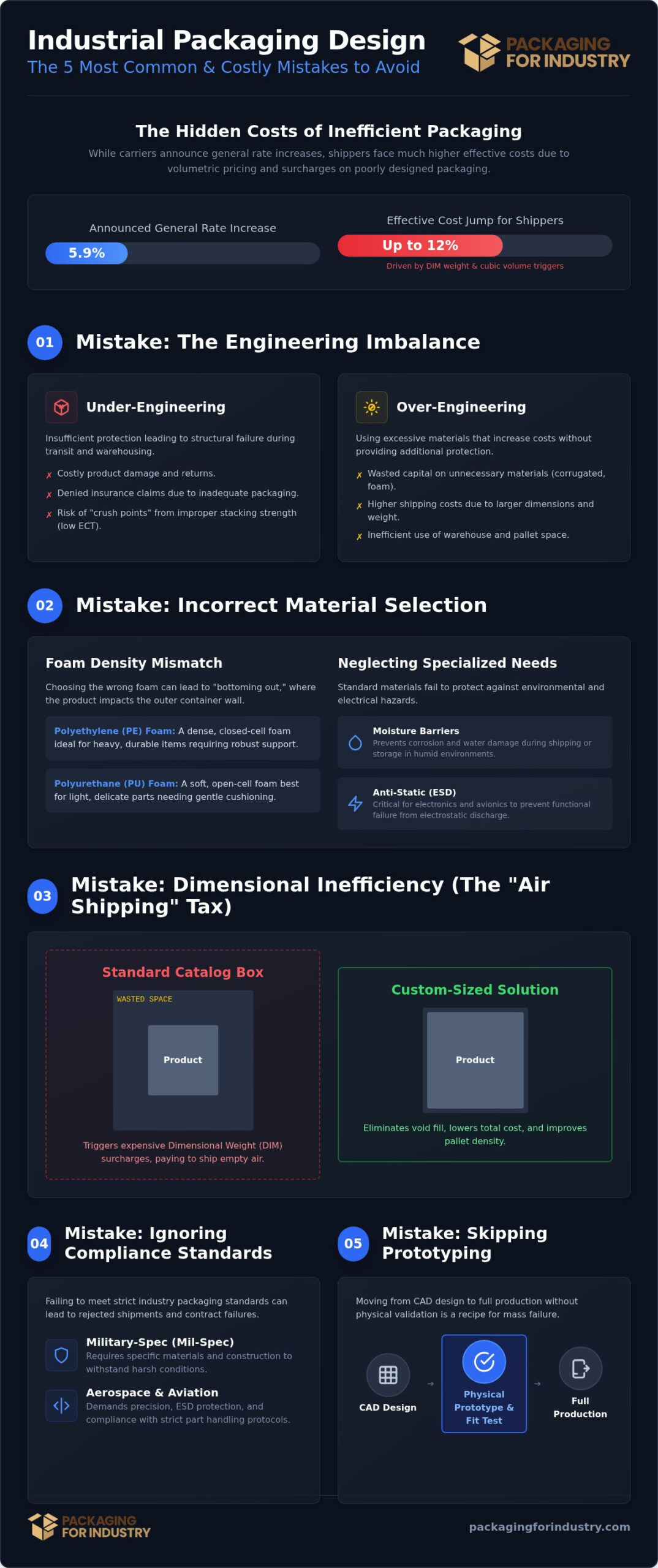
Did you know that while major carriers announced a 5.9% general rate increase for 2026, many industrial shippers are seeing effective costs jump by as much as 12%? This discrepancy often stems from new cubic volume triggers and mandatory upward rounding on dimensions that penalize inefficient designs. It’s frustrating to manage a budget when unexpected surcharges and high product return rates eat into your bottom line. You work hard to ensure your components are manufactured to precision, yet poor packaging choices can undermine that quality the moment a pallet leaves the dock.
Understanding the common industrial packaging design mistakes to avoid is now a requirement for fiscal responsibility and operational stability. We’ll help you identify where your current strategy might be failing, from over-engineered boxes that waste warehouse space to insufficient cushioning that leads to costly damage. This article provides a clear roadmap to lower your total cost of ownership and achieve zero-damage shipping for high-value parts. We’ll explore how custom-engineered corrugated solutions and precise prototyping can transform your packaging from a hidden expense into a streamlined logistical advantage.
Key Takeaways
- Learn how to balance under-engineering and over-engineering to prevent catastrophic product damage and ensure insurance providers don’t deny your claims.
- Discover why standard catalog boxes often trigger expensive Dimensional Weight (DIM) surcharges and how custom sizing can lower your total cost of ownership.
- Identifying common industrial packaging design mistakes to avoid allows operations managers to eliminate the “air shipping tax” and streamline procurement.
- Ensure your high-value parts meet strict Mil-Spec and aerospace packaging standards to avoid compliance failures in defense and aviation contracts.
- Understand why physical prototyping and fit tests are essential for validating CAD designs before you move to a full-scale production rollout.
Under-Engineering vs. Over-Engineering: Finding the Industrial Balance
Industrial packaging is a discipline of precision. One of the common industrial packaging design mistakes to avoid is failing to find the “sweet spot” between structural failure and material waste. This balance is determined by a product’s fragility, often measured in G-force ratings, which dictates the amount of deceleration required during a drop or impact. Without a formal fragility assessment, operations managers often default to generic solutions that either risk the product’s safety or the company’s profitability. True engineering balance ensures that every dollar spent on materials contributes directly to transit survival.
The High Cost of Under-Protected Shipments
Under-engineering happens when the packaging cannot withstand the compressive forces of a stacked warehouse or the dynamic shocks of a long-haul truck route. Many manufacturers mistakenly rely on standard single-wall RSC boxes for heavy industrial components. While these Regular Slotted Containers are versatile, a standard 32 ECT (Edge Crush Test) rating may buckle under the weight of high-density metal parts. When a box fails, it creates a “crush point” that transfers energy directly to the contents. Beyond the physical damage, carriers often deny insurance claims if they determine the packaging was insufficient for the load weight, making under-engineering a double financial loss.
The Over-Engineering Trap: Wasted Capital
Conversely, over-engineering involves using excessive materials that provide no additional protection but significantly increase costs. This often manifests as oversized outer containers filled with unnecessary void fill. By implementing custom design packaging, you can replace generic “over-boxing” with precision-engineered inserts. This allows you to use a smaller outer RSC box while maintaining superior protection. Calculating the ROI of material reduction is straightforward: you save on the initial procurement of corrugated and foam, while simultaneously reducing the dimensional footprint of every pallet.
- Analyze the Edge Crush Test (ECT) requirements for your specific stacking height to prevent sidewall bulging.
- Utilize double-wall or triple-wall corrugated for heavy machinery to provide the necessary stacking strength.
- Transition from “standard” catalog sizes to custom-tailored dimensions to eliminate the cost of excess void fill and wasted warehouse space.
Rightsizing your packaging through engineering ensures your supply chain remains both reliable and lean. By focusing on the structural requirements of the product rather than just the lowest unit price of a box, you create a more resilient logistical flow that supports long-term fiscal responsibility.
Material Selection Errors: Why One Size Does Not Fit All
Material science is the backbone of transit survival. Selecting materials based on unit cost rather than engineering specifications is one of the most common industrial packaging design mistakes to avoid. While a corrugated box provides the outer structure, the internal materials manage the energy of impacts, vibrations, and environmental shifts. Using generic solutions for specialized parts often leads to failure at the first point of turbulence or moisture exposure.
Foam Density and Shock Absorption
Choosing the wrong foam density can be disastrous for sensitive electronics or aerospace components. Polyethylene (PE) is a closed-cell foam ideal for heavy items that require durable support; Polyurethane (PU) is an open-cell, softer foam better suited for light, delicate parts. A frequent error is “bottoming out,” where the foam is either too thin or too soft to prevent the product from striking the outer box wall during a drop. Precision matters here. Die-cut custom foam packaging outperforms loose-fill packing peanuts because it locks the product into a fixed position. This ensures consistent shock absorption across every shipment, regardless of how many times it’s handled in the warehouse.
Specialized Protection: ESD and Moisture Barriers
Neglecting Electrostatic Discharge (ESD) requirements for semiconductor components or avionics is a mistake that often goes unnoticed until the end-user reports a functional failure. Static-shielding bags and pink anti-static foam are essential for preventing “invisible” damage to circuitry. Similarly, corrosion is a significant risk for precision-machined metal parts stored in non-climate-controlled warehouses, especially during high-humidity months in the Inland Empire or Orange County. Failing to use VCI (Volatile Corrosion Inhibitor) papers or moisture barrier bags can lead to oxidation before the part even reaches the assembly line.
Heavy machinery with sharp edges presents another challenge. Using generic void fill like air pillows for these items is ineffective; the edges easily puncture the plastic, leaving the product to shift freely. Heavy-duty corner boards or specialized kitting solutions provide the necessary durability to maintain package integrity. If you’re unsure which material fits your specific application, you can request a packaging quote to have our engineers evaluate your product fragility and environmental risks. We focus on providing the exact level of protection required to lower packaging costs while maintaining absolute reliability.
Dimensional Inefficiency: Avoiding the ‘Air Shipping’ Tax
Shipping air is one of the most expensive line items in a modern logistics budget. Relying on “standard” catalog boxes that don’t precisely match your product’s footprint is one of the common industrial packaging design mistakes to avoid. While these stock boxes might seem cheaper upfront, they often trigger massive surcharges that far outweigh the initial savings. In 2026, the financial penalties for dimensional inefficiency have become even more aggressive due to carrier rounding rules and new cubic volume triggers that penalize bulky, lightweight shipments.
Understanding Dimensional Weight (DIM) Surcharges
The 2026 DIM formula is now applied after rounding every fractional dimension up to the next whole inch. This means a box measuring 12.1 inches is billed as 13 inches. When you multiply this across three dimensions, the cost of “shipped air” compounds quickly. We help clients lower packaging costs by making custom sizes available, including heavy-duty RSC boxes tailored to your specific parts. Beyond basic DIM weight, you must also watch for cubic volume triggers like the Additional Handling Surcharge, which is applied to packages exceeding 10,368 cubic inches. Designing your packaging to stay just below these thresholds can save thousands in annual freight expenses.
Optimizing for Local and National Logistics
For manufacturers across Southern California, from the Inland Empire to San Diego, optimizing pallet patterns is vital for managing high-frequency freight routes. Poorly stacked pallets with overhang or gaps lead to unstable loads and wasted truckload density. Utilizing custom shipping crates allows you to maximize the vertical and horizontal space of a standard trailer while ensuring compliance with carrier-specific surcharges for non-conforming items. This precision ensures you’re paying for the product’s weight rather than its footprint.
Managing the storage of these optimized, custom-sized materials doesn’t have to be a burden on your warehouse floor in Los Angeles or Orange County. Implementing a Vendor Managed Inventory (VMI) program allows you to maintain a lean operation. We stock your specific corrugated and foam solutions and deliver them locally, often with next-day service. This approach eliminates the mistake of buying in excessive bulk to save on unit price, only to lose those savings through inefficient warehouse storage and “air shipping” taxes. By rightsizing your inventory and your boxes, you create a more agile and cost-effective supply chain.
Compliance and Industry-Specific Design Failures
Compliance in industrial sectors like defense and aviation is not a suggestion; it’s a legal and contractual obligation. One of the common industrial packaging design mistakes to avoid is assuming standard commercial packaging will suffice for highly regulated sectors. Failing to meet specific certifications can result in rejected shipments, hefty fines, or the loss of lucrative contracts. Our team sees this often when manufacturers prioritize speed over strict adherence to technical data sheets. True cost-effectiveness comes from getting the design right the first time.
Mil-Spec and Defense Compliance
Defense logistics require a level of precision that stock boxes cannot provide. A frequent error is providing a “commercial equivalent” for a military-grade requirement. Mil-Spec packaging involves specific material certifications for barrier materials, desiccants, and heavy-duty corrugated. Precise kitting and labeling are also vital. If a label is obscured or a material isn’t certified, the government may refuse the entire lot. This leads to costly rework and procurement delays that damage your reputation as a reliable supplier. Our engineers understand these complexities and design solutions that meet every line item of your contract.
Aerospace and High-Value Component Safety
The aerospace packaging sector demands even higher standards due to the extreme sensitivity of avionics and turbine components. Surface abrasion is a common failure point. Standard liners can scratch delicate finishes, so we recommend non-abrasive custom foam or specialized films. Vibration-induced fatigue is another risk during long-haul transit. If a part isn’t secured with precision, harmonic vibrations can cause micro-cracks in high-value alloys. Large sections, such as fuselages or wing components, require heavy-duty corner and edge protection to prevent structural damage during crane loading and flatbed transport.
For international transit, ignoring ISPM-15 heat-treatment requirements for wood packaging is a mistake that leads to immediate customs impoundment. All pallets and crates must be properly stamped to prove they are pest-free. Additionally, inadequate labeling or poor documentation placement on industrial crates can stall a shipment for days. Labels should be placed in high-visibility areas, protected from the elements with clear overlays to ensure they remain scannable. We ensure all our custom crates meet these global standards so your high-value parts move through customs without friction.
Skipping the Prototyping Phase: A Recipe for Mass Failure
Skipping the prototyping phase is one of the most high-risk common industrial packaging design mistakes to avoid because it turns your first shipment into an expensive experiment. While digital models provide a strong foundation, they cannot simulate the physical nuances of a complex industrial assembly or the friction of different material surfaces. A design that looks perfect on a high-resolution screen may fail during the first physical “Fit Test,” where components don’t slide into custom foam as expected due to minor manufacturing tolerances. Utilizing professional custom design packaging services eliminates this guesswork by validating every dimension with physical samples before you commit to a full production run. This proactive step prevents the mass failure of an entire lot, which could cost your company thousands in rework and freight.
The Role of CAD and CAM in Design Accuracy
Precision cutting for foam and corrugated depends on accuracy down to 1/16th of an inch to ensure a secure, “no-shift” fit. CAD support prevents production delays by identifying structural weaknesses during the initial modeling phase, ensuring the first physical prototype is as close to the final product as possible. These advanced systems allow our engineers to simulate transit stress, such as vertical compression and lateral vibration, before the first shipment even leaves your dock. However, the simulation is only half the battle. Physical prototyping reveals if the “unboxing experience” is functional for your end-users. If a technician in a fast-paced assembly plant can’t easily remove a high-value part without damaging the protective liners, the design has failed its primary purpose. We focus on making the removal process as efficient as the protection itself.
Implementing a Feedback Loop for Design Improvement
A successful packaging strategy is never static. It requires a consistent feedback loop where you review damage reports to identify recurring design flaws. If a specific corner consistently shows crush damage in your Southern California shipping lanes, it’s a signal to adjust the material density or the corrugated flute size. Implementing a Just-In-Time (JIT) inventory program allows for these design tweaks without the burden of storing thousands of obsolete units. This agility ensures your procurement remains lean and responsive to real-world performance data. By staying proactive and prioritizing physical validation, you protect your bottom line and your professional reputation.
Ready to eliminate design errors? Request a custom packaging quote today.
Optimizing Your Supply Chain Through Precision Engineering
Logistics in 2026 demand a higher level of precision than ever before. Carriers have tightened the rules on dimensional weight and cubic volume, making inefficiency a direct threat to your bottom line. Identifying the common industrial packaging design mistakes to avoid isn’t just about protecting a physical part; it’s about protecting your profit margins. From ensuring strict Mil-Spec compliance to rightsizing corrugated boxes to eliminate the “air shipping” tax, every design choice impacts your total cost of ownership.
PFI provides the technical support needed to navigate these operational challenges. We offer free prototyping and CAD/CAM support to ensure a precise fit before you commit to bulk production. Our specialized expertise in Aerospace and defense logistics ensures your high-value components arrive without damage or regulatory delays. With local next-day delivery across Orange County, Los Angeles, and the Inland Empire, we help you maintain a lean and responsive operation.
You don’t have to navigate complex shipping surcharges and material specifications alone. Let’s build a more efficient, damage-free future for your industrial shipments together.
Frequently Asked Questions
What is the most common cause of industrial packaging failure?
The most common cause of industrial packaging failure is the use of inadequate materials that don’t account for real-world transit stresses like vibration and stacking pressure. Many companies use standard corrugated for heavy parts, leading to crushed boxes and damaged products. Using the wrong foam density also causes “bottoming out” during drops. You can avoid these failures by conducting a fragility assessment and selecting materials based on technical engineering data rather than unit price alone.
How can I avoid dimensional weight surcharges from UPS and FedEx?
You can avoid dimensional weight surcharges by rightsizing your outer containers to minimize the amount of “shipped air.” In 2026, carriers like UPS and FedEx use a 139 divisor and round every dimension up to the next whole inch. We make custom sizes available to ensure your packaging is as tight as possible. This helps you avoid expensive cubic volume triggers and large package surcharges that significantly inflate your annual freight budget.
Is custom packaging more expensive than buying stock boxes in bulk?
Custom packaging often results in a lower total cost of ownership compared to stock boxes, even if the per-unit price is slightly higher. Stock boxes frequently require excessive void fill and trigger higher shipping costs due to dimensional inefficiency. By choosing custom sizes, you reduce material waste and eliminate the surcharges associated with oversized containers. This makes custom solutions a more fiscally responsible choice for manufacturers looking to compare packaging pricing and optimize their supply chain.
What is the difference between under-engineering and over-engineering?
Under-engineering occurs when packaging lacks the structural integrity to protect the product, leading to damage and insurance claim denials. Over-engineering involves using excessive materials or oversized boxes that inflate freight costs and waste warehouse space. Finding the industrial balance means using precisely enough material to ensure zero-damage shipping without incurring unnecessary “air shipping” taxes. This balance is a key factor in identifying common industrial packaging design mistakes to avoid during your next procurement cycle.
Why is prototyping important for industrial foam inserts?
Prototyping is essential because it validates the physical fit and shock absorption of a design before mass production. Even the most accurate CAD models can’t account for minor manufacturing tolerances or the “ease of removal” for end-users. A physical sample allows you to perform a fit test and simulate transit stress. This step is critical for custom foam inserts to ensure sensitive components don’t shift or bottom out during long-distance domestic or international transport.
How do I know if my packaging needs to be Mil-Spec compliant?
Your packaging must be Mil-Spec compliant if your contract with the Department of Defense or a government agency explicitly requires it. These specifications dictate everything from the barrier materials used to the precise placement of labels and kitting. Failing to meet these standards can result in rejected shipments and contract penalties. If you’re supplying parts for military or aerospace applications, it’s vital to review the technical data sheets to ensure every material meets the required certifications.
Can optimized packaging design really lower my total shipping costs?
Optimized packaging design consistently lowers total shipping costs by reducing billable weight and eliminating product returns. When you minimize the volume of your shipments, you fit more units per pallet and trailer, which improves truckload density. Additionally, preventing transit damage eliminates the hidden costs of rework, replacement parts, and secondary freight. Implementing an optimized design is a proven strategy to address the common industrial packaging design mistakes to avoid and lower packaging costs while improving your bottom line.
Does PFI offer packaging design reviews for Southern California businesses?
Yes, PFI offers comprehensive packaging design reviews for businesses throughout Southern California, including Orange County, Los Angeles, and the Inland Empire. Our engineers provide CAD/CAM support and free prototyping to help you identify inefficiencies in your current strategy. We also offer vendor-managed inventory (VMI) and local next-day delivery to help you maintain a lean warehouse. Contact us to request a packaging quote and learn how we can streamline your industrial procurement and logistics.