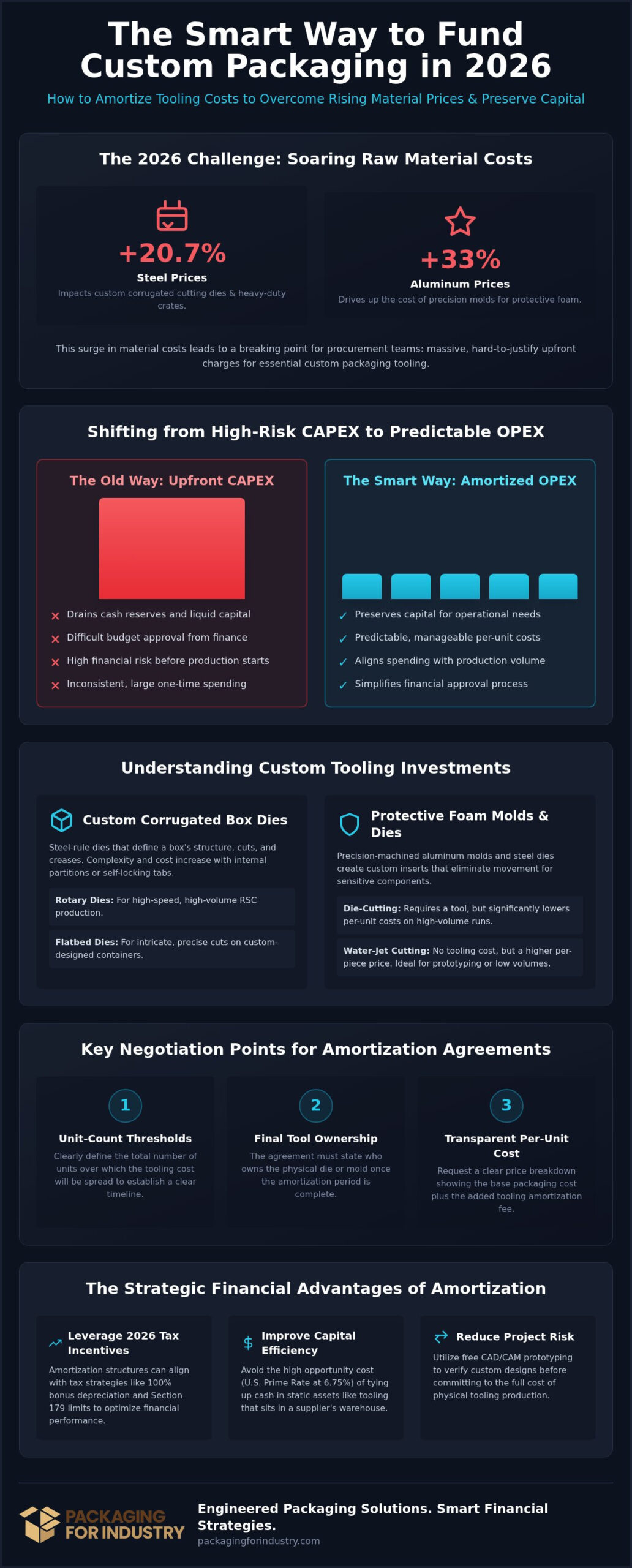
With steel prices up 20.7% and aluminum up 33% in early 2026, the cost of custom dies and molds has reached a breaking point for many procurement teams. You likely recognize that precision-engineered protection is non-negotiable for sensitive aerospace or medical components, yet justifying a massive upfront charge to your finance department often feels like an uphill battle. It’s a common struggle to balance the need for high-performance packaging with the reality of rigid annual budget cycles and the constant pressure to preserve liquid capital for other operational needs.
We understand that your goal is to protect your product and your bottom line simultaneously. In this guide, you’ll learn how to bypass traditional financial barriers by amortizing the cost of custom packaging tooling 2026 style. This strategy turns heavy capital expenditures into manageable, predictable per-unit costs that align directly with your production volume. We will examine how smart amortization structures, combined with 2026 tax incentives like 100% bonus depreciation and Section 179 limits, allow you to secure custom foam and corrugated solutions without draining your cash reserves. By the end of this article, you’ll have a clear roadmap to accessing elite engineering while maintaining total fiscal agility.
Key Takeaways
- Convert high upfront CAPEX into manageable per-unit costs to maintain liquidity during periods of raw material inflation.
- Discover the financial advantages of amortizing the cost of custom packaging tooling 2026 to leverage tax incentives while securing specialized protection.
- Understand the technical differences between rotary dies for heavy-duty corrugated boxes and precision molds for protective foam packaging.
- Identify critical negotiation points for amortization agreements, including unit-count thresholds and final tool ownership clauses.
- Reduce project risk by utilizing free CAD/CAM prototyping to verify custom designs before committing to physical tooling production.
What is Custom Packaging Tooling and Why Amortize in 2026?
Custom packaging tooling refers to the specialized physical equipment required to manufacture unique containers and protective inserts. This includes steel-rule dies for corrugated boxes, aluminum molds for precision protective foam packaging, and custom jigs for heavy-duty crates. In 2026, the cost of these assets has surged due to a 20.7% increase in steel prices and a 33% spike in aluminum. Amortizing the cost of custom packaging tooling 2026 allows manufacturers to roll these high entry costs into the unit price of the packaging itself.
Technically, Amortization (accounting) is the process of spreading an intangible asset’s cost over its useful life, but in the packaging industry, it serves as a practical financing mechanism. By spreading the setup fee across the first several thousand units, procurement teams can shift a large Capital Expenditure (CAPEX) into a predictable Operating Expenditure (OPEX). This shift simplifies the approval process with finance teams who prioritize cash flow over owning physical dies that sit in a supplier’s warehouse.
The Role of Tooling in Industrial Protection
Standard stock boxes often fail to provide the necessary security for high-value components in the aerospace and medical sectors. Custom tooling enables a precision fit that eliminates internal movement, which is the primary cause of transit damage. Through custom design and engineering, we create packaging that matches the exact geometry of your product. This optimization does more than just protect; it reduces the overall footprint of the shipment, leading to lower freight costs and improved pallet density.
Why 2026 is the Year to Rethink Upfront Costs
Preserving liquid capital is essential in 2026 as manufacturers face ongoing geopolitical supply chain risks. With the U.S. Bank Prime Loan Rate holding at 6.75%, the opportunity cost of tying up cash in static assets like tooling is higher than in previous years. Amortization helps purchasing managers meet strict quarterly budget targets by avoiding inconsistent spending patterns. Instead of a single large invoice for a new mold, the cost is distributed, ensuring that project margins remain stable from the very first shipment. This approach provides the financial flexibility needed to adapt to market shifts without being weighed down by heavy upfront investments.
Types of Tooling: From Corrugated Dies to Precision Foam Molds
When you pay a tooling fee, you’re investing in the physical hardware that ensures repeatability and precision across thousands of units. This includes steel cutting blades, custom-machined aluminum, and mounting boards. For many manufacturers, the sheer variety of hardware requirements makes amortizing the cost of custom packaging tooling 2026 a logical step to avoid large invoices before a single unit ships. Spreading these costs allows you to access high-performance materials without an immediate hit to your cash flow.
Custom Corrugated Box Dies
It’s vital to distinguish between printing plates and cutting dies. Printing plates transfer your branding to the material, while cutting dies define the box’s structure. Rotary dies are typically used for high-speed RSC production, whereas flatbed dies handle the intricate cuts required for custom corrugated box design services. If your project involves complex internal partitions or self-locking tabs, the die complexity rises. These structural elements are essential for stackability and protection, but they require a higher initial investment in blade precision and engineering time.
Foam Molds and Die-Cut Inserts
For high-performance protective foam packaging, the choice between water-jet cutting and die-cutting depends on your total volume. Water-jet cutting requires no tooling but has a higher per-piece cost. Die-cutting requires a physical tool but lowers the unit price significantly over time. When designing complex foam end caps for medical devices or electronics, you’ll likely need specialized molds for polyethylene or polyurethane. Spreading these costs across your first few production runs helps you understand the tax implications of amortization while securing the best possible protection for sensitive hardware.
Tooling for Specialized Crates and Pallets
Heavy machinery often requires custom wood crates built with specific jigs and specialized supports. These jigs ensure that every crate is built to the same engineering tolerances, which is critical for aerospace-grade packaging and military-spec compliance. Engineering these supports for international export isn’t just about the wood; it’s about the precision jigs that guarantee a perfect fit. If you’re looking to upgrade your transit security without a large initial outlay, you should compare packaging pricing and amortization options early in the design phase.
Amortization vs. Upfront Payment: A Financial Comparison
Choosing between an upfront payment and a structured agreement is a decision that impacts your immediate liquidity and long-term project margins. In an environment where the U.S. Bank Prime Loan Rate is 6.75%, tying up capital in a $5,000 cutting die represents a significant opportunity cost. When you pay for tooling upfront, you’re betting that the design will remain static for years. By amortizing the cost of custom packaging tooling 2026, you align your expenses with actual production, ensuring your project remains cash-flow positive from the first shipment.
Let’s look at the math for a typical production run. If you choose upfront payment for a $5,000 tool on a 10,000-unit project, you hit your budget with the full cost on day one. Through amortization, you instead add $0.50 to the per-unit price. This approach follows the fundamental principles of amortization by matching the cost of the asset to the revenue it generates. The ‘break-even’ point occurs once the 10,000th unit is shipped, at which point the per-unit price typically drops as the tool is fully paid off. This structure also creates supplier accountability; when a supplier’s payment is tied to successful unit delivery, they have a vested interest in maintaining the tool’s precision and quality.
Cash Flow and Budget Management
For startups and mid-market manufacturers, protecting EBITDA is a top priority. Converting a heavy Capital Expenditure (CAPEX) into an Operating Expenditure (OPEX) keeps your balance sheet lean and your cash reserves high. When you present this to your CFO, frame it as a value-add strategy that preserves your Section 179 deduction limits for larger machinery while keeping packaging costs flexible. It’s a pragmatic way to scale production without the “sticker shock” of initial setup fees.
Total Cost of Ownership (TCO) Analysis
A comprehensive TCO analysis must factor in the cost of transit damage. While stock boxes have no tooling fees, they often lead to higher replacement costs and insurance claims. Investing in custom packaging design through an amortized model reduces these losses without requiring a large initial outlay. This also mitigates “obsolescence risk.” If your product has a short lifecycle, owning a physical die that lasts seven years is inefficient. Amortizing over a specific unit count ensures you only pay for the tool’s utility during the product’s active market life.
Strategies for Structuring Tooling Amortization Agreements
Structuring a formal agreement requires more than just a per-unit price adjustment. It’s about protecting your long-term operational flexibility. When amortizing the cost of custom packaging tooling 2026, you must define the exact point where the financial obligation ends and the asset ownership begins. A well-drafted contract ensures that both the manufacturer and the supplier understand the lifecycle of the die or mold, preventing disputes over “dead” assets or unexpected setup fees later in the project.
Most industrial agreements specify that once the target unit count is reached, ownership of the cutting die or foam mold transfers to the buyer. However, you should always include a ‘Buy-Out’ clause. This allows you to pay the remaining balance at any time if you decide to consolidate production or change suppliers. It prevents your team from being ‘locked in’ to a relationship that no longer serves your logistical needs. Without this clause, you risk losing access to proprietary designs if you need to pivot your supply chain quickly.
Setting Clear Payoff Milestones
Unit-based amortization is generally safer for manufacturers than time-based models. If your production volume fluctuates, a time-based agreement can lead to unexpected invoices during slow months. Unit-based models ensure you only pay as you ship. You should also define how design revisions are handled. If a minor change is needed during the payoff period, clarify if this resets the count or adds a small secondary fee. Maintaining transparency in your packaging cost savings reports ensures your finance team sees the exact progress toward total tool ownership.
Vendor Managed Inventory (VMI) Integration
Integrating your payoff schedule with a VMI stocking program simplifies tracking. Under this model, the supplier manages the inventory levels and only bills for the amortized units as they are pulled for delivery. Using ‘Just-In-Time’ principles means your cash isn’t tied up in warehouse space or unpaid tooling. For manufacturers in Southern California, including those in Orange County and Los Angeles, partnering with a local supplier like PFI ensures next-day delivery and physical oversight of the tooling assets. This proximity reduces the risk of damage to expensive molds and allows for immediate design consultations if production specs change.
How PFI Optimizes Custom Tooling for Southern California
PFI acts as a seasoned consultant to manufacturers who need to balance elite engineering with fiscal responsibility. By amortizing the cost of custom packaging tooling 2026, we provide a clear path to high-performance protection without the initial capital strain. Our approach centers on custom design and engineering that prioritizes both material durability and logistical flow. We don’t just sell boxes; we provide a comprehensive system of protection that integrates directly into your existing warehouse operations.
We eliminate the uncertainty of custom projects through free prototyping. You can verify the fit and function of your foam inserts or corrugated boxes before a single die is cut. This proactive step ensures that your investment in tooling is right the first time, preventing costly rework or delays. It’s a pragmatic solution for purchasing teams that can’t afford errors in their supply chain. By testing physical samples in your actual shipping environment, you gain the confidence that your products will arrive undamaged.
Engineering Excellence for High-Value Sectors
Our specialized knowledge in Aerospace and Defense allows us to serve the most demanding sectors in Southern California. We routinely meet strict mil-spec and medical device requirements that leave no room for error. PFI’s integrated CAD/CAM support acts as a foundational precursor to tooling, enabling digital precision that translates directly to physical reliability. This engineering-first mindset ensures that your custom tooling is optimized for long-term durability and consistent performance.
The Local Advantage: Speed and Reliability
Based in Anaheim, we offer a level of responsiveness that distant suppliers simply can’t provide. Local production significantly reduces the lead times for custom dies and allows for rapid revisions when product specs change. We provide next-day delivery to facilities across Orange County and Los Angeles, ensuring your amortized orders arrive exactly when needed.
- Geographic Reach: We offer reliable local delivery throughout San Diego, the Inland Empire, and the greater Los Angeles area.
- Inventory Control: Our Vendor Managed Inventory programs track your amortized units automatically, so you never run out of stock.
- Capital Efficiency: Combining VMI with amortization allows you to pay for your tooling only as you consume the packaging, keeping your cash flow liquid.
Ready to upgrade your protection while preserving your cash flow? Request a custom packaging quote from PFI today.
Securing Your Supply Chain and Capital in 2026
Strategic financial management is the foundation of a resilient supply chain in 2026. By amortizing the cost of custom packaging tooling 2026, you remove the heavy burden of upfront capital expenditures and gain immediate access to precision-engineered protection. This strategy allows your procurement team to leverage specialized engineering for aerospace and medical components without compromising your liquid cash reserves. It turns a fixed cost into a flexible Operating Expenditure that scales directly with your production volume.
Partnering with a local Southern California supplier like PFI adds another layer of reliability through local next-day delivery and comprehensive VMI stocking programs. You can secure the high-performance custom-engineered protection your products require while maintaining the fiscal agility needed to adapt to changing market conditions. We’re here to act as your seasoned industrial consultant, providing the tools and strategies to help you lower packaging costs and reduce shipping damage. Let’s build a more efficient and capital-friendly packaging program for your facility.
We look forward to helping you optimize your packaging logistics and achieve your operational goals with confidence.
Frequently Asked Questions
What is the typical cost of a custom corrugated die in 2026?
Custom corrugated die costs depend on the complexity of the box structure and the type of die, such as rotary or flatbed. In 2026, raw material increases in steel have influenced these fees across the industry. While exact costs vary based on dimensions and internal partitions, we recommend you compare packaging pricing during the design phase. Factors like CAD/CAM engineering time and the precision required for mil-spec standards also play a major role in the final setup fee.
Can I amortize the cost of custom foam inserts for small orders?
Amortization is generally reserved for recurring production runs where the unit volume can absorb the setup fee over time. For very small, one-time orders, the per-unit price increase required to cover the tool might be prohibitively high. In these cases, we often suggest alternative manufacturing methods like water-jet cutting for foam, which requires no tooling. This helps you lower packaging costs while still accessing high-performance protection without a large initial capital outlay.
Who owns the custom tooling once it is fully amortized?
Ownership terms are defined in your specific agreement, but the tool typically transfers to the buyer once the amortization period concludes. Amortizing the cost of custom packaging tooling 2026 allows you to pay for the asset through production rather than upfront CAPEX. Once the agreed-upon unit threshold is reached, you own the physical die or mold. It’s important to ensure your contract includes clear language regarding the storage and maintenance of these assets at our facility.
What happens to the amortized cost if my production volume drops?
If your production volume drops significantly, the payoff period for the tooling naturally extends. Most agreements are unit-based, meaning the cost is only recovered as boxes ship. If a project is cancelled or volume falls below a critical threshold, a buy-out option may be triggered to cover the remaining balance. We work closely with procurement teams to align these milestones with realistic demand forecasts to avoid budget surprises and ensure the project remains financially viable.
Does PFI offer free prototyping before I commit to tooling costs?
Yes, PFI provides free prototyping to ensure your custom foam or corrugated design fits perfectly before we begin manufacturing the physical tooling. This process utilizes our CAD/CAM support to create digital and physical samples for your review. By verifying the design early, you eliminate the risk of spending capital on a die that requires revisions later. It’s a critical step in our engineering-first approach to industrial logistics and protection for high-value components.
Is it better to pay for tooling upfront if I have the capital available?
Paying upfront is often preferred by businesses that want to maximize 2026 tax benefits like 100% bonus depreciation or high Section 179 limits. If you have the capital, paying the fee immediately simplifies your long-term per-unit pricing. However, amortizing the cost of custom packaging tooling 2026 is the better choice if you need to preserve liquidity for raw materials or operational growth. It shifts the financial risk and spreads the expense across the project’s lifecycle.
How does amortization affect my per-unit price for custom boxes?
Amortization adds a small, fixed amount to the price of each box until the tooling fee is recovered. For example, a setup fee spread over several thousand units might add a few cents to each item. Once the tool is fully paid off, the per-unit price typically drops to the base manufacturing cost. This structure makes your packaging costs predictable and helps you justify custom sizes available for specialized aerospace or medical equipment to your finance team.
Can I move my amortized tooling to another supplier in Southern California?
You can move your tooling to another facility once the amortization is complete and you have full ownership. If the tool isn’t yet paid off, you would typically exercise a buy-out option to settle the remaining balance before the asset is released. PFI maintains a steady and dependable partnership with Southern California manufacturers, providing local support in Orange County and Los Angeles to ensure your transition or expansion is handled with professional oversight and care.