
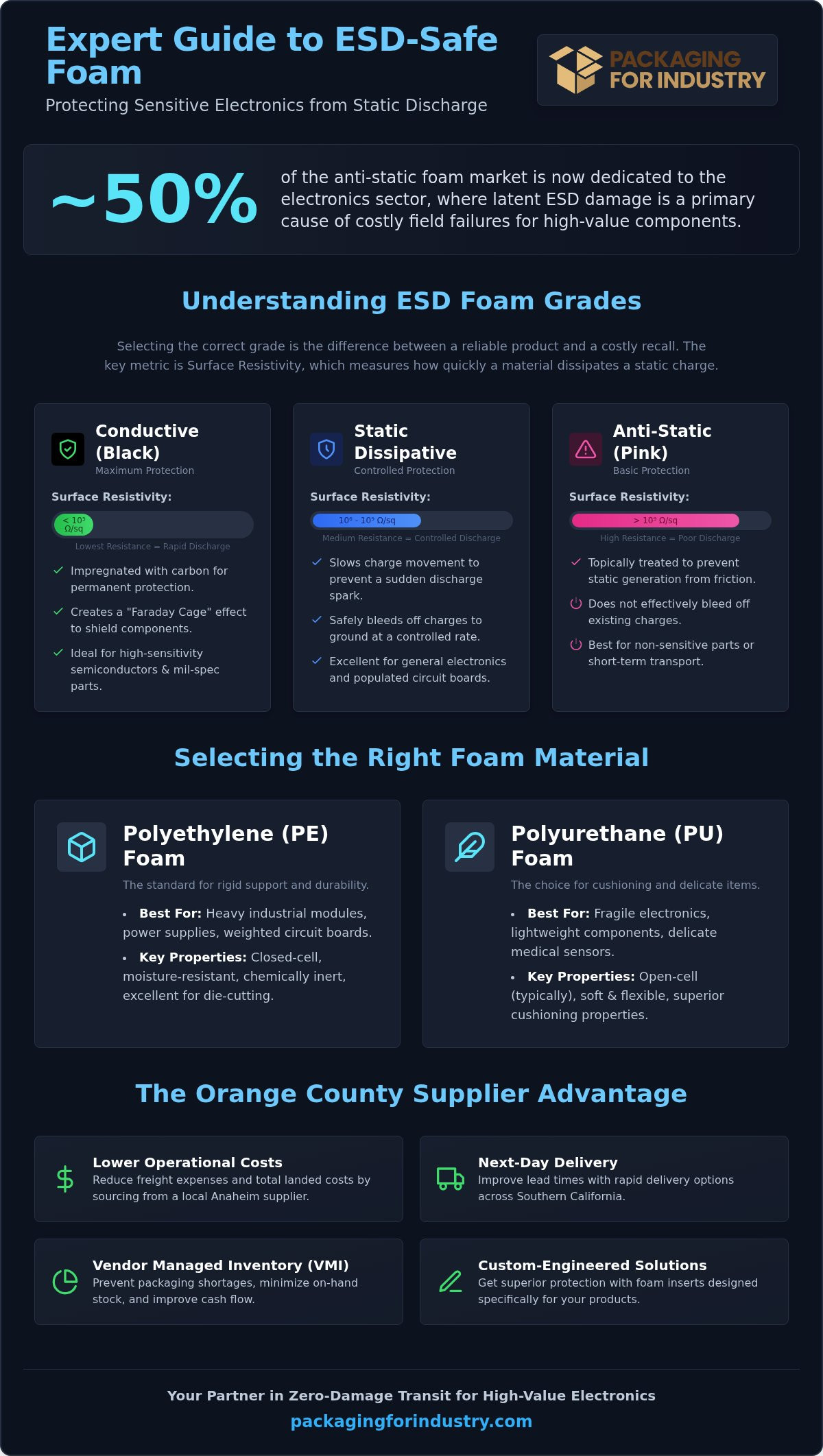
Nearly 50% of the anti-static foam market is now dedicated to the electronics sector, highlighting the extreme vulnerability of modern components. For manufacturers in Anaheim, Irvine, and Costa Mesa, securing the right conductive foam for static sensitive device handling Orange County is no longer just a logistical detail; it’s a baseline requirement for quality control. You’ve likely dealt with the frustration of latent ESD damage that only appears once a product reaches the field, or perhaps you’re tired of paying exorbitant shipping fees for bulky foam from out-of-state suppliers.
This expert guide provides the technical clarity you need to select the ideal ESD-safe foam, ensuring your high-value electronics remain protected while reducing your overall packaging footprint. We’ll explore the differences between conductive and dissipative materials, custom engineering for specialized sectors like aerospace, and the logistical advantages of working with a local supplier offering next-day delivery. By the end of this guide, you’ll understand how to optimize your protective packaging to achieve zero transit damage and a more efficient supply chain.
Key Takeaways
- Understand the technical distinctions between anti-static, dissipative, and conductive foam grades to eliminate latent ESD damage in your supply chain.
- Learn how to select the ideal material for your application, comparing durable Polyethylene for heavy components against soft Polyurethane for fragile electronics.
- Discover why custom-engineered conductive foam for static sensitive device handling Orange County provides superior protection compared to generic, off-the-shelf cushioning.
- Lower your operational costs and reduce freight expenses by sourcing from a local Anaheim supplier with next-day delivery options across Southern California.
- Improve production reliability and cash flow by utilizing Vendor Managed Inventory (VMI) programs to prevent packaging shortages and minimize on-hand stock.
Understanding ESD Foam Grades for Sensitive Device Handling
ESD-safe foam isn’t just a commodity; it’s an engineered barrier against latent component failure. While many manufacturers focus on physical impact, electrostatic discharge causes invisible damage that leads to field failures months after a product leaves the warehouse. Proper foam packaging utilizes specialized Electrostatic discharge (ESD) materials to manage surface resistivity. For electronics manufacturers, selecting the correct grade of conductive foam for static sensitive device handling Orange County is the difference between a reliable product and a costly recall.
Surface resistivity is the primary metric for determining how a material interacts with static. Conductive materials have a low resistance, allowing charges to move across the surface or through the volume of the material rapidly. In contrast, dissipative materials slow that movement to a controlled rate. Understanding these technical thresholds is essential for compliance with ANSI/ESD S20.20 standards, especially when handling high-value semiconductors or medical sensors.
Anti-Static vs. Conductive: Which Do You Need?
Choosing the wrong material often stems from confusing “anti-static” with “conductive.” Anti-static foam, typically identifiable by its pink color, is topically treated to prevent the generation of static caused by friction. However, it doesn’t bleed off existing charges effectively. These surfactants can also migrate or wear off over time, making pink foam a poor choice for long-term storage or high-sensitivity components.
- Conductive Foam (Black): Impregnated with carbon to provide permanent, humidity-independent protection. It maintains a surface resistivity of less than 1.0 x 10^5 ohms/square.
- Static Dissipative Foam: Offers a controlled charge removal rate, typically between 10^6 and 10^9 ohms/square, ideal for preventing rapid discharge.
- Anti-Static (Pink): Best for non-sensitive parts or as a cost-effective solution for short-term transport of less critical items.
The Science of the Faraday Cage Effect
High-density conductive foam creates a volume-conductive structure that engineers refer to as a Faraday Cage. This effect ensures that external electrostatic fields remain on the exterior of the packaging rather than penetrating the sensitive components inside. When you insert a semiconductor’s leads directly into the foam, you create an equipotential bond across all pins. This eliminates the risk of potential differences that could cause internal circuitry to bridge and fail.
Standard insulating foams are inherently dangerous for electronics because they generate triboelectric charges through simple movement. For aerospace and medical device manufacturers in Anaheim and Irvine, using conductive foam for static sensitive device handling Orange County provides a reliable path to ground. It ensures that your components arrive with their internal architecture intact, regardless of the environmental conditions during transit.
Selecting the Right Foam Material for Your Orange County Project
Selecting the right material is a balance between mechanical support and electrical safety. For manufacturers in Irvine or Brea, the choice usually comes down to Polyethylene or Polyurethane. Each material offers distinct advantages depending on the mass and fragility of the electronics being shipped. High-sensitivity items require strict adherence to ANSI/ESD S20.20-2021 standards to ensure the foam’s resistivity doesn’t degrade over time or under varying humidity levels. Using the wrong material density can lead to either inadequate cushioning or unnecessary packaging bulk, both of which increase your total landed costs.
Polyethylene (PE) Conductive Foam
PE is a closed-cell material known for its rigidity and durability. It’s the standard choice for heavy industrial modules, power supplies, and populated circuit boards with significant weight. Because PE is moisture-resistant and chemically inert, it protects against environmental hazards during long-distance transit or warehouse storage. We often use custom die-cutting for PE planks to create precise cavities that lock components in place, preventing movement that could lead to physical damage or static buildup. For projects requiring high-density support, you can request a packaging quote to see how custom-cut PE fits your specific requirements.
Polyurethane (PU) and Specialized ESD Materials
For delicate medical sensors, precision optics, or lightweight consumer electronics, Polyurethane (PU) is the preferred solution. This open-cell foam provides superior vibration damping and impact absorption for fragile items. Unlike PE, PU is soft and flexible, allowing it to conform to irregular shapes without applying excessive pressure to sensitive leads.
When your project involves aerospace or defense contracts, specialized conductive foam for static sensitive device handling Orange County must often meet mil-spec requirements. In these instances, Crosslinked Polyethylene (XLPE) is frequently utilized. XLPE offers a non-abrasive, smooth surface that won’t scratch sensitive finishes or lenses while providing the same permanent ESD protection found in standard conductive foams. It’s an ideal choice for cleanroom environments where particle shedding must be minimized.
- Polyethylene (PE): Best for heavy loads, high durability, and moisture resistance.
- Polyurethane (PU): Ideal for vibration damping and lightweight, fragile components.
- Crosslinked PE (XLPE): Premium non-abrasive protection for optics and high-finish parts.
Material density is another critical factor in your selection process. Higher density foams offer better support for heavy items but may transmit more shock to fragile components. Our engineering team analyzes the G-force tolerance of your device to determine the exact density required for maximum protection and cost-efficiency.
Custom Engineering: Designing Foam Inserts for Maximum Protection
Generic cushioning materials often fail to meet the rigorous demands of high-tech manufacturing. While off-the-shelf options provide basic padding, they lack the precision required to immobilize sensitive components during the vibrations of transit. Packaging For Industry (PFI) utilizes a rigorous CAD/CAM design process to create inserts that mirror the exact geometry of your hardware. This tailored approach ensures every lead and connector is supported, eliminating internal movement. For manufacturers requiring conductive foam for static sensitive device handling Orange County, this custom-fit methodology is a technical necessity that prevents physical stress and static buildup.
We focus on creating a cohesive system by integrating these engineered foam inserts with heavy-duty RSC boxes. This multi-layered defense protects against both mechanical shock and electrostatic discharge. To further streamline your operations, we provide kitting and assembly services. By receiving ready-to-use packaging kits, your production line can move faster, reducing warehouse labor costs and minimizing the risk of assembly errors that could compromise ESD safety.
The Role of Prototyping in Damage Reduction
A perfect fit is essential to prevent shifting during transit, which is a leading cause of latent component failure. We offer free prototyping services to Orange County manufacturers to ensure every design meets the specific G-force tolerances of their hardware. This allows you to verify the foam’s performance before committing to a full production run. Our team tests various configurations in Anaheim and Irvine to find the most cost-effective balance between material volume and protection levels. You don’t have to guess if your packaging will work; the prototype provides the data to prove it.
Integrated ESD Packaging Solutions
Effective protection often involves more than a single material. We design comprehensive solutions that combine conductive foam with static shielding bags and moisture barrier layers. For larger-scale aerospace components, we build foam-lined crates that provide mil-spec packaging compliance alongside ESD safety. When moving palletized electronics, we incorporate corner boards to prevent strap damage and maintain the structural integrity of the entire load. This holistic engineering approach ensures your high-value devices remain in an equipotential state, regardless of the handling conditions they encounter throughout the global supply chain.
Procuring Conductive Foam in Orange County: Local vs. National Suppliers
Sourcing protective materials from national catalog distributors often introduces unnecessary financial friction into your procurement process. When you compare packaging pricing, the hidden costs of freight for bulky foam become a significant factor that many purchasing managers overlook. Sourcing conductive foam for static sensitive device handling Orange County from a local provider like Packaging For Industry (PFI) allows you to lower packaging costs by eliminating the exorbitant out-of-state shipping fees that inflate your total landed cost.
Logistical proximity provides a level of accountability that distant distributors cannot replicate. While we are headquartered in Anaheim, our local delivery fleet provides next-day service to manufacturers and warehouses in Los Angeles, San Diego, and the Inland Empire. This regional reach ensures that high-tech hubs throughout Southern California have immediate access to ESD-safe materials without the long lead times associated with national fulfillment centers. By working with a local specialist, you ensure your production lines never stall due to inventory gaps.
Local Support for Orange County Tech Hubs
Packaging For Industry (PFI) provides tailored solutions for the specific industrial clusters in our region. This includes specialized support for medical device firms in Irvine and aerospace contractors in Anaheim who require mil-spec compliant materials. Because we maintain custom sizes available for immediate production needs, we can respond to design changes faster than a generalist supplier. Additionally, our presence in Huntington Beach supports industrial fulfillment centers that require rapid replenishment to maintain high throughput.
Just-In-Time (JIT) and Next-Day Delivery
Warehouse space in Southern California is a premium asset that shouldn’t be wasted on excess packaging inventory. Storing large quantities of bulky foam is an inefficient use of floor space and ties up capital in overhead. Our Just-In-Time (JIT) programs allow you to keep minimal stock on hand, as we can replenish your supply within 24 hours. This proximity allows your operations team to respond to emergency production spikes without the risk of a line shutdown or the burden of managing months of safety stock.
Next-day delivery options provide a vital safety net for your supply chain. You don’t have to wait days for a national supplier to ship from a distant hub when your materials are stocked locally. This responsive service model treats your packaging as a fluid resource, ensuring you have the protection you need exactly when you’re ready to use it, without the logistical headaches of long-distance procurement.
Optimizing Supply with Vendor Managed Inventory (VMI)
Managing a high-tech supply chain requires a logistics strategy that aligns with your production cycle. While high-quality materials are essential, they lose their value if they aren’t available when your line needs them. Vendor Managed Inventory (VMI) shifts the burden of stock monitoring from your purchasing team to our logistics experts. For companies utilizing conductive foam for static sensitive device handling Orange County, this model ensures that your facility never faces a production stoppage due to packaging shortages. We conduct regular on-site inventory reviews for businesses in Anaheim and Irvine, adjusting stock levels based on your real-time demand.
Capital optimization is a primary benefit of a well-executed VMI program. By reducing the amount of on-hand inventory you’re required to store, you free up warehouse floor space and improve cash flow. You only pay for the packaging you use, allowing you to scale your conductive foam supply up or down as your production volume fluctuates. This pragmatic approach to inventory management eliminates the “feast or famine” cycle often associated with ordering bulky materials from national distributors.
Streamlining Procurement for Electronics Manufacturers
Automated replenishment of foam packaging significantly reduces the administrative burden on your purchasing department. Instead of tracking dozens of SKUs and managing multiple lead times, your team can focus on core operational goals. We’ve seen this model improve efficiency across various sectors of manufacturing, particularly where high-value electronics require specialized ESD protection. By integrating VMI with our local next-day delivery, you create a responsive supply chain that adapts to market shifts without increasing your overhead.
Ready to Secure Your Static Sensitive Devices?
Choosing PFI means partnering with a fixer who understands the intersection of engineering and economics. We don’t just sell foam; we provide a complete system of protection designed to lower your total cost of ownership. From the initial CAD design to the final VMI replenishment, we maintain total accountability for your packaging’s performance. If you’re ready to optimize your protective packaging and eliminate ESD-related transit damage, you can request a packaging quote today.
Before finalizing your procurement strategy, use this final checklist to ensure your conductive foam partner meets industrial standards:
- Compliance: Does the foam meet ANSI/ESD S20.20 or specific mil-spec requirements?
- Prototyping: Is there a free prototyping process to verify the fit and G-force protection?
- Logistics: Does the supplier offer local next-day delivery to reduce freight costs?
- Inventory: Are VMI or JIT programs available to prevent shortages and optimize cash flow?
- Integration: Can the supplier provide custom corrugated boxes and kitting services?
Secure Your Electronics with Engineered ESD Protection
Choosing the right grade of conductive foam for static sensitive device handling Orange County is a strategic decision that impacts both product reliability and your bottom line. Reliability starts with precision. By moving away from generic cushioning and adopting custom-engineered inserts, you eliminate the risk of latent ESD damage and physical impact during transit.
Local next-day delivery and VMI programs reduce warehouse clutter while lowering freight costs. Our team provides the technical expertise required to meet rigorous aerospace and electronics standards, supported by free engineering prototypes to ensure a perfect fit every time. We’re ready to help you optimize your supply chain and improve fiscal efficiency.
We look forward to helping you streamline your operations and achieve zero transit damage for your high-value components.
Frequently Asked Questions
What is the difference between anti-static and conductive foam?
Anti-static foam is a topically treated material designed to prevent the generation of static charges caused by friction. It’s typically pink and suitable for non-sensitive components. Conductive foam is impregnated with carbon, allowing it to actively bleed off existing charges to a ground point. Unlike anti-static options, conductive foam provides permanent protection that doesn’t dissipate over time or rely on ambient humidity to remain effective during transit.
How do I know which foam density is right for my electronic device?
The ideal foam density depends on the mass of your component and its specific G-force fragility rating. Heavy industrial modules require high-density polyethylene to prevent bottoming out during a drop. Conversely, lightweight medical sensors need lower-density polyurethane to provide soft deceleration. Our engineering team analyzes your device’s weight and sensitivity to determine if a 1.7lb, 2.2lb, or specialized density is required for maximum shock absorption.
Does conductive foam lose its effectiveness over time?
No, carbon-impregnated conductive foam maintains its electrical properties indefinitely. Because the conductive carbon is integrated into the polymer matrix during manufacturing, it cannot wear off or migrate like the surfactants used in pink anti-static foam. This makes it the preferred choice for long-term storage of sensitive aerospace components or medical electronics. You can rely on the material to provide consistent surface resistivity throughout the entire lifecycle of your packaging.
Can I get custom-cut conductive foam inserts for existing shipping boxes?
Yes, we frequently design custom foam inserts to fit into your existing RSC boxes or plastic carrying cases. This approach allows you to lower packaging costs by reusing outer containers while significantly upgrading internal ESD protection. We use precision die-cutting or CNC routing to ensure the foam cavities match your components exactly. Custom sizes available for any box configuration help eliminate the need for excessive bubble wrap or loose fill.
What industries in Orange County typically require conductive foam?
Aerospace, medical device manufacturing, and semiconductor assembly are the primary sectors requiring these specialized materials. We support firms in the Irvine Spectrum and Anaheim industrial corridor that handle flight-critical sensors, implantable medical electronics, and high-speed processing units. These industries use conductive foam for static sensitive device handling Orange County to meet strict quality control standards and prevent latent failures that could compromise mission-critical hardware in the field.
How quickly can I get a prototype for a custom foam insert?
We typically deliver engineering prototypes within a few business days following CAD design approval. This rapid turnaround is essential for local manufacturers who need to verify fit and function before committing to a full production run. Our Anaheim facility is equipped to handle quick-turn prototyping, allowing your team to test the foam’s performance against real-world handling conditions. This proactive step ensures your final packaging solution is optimized for both protection and cost.
Does PFI offer mil-spec compliant ESD packaging?
Yes, we provide a range of materials that meet specific military specifications for electrostatic discharge control and physical durability. This includes specialized crosslinked polyethylene foams that satisfy stringent requirements for outgassing and cleanliness in defense applications. If your contract requires compliance with MIL-STD-2073 or other defense packaging standards, we can help you select the correct material and provide the necessary documentation to ensure your shipments pass inspection without delays.
What are the benefits of sourcing foam from a local Anaheim supplier?
Sourcing conductive foam for static sensitive device handling Orange County from a local partner eliminates the high freight costs associated with shipping bulky foam planks from out-of-state. You’ll benefit from next-day delivery options and the ability to utilize Vendor Managed Inventory programs. Proximity also allows for on-site consultations and immediate design adjustments. This logistical advantage ensures your production line remains moving while reducing the total cost of ownership for your protective packaging.