
How much does a single rejected shipment of precision surgical optics cost your Irvine facility when a non-compliant foam insert outgasses during transit? For medical device manufacturers in Orange County, packaging is far more than just a logistical afterthought; it’s a critical safeguard for both the product and your regulatory standing. You understand that protecting sensitive sensors and ensuring material compliance isn’t optional when patient safety and high-value inventory are on the line. Finding the right custom foam inserts for medical devices Irvine requires a partner who understands the intersection of engineering precision and fiscal responsibility.
This article provides the technical framework you need to specify, engineer, and source medical-grade foam solutions that satisfy strict cleanroom requirements and eliminate shipping damage. We’ll examine the performance differences between polyethylene and polyurethane foams, the advantages of local CAD/CAM prototyping, and how just-in-time delivery models can reclaim your valuable warehouse floor space. By the end of this guide, you’ll have a clear path toward optimizing your manufacturing logistics while maintaining total compliance and zero-damage delivery standards for your most sensitive medical equipment.
Key Takeaways
- Identify the material properties of PE and PU foams that provide critical G-force protection for sensitive diagnostic lasers and sensors.
- Ensure your packaging meets ISO 13485 and cleanroom standards by utilizing precision-cut materials designed to minimize particulate shedding.
- Streamline your development cycle with CAD/CAM engineering and rapid prototyping for custom foam inserts for medical devices Irvine.
- Optimize your facility’s footprint by implementing Vendor Managed Inventory (VMI) and just-in-time delivery to eliminate bulky foam stock.
- Lower your total procurement costs by switching from stock catalog options to custom-engineered kits that combine foam, corrugated, and crates.
Specifying Custom Foam for Medical Devices: Critical Materials
Choosing the right material for foam packaging is the first step in ensuring both product safety and regulatory compliance. In the medical sector, a generic approach to cushioning often leads to material failure or compromised sterile environments. Your choice of foam must align with the device’s weight, fragility, and the specific cleanliness requirements of the end-user facility.
Polyethylene (PE) vs. Polyurethane (PU) for Medical Use
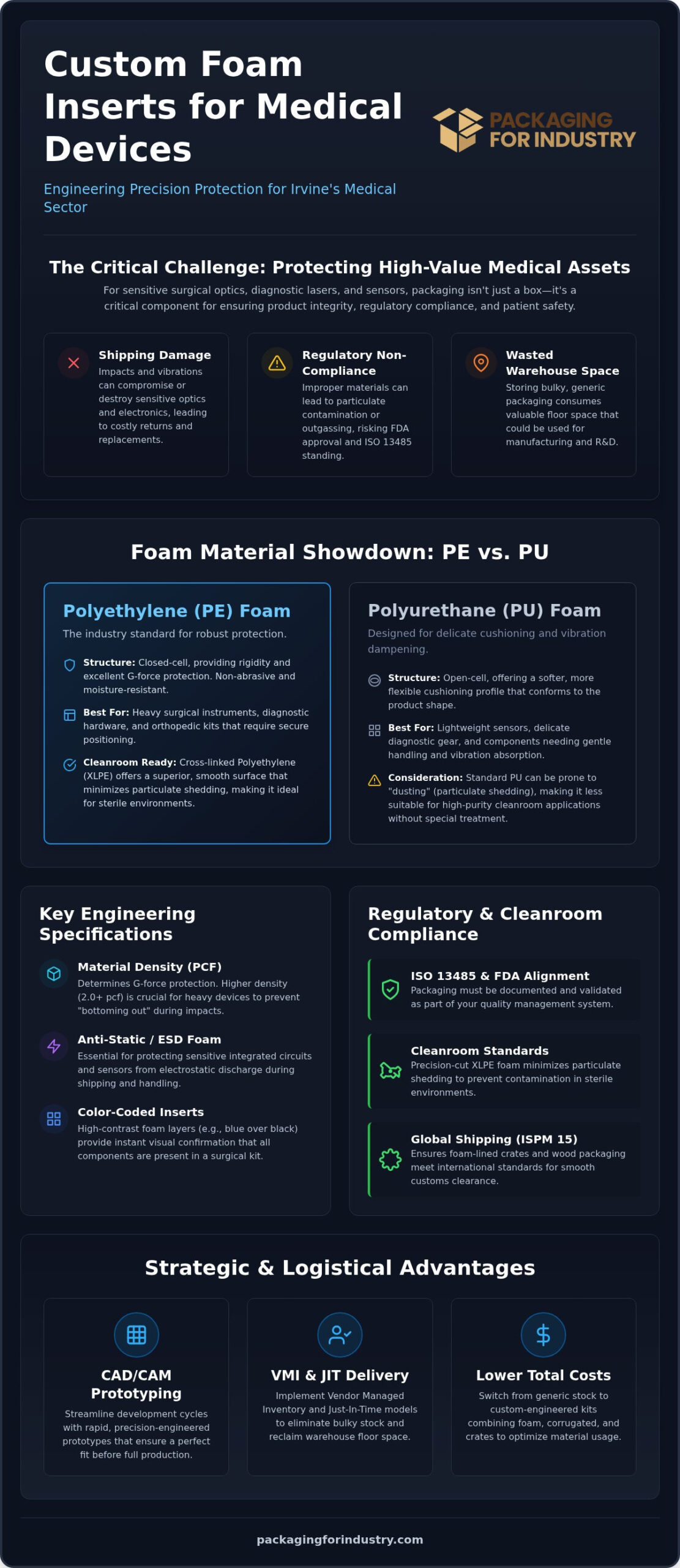
Closed-cell Polyethylene (PE) is the industry standard for securing heavy surgical instruments, orthopedic kits, and heavy-duty diagnostic hardware. It’s non-abrasive, moisture-resistant, and provides the structural rigidity needed to hold heavy items in place. In contrast, open-cell Polyurethane (PU) offers a softer, more flexible cushioning profile. It’s the preferred choice for vibration dampening in delicate diagnostic gear or lightweight sensors that require gentle handling.
Durability is a major factor in sterile environments. Standard PU can sometimes be prone to “dusting,” where small particles break off during repeated use. For high-purity medical applications, cross-linked polyethylene (XLPE) provides a superior, smooth surface finish. XLPE resists chemical degradation and significantly reduces the risk of particulate shedding, making it ideal for cleanroom-compatible kits.
Material density, measured in pounds per cubic foot (pcf), determines the G-force protection your device receives during a drop. High-density foams, typically 2.0 pcf and above, are necessary for heavy items to prevent them from “bottoming out” against the outer container. For sensitive diagnostic lasers, engineering the correct density ensures the foam absorbs impact energy rather than transferring it to the internal optics. When sourcing custom foam inserts for medical devices Irvine, matching the pcf to your device’s fragility is a primary engineering requirement.
Specialized Medical Foam Additives
Modern medical devices frequently contain integrated circuits and sensitive sensors vulnerable to electrostatic discharge. Specifying anti-static or ESD foam is critical to prevent latent component failure during shipping or storage. These materials are treated to dissipate static charges safely, protecting the electronic integrity of the device.
For complex surgical kits with multiple components, color-coding serves as a vital logistical tool. By using a high-contrast top layer, such as bright blue foam over a dark black base, technicians can immediately identify if a part is missing from the kit. This visual management system reduces errors in the field and improves overall assembly efficiency. We help manufacturers lower packaging costs by selecting the exact material grade required for your specific application, ensuring you don’t over-specify for non-critical components while maintaining total protection for sensitive ones.
Regulatory Compliance and Cleanroom Packaging Standards
Compliance isn’t a suggestion; it’s a fundamental requirement for Irvine-based medical manufacturers. When submitting a device for FDA approval or maintaining an ISO 13485 quality management system, the packaging must be as documented and reliable as the device itself. Custom foam inserts for medical devices Irvine play a pivotal role in this ecosystem by providing a validated, repeatable method for protecting high-value assets during transit. Our engineering process ensures that every insert aligns with your internal quality controls and external regulatory demands.
Meeting cleanroom standards requires materials that don’t introduce contaminants into sterile environments. While standard foams might shed particles, precision-cut cross-linked polyethylene (XLPE) is engineered for minimal particulate shedding. Its tight molecular structure prevents the “dusting” common in lower-grade materials. For firms shipping internationally, we ensure that foam-lined crates and heavy-duty corrugated boxes meet ISPM 15 standards. This facilitates smooth passage through global customs without the risk of quarantine due to non-compliant wood packaging or contaminated materials.
Bio-Compatibility and Material Safety
Medical packaging must be chemically inert and non-toxic to prevent adverse reactions with the device or the end-user. We prioritize virgin foam materials for all medical-grade applications. Recycled foams, while useful in other industries, carry a risk of cross-contamination that isn’t acceptable in a clinical setting. By selecting REACH and RoHS compliant materials, you ensure your global distribution chain remains uninterrupted by regional chemical restrictions. This attention to material purity maintains the integrity of sterile barrier systems, ensuring the device arrives in the same condition it left the cleanroom.
ESD Protection for Medical Electronics
Sensitive diagnostic sensors and integrated circuits require specialized protection against electrostatic discharge. Latent defects caused by static shocks can lead to device failure in the field, which is a significant liability. Proper ESD foam selection focuses on surface resistivity, ensuring that static charges are dissipated before they can damage internal electronics. We often integrate these anti-static foam inserts with moisture barrier bags or specialized kitting solutions to provide a comprehensive protective environment. If you’re concerned about meeting specific regulatory benchmarks for your next product launch, you can request a packaging quote to review our compliant material options.
Engineering Precision: The Custom Design and Prototyping Process
Designing custom foam inserts for medical devices Irvine requires a methodical approach that balances mechanical protection with cost-efficiency. Precision engineering starts with a comprehensive technical review of your device. The engineers at Packaging For Industry (PFI) analyze the unit’s weight, its specific fragility rating, and the anticipated drop-test requirements of your distribution cycle. This data-driven foundation ensures that the final packaging isn’t just a cushion, but a calculated shock-absorption system tailored to your specific hardware. By identifying high-risk impact points early, we prevent over-engineering and keep your material costs manageable.
Our team translates these requirements into 3D models using advanced CAD/CAM software. This digital environment allows us to simulate the fit and function of complex surgical kits or diagnostic sensors before a single piece of material is cut. By integrating the foam design with your custom corrugated boxes from the beginning, Packaging For Industry (PFI) creates a unified kitting solution that optimizes both protection and assembly speed on your production floor.
From CAD Drawing to Physical Prototype
Packaging For Industry (PFI) provides free prototyping to bridge the gap between a digital design and a physical solution. This stage is vital for testing the “hand-feel” of the insert and verifying that sensitive components are easily accessible yet securely held. Having local Southern California engineering support means we can iterate designs quickly. If a prototype needs a density adjustment or a cavity modification, we can often deliver a revised sample to your Irvine facility within 24 hours. This local partnership eliminates the weeks of back-and-forth communication common with distant suppliers and keeps your product launch on schedule.
Die-Cutting vs. CNC Routing for Medical Foam
The choice between die-cutting and CNC routing depends on your production volume and the complexity of the device. Die-cutting is a high-speed, cost-effective manufacturing method for high-volume orders with relatively simple geometries. It’s ideal for standard medical tray inserts where speed and unit cost are the primary drivers.
CNC routing offers superior precision for complex, multi-component diagnostic kits that require varying depths and intricate internal cavities. Because CNC routing doesn’t require expensive custom tooling or dies, it’s also a more flexible option for lower-volume runs or products still undergoing design revisions. Packaging For Industry (PFI) helps you select the most efficient manufacturing path to lower packaging costs without sacrificing the tight tolerances your medical equipment demands. Whether you need a simple foam pad or a complex multi-material kit, our facility is equipped to scale with your Irvine production schedule.
Optimizing Irvine Logistics: VMI and Just-In-Time Delivery
Managing the supply chain for custom foam inserts for medical devices Irvine involves more than just selecting the right material. It’s about ensuring those materials are available exactly when your production line needs them without clogging your warehouse floor. High-value medical manufacturing in Orange County requires a lean approach to inventory. Bulky foam inserts and corrugated boxes take up significant square footage that could be better utilized for assembly or cleanroom operations. By shifting from a traditional bulk-buy model to a strategic logistical partnership, you can significantly lower packaging costs and improve operational flow.
Vendor Managed Inventory (VMI) for Medical Packaging
Our Vendor Managed Inventory (VMI) program is designed to eliminate the administrative burden of recurring orders. Instead of your team manually tracking stock levels and risking a production stop, PFI monitors your inventory for you. We maintain a pre-determined buffer of your custom inserts and boxes at our facility, replenishing your stock automatically based on actual usage. This system improves your cash flow because you aren’t tying up capital in months of sitting inventory. You only pay for the packaging as it’s delivered to your facility, allowing for more precise budget management and reduced overhead.
Local Next-Day Delivery in Orange County
Proximity is a major competitive advantage for manufacturers in Irvine, Santa Ana, and Costa Mesa. Sourcing from out-of-state suppliers or national catalog giants often leads to high shipping fees and unpredictable lead times. PFI provides local next-day delivery for stocked items, ensuring your just-in-time delivery schedule remains intact. This rapid response capability is essential when production forecasts change or when you need to iterate a design quickly. By partnering with a local Southern California supplier, you eliminate the risks associated with long-distance logistics and gain a partner who understands the specific demands of the local medical hub.
Why Choose PFI for Medical Device Foam Inserts in Irvine?
Packaging For Industry (PFI) acts as a specialized extension of your manufacturing team, offering an integrated approach that standard catalog providers can’t replicate. We don’t just sell individual components; we engineer complete protective systems. By combining high-performance foam with custom corrugated boxes and specialized crates into a single kitted solution, we eliminate the friction of managing multiple vendors. This comprehensive oversight ensures every element of your kit is designed for a precise, secure fit. Our deep experience in the aerospace and medical sectors means we understand how to maintain technical integrity while driving out unnecessary costs. Sourcing custom foam inserts for medical devices Irvine from a local expert provides a level of accountability and responsiveness that distant distributors simply can’t match.
A Reliable Alternative to Large Catalog Suppliers
Off-the-shelf foam options often force you to compromise on protection. Generic, stock inserts rarely provide the exact tolerances required for surgical optics or diagnostic sensors, leading to internal movement during transit. We focus on lowering packaging costs by reducing your total cost of ownership through optimized sizing. Custom sizes allow for smaller outer containers, which lowers your shipping volume and material waste. By moving away from one-size-fits-all catalog items, you gain a solution specifically engineered for your distribution environment. This precision virtually eliminates the high expense of damaged inventory, secondary packaging, and regulatory rejections.
Request a Custom Packaging Quote Today
Transitioning to a more efficient packaging model begins with a technical review of your current systems. Our account managers specialize in the Irvine medical hub, offering on-site consultations to identify hidden inefficiencies in your kitting and shipping processes. Since our main facility is located nearby in Anaheim, we’re positioned to provide immediate design support and recurring inventory management. We’ll analyze your manufacturing schedule and provide a detailed cost-reduction strategy that prioritizes reliability and speed. Our team is ready to help you stabilize your supply chain and protect your most sensitive medical hardware.
Streamlining Your Medical Device Packaging Logistics
Protecting high-value diagnostic equipment requires a technical approach that balances material science with operational efficiency. By selecting specialized foams like XLPE and utilizing CAD/CAM engineering, you ensure your devices meet strict cleanroom standards while surviving the rigors of global transit. Transitioning to a local partner for custom foam inserts for medical devices Irvine allows you to leverage Vendor Managed Inventory (VMI) and just-in-time delivery to reclaim your warehouse floor.
PFI provides the engineering expertise and local presence needed to stabilize your supply chain. We offer free prototyping to validate every design before production begins. Our facility in Anaheim supports local next-day delivery to Irvine and the surrounding Orange County area, ensuring your manufacturing lines never stop due to packaging shortages.
We’re ready to help you optimize your logistics and lower your total packaging spend through precision engineering and dependable local service.
Frequently Asked Questions
What is the best foam material for sterile medical device packaging?
Cross-linked polyethylene (XLPE) is the superior choice for sterile environments because its molecular structure prevents the particulate shedding common in standard foams. It’s chemically inert and resists moisture, making it ideal for surgical kits and diagnostic tools. This material’s smooth surface finish also prevents abrasion on delicate device surfaces. We help manufacturers select the correct density to ensure both protection and cleanroom compatibility for their high-value medical equipment.
Can PFI provide ESD-safe foam for medical electronics in Irvine?
Yes, we specialize in supplying anti-static and ESD-safe foam for sensitive medical electronics. These materials are treated to dissipate electrostatic charges that could otherwise cause latent defects in sensors or integrated circuits. When sourcing custom foam inserts for medical devices Irvine, we ensure your electronic components are protected throughout the shipping cycle. Our ESD solutions are available in both polyethylene and polyurethane to match your specific cushioning requirements.
Do you offer free prototypes for custom medical foam inserts?
We provide free prototyping and CAD/CAM design support to ensure a precision fit before full-scale production. This allows your team to test the physical interface between the device and the foam cavity without any upfront tooling costs. Our engineers use your 3D models to create accurate samples at our Anaheim facility. Rapid prototyping helps Irvine manufacturers iterate designs quickly, ensuring the final packaging meets all drop-test and security benchmarks.
How does Vendor Managed Inventory (VMI) work for medical manufacturers?
Vendor Managed Inventory (VMI) allows us to take full responsibility for monitoring and replenishing your packaging stock. We track your usage levels and maintain a local buffer of your custom inserts and boxes, delivering them only when needed. This approach eliminates the risk of stockouts while freeing up valuable warehouse space in your Irvine facility. You improve cash flow by only paying for the packaging materials as they are delivered to your production floor.
Is your medical foam packaging compliant with ISO and FDA standards?
Our materials are selected specifically to support ISO 13485 quality systems and satisfy FDA packaging requirements. We use REACH and RoHS compliant foams that are non-toxic and non-abrasive, ensuring they don’t compromise the sterile barrier of your medical devices. By providing virgin materials and detailed documentation, we help you navigate the regulatory landscape. This commitment to compliance ensures your shipments move through global supply chains without regulatory rejection or delays.
What are the lead times for custom die-cut foam in Southern California?
Lead times for custom die-cut foam are significantly reduced because we manufacture locally in Orange County. While national suppliers might take weeks, our proximity allows for rapid production cycles and immediate design adjustments. For recurring orders managed through our stocking programs, we offer next-day delivery to facilities in Irvine. This speed is essential for manufacturers who need to scale production quickly or respond to sudden changes in market demand.
Can you integrate foam inserts with custom corrugated boxes and crates?
Yes, we provide comprehensive kitting services that integrate custom foam inserts with heavy-duty corrugated boxes or wooden crates. This unified approach ensures that all packaging components are engineered to work together, providing maximum protection for sensitive diagnostic gear. By sourcing your entire kit from a single local supplier, you simplify your procurement process and lower packaging costs. We handle the assembly and delivery, providing a ready-to-use solution for your manufacturing team.
Do you provide next-day delivery to medical facilities in Irvine?
We offer local next-day delivery to medical manufacturing facilities throughout Irvine and the broader Orange County area. Our Anaheim headquarters is strategically located to provide rapid logistics support for the local healthcare technology hub. This service is a core component of our just-in-time inventory programs, allowing you to maintain lean operations. By eliminating long-distance shipping delays, we ensure your production lines stay active and your delivery schedules remain dependable.